
9 ways to promote gender equality in the workplace
Nine practical ways HR teams can make hiring, pay, promotion and flexibility fair for every gender, with the metrics that show progress.

Knowing how to promote gender equality in the workplace comes down to one habit: make every decision about hiring, pay, promotion, and flexibility on the same clear criteria for everyone, then check the results by gender. Good intentions and one-off training do not close gaps. Fixed rules, open pay and regular measurement do.
 ChatGPT
 Gemini
 Claude
 Grok
 Perplexity
TL;DR
- To promote gender equality in the workplace, judge everyone on the same job criteria at every stage, publish pay ranges, audit pay yearly, and track hiring and promotion results by gender.
- The gap is still real: US women working full time earned 82.7% of men's median weekly pay in 2024, according to the Bureau of Labor Statistics.
- The biggest leak is the first promotion. Lean In and McKinsey found only 93 women were promoted to manager for every 100 men in 2025.
- Skills tests and structured interviews cut bias in hiring, but they work best alongside fair pay, sponsorship and flexibility.
- Measure five numbers by gender: applicants, pass rate per stage, offers, pay at offer and promotion rate. A gap of more than a few points at one stage shows where to act.
- EU employers face new pay transparency rules from June 2026, including pay ranges for applicants and no salary history questions.

What is gender equality in the workplace?
Gender equality in the workplace means people of every gender get the same access to jobs, pay, promotion, development and flexibility, and are judged on the same criteria. Australia's Workplace Gender Equality Agency describes it as broadly equal opportunities and outcomes, not identical results for every person.
In practice, equality at work shows up in four places:
- Access: Every role, including leadership and technical roles, is open to anyone with the skills.
- Pay: Equal pay for work of equal value, with pay gaps explained by job, level and performance only.
- Progression: Promotion depends on clear, written criteria and on who has a sponsor, not on who is most visible.
- Care and flexibility: Parental leave and flexible work are offered to everyone, so caring does not stall one gender's career.
Gender equity is the related idea of giving people what they need to reach the same starting line, such as returnships for parents coming back to work. Most programs use both.
Why does gender equality at work matter in 2026?
Gender equality at work matters because the gaps are still measurable and they cost employers talent. According to the Bureau of Labor Statistics report on women's earnings in 2024, women working full time had median weekly earnings of $1,043, compared with $1,261 for men, or 82.7%.
Progression is the second gap. Lean In and McKinsey's Women in the Workplace 2025 study, which covers more than 120 companies and 9,000 employees, found that for every 100 men promoted to manager, 93 women were promoted. The number was 82 for Asian women and Latinas and 60 for Black women. The same study found that 1 in 4 companies discontinued or scaled back remote and hybrid options in the past year, which hits carers hardest.
For HR and TA leaders, the business case is practical:
- Bigger talent pool: Roles open to every gender draw more qualified applicants.
- Retention: People stay where pay and promotion feel fair.
- Compliance: Sex discrimination in hiring and pay is illegal in the US, UK, EU and India, and pay reporting rules keep growing.
- Better decisions: Mixed teams catch blind spots in products and hiring.
How to promote gender equality in the workplace: 9 ways
The nine ways below follow the employee's path, from the job ad to promotion. Start with the stage where your numbers show the biggest gap, not with the easiest program to launch.
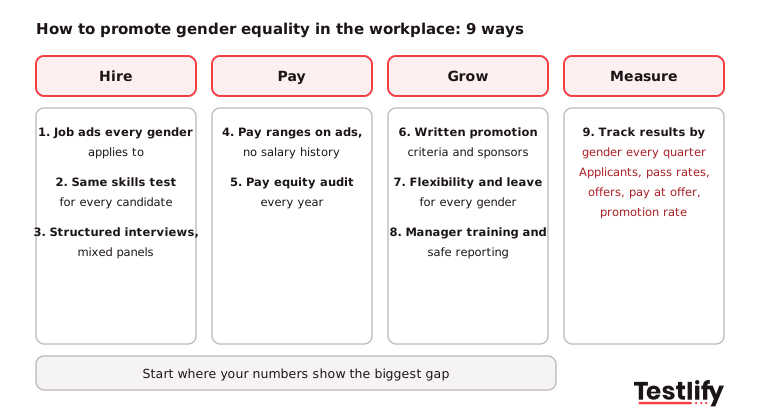
1. Write job ads that every gender will apply to
Job ads decide who applies. Cut "must-have" lists to the skills the job truly needs, drop degree or years-of-experience rules that the role does not require, and remove coded words such as "rockstar" or "dominant". State the pay range and the flexibility on offer. Blind hiring, where early screening hides names and photos, also reduces gender discrimination in hiring at the first filter.
2. Test every candidate on the same job skills
Replace resume screening with a short, role-specific test that every applicant takes under the same conditions. Skills-based hiring widens the pool because people are judged on what they can do, not on past titles or networks.
Be realistic about the effect. LinkedIn's Skills-Based Hiring 2025 report found that a skills-based approach grows the talent pool 6.3 times for women and 6.2 times for men on average, a modest shift in women's share overall, but up to 24% more women in the pool for AI roles. Skills tests remove one source of bias. They do not fix pay or promotion on their own.
3. Use structured interviews and mixed panels
Ask every candidate the same questions, in the same order, scored against a rubric written before the first interview. Structured interviews stop "culture fit" chats from deciding the outcome. Put at least two interviewers of different genders on each panel, and have each score alone before the debrief.
4. Publish pay ranges and stop asking about salary history
Pay secrecy hides gaps. Indeed Hiring Lab found that 57.8% of US job postings on Indeed included pay in September 2024, up from 52.2% a year earlier. Post a range on every ad, set offers inside it, and never anchor an offer to a candidate's last salary, which carries old gaps forward. See the Testlify guide to pay transparency.
5. Run a pay equity audit every year
Compare pay for people in the same role, level and location, then explain every gap by job factors such as performance or tenure. Fix gaps you cannot explain in the next pay cycle, and check starting salaries, bonuses and equity, not only base pay. The Testlify guide to the gender pay gap covers the causes in more depth.
6. Set clear promotion criteria and sponsor women
Write down what each level requires and score promotion candidates against it, using the same rules as fair performance reviews. Then fix access to sponsors. Lean In and McKinsey's 2025 study found 31% of entry-level women have a sponsor, compared with 45% of men. Ask every senior leader to sponsor at least one person from an under-represented group each year.
7. Offer flexibility and parental leave to everyone
Make flexible working and parental leave available to every gender, and encourage fathers to take it. When only mothers use leave and flexible hours, they pay the career cost alone. Judge output, not hours seen in the office.
8. Train managers and make reporting safe
Short, regular training on bias in interviews, reviews and promotion beats a yearly slide deck. Give people a clear, confidential way to report harassment or unfair treatment, protect them from retaliation, and act on every report.
9. Measure and publish progress
Track hiring and promotion results by gender every quarter, set targets for the stages with the biggest gaps, and share the numbers with leaders. What gets reported gets fixed.
Pro tip: Pick the one stage where the gap is largest and fix it first. A single clear win, such as equal pass rates at the skills test stage, builds support for the harder changes in pay and promotion.
What are equal opportunity examples in the workplace?
Equal opportunity examples in the workplace are everyday practices that give every gender the same chance to be hired, paid and promoted. The table shows common examples, what each looks like in practice, and the problem it prevents. Each one maps to equal employment opportunity principles.
Practice | What it looks like | What it prevents |
|---|---|---|
Pay range on every job ad | Range agreed before the role opens | Lower offers to people who negotiate less |
Same skills test for all applicants | One timed, role-based test, auto-scored | Resume filters that favor past titles |
Structured interview scorecard | Same questions, rubric written in advance | "Culture fit" decisions |
Mixed interview panel | Two or more genders on each panel | One person's bias deciding the hire |
Written promotion criteria | Level guide shared with everyone | Promotions going to the most visible |
Parental leave for all parents | Same leave for mothers and fathers | Care falling on one gender |
Yearly pay equity audit | Same role, level and location compared | Unexplained pay gaps growing over time |
Key takeaway: Equal opportunity is built into the process, not added at the end. Each practice above replaces a judgment call with a rule that applies to everyone.
How can you spot gender discrimination in hiring?
Gender discrimination in hiring shows up as a gap in pass rates between genders at one stage of the funnel. Under US Title VII, the EEOC says sex discrimination is illegal in any part of employment, including hiring, pay and job assignments, for employers with 15 or more employees.
Most gaps are not deliberate. They come from filters that look neutral, such as a years-of-experience rule or an unstructured final interview. The only way to find them is to count.
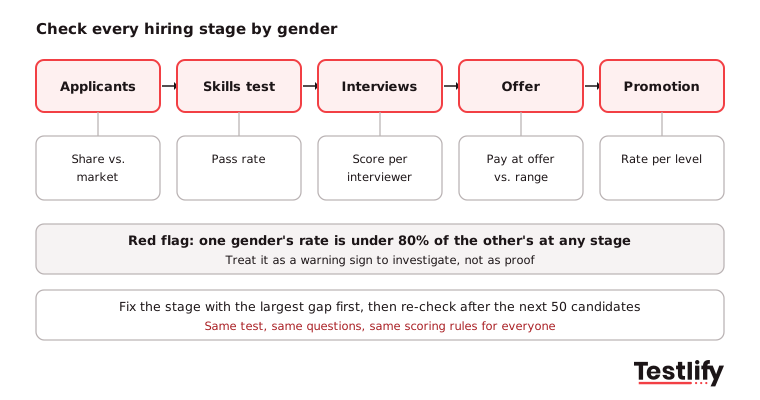
Stage | What to measure by gender | Red flag |
|---|---|---|
Applicants | Share of applicants vs. share of qualified people in the market | Far fewer women than the market has |
Screening or skills test | Pass rate | One gender passes much less often |
Interviews | Pass rate and average score per interviewer | One interviewer scores one gender lower |
Offer | Offer rate and pay at offer vs. the posted range | Lower offers inside the same range |
Acceptance | Acceptance rate and reasons for decline | Women decline over flexibility or pay |
Promotion | Promotion rate per level | Fewer women promoted to first manager |
A common rule of thumb in US practice is the four-fifths rule: if one group's selection rate is under 80% of the highest group's rate, look closer. Treat it as a warning sign, not proof.
Which laws shape gender equality at work?
Laws on gender equality at work cover hiring, pay and, more and more, pay transparency. The main ones for employers who hire across regions:
- United States: Title VII of the Civil Rights Act bans sex discrimination in hiring, pay and promotion, and the Equal Pay Act requires equal pay for equal work. Several states and cities require pay ranges on job ads.
- European Union: The Pay Transparency Directive had to be written into national law by 7 June 2026. It gives applicants a right to pay information before hiring, bans questions on salary history, and requires employers with at least 100 employees to report gender pay gaps.
- New York City: Local Law 144 requires a yearly bias audit for automated tools used to screen or rank candidates. Testlify's own audit is public on the NYC bias audit page.
- United Kingdom and India: The UK's Equality Act 2010 and India's Code on Wages both require equal pay for the same or similar work.
This is a summary, not legal advice. Check local rules with counsel before you change pay or hiring policy.
What should HR do in the first 90 days?
HR teams can make visible progress in 90 days by measuring first, fixing one stage, and then locking the change into policy. The plan below suits a mid-sized or enterprise team.
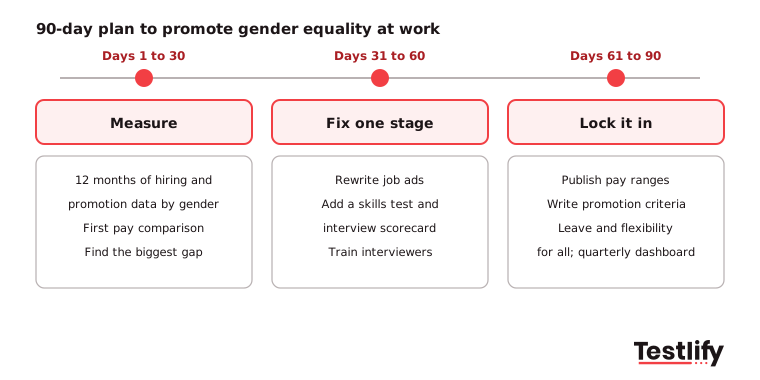
- Days 1 to 30, measure: Pull the last 12 months of hiring and promotion data by gender, run a first pay comparison by role and level, and find the stage with the largest gap.
- Days 31 to 60, fix one stage: Rewrite the job ads for your highest-volume roles, add a skills test and a structured interview scorecard, and train the interviewers who use them.
- Days 61 to 90, lock it in: Publish pay ranges, write promotion criteria for each level, open parental leave and flexibility to all, and set a quarterly dashboard for leaders.
How does Testlify support fair hiring?
Testlify supports fair hiring by giving every candidate the same role-based test and structured interview, scored the same way. Hiring teams pick from 3,500+ validated tests or build one from a job description, and every response is scored automatically.
- Same test for everyone: Role-specific, cognitive, situational judgment and language tests, with 25+ question types and assessments in 15+ languages. Browse the test library.
- Structured AI interviews: Video, voice and chat interviews ask every candidate the same questions and score each answer against the same criteria, with a person making the final call.
- Evidence to check for gaps: Per-skill reports, benchmarking and CSV export let teams compare pass rates by stage.
- Audited: Testlify's matching model completed a third-party bias audit under NYC Local Law 144 on June 16, 2023.
Testing skills is one step, not the whole program. Pair it with the pay, promotion and flexibility steps above.
Ready to make your hiring fairer?
Start with one role. Build a skills test and a structured interview for it, then compare pass rates by gender after the first 50 candidates. Start a 7-day free trial of Testlify, no credit card needed, or book a demo to see it on your own roles.
Frequently asked questions (FAQs)
Related resources
View all
Workplace culture
5 methods to improve team dynamics and employee behaviors

Workplace culture
Workplace Communication: How to Build Team Harmony

Workplace culture
How to lead cross cultural change across a global workforce

Workplace culture
How to create a learning and development plan (with template)
Workplace culture
Learning and development activities: 16 types with examples

Workplace culture
How to build a strong employer brand without a marketing agency?
Get started.
Hire on proof, not resumes.
Run your first skills-based assessment free — no credit card required.