
Top 15 TestGorilla Alternatives and Competitors
Discover 15 powerful TestGorilla alternatives to streamline your hiring process and assess candidates with confidence.
The strongest TestGorilla alternatives in 2026 are Testlify for broad role coverage and AI interviews, Predictive Index for behavioral and cognitive fit, and Codility for deep technical screening. Which one wins depends on what you actually hire for, not on which platform has the longest feature list.
TestGorilla works. It stops working well once roles get specific, hiring volume swings through the year, or finance asks why a 12-month contract renews to cover one seasonal push.
This comparison covers 15 platforms, what each one is genuinely good at, where it falls down, and what it costs. Every pricing figure below comes from the vendor's own published plans at the time of writing.
 ChatGPT
 Gemini
 Claude
 Grok
Grok Perplexity
TL;DR
- Most teams leave TestGorilla for one of three reasons: a test library that runs out on specialist roles, proctoring that misses AI-assisted cheating, or annual billing that does not match seasonal hiring.
- Testlify is the closest like-for-like swap, with 3,500+ tests, 25+ question types, and conversational AI interviews across chat, voice, and video.
- Pick by hiring shape, not by rating. Developer-heavy hiring points to Codility, HackerRank, or Coderbyte. Behavioral fit points to Predictive Index. High-volume campus hiring points to Mercer Mettl.
- Pricing models differ more than the products do. Per-candidate credits suit lumpy hiring, flat monthly plans suit steady hiring, and quote-only vendors are usually the expensive ones.
- Skills gaps are the biggest barrier to business transformation for 63% of employers, so the assessment layer is doing more work than it was five years ago.

Why look for TestGorilla alternatives?
Teams move off TestGorilla when the platform's limits start showing up in the shortlist rather than in the feature comparison. Five complaints come up again and again.
- The test library runs out. TestGorilla's library sits at roughly 400+ tests. That is fine for generalist roles. It gets thin fast for niche or regulated ones, and teams end up writing their own questions anyway.
- Few question formats. Multiple-choice, essay, video response, and file upload. Four formats means every assessment starts to feel like the same assessment, and candidates notice.
- Proctoring is basic. Full-screen tracking and multiple-attempt prevention catch casual cheating. They do not catch a candidate running an AI assistant on a second device, which is now the common case.
- Costs climb with seats. Pricing keyed to users rather than hiring volume punishes the exact thing you want, which is more hiring managers looking at candidate evidence.
- Annual commitment on every plan. Even entry plans lock in for a year. If you hire in bursts, you pay through the quiet months.
None of that makes TestGorilla a bad product. It makes it a product with a shape, and plenty of hiring teams have a different shape.
What is TestGorilla and who is it for?
TestGorilla is a pre-employment skills assessment platform. Hiring teams build a test from a library of role and skill tests, send it to applicants before the first interview, and rank candidates on scored results instead of resumes. It is built for generalist, high-applicant-volume screening: support roles, sales, admin, entry-level operations.
It fits best when you hire a lot of similar people and want a fast, consistent filter at the top of the funnel. It fits worst when roles are specialised, when assessment security has to survive a determined candidate, or when hiring volume is uneven across the year.
How we evaluated these tools
Every platform below was compared on the same five things, because these are what actually change a hiring outcome:
- Test coverage. How many roles and skills the library reaches without custom authoring.
- Question depth. Whether the platform can ask more than a multiple-choice question, including simulations and live coding.
- Assessment integrity. What stops a candidate from getting help, and what evidence a reviewer gets afterwards.
- Pricing shape. Whether cost tracks hiring volume, seats, or a negotiated annual block.
- Review evidence. Public G2 ratings and review counts, so a 5.0 from 4 reviews is not read as a 4.5 from 900.
That last one matters more than it looks. Several platforms in this list have excellent ratings on very small review counts.
TestGorilla competitors at a glance
Here is the short version before the detail. Starting prices are the vendor's lowest published tier, which is rarely the price a growing team ends up paying.
Tool Name | Best For | Starting Price | Standout Features | Core Limitations |
|---|---|---|---|---|
Testlify | Enterprises requiring a large library of role-specific tests and conversational AI interviews | Standard plan $139/month | 3,500+ role-specific tests, 25+ question types, and AI interviews | Only a 7-day free trial is offered for exploring the platform |
Predictive Index (PI) | HR teams that emphasize cultural, behavioral, and cognitive fit in hiring | Custom quote | Research-backed behavioral and cognitive assessments | No technical assessment tests are available |
PMaps | Enterprise and high-volume hiring that blends cognitive, behavioral, and job-skill testing | From $100/month | Multi-dimensional tests plus adaptive interviews and fraud detection | Advanced features sit behind higher plans |
Codility | Developer hiring teams who need role-specific tests and live coding interviews | $1,200/year (120 candidate invites) | Visual studio style coding environment with a large test library | Annual plans are expensive and offer limited flexibility for seasonal hiring |
Mercer Mettl | High-volume and campus testing | Custom quote | Large question bank, remote proctoring, multilingual tests | No transparent pricing |
iMocha | Organizations needing a large skills assessment library and AI proctoring | $1,100/year (250 test attempts) | Patented AI and LogicBox assessments plus live coding simulators | The platform is feature-heavy with a noticeable learning curve |
Hirevue | Large enterprises that need an on-demand video interviewing tool | Enterprise pricing (custom) | Game-based assessments and AI-powered coding screening tools | Costly, and best suited to high-volume corporate hiring |
TestDome | Teams seeking simple pay-per-use assessments | $100 for 5 candidates | Broad technical test library and collaborative IDE for coding interviews | No custom test builder in lower plans, and limited analytics |
Coderbyte | Tech recruiters seeking unlimited technical assessments and AI interviewers | $199/month | Unlimited candidates and admins, integrated coding IDE and AI auto-grading | Expensive for smaller teams, and exports need a higher tier |
Hiremojo | Companies seeking an AI-driven ATS and sourcing assistant | Custom quote (no public pricing) | Automated candidate sourcing and strong recruiting analytics | Primarily an ATS rather than a dedicated assessment platform |
HackerEarth | Recruiting teams who need coding assessments and a technical interview tool for developer hiring | Growth plan $99/month | Role-based developer screening assessments | No integration support on entry plans |
HackerRank | Organizations seeking a coding test and interview solution for hiring developers | Starter $198/month | Technical role-based assessments and an AI-assisted IDE | Expensive for small teams, with $20 per additional test attempt |
TestInvite | Businesses that require customizable tests with solid proctoring features | $37/month ($450/year) | Flexible test builder and strong anti-cheat features | Base plan limits users and tests, and the UI is dated |
eSkill | Teams seeking assessment tests and job simulations for entry-level hiring | Quote-based (custom) | Large test library (600+ subjects) and interactive simulations | Dated interface, and no transparent pricing |
Canditech | Companies wanting realistic work-sample simulations for role-specific skills | $150/month | Job simulation and benchmarking analytics | Smaller platform with fewer third-party reviews |
Pro Tip: Before you shortlist a platform, write down the three roles you hired for most last year and check each vendor's library for those exact roles. Coverage claims are averages. Your hiring is not.
1. Testlify
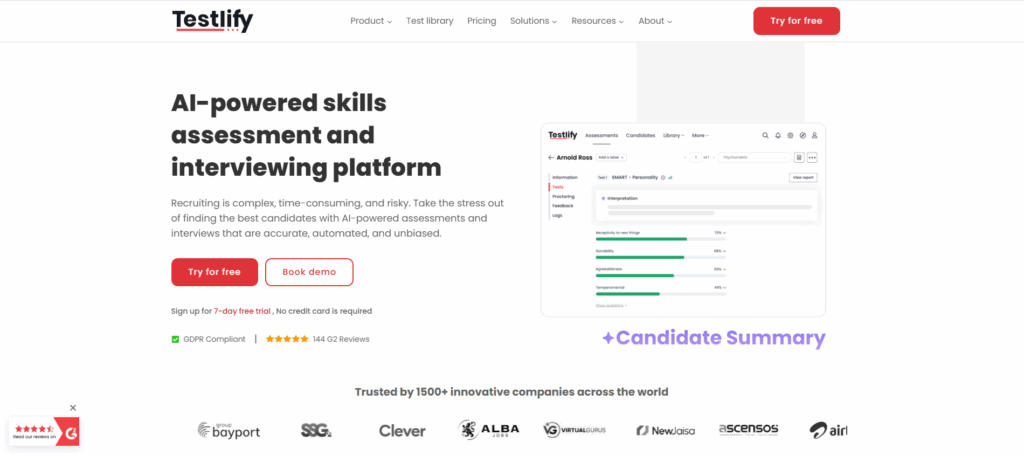
Testlify is an AI-native skills assessment and interviewing platform with 3,500+ role-specific tests and 180,000+ validated questions, available in 15+ languages. It is the closest like-for-like replacement for TestGorilla, with a wider library and more question formats.
It also offers conversational AI interviews across chat, voice, and video, allowing recruiters to assess communication and situational judgment alongside hard skills in the same stage, rather than waiting for a separate recruiter screen.
Features
- Large test library: Over 3,500 pre-built tests across technical, cognitive, and soft skills, plus custom test creation.
- 25+ question types: From standard multiple-choice and essay responses through to video and voice AI interviewing formats.
- Conversational AI interviews: AI interviewers simulate on-the-job scenarios across chat, voice, and video.
- Psychometric tests: DISC and SMART personality tests covering behavioral tendencies and thinking styles.
- AI insights: Short summaries of candidate performance that flag strengths and gaps for the reviewer.
- 100+ integrations: Connects to ATS and workflow tools including Zapier and Zoho Recruit.
- Anti-cheating and proctoring: Identity checks, dual-camera proctoring, AI-assistance detection, and live video proctoring.
Pros
- Wide, flexible library covering cognitive, technical, soft-skill, and role-based assessments
- Multilingual role-specific tests for more accurate evaluation across regions
- Custom tests can be built to match specific job requirements
- AI interviews and detailed analytics shorten the screening loop
- Proctoring depth that holds up against AI-assisted cheating
Cons
- The breadth of features takes some time to explore before the first assessment goes out
- Proctoring and analytics need configuration up front
- The free trial is 7 days, which is short if your hiring cycle is slow
What customers are saying
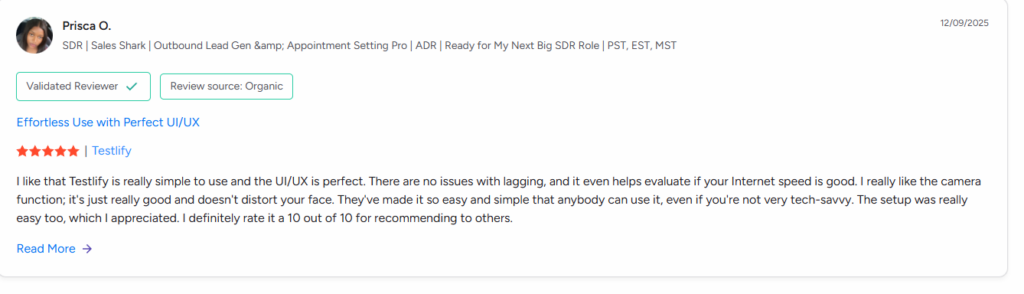
Reviewers point to the AI capabilities and ease of use, and to an interface that works for administrators and candidates alike. The library depth and customization options come up repeatedly, particularly from teams tailoring assessments to specific skill levels.
The AI interviews get called out as useful for first-pass screening, with AI-driven scoring helping teams compare candidates consistently.
Testlify vs TestGorilla direct comparison
A side-by-side view across the product categories buyers weigh most, and how each platform is rated by its customers.
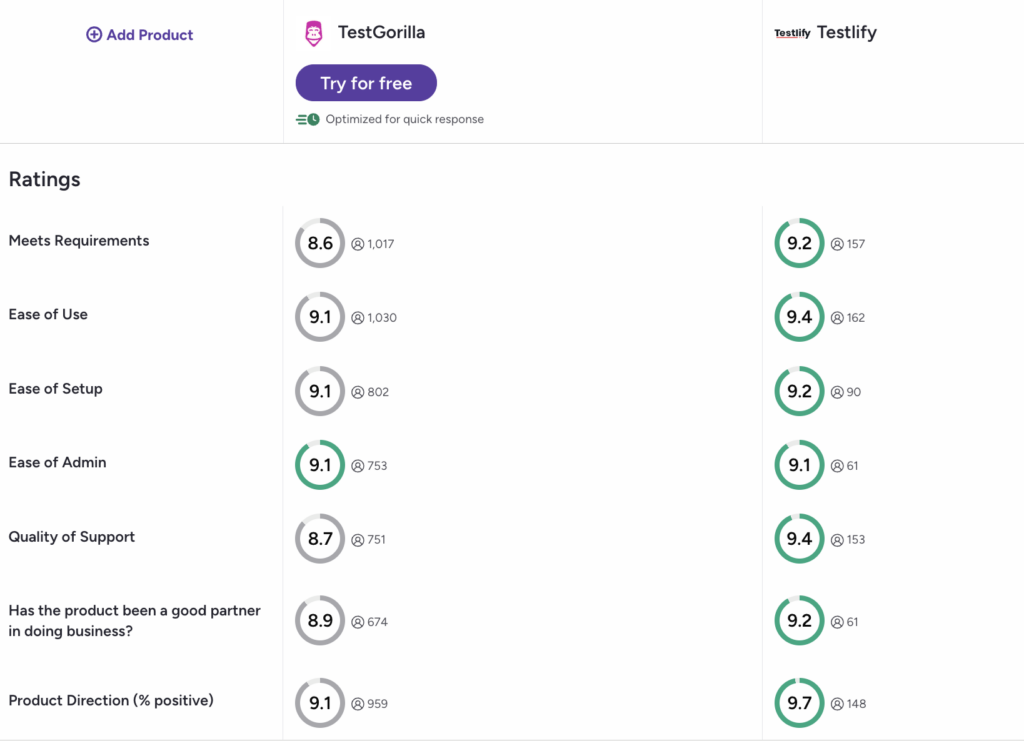
G2 Rating: 4.7 (500+ reviews)
Testlify pricing
Testlify's published pricing plans run on candidate credits rather than seats, so cost tracks hiring volume:
- Standard plan: $139/month (billed at $1,668/year), including 100 candidate credits per year and 3 user seats. Additional seats are $15/month each.
- Custom plan: Quoted for organizations assessing 25,000+ candidates a year, with custom workflows and compliance options.
- Trial and guarantee: A 7-day free trial with no credit card, and a 30-day money-back guarantee. Base plan pricing is locked for 24 months from purchase.
Credits are consumed when a candidate starts an assessment, and unused credits expire at the end of the cycle. Worth modelling against your actual hiring pattern before committing.
2. Predictive Index (PI)
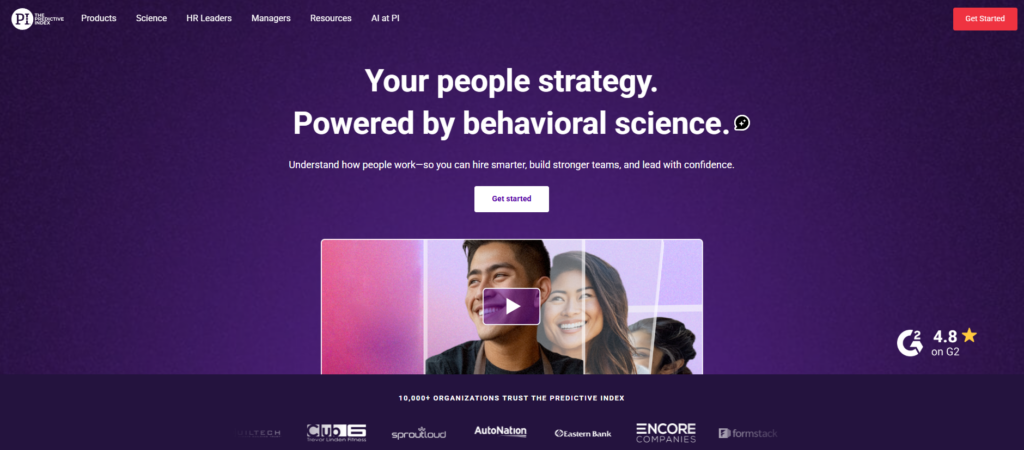
Predictive Index is a talent optimization and psychometric assessment platform used by enterprises to improve hiring accuracy and team alignment. Rather than hard-skill testing, PI specializes in behavioral and cognitive assessment backed by decades of research.
Features
- Behavioral assessment: Measures four behavioral drives (Dominance, Extraversion, Patience, Formality) to describe workplace behavior.
- Cognitive assessment: Evaluates learning agility and problem-solving across numerical, verbal, and abstract reasoning.
- Job targeting: Defines the ideal behavioral and cognitive profile per role, which improves job-fit scoring.
- Team discovery tools: Visualizes team dynamics and surfaces areas of misalignment.
- Talent optimization: Extends past hiring into onboarding, leadership development, and engagement programs.
Pros
- Scientifically validated behavioral and cognitive assessments
- Detailed role profiles and team-dynamic visualizations
- Extends beyond recruitment into onboarding and coaching
- Strong fit for long-horizon workforce planning
Cons
- Does not test technical or role-specific skills
- Implementation is complex and suits teams with analytics capacity
- Rarely cost-effective for smaller organizations
What customers are saying
Reviews describe PI as highly customizable and valid for predicting job performance, and reviewers value how clearly reports separate candidate strengths from development needs.
The recurring criticisms are price and a steep learning curve when building assessments.
G2 Rating: 4.7/5 (28 reviews)
Pricing: Not publicly disclosed. Requires a custom quote.
3. PMaps
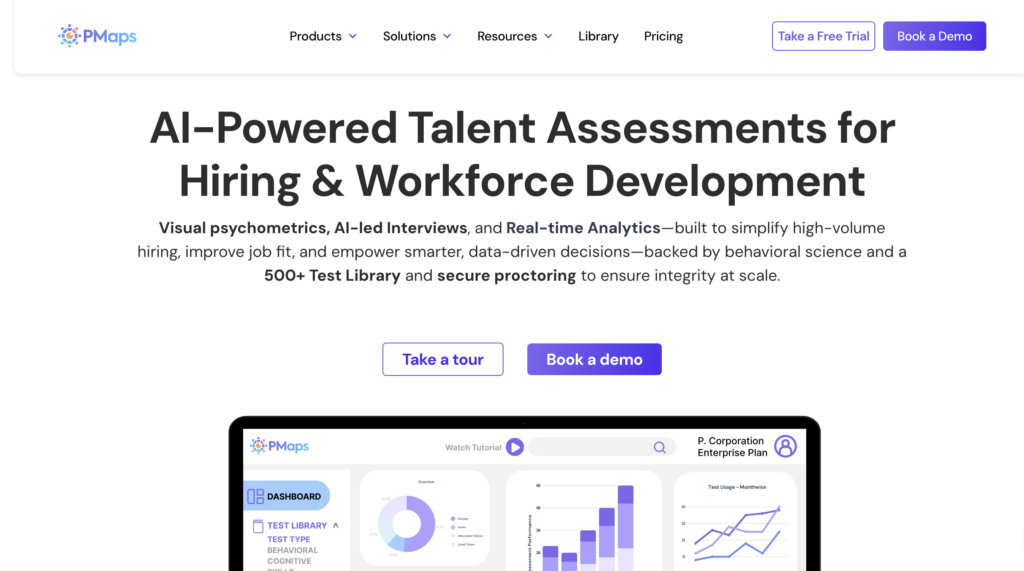
PMaps is a skill-based assessment platform built for organizations evaluating candidates beyond resumes. It combines cognitive ability testing, behavioral profiling, and job-specific skill assessment in one AI-driven system, aimed at large-scale and enterprise recruitment.
Features
- Multi-dimensional tests measuring cognitive ability, job skills, and behavioral fit
- Automated, adaptive interviews that evaluate communication and job readiness
- 400+ pre-built role assessments across industries
- AI-powered monitoring and fraud detection for remote testing
- Predictive analytics to surface high-potential candidates early
Pros
- Evaluation that reaches past basic skill testing
- Screening, assessment, and analytics in a single platform
- Scales for high-volume hiring
- Predictive insights reduce mis-hire risk
Cons
- Advanced features require higher plans
- Configuration varies by hiring need, so setup is not uniform
What customers are saying
Users report faster shortlisting and better hiring accuracy, and value the structured evaluation process and the data behind it.
G2 Rating: 4.6/5 (26 reviews)
Pricing: Plans start from $100/month depending on hiring volume and assessment requirements.
4. Codility
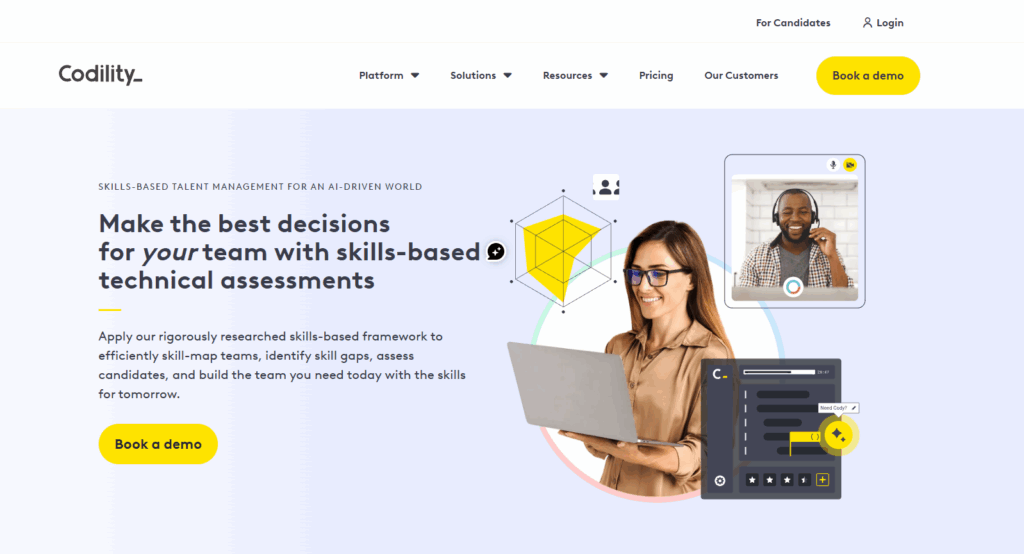
Codility is an online coding test and interview platform used by enterprises to validate the skills of technical talent. It covers coding tests, technical interviews, and training tests, with features aimed at reducing bias and saving engineering time on screening.
Features
- Large technical library: 1,100+ coding and technical tests across dozens of programming languages.
- Live technical interviews: Real-time coding interviews with a pair-programming interface and code evaluation.
- Enterprise features: Anti-plagiarism tooling, ATS integrations, and detailed performance reports.
- Bias mitigation and analytics: Skill-based tasks and standardized scoring, with analytics for objective candidate comparison.
Pros
- Strong live coding environment with an in-browser IDE
- Deep library of algorithmic and language-specific problems
- Integrates with Greenhouse, iCIMS, and common collaboration tools
- Plagiarism detection and AI assistance help standardize grading
Cons
- Entry price is high at $1,200/year for 120 invites
- Admins face a learning curve setting up questions and tests
- Little coverage of non-coding or soft-skill assessment
What customers are saying
Codility scores well on its coding tools. Reviewers single out the VS Code style editor and the variety of problems, which makes interviews feel closer to real work.
The complaints are cost as usage grows, extra configuration for some integrations, and a UI that a few reviewers find heavy for simple tasks.
G2 Rating: 4.6/5 (861 reviews)
Pricing: Three tiers. Starter at $1,200/year, Scale at $6,000/year, and a custom enterprise plan.
5. Mercer Mettl
Mercer Mettl is an online assessment platform covering technical, cognitive, behavioral, and psychometric evaluation. It is known for research-based assessments and secure proctoring, and is widely used in corporate hiring, campus recruitment, and certification testing.
Features
- Wide test range: 200+ job roles and levels, including domain-specific exams and coding tests.
- Proctoring toolkit: AI monitoring, lockdown browsers, and human proctoring options.
- Customization and branding: Company logos, color themes, and assessments hosted on a custom subdomain.
- Reporting and analytics: Competency scores, percentile benchmarks, and hiring recommendations.
Pros
- Broad library spanning aptitude, coding, domain knowledge, psychometrics, and language
- Live proctoring and remote invigilation
- Multi-language support and GDPR compliance for global exams
- Strong customer support and test consulting
Cons
- Custom pricing usually sold in bulk packages with a sizable minimum
- Not cost-effective for small-scale or infrequent hiring
- Some users find consolidated data export difficult on large programs
What customers are saying
Reviewers describe Mettl as easy to use and praise the modular test design and support. The few complaints centre on aggregate reporting and a wish for more flexible pricing for occasional use.
G2 Rating: 4.4/5 (505 reviews)
Pricing: Custom quote based on test count and usage.
6. iMocha
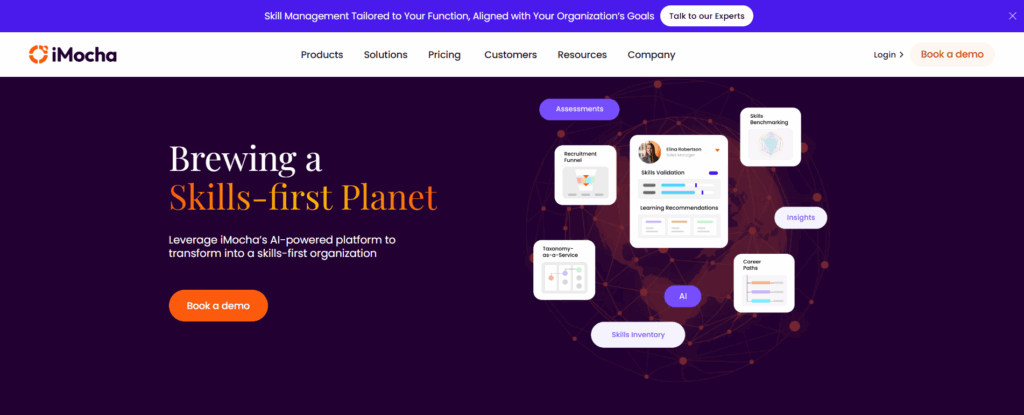
iMocha is an AI-powered skills assessment platform covering both pre-employment testing and workforce upskilling. It has built a large skills database and is known for its skills-intelligence features, with coverage from coding and IT through to finance and language.
Features
- Large test library: Ready-to-use tests with skills mapped across industries.
- Custom test creation: Build tests from scratch or combine existing platform questions.
- Conversational interviews: An AI interviewer that generates qualitative reports on candidate strengths and gaps.
- AI-powered analytics: Performance reports benchmarked against industry standards.
Pros
- Very large skills coverage across coding, IT, business, and soft skills
- AI features including resume parsing, code comparison, and test generation
- Live and record-and-review proctoring, plus plagiarism checks
- Analytics dashboards with LMS and ATS integration
Cons
- The $999/year entry tier for 100 attempts is expensive for small teams
- The interface and feature set take time to learn
- No pure pay-per-use option, so an annual seat-based plan is required
What customers are saying
Reviewers rate iMocha well for its feature depth and question quality, and mention the dedicated customer success team and frequent updates.
The quibbles are minor: some reviewers want more question types, and initial setup is described as steep.
G2 Rating: 4.4/5 (276 reviews)
Pricing: 14-day free trial. Plans start at $1,100/year and scale for larger teams.
7. Hirevue
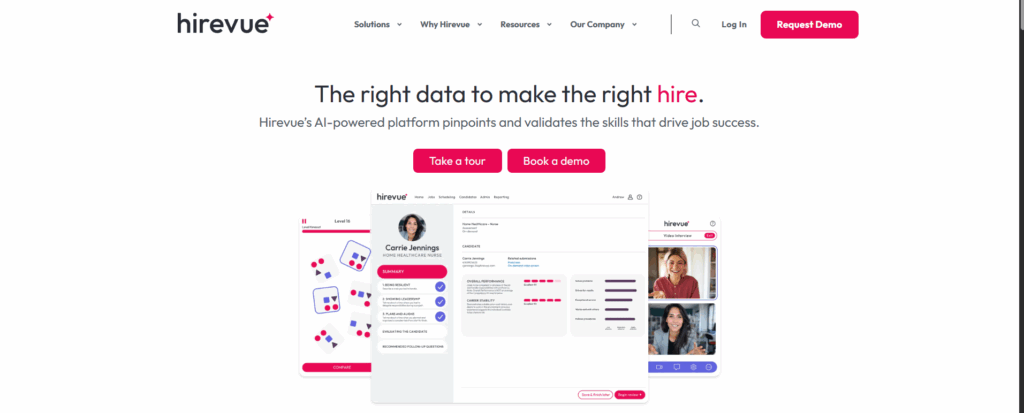
Hirevue built the digital interviewing category and has since expanded into assessments. It pairs video interviewing with game-based and AI-driven assessments, and is used by large enterprises to run high-volume hiring through on-demand video, coding challenges, and AI-scored games.
Features
- Validated content library: Role-specific interview content grounded in industrial-organizational research.
- Video interviews: One-way and live video with scoring rubrics, evaluating verbal response content and tone.
- Game-based assessments: Cognitive games measuring problem-solving, communication, and coding skills.
- Scheduling and automation: Auto-scheduling, candidate chatbots, and ATS integration.
Pros
- Verbal and nonverbal interview analytics
- Covers on-demand video, live interviews, coding challenges, and game-based assessment
- Explicit focus on bias reduction with an AI explainability framework
- Integrates with many HR systems and includes consulting support
Cons
- Setup and change management are significant for new customers
- Reviewers report occasional scheduling glitches and technical issues in live interviews
What customers are saying
Users value how well Hirevue scales, and describe self-recorded candidate responses as a genuine time-saver for scheduling and running interviews.
The reported downsides are scheduling limitations, including a lack of buffer times and rescheduling, plus rare outages.
G2 Rating: 4.1/5 (253 reviews)
Pricing: Three tiers, none publicly disclosed. Requires contacting the vendor.
8. TestDome
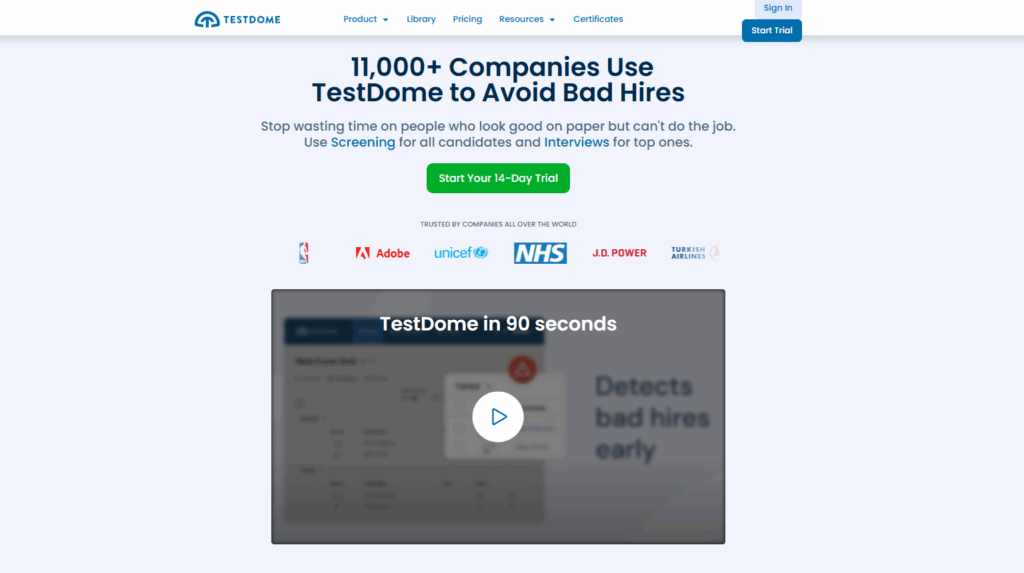
TestDome focuses on work-sample assessments, with 150+ pre-made tests spanning programming, IT, accounting, and customer service. The premise is simple: test applicants with tasks that mirror the actual job rather than abstract puzzles.
Features
- Work-sample tests: Real tasks such as coding, data entry, and customer service scenarios.
- 150+ pre-built tests: Short tests designed to filter unqualified applicants quickly.
- Basic proctoring: Webcam monitoring and screen recording to deter and detect cheating.
- Benchmarking analytics: Side-by-side candidate comparison on test scores.
Pros
- Pay-as-you-go credits, bought as needed
- Solid library of coding, IT, and workplace skills tests
- Quick setup with turn-key tests and basic proctoring
- Well suited to one-off or irregular hiring
Cons
- Mostly English-language tests with no built-in localization
- The non-technical and soft-skill library is limited
- No free plan, with the lowest tier a 5-candidate pack at $100
What customers are saying
Reviewers describe TestDome as easy to use with a clean interface, and highlight automated reminders and flexible deadlines. Teams hiring sporadically value paying only for what they use.
Common requests are more languages and a few more question options, but the simplicity and straightforward pricing are consistent positives.
G2 Rating: 4.5/5 (139 reviews)
Pricing: Pay-per-candidate. $100 for 5 candidates.
9. Coderbyte
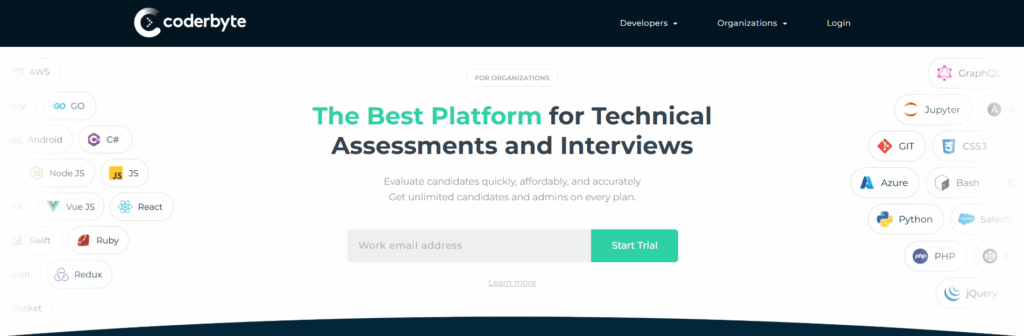
Coderbyte is a technical assessment platform aimed at startups and mid-sized firms hiring developers and data scientists. It offers unlimited coding tests, screening challenges, and take-home projects on a flat subscription.
Features
- Coding challenges and projects: 1,000+ coding challenges across 30+ languages and 100+ skills.
- Multiple question types: Multiple-choice, open-ended responses, and SQL queries.
- Built-in interviewing tools: Live video coding with a real-time editor, spreadsheets, Jupyter notebooks, and a whiteboard.
- Reporting and analytics: Candidate code, video recordings, skill ratings, and internal benchmarking charts.
Pros
- Simple monthly pricing at $199/month for the standard plan
- Built-in code editor and a large challenge library
- Easy test creation mixing custom questions with templates
- Supports one-on-one live coding interviews in-platform
Cons
- JSON and CSV export requires a higher-tier plan
- Few enterprise features, with the focus firmly on coding tasks
What customers are saying
Reviewers call Coderbyte much less expensive than comparable tools while covering the basics well, and describe assessment configuration as straightforward.
Two warnings recur: a 50-candidate invite limit per plan that catches teams by surprise, and paying extra to export results.
G2 Rating: 4.4/5 (356 reviews)
Pricing: $199/month for unlimited candidates and tests. Annual plans are discounted.
10. Hiremojo
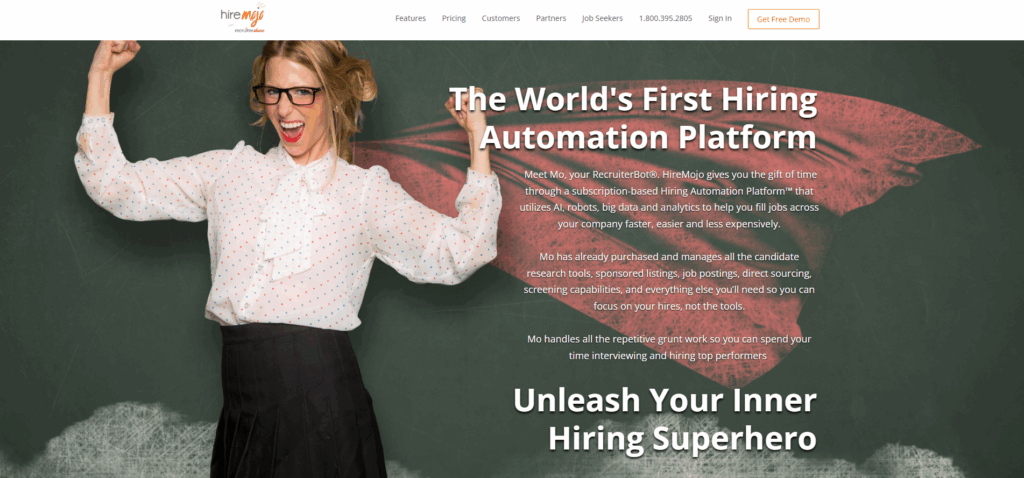
HireMojo is a hiring automation platform rather than an assessment specialist. It automates the recruitment process end to end, from writing job descriptions and posting jobs through to pre-screening applicants and scheduling interviews.
Features
- Automated job posting: Distributes openings across job boards matched to the role.
- Candidate pre-screen and scoring: Automatically pre-screens and ranks applicants through a patented online interview process.
- Job and interview content library: Ready-to-use templates for job descriptions and interview questions.
- Candidate management: Resume review, status tracking, notes, scheduling, and rejection emails in one place.
Pros
- All-in-one recruiting suite covering distribution, database, screening, and scheduling
- AI-driven job marketing and resume matching cut manual outreach
- Includes EEO compliance reporting and background checks
- Unlimited user seats on flat-price plans
Cons
- The interface feels dated and navigation is not always intuitive
- Not specialized for technical skill testing, with more of an ATS focus
- Flat pricing is inefficient at low hiring volumes
What customers are saying
Customers describe it as a one-stop shop for recruiting tasks, and highlight the job marketing and candidate sourcing as time-savers.
The counterpoint is that the interface needs a redesign, and that the platform does considerably more than assessment, which is not always what a buyer wants.
G2 Rating: 4.5/5 (4 reviews)
Pricing: Not disclosed publicly. Requires a custom quote.
11. HackerEarth
HackerEarth is an AI-driven tech hiring platform for screening developers, covering standardized coding assessments, hackathons, and remote interviews. It is known for proctoring depth and the variety of its coding challenges.
Features
- Large question library: 25,000+ questions including multiple-choice, project-based, and data science problems.
- Advanced proctoring: AI-powered webcam monitoring and plagiarism detection.
- Real-time interviews: A live coding tool with a collaborative editor, question library, HD video, and whiteboard.
- Analytics and skill reports: Skill-based performance reports with AI summaries of technical and behavioral signals.
Pros
- Very large library of coding problems
- Live AI video interviews where candidates code on camera
- Supports virtual hackathons and competitions
- Real-time proctoring with IP-based and webcam monitoring plus plagiarism checks
Cons
- Rigid test time limits frustrate candidates on complex problems
- Enterprise-focused pricing means small teams pay for surplus features
What customers are saying
Reviewers rate the platform highly for assessment creation and multi-language support.
The consistent concern is strict timers hurting candidate experience on complex coding problems, plus occasional bugs in test creation.
G2 Rating: 4.5/5 (900 reviews)
Pricing: Plans start at $99/month, with higher tiers for larger teams.
12. HackerRank
HackerRank is an enterprise developer assessment platform and coding challenge hub that has been on the market for over a decade. Companies use it to build skill-based technical assessments for screening at scale.
Features
- Extensive question bank: 7,500+ questions, mostly coding challenges, across 45+ programming languages.
- Screen and interview: Coding tests, live pair programming, and interview tooling.
- Fair scoring: Multiple proctoring and user signals protect assessment integrity while keeping the process consistent.
- Enterprise integrations: Connects to ATS and other recruitment tools.
Pros
- Deep problem library across algorithmic, database, functional, and domain-specific areas
- Flexible assessment and interview modules
- Strong anti-cheating with screen monitoring and plagiarism checks
- Wide ATS and IDE integration with enterprise SLA support
Cons
- Expensive, starting at $198/month and rising with volume
- Steep learning curve for advanced use, with custom tests needing several iterations
- Pricing and attempt models favour large-volume hiring
What customers are saying
HackerRank has a long track record in technical hiring, and most developers have encountered it. Reviewers cite the breadth of questions as the main strength.
The consistent feedback is that building custom questions takes time and that pricing is high for small teams, with reviewers noting cheaper or simpler options exist.
G2 Rating: 4.6/5 (990 reviews)
Pricing: Usage-based, starting at $198/month.
13. TestInvite
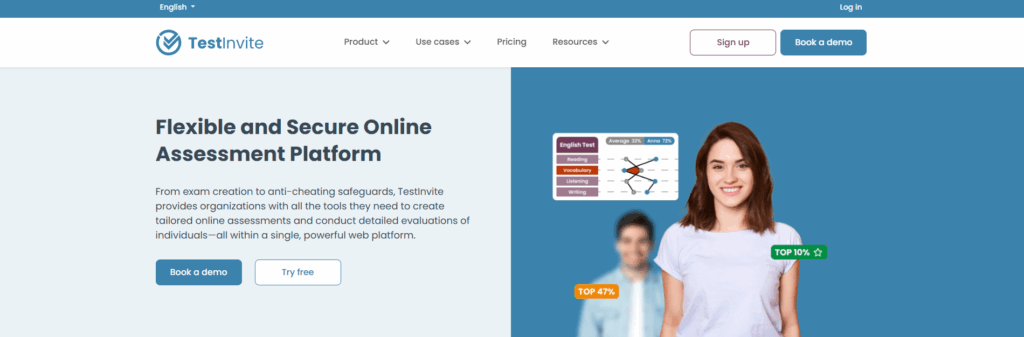
TestInvite is online exam and assessment software built for secure, highly customizable testing across corporate hiring, education, and certification.
Features
- Custom test creation: A flexible test builder with a wide range of question types for teams that want granular control.
- Talent assessment library: Pre-built tests covering problem-solving, communication, and role-specific competencies.
- Detailed reports: Modify scoring logic, derive new metrics, compare against benchmarks, and add interpretations per score range.
- Anti-cheating measures: Lockdown browsers, AI-driven cheating detection, and question randomization.
Pros
- Strong anti-cheating with lockdown browser, webcam snapshots, and randomized questions
- Very flexible test authoring including multi-step workflows and conditional branching
- Responsive support and useful tutorials
- Live proctoring available as an add-on
Cons
- Entry plans are basic, with the $37/month tier covering only 5 tests and limited teammates
- Scaling beyond 500 credits a year requires an upgrade
- Some reviewers report UI translation issues
What customers are saying
Users highlight support quality and ease of use, and commend the platform's data management and reliability.
On the other side, smaller language institutes mention imperfect French translation and the entry plan's limited test count.
G2 Rating: 4.7/5 (16 reviews)
Pricing: Starts at $37/month, rising with features.
14. eSkill
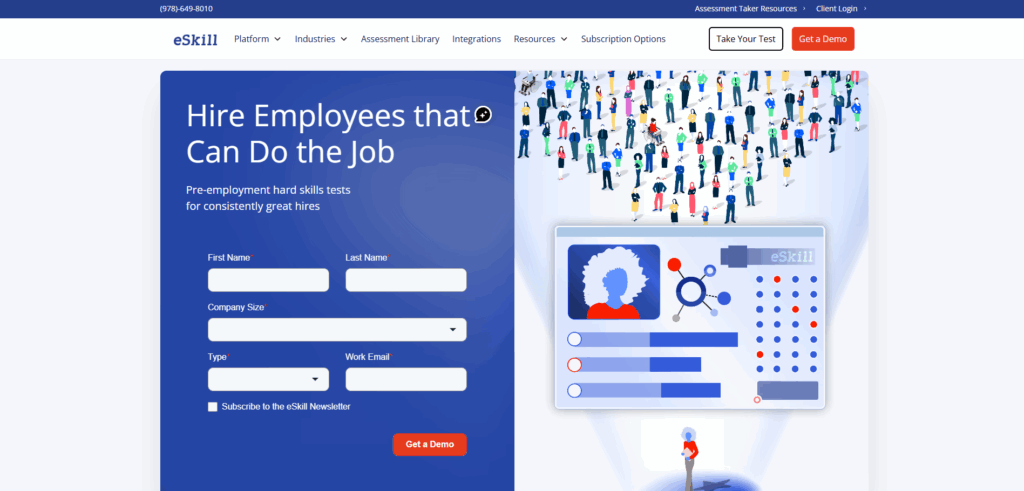
eSkill is a long-established pre-employment testing platform with a wide variety of skills tests. It offers ready-made and custom assessments covering clerical skills, software proficiency, literacy and math, accounting, legal, and call centre scenarios.
Features
- Large test library: 600+ ready-to-use assessments, or custom tests built by selecting subjects, topics, and questions.
- Simulations: Interactive job simulation tests that show how candidates perform in real work scenarios.
- Anti-cheating and proctoring: Monitors copy-pasting and tab switching, flagging suspicious activity in real time.
- Reporting and analytics: Candidate reports with overall scores and breakdowns by subject or question.
Pros
- Wide library spanning technical, cognitive, safety, and software simulation tests
- Mix-and-match question selection for custom assessments
- Strong analytics and score reports with skill-gap charts
- Good integrations with Greenhouse and iCIMS, plus multilingual support
Cons
- The interface is clunky, and finding specific questions takes searching
- Fewer pre-built job-specific tests than expected, so some teams build from scratch
What customers are saying
Reviewers emphasize flexibility and breadth, with recruiters noting they can find the most useful questions for each department by customizing tests.
The criticisms are a tedious test library to navigate, a wish for more ready-made templates, and pricing that feels expensive at low hiring volume.
G2 Rating: 4.5/5 (341 reviews)
Pricing: Not disclosed publicly. Requires a custom quote.
15. Canditech
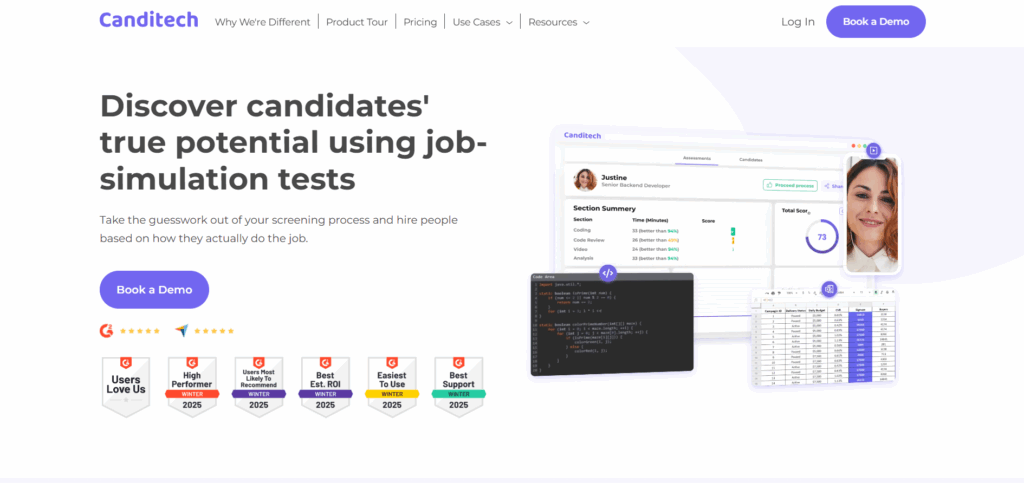
Canditech is a newer job simulation assessment platform that lets employers evaluate candidates through realistic work scenarios. It carries a 5.0 G2 rating, though on a small review base.
Features
- Custom and expert-built tests: 500+ pre-built tests, or build your own assessment from scratch.
- Job simulations: Coding exercises, Excel tasks, open-text responses, and more.
- Automatic scoring: Candidates are ranked on performance so reviewers focus on the strongest applicants.
- Benchmarking analytics: Score benchmarking against industry or job-specific standards.
Pros
- Supports complex question types including live SQL and Excel scenarios, video responses, and collaborative tasks
- Test builder is usable by non-technical staff
- Strong data-skills coverage, including SQL tests against a real database
Cons
- Branding customization is limited
- Reporting does not integrate well with internal score rubrics
- The 5.0 rating rests on 54 reviews, a much smaller base than the established platforms
What customers are saying
Reviewers say assessments are easy to create and work well for filtering candidates during interview processes.
Criticisms centre on exam security and the need for better rubric integration.
G2 Rating: 5/5 (54 reviews)
Pricing: Team plan starts at $150/month for 100 candidates.
Which is the best TestGorilla alternative?
For most teams replacing TestGorilla outright, Testlify is the closest match with more room: 3,500+ tests against roughly 400+, 25+ question types against four, and proctoring that covers AI-assistance detection rather than screen tracking alone. It also supports 100+ ATS integrations and an extensive test library spanning technical and non-technical roles.
But the honest answer is that "best" depends on your hiring shape:
- Hiring across many role types? Library breadth is the constraint. Testlify or iMocha.
- Hiring mostly developers? Coding depth beats breadth. Codility, HackerRank, or Coderbyte.
- Hiring for fit and long-term performance? Predictive Index, though you will still need a skills test alongside it.
- Hiring in bursts? Avoid annual seat-based contracts. TestDome's pay-per-candidate model or a credit-based plan will cost less.
- Hiring at campus scale? Mercer Mettl and PMaps are built for that volume.
Consider a 600-person software company hiring 25 people a quarter across engineering, support, and sales. A developer-only platform covers eight of those roles well and leaves seventeen to a second tool. That is the trap: buying for the hardest role instead of the most common one, then paying for two platforms. Map your last twelve months of hires by role before you shortlist.
The cost of getting this wrong is not just licence fees. SHRM's benchmarking data puts the average cost per hire at $4,129, and US employers made 5.1 million hires in July 2026 alone according to Bureau of Labor Statistics data. At that volume, a screening layer that surfaces the wrong shortlist is expensive well before the renewal invoice arrives.
There is also a moving target underneath all of this. The World Economic Forum expects 39% of workers' core skills to change by 2030, and 63% of employers name skills gaps as the biggest barrier to transforming their business. A test library that is adequate today is the one that runs out in two years, which is a good reason to weight library depth and custom authoring more heavily than a feature checkbox comparison suggests.
For a direct head-to-head on features, pricing, and proctoring, read the full Testlify vs TestGorilla comparison.
See how Testlify handles your roles
The fastest way to settle this is to run one of your real roles through a shortlist of platforms and compare what comes back. Start a 7-day free trial, or book a demo and bring the three roles you hire for most.
Key takeaways
- Switch for a reason you can name. Library depth, proctoring strength, or billing shape are real reasons to move off TestGorilla. A slightly nicer interface is not, because migration costs you a hiring cycle of retraining and re-benchmarking.
- Buy for your most common role, not your hardest one. Teams routinely over-index on engineering screening and then discover the platform cannot assess the support and sales roles that make up most of their hiring. That is how companies end up paying for two assessment tools.
- Pricing model matters more than headline price. Seat-based annual contracts punish uneven hiring, while per-candidate credits track actual volume. Model your last twelve months of hires against each pricing page before you talk to a salesperson.
- Proctoring has to cover AI assistance now. Full-screen tracking and attempt limits were adequate three years ago. If a platform cannot flag a candidate using an AI assistant on a second device, your scores mean less than they used to.
- Weigh review counts, not just ratings. A 5.0 from 54 reviews and a 4.6 from 990 are not comparable signals. Check the base before you treat a rating as evidence.
- One signal is fragile. Combining a skills test with a structured interview and reviewer feedback catches the candidates a single score misreads, in both directions.
- Re-check your library every year. With 39% of core skills expected to shift by 2030, the roles you assess in 2026 will not be the roles you assess in 2028.
Frequently asked questions (FAQs)

Director of Marketing
Akash Patange is the Director of Marketing at Testlify, where he works closely with HR leaders and recruiters to help organizations improve hiring outcomes. He writes about talent assessment, recruitment technology, and data-driven hiring practices.
LinkedInRelated resources
View all
Alternatives
Top 15 The Talent Games Alternatives and Competitors (2026)
Alternatives
Top 15 The TalentMetrix Alternatives and Competitors
Alternatives
Top 15 Equip Alternatives and Competitors
Alternatives
Top 15 Harver Alternatives and Competitors
Alternatives
Top 15 Talview Alternatives and Competitors
Alternatives
Top 15 Cangrade Alternatives and Competitors
Get started.
Hire on proof, not resumes.
Run your first skills-based assessment free — no credit card required.