
Top 15 Maki People Alternatives and Competitors
Discover 15 powerful Maki People alternatives to streamline your hiring process and assess candidates with confidence.
The best Maki People alternative depends on what you actually need to replace: Maki's conversational AI screening agents, its timed skills tests, or its quote-only pricing. Testlify is the closest like-for-like swap for teams that want AI interviews plus a 3,500-test library on a published price, while TestDome, Adaface and Coderbyte win on cost at low volume and Mercer Mettl, HireVue and TalentLens win on psychometric depth. This guide compares 15 MakiPeople alternatives on pricing checked on each vendor's own page on 5 September 2026, and it also answers the candidate-side questions (what a Maki assessment looks like, who the "Maki assessments team" is) that most buyer guides skip.
 ChatGPT
 Gemini
 Claude
 Grok
Grok Perplexity
TL;DR
- Maki People sells AI hiring agents (screening, voice interviews, deep assessment, interview co-pilot, scheduling) to large employers, and it does not publish a price. Every alternative below is judged on what it publishes and what it hides.
- Only six of the 15 vendors list a price you can compute a 100-candidate cost from. Testlify Standard lands at $1,668 a year for 100 credits; TestDome, Adaface and Coderbyte list cheaper at that volume, and the section on cost explains what the extra spend buys.
- An AI conversation is one signal, not a decision. Structured interviews (.42) and job knowledge tests (.40) predict performance better than a single cognitive score (.31) in the updated Sackett meta-analysis, so the strongest alternative is the one that combines several signals.
- Only 26% of candidates trust AI to evaluate them fairly, and 6% admit to interview fraud (Gartner, 2025). Pick a platform that shows candidates how they were scored and that verifies who took the test.
- If you are a candidate who searched "maki assessment test sample" or "maki assessments team", the section on what a Maki assessment looks like answers you directly.

Who is Maki People (MakiPeople) and what does it sell?
Maki People (often written MakiPeople, brand name Maki) is a hiring platform that runs recruiting workflows with a set of named AI agents. Its site describes a five-stage process: intake (turning a job description into a hiring journey), screening (a skills screener it calls Shiro and a voice interviewer it calls Mochi), deep assessment (Ken), a live interview co-pilot (Tomo) and interview scheduling (Kumi). It sells to enterprises and lists Deloitte, Capgemini, BNP Paribas, PwC and Foundever among its customers.
Three things matter for anyone comparing alternatives. First, Maki positions itself as "the intelligence running your hiring, end to end" on top of an existing ATS, so it competes with assessment vendors on the screening and assessment stages but also with AI-interview and scheduling tools. Second, its voice interviewer claims 45+ languages, which is a real differentiator for multi-country volume hiring. Third, there is no pricing page. Every figure you see for Maki's cost on third-party sites is an estimate, and this guide does not repeat any of them.
That last point is the reason most buyers end up on a page like this one. If you cannot see the price, you cannot model the cost of a 2,000-candidate season, and you cannot compare it with a vendor that publishes one.
Why do teams look for a Maki People alternative?
Teams look for a Maki People alternative for four reasons: pricing is quote-only, the product is built around AI agents rather than a deep test library, proctoring and identity checks are not the centre of the pitch, and AI-scored screening now carries compliance obligations that a buyer has to be able to explain. None of these makes Maki a bad product. They make it a specific one.
Quote-only pricing. Maki's own compare page and its help centre never state a price. A mid-market team that hires 300 people a year cannot budget against "contact sales", and procurement teams increasingly refuse to.
AI-agent-first design. Maki's help centre sizes its library at more than 200 skills tests. That is enough for volume roles in sales, support and retail. It is thin next to Testlify's 3,500+ tests or eSkill's 600+ subjects if you hire across engineering, finance, blue-collar and language-heavy roles at the same time. The World Economic Forum expects 39% of core skills to change by 2030, which is a strong argument for a library that keeps adding role-specific tests rather than a fixed agent set.
Trust and fraud. A Gartner survey of 3,000 job candidates in the second quarter of 2025 found that only 26% trust AI to evaluate them fairly, 6% admitted to interview fraud, and Gartner predicts one in four candidate profiles will be fake by 2028. A voice agent that runs 24/7 is exactly the surface a proxy test-taker targets. Identity verification, dual-camera proctoring and AI-assistance detection stop being nice-to-haves.
Explainability. New York City's Local Law 144 requires a bias audit and candidate notice before an automated employment decision tool is used, and the EU AI Act lists recruitment and selection systems as high-risk in Annex III. If an AI agent produced the score, you need to be able to show a regulator what it measured and how a human reviewed it.
What does a Maki assessment test look like?
A Maki assessment is whatever the employer configured it to be: a set of timed skills and personality tests from Maki's library, a short AI screening conversation (Maki calls it Mochi) by phone or web, or both. Candidates get an email link with a deadline set by the employer. There is no single "Maki test", which is why sample questions found online vary so much.
This section exists because Google already sends candidates here for "maki assessment test sample" and "maki test example". The honest answer is that the format depends on the employer, but the building blocks are predictable.
Maki assessment test sample and example
The library tests are short, timed modules. A job-specific module (for example, a sales or customer-support test) asks multiple-choice or situational questions about the role. A cognitive module asks numerical, verbal or logical reasoning questions against the clock. A personality module asks you to rate statements about how you work. One format Maki documents in its help centre is a Chat Proficiency test, where you handle a simulated customer chat by picking the best pre-written reply at each turn rather than typing your own.
The AI screening conversation is different. Mochi asks a handful of structured questions about your experience, motivation and skills, then a few situational ones, and it records and scores your spoken answers. Keep each answer to a minute or two. A good example answer to "tell us about a time you handled an angry customer" states the situation, what you did, and the result, in that order, in under two minutes.
Two practical tips. Use a laptop with a working camera and microphone, because the voice interview will not run well on a flaky phone connection. And treat the personality module like the interview, not like a quiz: answer consistently, because these instruments are built to flag contradictory responses.
Maki assessment at Foundever and other employers
Foundever, the customer-experience outsourcer, appears on Maki's customer list, and a share of the people searching for a Maki assessment sample are Foundever applicants. Contact-centre employers typically use the chat and voice modules plus a language test, because the job is talking and typing to customers. The same goes for retail and hospitality employers on Maki's list: expect short, role-specific modules and an AI conversation rather than a long aptitude battery.
Is Maki a third party interview service?
No. Maki is a software platform licensed by the employer, not an outsourced interviewing agency. When you take a Maki interview, the employer's own recruiting team set it up, chose the questions and reads the results. Maki's AI records and scores the conversation, but the hiring decision stays with the company that invited you. The distinction matters if you are wondering who to contact: it is the employer, not Maki.
What do MakiPeople reviews say?
Independent reviews of Maki sit on G2, Gartner Peer Insights and Capterra, and they cluster around three themes: candidates like the conversational format, recruiters like the ATS hand-off, and buyers complain that pricing is opaque and the test library is smaller than the assessment specialists'. Maki also publishes its own candidate-feedback and time-to-hire figures on its homepage; treat those as vendor claims, not independent evidence.
Here is how we read any review set for an AI-interview vendor. Look for reviews from people who ran more than one hiring season, because agent quality shows up in the second year, not the demo. Discount any review that praises "speed" without a number. And check whether reviewers mention explainability: a platform that scores a voice interview needs to show a recruiter why, and that is the feature reviewers are least likely to describe unprompted.
How we evaluated these Maki People alternatives
We scored each alternative on seven criteria, and we weighted validity and pricing transparency above the rest. The logic comes from the Testlify Multi-Signal Talent Evaluation Model: a candidate should be advanced when several independent, role-relevant signals agree, not because one AI conversation or one test score looked good. A platform earns a high rank here if it lets you collect more than one signal, verify who produced it, and pay a price you can see.
- Validity evidence. Does the vendor use methods with published predictive validity? In the 2022 revision of the selection meta-analysis by Sackett and colleagues, structured interviews (.42), job knowledge tests (.40) and work samples (.33) outperform cognitive ability alone (.31) once the older over-corrections are removed. A platform that offers only one of these is a narrow bet.
- Role breadth. How many roles can you cover without building tests yourself?
- Proctoring depth. Identity checks, environment control, AI-assistance detection and reviewable evidence, not just a webcam snapshot.
- Integrations. Native ATS connections for the systems a 1,000-person company actually runs (Workday, SAP SuccessFactors, Greenhouse, Lever, SmartRecruiters).
- Pricing transparency. Is there a public price, and can you compute a per-candidate cost from it?
- Candidate experience. Length, device support, languages and whether candidates see their own results.
- Compliance and explainability. Can you produce the adverse-impact analysis the Uniform Guidelines' four-fifths rule expects, and can you explain an AI-generated score to a candidate?
Pro tip: Ask every vendor the same three questions on the first call. What is the price for 100 assessed candidates? Which ATS integrations are native versus add-on? And can a recruiter see why the AI scored a candidate the way it did? The answers separate the 15 tools below faster than any feature grid.
MakiPeople alternatives compared: the quick table
Prices below were read on each vendor's own pricing page on 5 September 2026. "Quote only" means the page shows no figure at all. Where a vendor lists a price, the table shows the cheapest published paid tier.
Tool | Best for | Published starting price | Standout | Watch out |
|---|---|---|---|---|
Testlify | Skills tests plus AI interviews at a published price | $139/month (Standard, 100 credits a year) | 3,500+ tests, chat/voice/video AI interviews, 100+ ATS integrations | ATS integrations are an add-on on Standard |
TestGorilla | Teams that want a free tier to start | $0 (Free); $142/month (Core, annual) | Free plan with 10 credits a month | AI interviews and ATS integrations start at Plus ($400/month) |
Adaface | Low-volume, conversational assessments | $180/year (Individual, 12 credits) | Chatbot-style tests, cheap entry | Credits also pay for test set-up (5 per ready-made test) |
Vervoe | Work-sample simulations | Quote only | AI-graded job simulations | No public price |
Codility | Engineering screens at scale | $1,200/year (Starter, 120 invites) | Live coding interviews, plagiarism detection | Engineering only |
Mercer Mettl | Psychometrics with human proctoring | Quote only | Live invigilation, research-based instruments | No public price |
iMocha | Skills intelligence and upskilling | Quote only | Large skills taxonomy, AI interviewer | No public price |
HireVue | Enterprise video interviewing | Quote only (Essential and Premium packages) | Structured video interviews, game-based assessments | No public price; interview-first, not test-first |
TestDome | Pay-per-candidate work samples | $20 per candidate (5-pack); $7 at 600 | No subscription at all | Small library, no AI interviews |
Coderbyte | Startups hiring developers | $99/month (20 invites); $1,799/year unlimited | Unlimited candidates on Pro | Developer and data roles only |
The Talent Games | Gamified volume and campus hiring | Quote only | Game-based SJTs and aptitude | No public price |
TalentMetrix | Psychometrics for Indian employers | Quote only | DISC, motivators, EQ, sales index | Personality-first, few skills tests |
TalentLens | Validated cognitive instruments | Quote only | Pearson-owned, Watson-Glaser | No public price; not a screening workflow tool |
TestInvite | Custom exams with lockdown proctoring | $900/year (Starter, 500 credits) | Fine-grained test builder, strict proctoring | Small pre-built library; 1 teammate on Starter |
eSkill | Clerical, admin and call-centre testing | Quote only | 600+ subjects, 70,000 questions, simulations | No public price |
1. Testlify
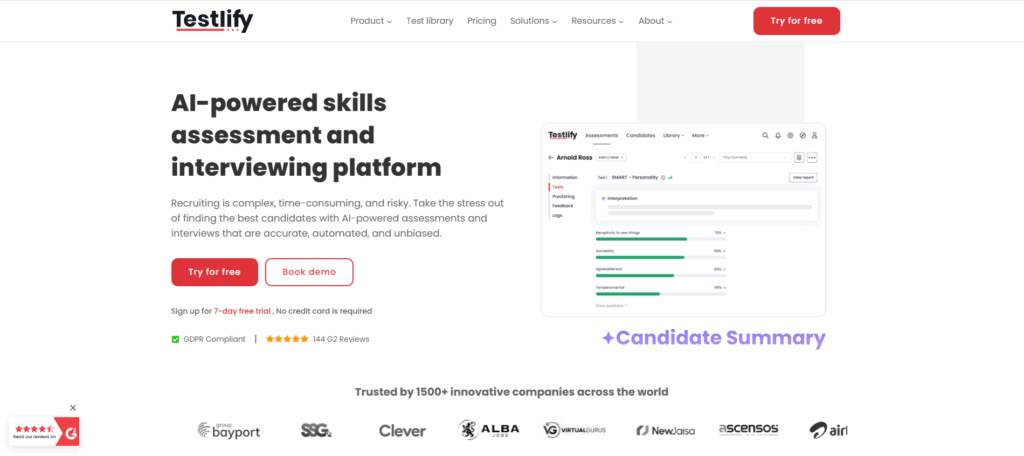
Testlify is the closest like-for-like Maki People alternative on this list, because it covers both halves of what Maki sells: a large test library for timed skills assessments and conversational AI interviews across chat, voice and video. The difference is that Testlify publishes its price and starts from the test library rather than from an agent.
Key features
- 3,500+ tests across 12 categories (role-specific, cognitive ability, software, programming, coding, engineering, personality and culture, language, situational judgment, typing, blue-collar and simulation), with custom questions and weighted scoring on top.
- Conversational AI interviews in chat, voice or video that mimic a recruiter screen and score job-specific answers, which is the Maki capability most buyers are trying to replace.
- AI insights that summarise each candidate's strengths and gaps so a recruiter can explain a score, not just read it.
- 100+ ATS and HR integrations, native for Workday, SAP SuccessFactors, Greenhouse, Lever, Workable, SmartRecruiters and BambooHR among others (see the integrations directory).
- Proctoring that includes dual-camera monitoring, randomised question banks, AI-assistance detection and a lockdown browser, with photo ID verification and live video proctoring available per attempt.
Pros and cons
Pros: published pricing; one platform for tests and AI interviews; the widest library in this comparison; SOC 2 Type II and GDPR compliance. Cons: on the Standard plan, white-labelling and ATS integrations are paid add-ons ($2,388 a year each), so a team that needs a Workday sync from day one should price the Custom plan instead. Extra credits on Standard cost $21 each, more than the $16.68 blended rate inside the plan.
Best for
Mid-market and enterprise teams that want Maki-style AI interviews plus a deep test library, on a price they can put in a budget. It is also the natural pick for teams hiring across very different role families at once.
Pricing
Standard is $139 a month, billed at $1,668 a year, and includes 100 candidate credits ($16.68 a credit), 3 user seats and a 7-day free trial. Extra seats are $15 a month. Phone interviews are metered at $0.18 a minute, photo ID verification at $0.50 an attempt and live video proctoring at $5 an attempt. The Custom plan is priced to volume on request. Full detail is on the Testlify pricing page.
2. TestGorilla
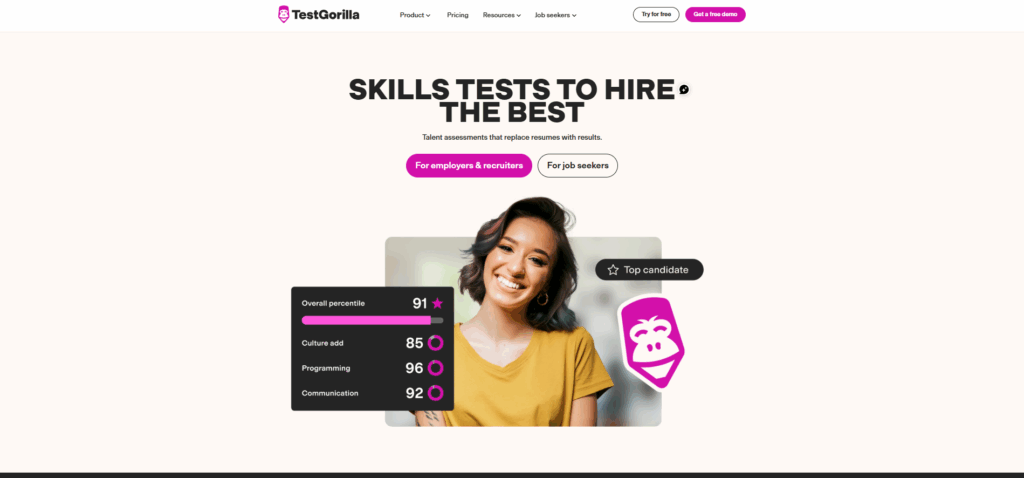
TestGorilla is the volume-screening platform most buyers already know, and it is the only tool here with a free tier that never expires. It suits teams that want to trial structured assessments before committing, with the caveat that the features closest to Maki (AI interviews, ATS integrations) sit two tiers up.
Key features
- 350+ tests on the Core plan and above, covering cognitive, role-specific, language, personality and situational judgment.
- Video questions and AI interviews, with full customisation and AI scoring on the Plus plan.
- Resume scoring and qualifying questions on every tier, including Free.
- Talent sourcing access to a candidate pool the vendor sizes at 2 million on Core and above.
Pros and cons
Pros: a real free plan (10 credits a month, 5 tests, 1 seat); standardised scoring across candidates; wide role coverage. Cons: Core buys tests but not the AI interviews or ATS integrations, and Plus starts at $400 a month; the library is a tenth the size of Testlify's for niche roles.
Best for
Teams under 200 people that want to start free and grow into structured screening, and larger teams that hire mostly for common roles.
Pricing
Free is $0 with 10 credits a month. Core is $142 a month on an annual commitment ($1,704 a year) with 2 seats. Plus starts at $400 a month ($4,800 a year) and scales with volume. Enterprise is quote only. Read the TestGorilla alternatives comparison if you want the same breakdown from the other direction.
3. Adaface
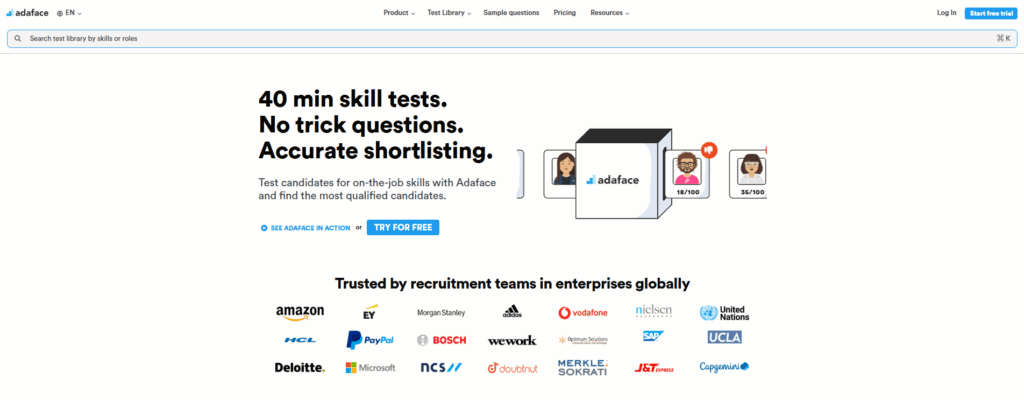
Adaface is the cheapest way to get a conversational, chatbot-style assessment in front of candidates, which makes it a frequent shortlist entry for teams leaving Maki on cost grounds. Its assessments are delivered by a chat agent named Ada instead of a static form.
Key features
- Conversational assessments that ask contextual follow-ups, which the vendor credits for higher completion rates.
- Pre-built templates for engineering, finance, support and operations roles, plus custom tests.
- Automatic pass, borderline and fail buckets so recruiters can filter without reading every report.
- In-house question authoring, so the questions are not sitting on public practice sites.
Pros and cons
Pros: the lowest entry price on the list; a 14-day trial; candidate-friendly format. Cons: the credit model charges for set-up as well as invites (5 credits for a ready-made test, 10 for a custom one, 1 per invite), so the effective cost per candidate rises on small plans; no voice or video interviewing.
Best for
Small teams and single hiring managers who need a handful of assessments a month, and teams that care most about candidate completion rates.
Pricing
Annual plans run Individual $180 (12 credits), Starter $500 (50), Pro $900 (100), Scale $3,000 (500), Growth $5,500 (1,000), Enterprise $20,000 (5,000) and Unlimited $50,000. See the Adaface alternatives guide for a deeper look at where it fits.
4. Vervoe
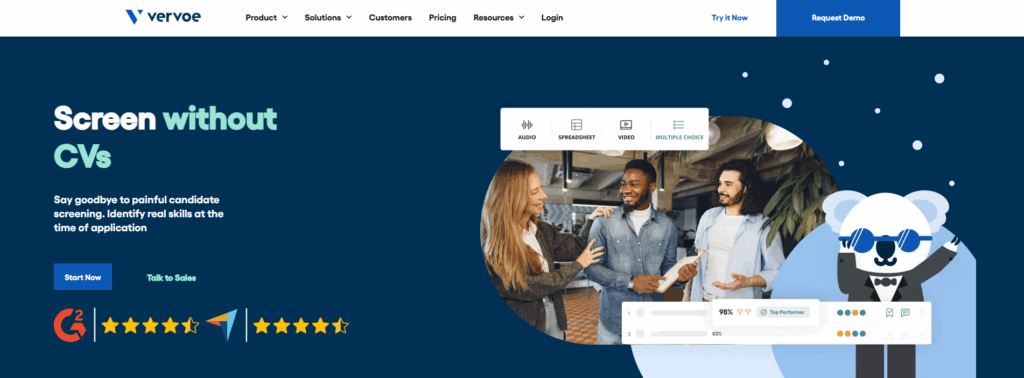
Vervoe replaces the test with the task. Candidates complete job simulations (text, video, file upload, spreadsheet) and an AI grades and ranks the responses. If your reason for leaving Maki is that a screening conversation does not show whether someone can do the work, Vervoe is the most direct answer.
Key features
- Pre-built simulations across support, sales, marketing, technology and operations.
- Multi-format questions so a single assessment can mix a written answer, a video and a spreadsheet exercise.
- AI grading and ranking that scores accuracy, effort and relevance.
- Team review in one dashboard, with reviewer comments per candidate.
Pros and cons
Pros: work samples carry a .33 validity in the Sackett revision, well above most screening questionnaires; strong for skills-first hiring stories. Cons: pricing is quote only (the pricing page shows a "request pricing" button and nothing else); building good simulations takes hiring-manager time.
Best for
Enterprise teams hiring for roles where a work sample is easy to define (support, sales, analysts) and where procurement can live without a list price.
Pricing
Quote only as of 5 September 2026. Our Vervoe alternatives comparison covers what to ask for on the pricing call.
5. Codility
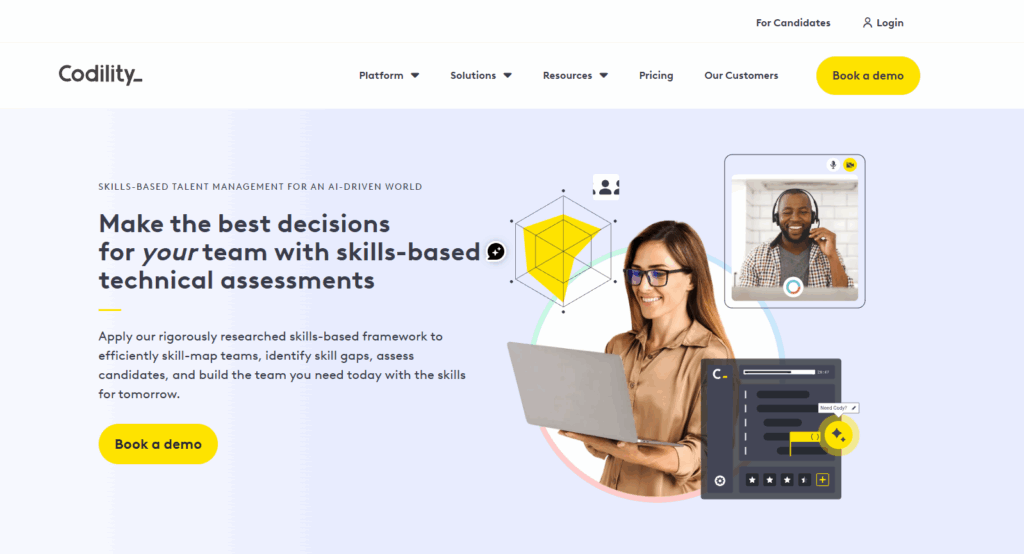
Codility is an engineering-only alternative. It makes the list because a share of teams leaving Maki are doing so for technical hiring, where a conversational agent cannot verify code. Codility pairs an automated coding screen with a live collaborative interview and now sells an AI copilot inside the assessment.
Key features
- Task library spanning algorithms to system design, with task-leakage protection and plagiarism detection on every plan.
- Live technical interviews in a shared IDE with a compiler and test runner.
- Automated scoring for correctness, efficiency and readability, with structured reports.
- Enterprise integrations (Greenhouse, Lever, Ashby, Workday, SAP) and SSO on the Custom plan.
Pros and cons
Pros: published annual pricing; strong anti-cheating for code; occupational psychologists validate assessments on the Custom tier. Cons: engineering only; Starter allows 1 platform user and Scale caps invites at 25 a month, so seasonal hiring spikes need the Custom plan.
Best for
Engineering organisations screening hundreds of developers a year who want the interview and the screen in one tool.
Pricing
Starter is $1,200 a year (up to 120 invite credits, 1 user, annual billing only). Scale is $6,000 a year or $500 a month (up to 300 invites, 3 users). Custom is quote only. The Codility alternatives guide compares it with broader platforms.
6. Mercer Mettl
Mercer Mettl is the psychometrics-and-proctoring alternative. Backed by Mercer, it is used for corporate hiring, campus drives and certification exams, and it is one of the few vendors here that sells live human invigilation alongside AI proctoring.
Key features
- Research-based assessments across technical, cognitive, behavioural and psychometric domains, all customisable.
- Enterprise proctoring with face recognition, browser lockdown and live invigilators.
- White-label delivery with a dedicated test domain.
- Competency reports with percentile comparisons and hiring recommendations mapped to your framework.
Pros and cons
Pros: proctoring depth that satisfies exam boards; strong in India and Southeast Asia campus hiring; a free trial sign-up. Cons: pricing is quote only ("customised plan as per your organisation"); the interface reads as an exam platform rather than a candidate-experience product.
Best for
Large employers running high-stakes, high-volume assessments where integrity matters more than candidate delight, and certification bodies.
Pricing
Quote only as of 5 September 2026.
7. iMocha
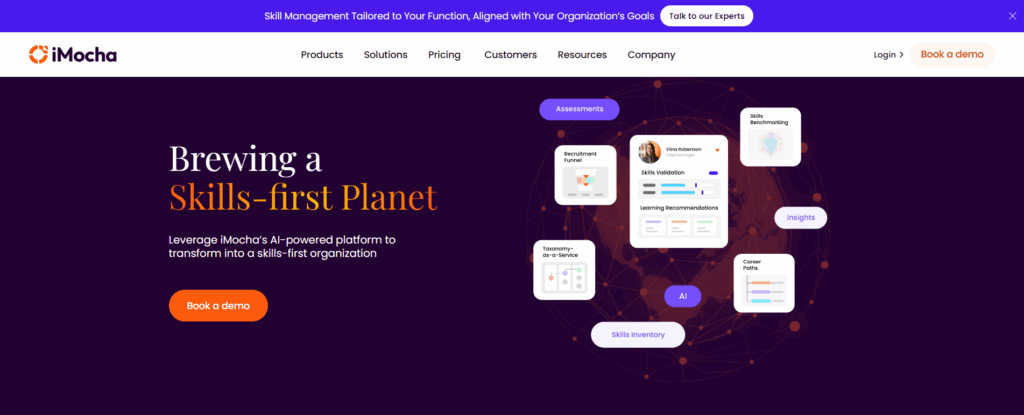
iMocha sells a skills-intelligence layer as much as an assessment tool: a large skills taxonomy that maps to roles, a test builder, and an AI interviewer it calls Tara. It suits companies that want the same platform for hiring and for internal upskilling, which Maki does not attempt.
Key features
- Large assessment library mapped to a skills taxonomy that covers specialist areas such as SAP, cybersecurity and financial services.
- Custom test builder with flexible scoring logic.
- AI interviewer for conversational, adaptive screening.
- Skill-level analytics by domain and question category.
Pros and cons
Pros: taxonomy depth for technical and IT roles; one platform for hiring and learning. Cons: quote-only pricing (the pricing page is a demo form); the upskilling features are overkill if you only need pre-hire screening.
Best for
Enterprises with a skills-based talent strategy that spans hiring and development, especially in IT services.
Pricing
Quote only as of 5 September 2026. The iMocha alternatives comparison lists the platforms that publish a price.
8. HireVue
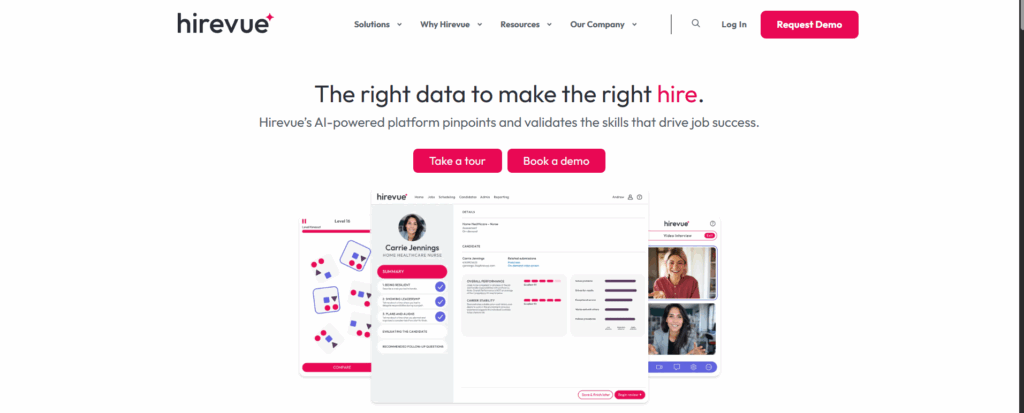
HireVue is the enterprise incumbent for structured video interviewing, and it is the alternative most often shortlisted against Maki's voice agent. It combines on-demand and live video interviews with game-based assessments and coding challenges, built on a library of validated, role-specific questions.
Key features
- On-demand and live video interviews with structured scoring rubrics.
- Game-based assessments that measure cognitive traits in an engaging format.
- Industrial-organisational science content library of validated interview questions.
- Scheduling and chatbot automation that hand off to the ATS.
Pros and cons
Pros: enterprise scale, mature compliance posture, deep ATS integrations. Cons: pricing is quote only (the page names Essential and Premium packages with no figures); interview-first design means skills testing is a secondary strength; sales cycles are long.
Best for
Global enterprises running tens of thousands of video interviews a year that need vendor-side compliance support.
Pricing
Quote only as of 5 September 2026. See the HireVue alternatives guide for options with a list price.
9. TestDome
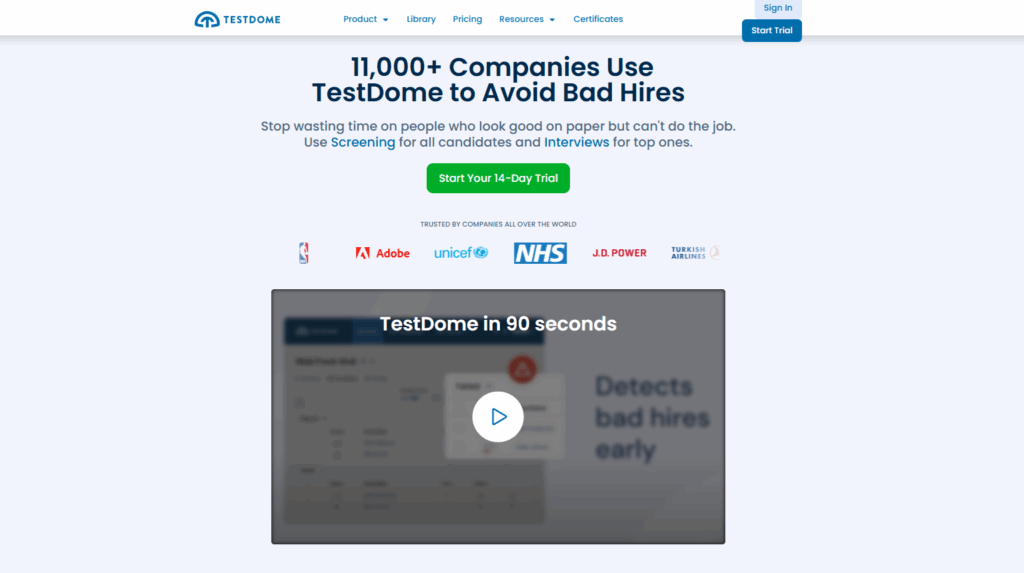
TestDome is the pay-as-you-go work-sample platform. There is no subscription at all: you buy candidate packs and every feature is included at every pack size. For a team that assesses 50 people a quarter, that model beats any annual licence.
Key features
- Work-sample tests across programming, IT, accounting, customer service and data entry.
- Custom question creation that can be mixed with library tests.
- Benchmarking with percentile rankings and pass or fail indicators.
- All features on every pack, with no tiering.
Pros and cons
Pros: the most transparent pricing in this comparison; cheap at low volume; realistic tasks. Cons: small library; no AI interviews; no live proctoring, so it is weak on the fraud problem Gartner describes.
Best for
Small and seasonal hiring teams that want realistic tasks without a contract.
Pricing
$20 a candidate in a 5-pack ($100), $16 in a 25-pack ($400), $10 in a 100-pack ($1,000), $8 in a 300-pack ($2,400) and $7 in a 600-pack ($4,200). Our TestDome alternatives comparison shows where the per-candidate model stops being cheapest.
10. Coderbyte
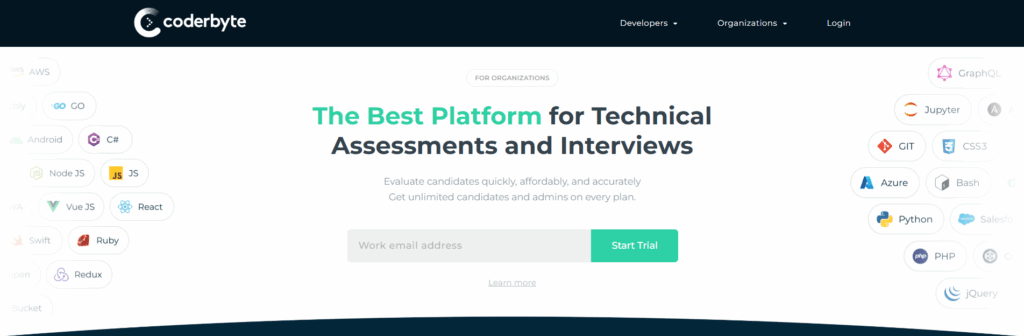
Coderbyte is the developer-screening tool for startups and mid-sized companies, and its Pro plan is the only "unlimited candidates" price on this list. It bundles screening, assessments and interviews with a full question library and automated grading.
Key features
- Screening, assessments and interviews in one product, with up to 50 simultaneous assessments on Pro.
- Full question library for developer and data roles, plus unlimited AI credits on Pro.
- Cheating detection with recorded video responses and automated grading.
- Add-ons for SSO and SCIM, analytics and personality testing.
Pros and cons
Pros: unlimited candidates and admins on Pro; a 14-day trial; a monthly plan for occasional hiring. Cons: developer and data roles only; add-ons (SSO, analytics, personality testing) cost extra; the monthly plan charges $20 per invite beyond 20.
Best for
Startups and scale-ups hiring developers continuously, where a flat annual fee beats per-candidate pricing.
Pricing
Pro is $1,799 a year with unlimited candidates. The monthly plan is $99 a month for 20 invites ($20 per extra invite). Pay-as-you-go is $500 for 50 invites, valid for a year. Enterprise starts at $12,495 a year.
11. The Talent Games
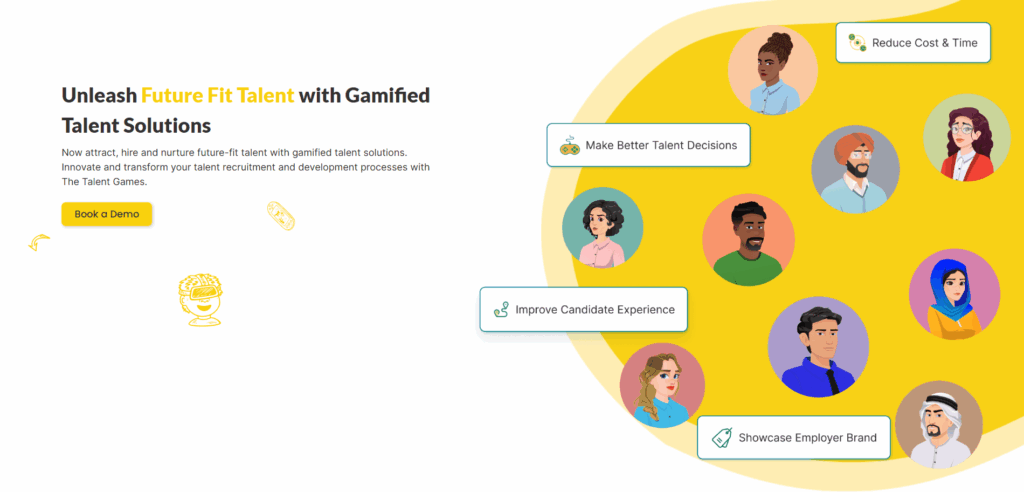
The Talent Games is a gamified assessment platform for graduate, campus and large-volume hiring. Candidates play short game-based scenarios that measure decision-making, teamwork and adaptability, and the vendor has added AI agents for interviewing and evaluation under its C-Factor AI banner.
Key features
- Game-based assessments for culture and future fit, situational judgment and aptitude.
- Job-specific role assessments and career-mapping tools.
- Solutions packaged for graduate, campus and volume hiring.
- AI interviewing agents for screening at scale.
Pros and cons
Pros: completion rates that early-career candidates respond to; strong employer-brand angle. Cons: quote-only pricing; game-based scores are harder to explain to a candidate or a regulator than a job knowledge test; limited technical testing.
Best for
Employers running graduate schemes and campus drives where candidate engagement is the constraint.
Pricing
Quote only as of 5 September 2026.
12. TalentMetrix
TalentMetrix is an India-based psychometrics provider. It sells predictive psychometric, DISC-style behavioural, motivators, soft-skills, emotional quotient, stress quotient and sales-skills instruments, plus consulting around engagement and high-potential development. It is a fit when the gap you are closing is personality and behaviour, not skills.
Key features
- Psychometric battery covering personality, cognition, emotional intelligence and job competencies.
- Diagnostic reports that pair scores with narrative interpretation.
- HR analytics and development programmes layered on the assessments.
Pros and cons
Pros: consultative delivery; instruments built for the Indian market. Cons: quote-only pricing; few hard-skills tests; no AI interviewing.
Best for
Indian employers adding a behavioural layer to hiring and promotion decisions.
Pricing
Quote only as of 5 September 2026.
13. TalentLens
TalentLens is Pearson's assessment division, best known for the Watson-Glaser critical thinking test. Its instruments are cognitive, personality, skill and motivation measures with decades of validation behind them, sold to employers and to the consultancies that run their selection processes.
Key features
- Watson-Glaser and related cognitive ability instruments.
- Personality and motivation assessments for selection and development.
- Development standards aligned to the British Psychological Society and the European Federation of Psychologists' Associations.
Pros and cons
Pros: the strongest validation pedigree on the list; widely accepted in law, finance and graduate schemes. Cons: quote-only pricing; it is an instrument catalogue, not a screening workflow, so you still need a platform to run invites, proctoring and ATS sync.
Best for
Employers that need a defensible cognitive instrument for a specific high-stakes role, often alongside a broader platform.
Pricing
Quote only as of 5 September 2026.
14. TestInvite
TestInvite is an online exam builder with strict proctoring, used for pre-employment screening, education and certification. Its strength is control: you design every question, scoring rule and timing window, and you enforce lockdown-browser and video monitoring on the candidate.
Key features
- Custom test builder with multiple choice, essay, coding and video-response questions.
- Proctoring with lockdown mode, AI cheating detection, randomised banks and audio or video monitoring.
- Configurable reports with custom metrics, benchmarks and textual interpretation.
- Credit-based pricing with bulk discounts down to $0.20 a credit at very high volume.
Pros and cons
Pros: published pricing; a free sign-up with 100 credits and no card; proctoring rigour. Cons: a small ready-made library, so you build most content yourself; Starter allows 1 teammate and 5 tests.
Best for
Organisations with in-house assessment content (certification bodies, training providers, regulated employers) that need secure delivery more than a library.
Pricing
Annual plans: Starter $900 (500 credits, 5 tests, 1 teammate), Essential $1,900, Advanced $2,900, Pro $3,900, Premium $6,000, Premium+ $35,000 (unlimited), Enterprise from $9,900 (pay as you go) or $40,000 (flat fee).
15. eSkill
eSkill is a long-established pre-employment testing platform with a library the vendor sizes at 600+ subjects and 70,000 questions, plus job simulations for customer-service calls, data entry and IT troubleshooting. It is the alternative for clerical, administrative and contact-centre hiring at scale.
Key features
- 600+ subjects spanning hard skills, soft skills, cognitive aptitude and behaviour.
- Job simulations that mirror real tasks rather than quiz questions.
- AI proctoring that flags copy-paste, window switching and irregular response patterns.
- Assessment experts who help configure and refine tests.
Pros and cons
Pros: breadth for administrative and call-centre roles; simulations; consultative support. Cons: quote-only pricing; no conversational AI interviews; the interface is dated next to newer entrants.
Best for
Staffing firms and employers hiring clerical, administrative and support staff in volume.
Pricing
Quote only as of 5 September 2026.
How much does a Maki People alternative cost?
Six of the 15 vendors publish enough to compute the cost of assessing 100 candidates, and the spread is wide. The table uses list prices read on 5 September 2026 and the cheapest tier that covers 100 candidates. Maki itself publishes nothing, so it cannot appear here.
Vendor and tier | Cost for 100 assessed candidates | What is included |
|---|---|---|
TestDome (100-pack) | $1,000 | All features, no subscription, no AI interviews |
Coderbyte (pay-as-you-go, 2 x 50 invites) | $1,000 | Developer screening only; Pro at $1,799 removes the cap |
Adaface (Pro, 100 credits) | $900 plus 5 credits per test set-up | Chat-style tests; no voice or video interviews |
Codility (Starter, 120 invites) | $1,200 | Engineering tasks only, 1 user |
Testlify (Standard, 100 credits) | $1,668 | 3,500+ tests, AI interviews, 3 seats, proctoring; ATS sync is an add-on |
TestGorilla (Core) | $1,704 | 350+ tests, 2 seats; candidate allowance not published; AI interviews start at Plus |
The honest reading is that TestDome, Adaface and Coderbyte are cheaper than Testlify Standard at 100 candidates. What the extra spend buys is the second signal: a conversational AI interview and a library wide enough that you are not writing questions yourself. For a team replacing Maki, which was chosen for the interview agent, that second signal is usually the point. For a team that only ever needed a coding screen or a 20-minute work sample, it is not, and the cheaper tool is the right call.
Which Maki People alternative should you choose?
Choose by the job you were hiring Maki to do, not by the longest feature list. Across the teams we work with, the switch goes wrong when a buyer replaces an AI interviewer with a test library and then wonders why recruiters miss the conversation, or the reverse.
- You want the AI interview and a real library, with a price you can see. Testlify. It is the only tool here that lists a price and covers chat, voice and video interviews plus 3,500+ tests.
- You want to start free. TestGorilla, then budget for Plus if you need AI interviews or an ATS sync.
- You assess fewer than 50 people a quarter. TestDome or Adaface. Pay per candidate and skip the licence.
- You hire engineers. Codility for enterprise scale, Coderbyte for a flat fee.
- You need exam-grade proctoring or psychometrics. Mercer Mettl, TalentLens or TestInvite, depending on whether you want instruments, invigilation or a builder.
- You run graduate or campus drives. The Talent Games.
- You hire clerical and contact-centre staff in volume. eSkill.
- You should probably stay with Maki. If your hiring is multi-country, high-volume and interview-led, and the 45+ language voice agent is the thing your recruiters use every day, no alternative on this list matches that specific strength. Negotiate the price instead of the product.
One more filter, whichever way you go. The EEOC's guidance says the employer is still responsible for ensuring its tests are valid under the Uniform Guidelines, whoever built them. So the vendor's own validity study is not your defence. Ask how you will run an adverse-impact check on your own applicants, and pick the platform that makes that report easy.
Hire on evidence with Testlify
If Maki's price is the blocker and its interview agent is the feature you would miss, start with Testlify's 7-day free trial and run the same role through a conversational AI interview and a role-specific test side by side. Then book a demo to price the Custom plan against your real annual volume, with ATS integration included. For a head-to-head on features, read the Testlify versus Maki People comparison, and for the wider market, the best talent assessment tools roundup.
Key takeaways
- Maki People is an AI-agent platform with no public price. That makes it hard to budget and hard to compare, which is why buyers look for a Maki People alternative before they have a complaint about the product. The implication: shortlist on published pricing first, then on features.
- Only six of 15 alternatives let you compute a 100-candidate cost. TestDome, Adaface and Coderbyte are cheapest at that volume; Testlify Standard ($1,668) and TestGorilla Core ($1,704) cost more but add the AI interview signal and a bigger library. Pay for the second signal only if you will use it.
- An AI conversation is one signal, not a decision. Structured interviews (.42), job knowledge tests (.40) and work samples (.33) each beat cognitive ability alone (.31) in the 2022 Sackett revision. The Testlify Multi-Signal Talent Evaluation Model says advance candidates when several signals agree, so favour platforms that collect more than one.
- Fraud and trust are now platform requirements. With 6% of candidates admitting interview fraud and only 26% trusting AI to score them fairly, identity verification, proctoring and explainable scores belong in the core product, not the add-on list.
- Compliance follows the AI. NYC Local Law 144, the EU AI Act's Annex III and the Uniform Guidelines' four-fifths rule all apply to AI-scored screening, and the EEOC says the employer is still responsible for validating a test regardless of who built it. Choose the platform whose reports make an adverse-impact check routine.
- Candidates land on this page too. A Maki assessment is a set of short timed tests, an AI screening conversation, or both, configured by the employer. Maki is the software, not a third-party interviewer, and the "assessments team" emailing you is the employer's hiring team.
FAQs

Director of Marketing
Akash Patange is the Director of Marketing at Testlify, where he works closely with HR leaders and recruiters to help organizations improve hiring outcomes. He writes about talent assessment, recruitment technology, and data-driven hiring practices.
LinkedInRelated resources
View all
Alternatives
Top 15 TestGenius Alternatives and Competitors
Alternatives
Top 15 Thrive Alternatives and Competitors
Alternatives
Top 15 Total Testing Alternatives and Competitors
Alternatives
Top 15 ThriveMap Alternatives and Competitors
Alternatives
Top 15 UbiAptitude Alternatives and Competitors
Alternatives
Top 15 Zapilio Alternatives and Competitors
Get started.
Hire on proof, not resumes.
Run your first skills-based assessment free — no credit card required.