
Recruitment process management: a step-by-step guide
How to run recruitment as one managed process: the 8 stages, who owns each step, the metrics to watch and the mistakes that slow hiring.

Recruitment process management is the planning, running, and improving of every step between an approved opening and a new hire's first weeks: workforce planning, job analysis, sourcing, screening, interviews, the offer, and onboarding. Each step gets an owner, a deadline, and a measure, so hiring runs the same way every time instead of depending on who happens to be recruiting.
It matters because hiring is still hard. In SHRM's 2026 Talent Trends research, 68% of HR professionals said they struggle to recruit full-time employees, and 53% of them said it got harder than a year before.
 ChatGPT
 Gemini
 Claude
 Grok
 Perplexity
TL;DR
- Recruitment process management means running hiring as one repeatable process with a named owner, an output, and a deadline for every stage, from workforce plan to onboarding.
- Most teams use 8 stages: plan, define the role, source, screen, interview, decide, offer, and onboard.
- Delays happen at handoffs between recruiters, hiring managers, and interviewers, so agree on service levels (for example, feedback within 48 hours) before the role opens.
- Track a few numbers: SHRM puts the median time-to-fill for nonexecutive roles at 39 days, and CareerPlug found about 3% of applicants reach an interview.
- Screen on skills early. With around 180 applicants per hire, resume reading alone wastes recruiter time and misses good people.
- Build fairness in one scorecard per role, structured interviews, and a bias audit, plus candidate notice if you use automated tools in New York City.

What is recruitment process management?
Recruitment process management is the work of designing, running, and improving the hiring process as a whole, rather than handling each vacancy from scratch. It covers who does each step, what each step must produce, how long it should take, which tools support it, and how the team checks whether the process is working.
Three terms get mixed up:
- Recruitment process: The sequence of steps a candidate moves through, from job ad to offer.
- Recruitment process management: Owning that sequence: setting standards, deadlines, and measures, and fixing the steps that leak time or candidates.
- Staffing process: A wider term that starts with workforce planning and continues past the hire into integration, growth, and retention. A managed recruitment process is the core of good staffing.
A managed process does not mean a rigid one. Business needs change, so roles, channels, and interview plans should change with them. What stays fixed is the structure: every role gets an intake, a scorecard, a defined interview plan, and a decision rule.
Why does recruitment process management matter?
Recruitment process management matters because every hire shapes how a team performs, and a loose process costs time, money, and candidates. The wrong hire leads to early turnover, lost output, and a second round of recruiting and training. A slow or silent process loses the best candidates to faster employers.

Candidates notice when nobody owns the process. A 2026 candidate experience report covered by Fortune found that 53% of job seekers were ghosted by an employer in the past year, up from 48% in 2025 and 38% in 2024. Each silent rejection is a candidate who may not apply again or recommend you.
Retention is the other side. SHRM's 2026 Talent Trends report found 42% of HR professionals had trouble keeping full-time employees. A process that tests for the skills the job really needs and sets honest expectations cuts the mis-hires that drive that number.
What are the stages of the recruitment process?
The stages of the recruitment process are planning, role definition, sourcing, screening, interviewing, selection, offer, and onboarding. Some guides merge stages to get 5 or 7; the work is the same. What changes results is giving each stage an owner, a clear output, and a target time.
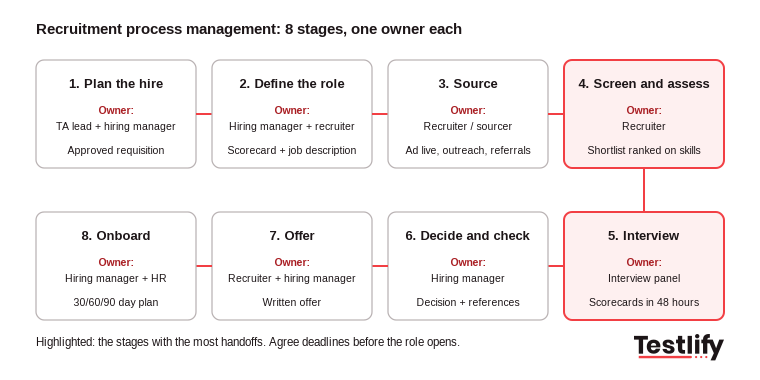
Stage | Owner | Output | Target time |
|---|---|---|---|
1. Plan the hire | TA lead + hiring manager | Approved requisition, budget, start date | Before the role opens |
2. Define the role | Hiring manager + recruiter | Job analysis, scorecard, job description | 2 to 3 days |
3. Source candidates | Recruiter / sourcer | Ad live, outreach list, referrals asked | Week 1 |
4. Screen and assess | Recruiter | Shortlist ranked on skills | Within 5 days of applying |
5. Interview | Interview panel | Scorecards for every interview | Feedback within 48 hours |
6. Decide and check | Hiring manager | Hire decision, references, background check | 2 to 3 days |
7. Offer | Recruiter + hiring manager | Written offer, accepted or declined | Offer within 24 hours of decision |
8. Onboard | Hiring manager + HR | 30, 60 and 90 day plan | First 90 days |
The target times are starting points, not industry rules. Set your own from your data, then hold every role to them.
How do you manage each stage of the recruitment process?
Managing each stage means agreeing what "done" looks like before work starts, then checking it at every handoff. Here is what good looks like in each of the 8 stages.
1. Plan the hire and set staffing objectives
Start with the need, not the job ad. Confirm why the role exists, what it must deliver in its first year, the budget, and the start date. Decide whether you need someone who can deliver from week one or someone with potential you will develop. Bring department heads in early, because the people closest to the work know which gaps hurt most. A recruitment plan keeps these answers in one place.
2. Define the role with a job analysis
A job analysis breaks the position into tasks, the skills each task needs, and the level of each skill. Ask people who do the job today and the managers they work with. Then define the role's context: who it works with, what it owns, and how success is measured.
Turn this into two documents. The scorecard lists 4 to 6 skills and how you will test each one. The job description explains the role, the responsibilities, the must-have skills, and why someone would want the job. Our job description templates give you a starting point for hundreds of roles.
3. Source and attract candidates
Pick channels by who you want to reach. Job boards bring volume, but CareerPlug's 2025 Recruiting Metrics Report found job boards produce about 60% of applications without producing hires at the same rate as other sources. Career pages, employee referrals, and direct outreach usually bring fewer but better-matched applicants.
Your employer brand does the work before a recruiter ever calls. Show what the job is really like, what people learn, and how the team works. See these talent sourcing strategies for channel ideas.
4. Screen and assess on skills
Screening is where most time is lost. CareerPlug counted about 180 applicants per hire in 2024, so reading every resume by hand is slow and inconsistent. Use knock-out questions for hard requirements, then a short skills test so candidates show what they can do, not only what they claim.
Skills assessments measure job skills, problem-solving, cognitive ability, and work style. Testlify's AI resume screener adds an explainable match score and high, medium, or low fit labels, so recruiters review the strongest profiles first. Keep a short phone or video screen for motivation, pay expectations, and notice period.
Pro tip: Put the skills test before the first interview, not after. Interviews are the most expensive hours in the process, so spend them only on candidates who already showed the skills.
5. Run structured interviews
Use the same questions, in the same order, and score against the same scorecard for every candidate. Structured interviews use scenario and behavioral questions tied to the job, such as "Tell me about a time you had to fix a process that kept failing." Give each interviewer a different set of skills to cover, so the panel does not ask the same thing four times.
Assess values fit with care. Look for people who share the values that matter for the work, such as ownership or care for customers, and who add something new to the team. "Would I have a beer with them" is not a hiring criterion. An interview scorecard keeps every rating tied to evidence.
6. Decide, then check references and background
Hold a short debrief within 48 hours of the last interview. Each interviewer shares their scores before discussion, so the loudest voice does not set the result. Combine the skills test, interview scores, and work samples, and involve the people who will work most closely with the new hire.

Then verify. Reference checks with former managers give insight into work habits, reliability, and performance. Background checks confirm that claims about education, employment, and licenses are accurate. Follow local law on what you may check and when.
7. Extend the offer
Move fast once you decide. Call the candidate first, then send a written offer with salary, benefits, start date, and any conditions. Be ready for questions and set a clear reply date. A slow or vague offer is where many processes lose their first choice.
8. Onboard and integrate the new hire
Recruitment ends when the new hire is productive, not when they sign. Prepare equipment and access before day one, assign a buddy or mentor, and agree on a 30, 60, and 90-day plan. Mix formal training with real work early, and check in often during the first weeks. Our employee onboarding guide has a full checklist.
Who owns each step in recruitment process management?
Recruitment process management works when each person knows their part and their deadline. Most delays happen at handoffs, not inside a stage, so write the handoffs down.
- TA lead or Head of Recruitment: Owns the process itself: standards, tools, service levels, reporting, and fixing bottlenecks.
- Recruiter: Runs each role day to day: intake, sourcing, screening, scheduling, candidate updates, and the offer.
- Hiring manager: Owns the role definition, joins the intake meeting, reviews the shortlist within agreed time, and makes the final decision.
- Interviewers: Prepare, ask the agreed questions, and submit scorecards within 48 hours.
- Recruiting coordinator or recruitment ops: Manages scheduling, ATS hygiene, reports, and tool settings.
- HR and the new hire's team: Own onboarding and the first 90 days.
Agree these as service levels at the intake meeting for every role. For example: the hiring manager reviews the shortlist within 2 working days, interviewers submit feedback within 48 hours, and every candidate gets an update at least once a week.
Which metrics show your recruitment process is working?
Recruitment metrics show whether the process is fast, efficient and producing good hires. Track a short list every week and review trends every quarter.
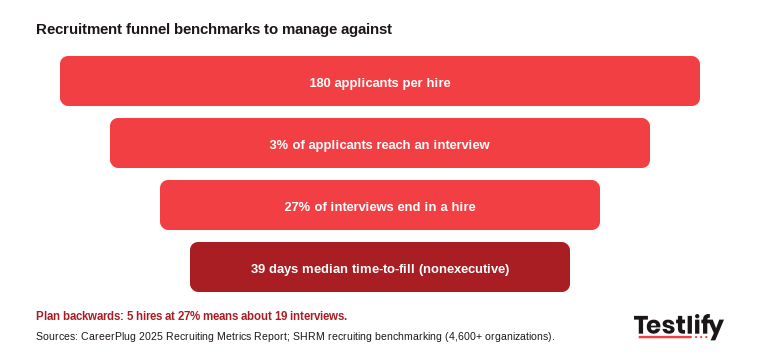
- Time-to-fill: Days from approved requisition to accepted offer. SHRM's recruiting benchmarking data from more than 4,600 organizations puts the median at 39 calendar days for nonexecutive roles.
- Time in stage: Days candidates wait at each stage. This shows where the process stalls.
- Applicants per hire: CareerPlug's 2024 average was 180.
- Stage conversion rates: CareerPlug found 3% of applicants reached an interview and 27% of interviews led to a hire.
- Offer acceptance rate: Share of offers accepted. A falling rate points to pay, speed or candidate experience problems.
- Quality of hire: Performance and retention of new hires after 6 to 12 months.
- Candidate experience: Short surveys after the interview stage, and the share of candidates who got a final answer.
Conversion rates also help you plan. If 27% of your interviews end in a hire and you need 5 hires, plan for about 19 interviews. At a 3% applicant-to-interview rate, that means roughly 630 applicants, or a better-targeted channel mix.
Key takeaway: Quality of hire is the metric that matters most and the one teams measure least. LinkedIn's Future of Recruiting 2025 found 89% of talent pros expect measuring it to become more important, but only 25% feel highly confident they can. Start simple: hiring manager rating at 90 days plus 12-month retention.
What tools support recruitment process management?
Recruitment process management tools cover tracking, assessment, interviewing, scheduling and reporting. Most teams build a stack around one applicant tracking system rather than buying one tool for everything.
Tool | What it does in the process | Stage |
|---|---|---|
Applicant tracking system (ATS) | Stores candidates, moves them through stages, keeps records | All |
Skills assessment platform | Tests job skills before interviews and ranks candidates | Screen |
Resume screening | Matches resumes to the job and flags fit | Screen |
Video and AI interviews | One-way or AI-led first rounds, no scheduling | Screen, interview |
Scheduling tool | Books panels and sends reminders | Interview |
Reporting and analytics | Time in stage, conversion, source quality | All |
A system that ties these together is often called a recruitment process management system. Two things decide whether it helps: whether the pieces sync with each other, and whether people use them the same way.
AI now sits in several of these steps. LinkedIn's Future of Recruiting 2025 found talent pros using generative AI save about 20% of their work week, and many put that time into screening and skills assessment. Testlify connects with 100+ ATS and HRIS platforms through two-way sync, so assessment scores land in the ATS your team already uses. See Testlify integrations.
How do you keep the recruitment process fair and compliant?
A fair recruitment process judges every candidate on the same job-related criteria and keeps a record of how each decision was made. Fairness also protects the business: consistent, documented decisions are easier to defend.
- Same criteria for everyone: One scorecard per role, built from the job analysis, used at every stage.
- Structured interviews: The same core questions for every candidate, scored independently before the debrief.
- Skills over proxies: Test the skill instead of relying on school, previous employer or years of experience.
- Accessible process: Offer reasonable adjustments for tests and interviews, and say how to request them.
- Automated tools: In New York City, Local Law 144 lets employers use an automated employment decision tool only if it had a bias audit within the past year, a summary of the results is public, and candidates get notice 10 business days before use. Testlify publishes its NYC bias audit.
- Records: Keep applications, scorecards and decision notes. In the US, EEOC rules require employers to keep personnel and employment records for at least one year, and longer if a charge is filed.
- Integrity checks: Remote tests need cheating controls. Testlify includes 20+ proctoring checks, such as tab tracking and AI assistance detection; see anti-cheating and proctoring.
What are common recruitment process mistakes?
Common recruitment process mistakes are vague role definitions, too many interview rounds, slow feedback and no candidate updates. Each one has a simple fix.
Mistake | What happens | Fix |
|---|---|---|
No intake meeting | Recruiter sources for the wrong profile | 30-minute intake with a scorecard before the ad goes live |
Resume-only screening | Good candidates without the "right" background are missed | Short skills test before the first interview |
Too many rounds | Top candidates accept other offers | Cap at 3 or 4 steps, each testing different skills |
Unstructured interviews | Scores reflect the interviewer, not the candidate | Shared questions and scorecards |
Slow feedback | Days lost waiting for one interviewer | 48-hour feedback rule, tracked in the ATS |
Silent rejections | Candidates feel ghosted and stop applying | Automated updates at every stage |
No review | The same problems repeat on every role | Quarterly process review with data |
For a step-by-step list you can work through on each role, use our hiring process checklist.
How do you improve the recruitment process over time?
Improving the recruitment process means reviewing data and feedback on a fixed schedule, then changing one thing at a time. Recruitment is a cycle, not a one-off project.
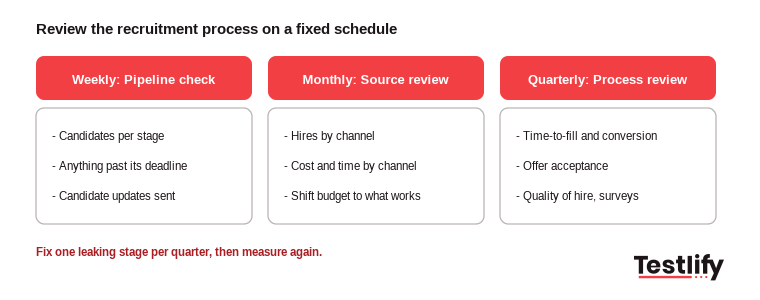
- Weekly pipeline check: Open roles, candidates per stage, anything waiting longer than its service level.
- Monthly source review: Which channels brought hires, not only applicants. Move budget toward them.
- Quarterly process review: Time-to-fill, conversion, offer acceptance, candidate survey results and quality of hire. Pick the one stage that leaks most and fix it.
- Feedback from people: Ask new hires, hiring managers and interviewers what slowed them down. New hires remember the candidate experience clearly in their first month.
Use the ATS and analytics to make this quick. If a review takes a day of spreadsheet work, it will not happen every quarter. For a view on how long the hiring process should take, compare your stage times against role type and seniority before you set new targets.
How can Testlify help you manage the recruitment process?
Testlify helps hiring teams screen and rank candidates on real skills before interviews. Choose from 3,500+ tests, or build a custom assessment from a job description, add AI interviews, and get scored, ranked results in your ATS. Tests run in 15+ languages, with 20+ proctoring checks included.
Browse the Testlify test library to find tests for your open roles, start a 7-day free trial with no credit card, or book a demo to see how it fits your process.
Frequently asked questions (FAQs)

Content Writer
Yashika Khandelwal is a Content Writer with 3+ years of experience creating research-backed content on hiring, talent assessment, and HR technology. She is a registered Organizational Psychologist and subject matter expert who combines behavioral science with practical recruitment insights to produce accurate, evidence-based content.
LinkedInRelated resources
View all
HR & recruitment
How to use social media for recruiting

HR & recruitment
How to Conduct an Effective Job Interview (Structured Guide for 2026)

HR & recruitment
Top 4 talent assessment tools available in German

HR & recruitment
Top 4 talent assessment tools available in French

HR & recruitment
Top 4 talent assessment tools available in Dutch

HR & recruitment
Top 8 Employee Recognition tools
Get started.
Hire on proof, not resumes.
Run your first skills-based assessment free — no credit card required.