
What is skills-based hiring? Importance & how to get started
Skills-based hiring focuses on candidates’ abilities over credentials, improving efficiency, reducing bias, and aligning talent with organizational needs.

Skills-based hiring is on the rise, and all for the right reasons. A global talent shortage is anticipated to hit the economy by 2030, leading to an $8.5 trillion loss in unrealized annual revenue. This is due to a significant gap in employees’ skills and the skills companies need.
Even universities are taking note. Northeastern University has already moved toward skills-based education, offering micro-credentials and digital badges for specific hard and soft skills instead of relying solely on traditional degrees.
With businesses struggling to find talent, skill-based hiring is the future. Let’s learn everything about it.
 ChatGPT
 Gemini
 Claude
 Grok
Grok Perplexity
What is skills-based hiring?
Skills-based hiring is a recruitment strategy by which candidates are hired based on their skillsets instead of their work experience. This talent acquisition method determines if a candidate fits the position by heavily relying on their competencies and knowledge.
Historically, for many employers, adding degree requirements was an appropriate indicator when choosing the best candidates.
If someone had a degree in computer science, people assumed they would be good at logical reasoning, aptitude, etc. Degrees and work experience were perceived as indicators of foundational skills and capabilities.
But this is not the case anymore.
Skills-based hiring turns the focus from what candidates did (their previous job designations and educational backgrounds) to what they can do.
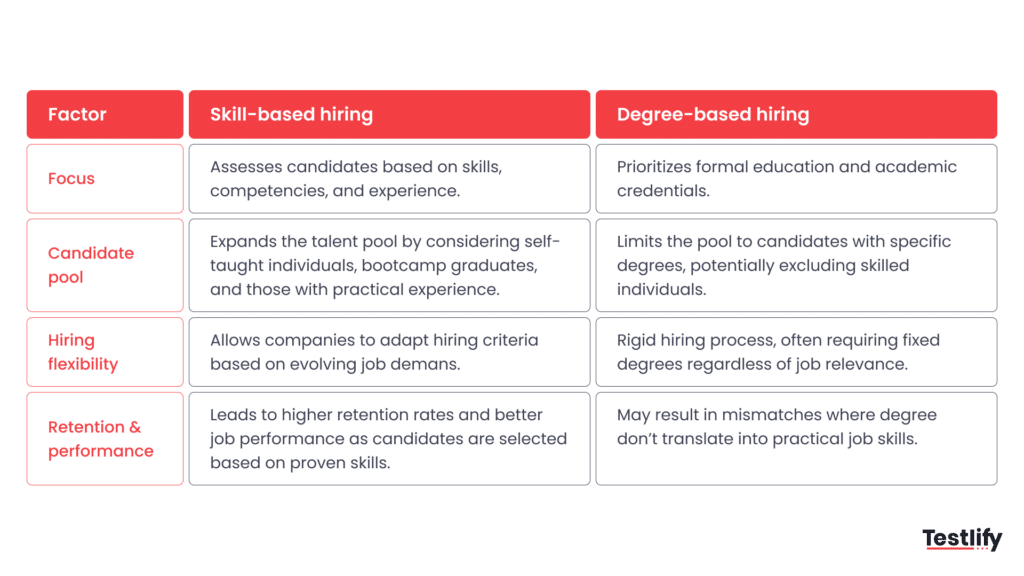

Why skills-based hiring is replacing traditional hiring?
Skills-based hiring is on the rise to replacing traditional hiring, mainly due to this practice of blind faith in experience cultivating mediocre employees.
This shift in blindly trusting candidates’ experience over skills is no longer tolerable. By 2025, the World Economic Forum states that 50% of employees need reskilling. Gartner HR Research also estimates that 58% of the workforce must learn new skills to do their jobs efficiently.
This realization is not just breaking conventional hiring practices but also compels employees. 52% of employees admitted they need reskills to succeed in their careers.
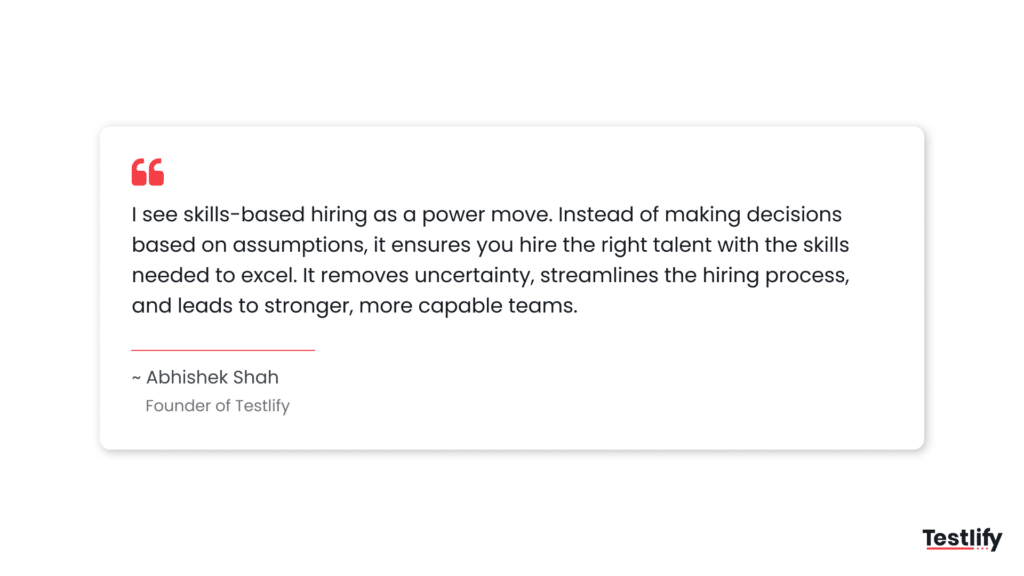
This shift from experience to actual skills eliminates many inefficiencies that have hindered success in experience-based hiring.
Also, a college degree is no longer a decisive factor in hiring. This is mainly because of the skills gap between what the curriculum teaches and what the current industry needs.
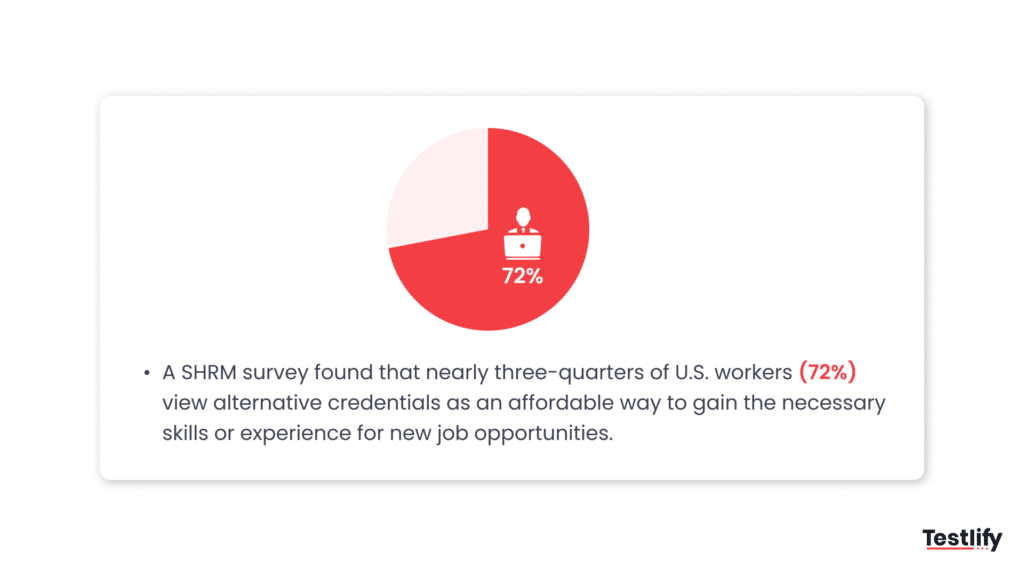
55% of employees surveyed by the Freedom Economy Index (FEI) said that higher education is not graduating students with relevant skills.
Even if they do, only 38% of the U.S. population aged 25 and older possess a bachelor’s or higher degree, as per the U.S. Census Bureau.
This is not just a US problem. It’s a global challenge affecting countries like Germany, India, Belgium, Europe, etc.
A report by the Charles Koch Foundation reveals that 87% of executives, 81% of supervisors, and 90% of HR professionals acknowledge the value employees with alternative credentials bring to the workplace. This highlights the increasing recognition of skills gained through non-traditional education.
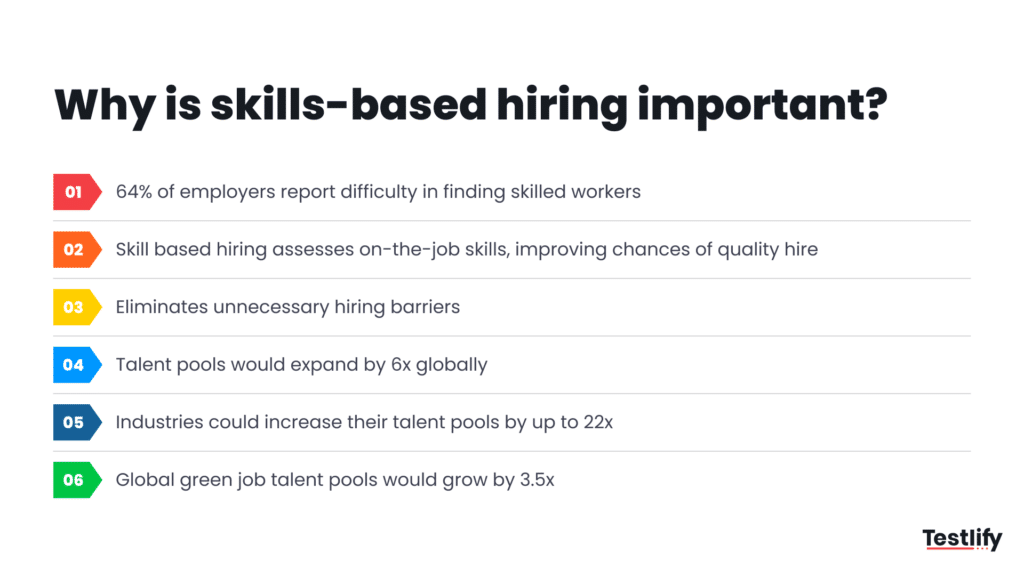
Benefits of skills-based hiring
There are several advantages to adopting skills assessment, one of which is increasing predictive validity.
It’s a psychological reasoning that measures the ability to predict real-world performance. This allows companies to assess how well a candidate will fit into the role after selection, reducing the chances of bad hires.
By measuring real skills of candidates, companies can make better decisions as they don’t have to rely on predictive factors. For example, HR professionals assume that candidates who perform well in interviews will eventually be the best employees. But often, this is not the case.
94% of employers witnessed a reduced time-to-hire after implementing skills-based recruitment.
Expand talent pools by 6x
LinkedIn research shows that employers significantly increase the number of eligible candidates for a typical job when they prioritise skills over traditional job titles or degrees.
- On average, talent pools grow 6.1 times when hiring is based on skills.
- The United States sees the biggest increase, with a 15.9x expansion in eligible candidates.
- Brazil follows with a 12.9x increase, while Mexico (10.4x) and the UK (8.4x) also experience significant growth.
- Smaller increases are seen in Slovenia (1.1x) and Croatia (1.7x), while countries like Ireland, Singapore, and Switzerland see 4.3x to 4.4x increases.
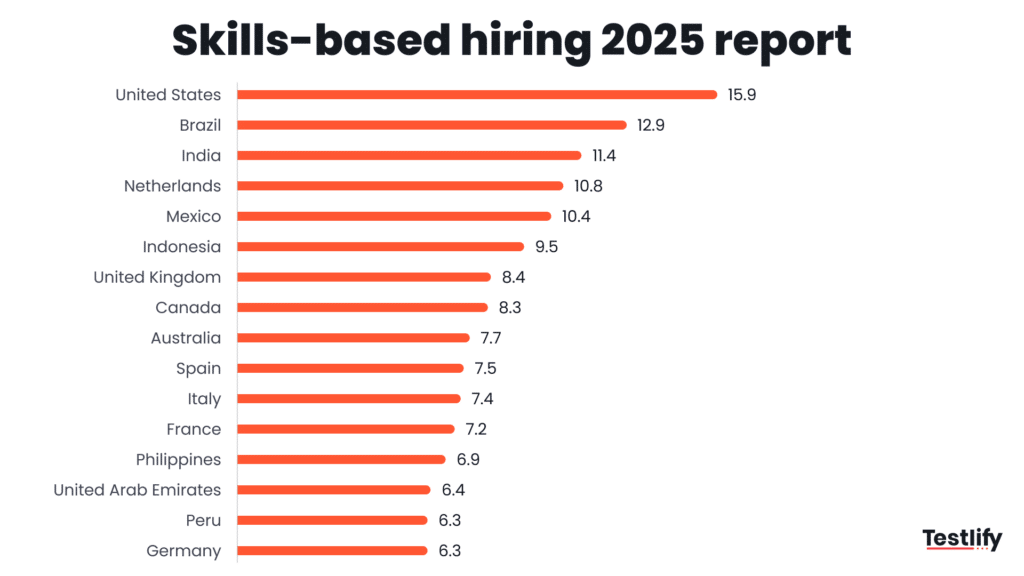
The trend suggests that skills-based hiring can dramatically broaden talent pools in countries where many workers share transferable skills, making recruitment more inclusive and efficient.
Industries can improve their talent pool by 22x
This means that skills-based hiring can dramatically expand the number of eligible candidates in various industries up to 22 times in some cases by focusing on skills rather than job titles.
Industries where skills overlap across different roles, see the biggest increases in available talent.
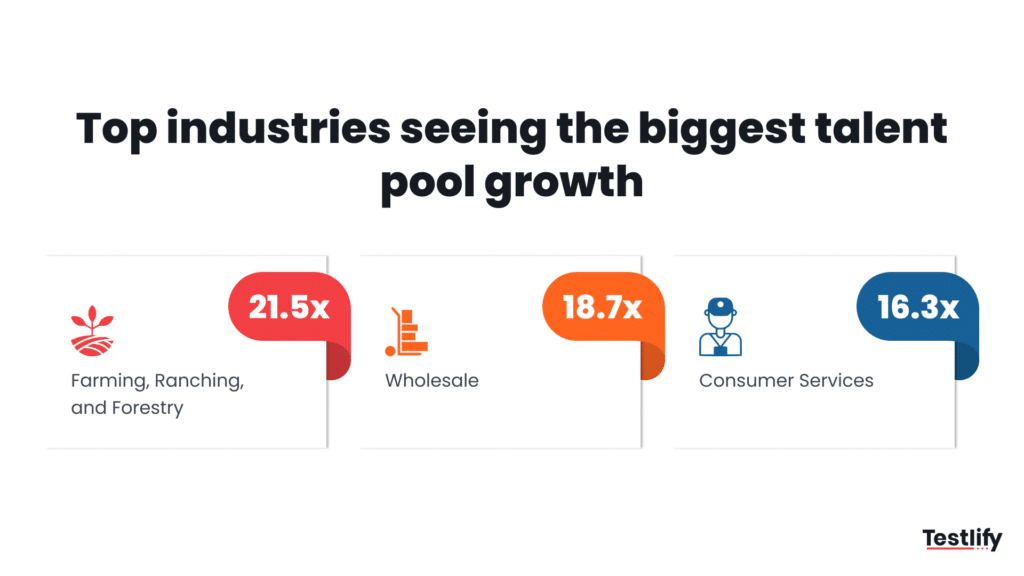
In India, the Real Estate and Equipment Rental Services industry could expand its talent pool by 86.4x. In the U.S., Accommodation and Food Services could see a 34.9x increase in candidates.
In France, the Construction sector could experience a 23.4x expansion.
This shows that traditional hiring methods often overlook skilled candidates simply because they don’t have the “right” job title. A skills-based approach helps companies find more qualified talent while making hiring more efficient and inclusive.
Low cost per hire
The average cost per hire based on the SHRM study is around $4700. This number is only climbing up. The cost per hire increases primarily when recruiters spend excessive time on job postings, lengthy interview processes, and talent sourcing.
Skills-based hiring reduces unnecessary processes and teams’ workloads with data-driven candidate scores, real-time analytics, AI overviews, and better collaboration between recruiters and candidates.
Higher quality hires
Companies are shifting away from traditional degree requirements and focusing more on skills. This means candidates who make it through the hiring process already have the right expertise.
91% of companies using skills assessment improved retention, and 81% reduced total time-to-hire.
These candidates ramp up faster in their roles and are 2.5 times more likely to become top performers: a win for both productivity and business growth.
Lower risk of a bad hire
Hiring decisions based on gut feeling or resumes alone can be risky.
Pre-employment assessments introduce data into the process, allowing recruiters to compare candidates based on their actual skills rather than just job titles, degrees, or backgrounds.
With objective insights, businesses can reduce hiring biases and make more confident decisions.
Related: How Testlify supports diversity and inclusion through bias free hiring?
Better candidate experience
How you treat candidates throughout the hiring process directly impacts your ability to attract and retain top talent.
Slow, repetitive hiring practices like asking for the same information multiple times, delayed feedback, and poor interview scheduling can push great candidates away. Nearly half (46%) of candidates will move on if they don’t hear back within 1-2 weeks after an interview.
Skills-based hiring speeds things up by cutting out unnecessary steps and replacing them with a more engaging, interactive experience. 68% of employees prefer a hiring process that includes skills assessments.
Better employee retention
Employees hired based on their skills tend to stick around longer. On average, they stay 9% longer than those hired through traditional methods. Instead of feeling misplaced or underutilized, these employees are in roles where they can fully apply their strengths and grow.
McKinsey’s study found that hiring based on skills was 5x more predictive of job performance than hiring based on education and more than 2x better than hiring based on work experience.
More diverse and inclusive teams
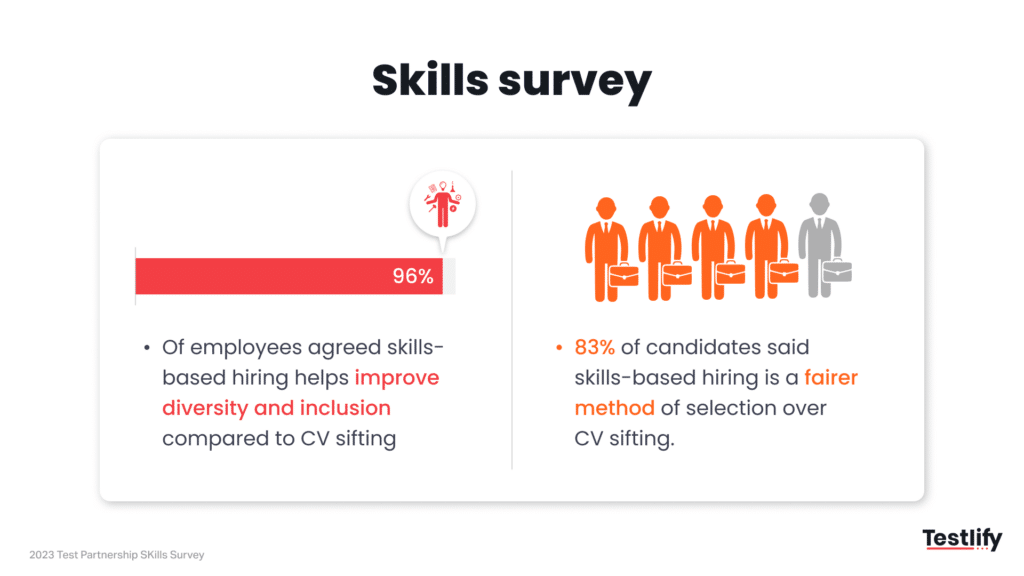
By removing unnecessary barriers like degree requirements, businesses can tap into a wider and more diverse talent pool. According to LinkedIn, skills-based hiring can increase the proportion of Gen Z candidates by 10x and Millennials by 9x.
Skills-based hiring increases women’s representation in underrepresented roles by 24% compared to traditional recruitment practices.
When hiring focuses on ability rather than pedigree, more opportunities open up for underrepresented groups.
How to implement skills based hiring (Best practices)
Testlify helps companies reduce cost per hire and time to hire by up to 4x. Hiring takes 44 days on average, but companies have streamlined their process to just 7 days with our pre-vetted skills assessment tool.
If you want to make hiring faster and more efficient, here’s how to integrate skills assessments into your recruitment process.
Identify where to fit skills assessments in the hiring process
Pre-employment assessments based on skills can be used anywhere in the hiring process. It can be a quality filter before conducting interviews, right after interviews, or even as the final step.
Using assessments as quality filters and evaluating core competencies and job-related skills is ideal. This helps eliminate candidates who mass apply and prioritize those with proven skills. On average, a job posting receives around 250 applications; separating the clunk is important.
You can send bulk invites to all candidates and assess their results in real time. Testlify offers an AI overview feature, which gives a snapshot of candidates’ performance.
We recommend using skills tests after the first screening with a recruiter. This keeps the process personal and helps assess a candidate’s fit through a small task or soft skills test.
What does it look like for employers?
Always go for a skills assessment platform that offers a wide range of choices, like mixed question types and options to assess MS or other media-based skills.
Testlify offers diverse question types, including multiple-choice, text-based, and ranking options. Hands-on assessments like coding, typing, AI chat simulations, and practical tasks ensure real-world evaluation.
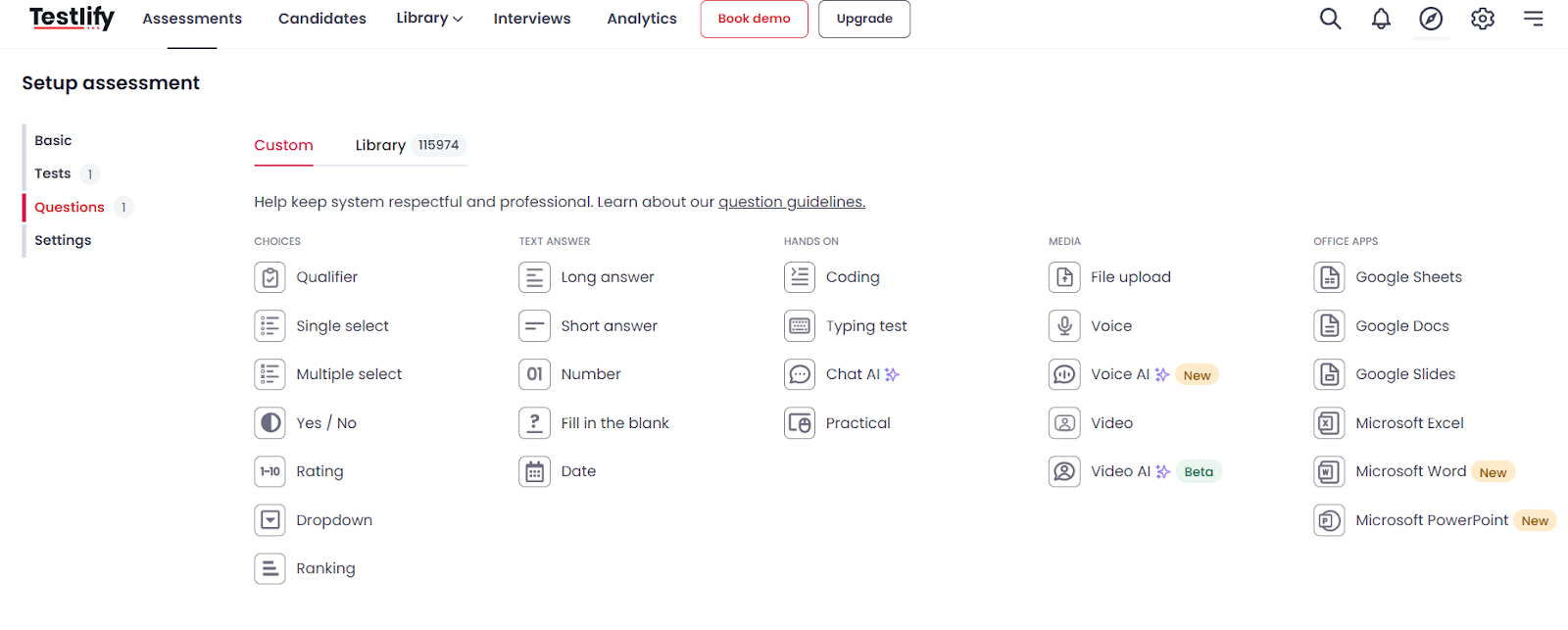
Media-based options such as voice, video, and file uploads enhance engagement. Integration with Google and Microsoft Office tools makes assessments more job-specific and interactive.
Additionally, Testlify offers voice and video AI features to provide exceptional candidate experience.
Break conventional hiring parameters
Historically, employers have been wired to look for employment histories or educational background as a prerequisite for choosing a candidate. Skills-based hiring challenges this concept.
Instead of thinking, “Should we hire a Harvard candidate?” think, “Who would fit this role perfectly and be culturally competent?”
Always rethink what makes an ideal hire for your team. Focus on a core list of must-have skills while keeping a flexible list of nice-to-haves to assess shortlisted candidates rather than ruling out potential applicants.
Identify the right skills before hiring
Skills-based hiring helps compare candidates objectively, but it’s only effective if you know what skills you actually need. Start by analyzing the job tasks and defining key competencies, then design an assessment to measure them.
There are majorly three types of skills:
Soft skills: Soft skills, also called power skills, focus on a person’s interpersonal and personal behavior. These include communication, emotional intelligence, resilience, creativity, time management, etc. These majorly affect employee engagement, retention, and job satisfaction. These are the skills people are born with and can be developed over time. Hard skills: Hard skills, also known as technical skills, refer to the specific knowledge and competencies that enable a person to perform a job effectively. These require formal learning and hands-on experience. Cognitive skills: Cognitive skills are the core mental abilities that help individuals process information, learn, and solve problems. They include critical thinking, memory, attention, reasoning, problem-solving, and decision-making. These skills are what separates a great candidate from a mediocre one.
Identify which skills you want to test. We recommend combining all these skills to evaluate candidates better.
Choose the right assessment to measure
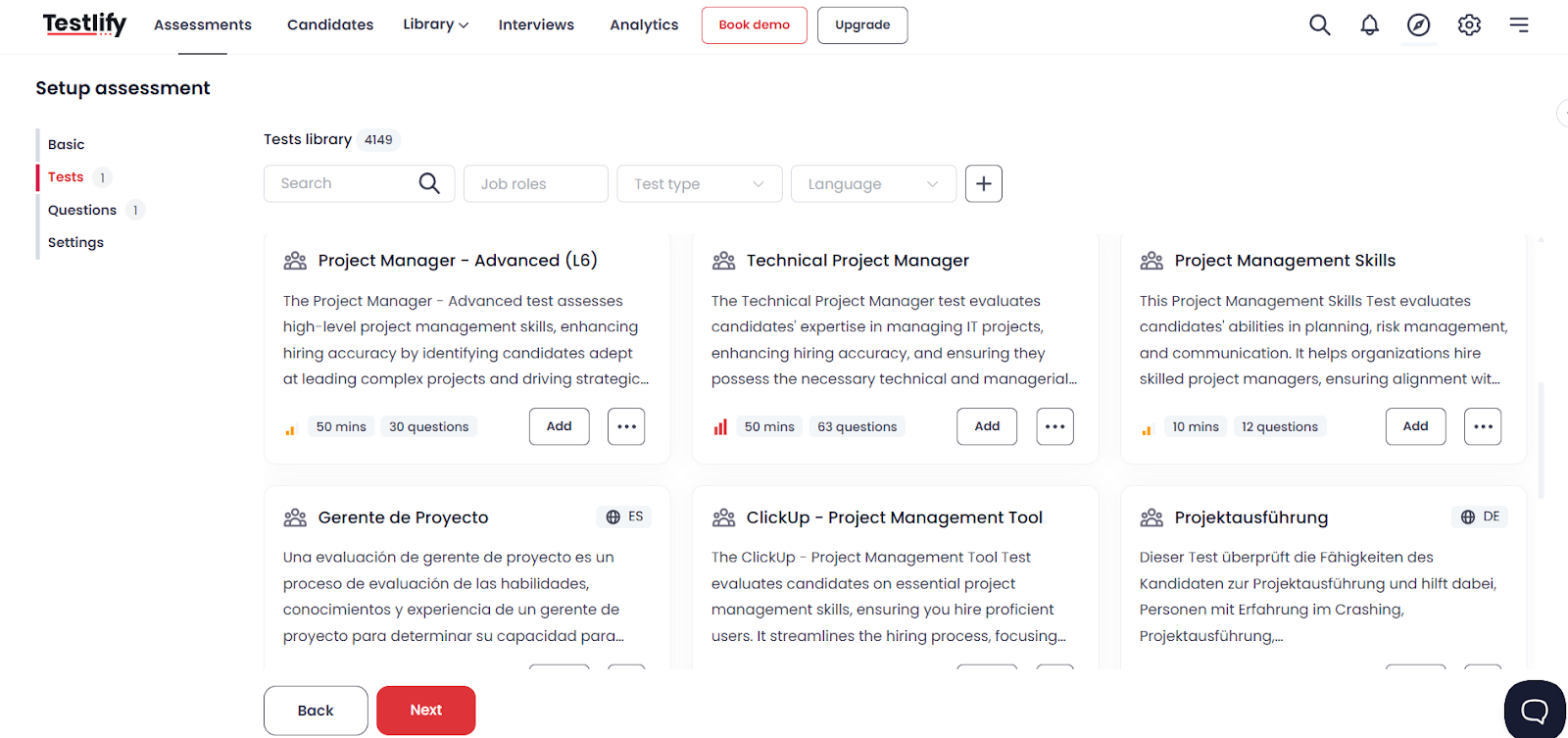
Once you’ve chosen what skills you want to measure, the next step is to go for an assessment that would give you a 360-degree view of your candidates’ abilities.
Testlify offers 3,500+ test libraries to assess 4,500+ in 50+ countriess in 25 languages.
Make sure assessments are proxy-proof
Almost one of the main concerns of adopting skills-based assessments rather than degrees is that a degree is obtained from a true institution with reduced changes of proxies. This can’t be said for pre-employment tests as concerns of proxy interviews or assessments are more.
This is why your pre-employment software must be advanced and have anti-cheating features. Testlify excels in this regard.
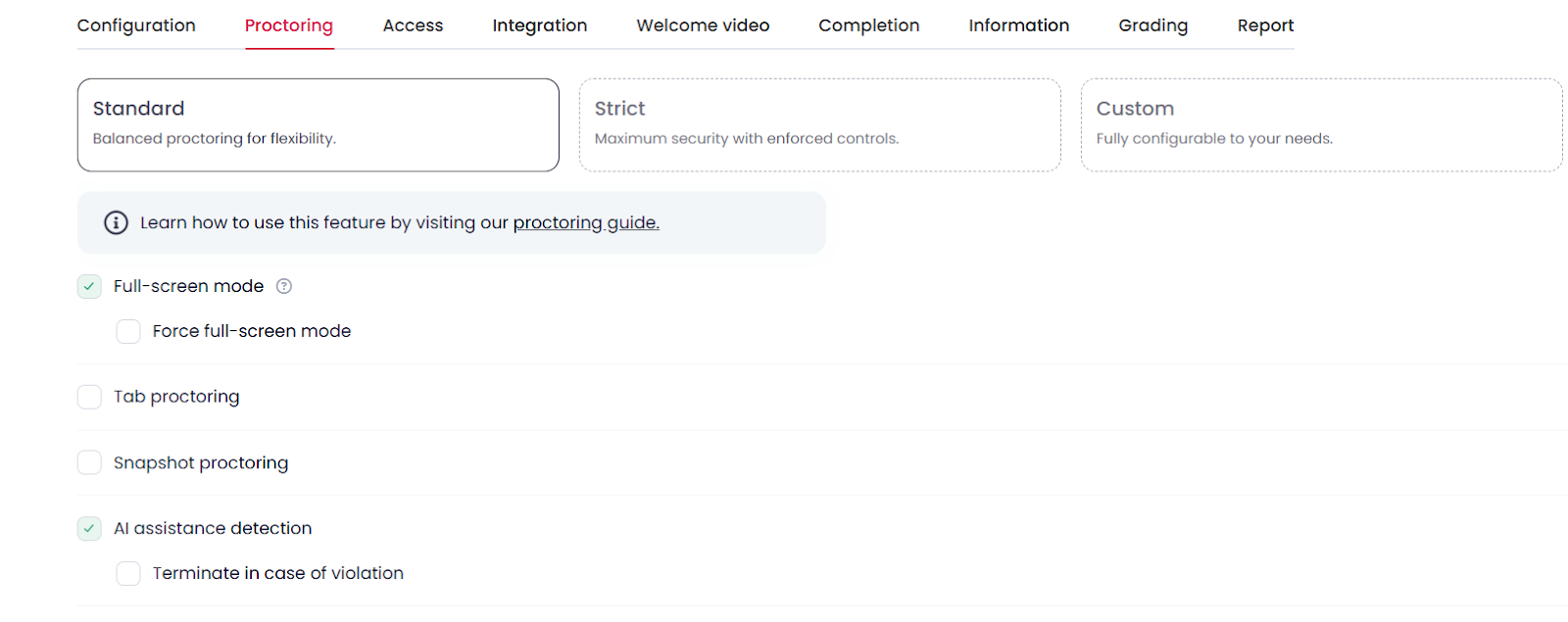
With highly advanced gen AI features, Testlify prevents cheating to 0%. Its advanced options like Tab switching control, force full screen, IP tracking, shut down double login, screen recording, snapshot recording, audio, video, etc, prevent any chances of cheating.
Related: How do proctored exams work and best proctoring features?
Combine skills tests with strong interviews
Skills tests confirm a candidate’s abilities, allowing interviews to focus on leadership potential, personality, and cultural fit. You might need someone who aligns with company values, balances team dynamics or excels in communication.
Structured interviews help ensure the candidate fits both the role and the company culture, preventing mismatched expectations, one of the top reasons employees leave jobs.
Employers who rely on unstructured interviews should consider switching to structured interviews, as research shows they are much better at predicting job performance. Using the same questions for every candidate ensures consistency and helps identify top talent more effectively.
While unstructured interviews feel more natural and conversational, they reduce hiring accuracy and should be avoided. Additionally, hiring managers need proper interview training, as their skills directly impact the quality of hires.
Related: Structured vs Unstructured interviews: What’s the difference
Monitor results and improve
Keep monitoring and make changes to your skills-based selection process over time. This approach is never followed with conventional hiring practices as there is almost little to no scope for improvement.
The skills approach allows you to review and make changes to the process. This can be done through simple practice, such as providing a feedback section to candidates or sharing the assessments with existing employees and asking their views on them.
You can also track how well new hires perform and see if each new group is getting better, proving that your hiring process works.
Once you have enough data, you can use it to improve hiring. If a test isn’t working well, you can replace it. If a test effectively predicts success, you can use it earlier to screen more candidates efficiently.
Does skills based hiring require degrees?
No, skills-based hiring does not require degrees.
While college degrees can be valuable, many roles do not necessarily require them. It promotes inclusivity by creating opportunities for individuals without degrees, ensuring job access is based on skills rather than formal education.
In countries, especially in the U.S., the cost of higher education is skyrocketing, most candidates opt for other means of education than traditional ones. This prompts a global appreciation for skills-based hiring.
Companies worldwide are facing trouble filling roles, specifically ones that require technical expertise. The talent shortage is no longer a minor issue; globally, around 80% of employers report challenges filling open positions.
Also, the employer-employee contract has significantly changed. Employees need more flexibility, and skills-based recruitment offers exactly that. Candidates no longer need to visit the company to conduct interviews.
As education pathways diversify and the demand for specialized skills rises, this approach is the future.
Either way, having a degree or formal education doesn’t guarantee skilled workers. Boeing, for example, is one of the companies that is not satisfied with college graduates and is now testing the waters with skills-based hiring.
Are employers removing degrees from job postings?
Yes, many employers are removing degree requirements from job postings. From 2014 to 2023, the number of roles that dropped degree requirements nearly quadrupled, although there was a slight decline after a peak in 2022.
Companies such as Koch Industries, Walmart, Apple, General Motors, Target, Cigna, Tyson Foods, ExxonMobil, and Yelp, along with government employers like the State of Minnesota and the City of Denver, have eliminated degree requirements and hired more non-degreed workers.
However, adopting skills-based hiring isn’t just about removing degree requirements from job descriptions. Companies must implement structured hiring practices to assess candidates based on their skills effectively.
While progress has been slow, companies embracing skills-based hiring see measurable benefits. For example, non-degreed employees in roles that previously required degrees have a retention rate 10 percentage points higher than their degree-holding colleagues. Additionally, these workers experience an average salary increase of 25%.
This shift benefits both employers and workers, making skills-based hiring a valuable approach. Despite its slow adoption, research suggests that it has the potential to expand significantly, with at least 250,000 more jobs becoming eligible for skills-based hiring each year.
For further reading, explore Zero Based Budgeting.
For further reading, explore How To Find Top Talent With Skill Based Hiring Tools.
Frequently asked questions (FAQs)

Content Writer
Yashika Khandelwal is a Content Writer with 3+ years of experience creating research-backed content on hiring, talent assessment, and HR technology. She is a registered Organizational Psychologist and subject matter expert who combines behavioral science with practical recruitment insights to produce accurate, evidence-based content.
LinkedInRelated resources
View all
HR & recruitment
Recruitment Software for Small Businesses: The 2026 Buyer’s Guide

HR & recruitment
How to use recruitment technology to improve your hiring process

HR & recruitment
Top 10 recruitment technology trends for 2026

HR & recruitment
Employee engagement case studies

HR & recruitment
How to use recruitment technology to onboard new employees?

HR & recruitment
How to use recruitment technology to conduct virtual interviews?
Get started.
Hire on proof, not resumes.
Run your first skills-based assessment free — no credit card required.