
The future of skills assessment: 8 trends for 2027 and beyond
Where skills assessment is heading: AI-built tests, job simulations, AI-free checks, new hiring rules and the steps TA teams can take now.

The future of skills assessment is proof over paper: hiring teams will judge candidates on real work samples, structured AI interviews and short tests built from the job description, with a person reviewing every decision. The World Economic Forum expects 39% of workers' core skills to change by 2030, so a resume or a degree says less every year about what someone can do on day one.
TL;DR:
- The future of skills assessment is real work tested early: job simulations, role tests and structured AI interviews before the first human interview, not after it.
- AI will build, deliver and score most assessments, but people will still make the hiring decision. Only 6% of HR leaders fully trust AI to pick candidates on its own.
- Expect two kinds of tests side by side: AI-free checks for core thinking and AI fluency tests for how people use AI at work. Gartner predicts both.
- Integrity moves from watching candidates to designing tests that AI cannot pass alone, backed by identity checks and human review of every flag.
- Rules are tightening. NYC Local Law 144 already requires bias audits and candidate notice, and the EU AI Act treats hiring AI as high risk.
- Most teams are behind: 32.8% of organizations use no skills assessment at any stage of hiring, and only 6.9% test skills before the first interview.
- Start with one high-volume role, test real tasks before interviews, set clear AI rules and refresh tests every 6 to 12 months.
 ChatGPT
 Gemini
 Claude
 Grok
 Perplexity
What is the future of skills assessment?
The future of skills assessment is a hiring process where candidates prove skills through tasks that mirror the job, early in the funnel, with AI handling test creation and scoring and people making the final call. Tests will be shorter, built per role, checked for integrity by design and reused after hiring for mobility and learning.
Three shifts sit behind that answer. Skills change faster than job titles. Degrees and resumes predict less, and AI tools now write polished resumes for anyone. And AI itself is now both the tool that builds assessments and the tool candidates may use to game them.

Why is skills assessment changing so fast?
Skills assessment is changing fast because the skills employers need are changing faster than the signals they used to rely on. Job titles, degrees and years of experience lag behind what a role actually requires, and generative AI has made resumes and take-home work easier to fake.
The data points the same way:
- Skills churn: The World Economic Forum Future of Jobs Report 2025 found that 39% of core skills are expected to change by 2030, and 63% of employers name skill gaps as the biggest barrier to business change.
- Degrees matter less: SHRM's 2025 skills-first research found demonstrated competencies and relevant experience have overtaken education as the top hiring criteria for HR teams and supervisors.
- AI skills are now a hiring filter: According to the Microsoft and LinkedIn Work Trend Index 2024, 66% of leaders say they would not hire someone without AI skills.
- Resumes are easier to inflate: AI writing tools let every applicant send a tailored, keyword-matched resume, so screening on resumes alone now sorts writing quality, not ability.
For the hard numbers behind the candidate skills assessment market, including adoption rates by company size, see our skills-based hiring statistics roundup. This guide looks forward instead: what changes next and what to do about it.
What are the biggest skills assessment trends for 2026?
The biggest skills assessment trends for 2026 are AI-built tests, job simulations, AI interviews, AI-free checks, AI fluency testing, integrity by design, human review of AI scores, and using assessment data beyond hiring. Each one moves testing earlier in the funnel and closer to the real work.
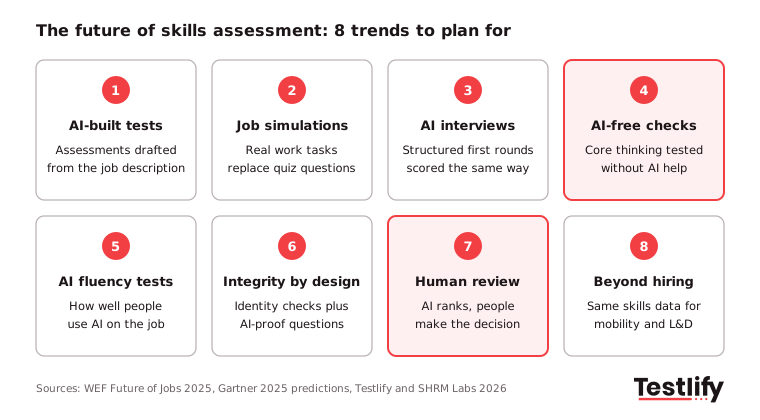
1. AI-built tests from the job description
Hiring teams no longer start from a blank page. AI test builders read a job description, suggest the skills that matter and draft a role-specific assessment in minutes. The recruiter's job shifts from writing questions to checking that the suggested skills match the role.
2. Job simulations instead of quiz questions
Job simulations ask candidates to do a slice of the actual work: answer a customer chat, clean a spreadsheet, fix a bug, write a short email. Candidates prefer them too, because a job simulation shows them what the job really involves.
3. Structured AI interviews in the first round
AI interviews by video, voice or chat ask every candidate the same role-based questions and score each answer against the same criteria. Scheduling disappears from the first round, which matters most in volume hiring.
4. AI-free skills assessments
Gartner predicts that through 2026, the loss of critical-thinking skills from heavy generative AI use will push 50% of global organizations to require "AI-free" skills assessments. Expect more supervised tests of reasoning, writing and coding with AI switched off.
5. AI fluency tests
The same Gartner release predicts that by 2027, 75% of hiring processes will include testing for workplace AI proficiency. WGU's Workforce Decoded survey of more than 3,100 employers, as reported by Built In in May 2026, found 52% already assess AI competency during hiring. Future assessments will ask candidates to use AI on a real task, then judge the result and their judgment.
6. Integrity by design
Proctoring alone cannot keep up with AI help. The next step is test design: scenario questions with follow-ups, tasks tied to the candidate's own earlier answers, and identity checks for the stages that matter.
7. Human review on top of AI scores
AI will rank, but people will decide. In Testlify's survey with SHRM Labs, 53% of HR leaders preferred AI recommendations with human review on top, and only 6% placed high trust in AI to surface the right candidates on its own.
8. Skills data beyond hiring
The same skills data that picks a hire can map gaps in the current team, guide training and support internal mobility. Assessment becomes a shared skills record, not a one-off gate.
Key takeaway: Every trend moves assessment earlier and closer to the real job. Teams that still test after interviews, or not at all, will compare candidates on the weakest signal they have.
How is AI changing skills assessment for employers?
AI is changing skills assessment for employers at every step: it drafts tests from job descriptions, runs structured first-round interviews, scores open answers, flags integrity risks and writes per-skill summaries for reviewers. The work that used to take recruiters days now takes minutes, so the human effort moves to setting criteria and reviewing the shortlist.
Assessment step | How it worked before | How it works next |
|---|---|---|
Test creation | Recruiter picks generic tests | AI drafts a role-specific test from the job description, a person checks the skills |
First screen | Resume keyword match | Short role test or AI interview for every applicant |
Scoring | Manual review of open answers | AI scores every answer against set criteria, with evidence |
Integrity | Webcam proctoring only | Identity checks, AI-assistance detection and AI-proof task design |
Decision | Gut feel after interviews | Per-skill report, then a person decides and records why |
The risk is false precision. AI scoring follows whatever criteria it is given, so vague criteria produce confident-looking scores that mean little.
Pro tip: Write down the three to five skills that separate a strong hire from an average one before you switch on any AI scoring. Then check a sample of AI scores against your best interviewer's judgment for the first month.
How will employers protect test integrity when candidates use AI?
Employers will protect test integrity with two separate fixes: verification for honesty and better test design for meaning. Identity checks, live environment checks and AI-assistance detection confirm the right person took the test alone. Scenario tasks and follow-up questions make sure a pass still reflects real skill, even if AI is nearby.
The pressure is real. In Testlify's State of AI-Ready Talent 2026 report, 73.4% of HR leaders reported some concern about candidates using AI during interviews or assessments. A Forbes study cited by People Matters in September 2026 found over a third of candidates in nearly 20,000 AI-led interviews were flagged for AI help, up from under one in ten a year earlier.
Three rules keep integrity fair:
- Decide where AI is allowed: If the job uses AI daily, let candidates use it and assess how well they do. If the job needs independent thinking, test that part AI-free.
- Treat flags as questions, not verdicts: Gaze and audio models misread honest candidates. Every flag should go to a person, with context and a chance to explain.
- Tell candidates the rules up front: Clear honesty agreements and visible proctoring settings cut cheating and complaints at the same time.
Which assessment methods will replace resume screening?
Resume screening will give way to a mix of short role tests, job simulations, structured AI interviews and cognitive or situational judgment tests, chosen per role. No single method fits every job, so the future is a short battery matched to the skills that predict success in that role.
A skills-based search also widens the pool. The LinkedIn Economic Graph skills-based hiring report found that searching on skills instead of titles and degrees grows the eligible talent pool for a typical job by a median 6.1 times across the countries studied.
Method | Best for | What it shows | Watch out for |
|---|---|---|---|
Role-specific skills test | Most roles, early screen | Core job knowledge | Generic tests that miss the real work |
Job simulation | Support, sales, ops, office roles | How someone handles a real task | Too long a task lowers completion |
Coding test or live coding | Engineering roles | Working code, problem solving | AI help on unsupervised tasks |
AI interview (video, voice, chat) | Volume and first rounds | Communication, role judgment | Weak criteria, candidate trust |
Cognitive or situational judgment test | Graduate and fast-changing roles | Reasoning and decisions | Over-weighting one score |
For a full breakdown of formats, see our guide to types of skills assessment.
What rules will shape skills assessment in the next few years?
Rules that shape skills assessment focus on bias audits, candidate notice and human oversight whenever AI scores or ranks people. New York City already enforces these for automated hiring tools, and the EU AI Act classes AI used in recruitment as high risk, with stricter duties phasing in for employers and vendors.
- New York City: Local Law 144 requires an independent bias audit within the past year and notice to candidates before an automated employment decision tool is used.
- European Union: The EU AI Act has banned emotion recognition in the workplace, including hiring, since 2 February 2025, and treats AI for screening and evaluating candidates as high risk.
- Other US states: Several states are drafting or passing AI-in-hiring laws, so check where your candidates live, not just where your company sits.
Ask every assessment vendor for its audit history. Testlify, for example, published a third-party NYC bias audit of its matching model, completed on 16 June 2023.
How should TA teams prepare for the future of skills assessment?
TA teams should prepare for the future of skills assessment by mapping role skills, setting AI rules, testing real work before interviews, keeping people in every decision and refreshing tests on a schedule. Starting with one high-volume role makes the gain easy to measure before a wider rollout.
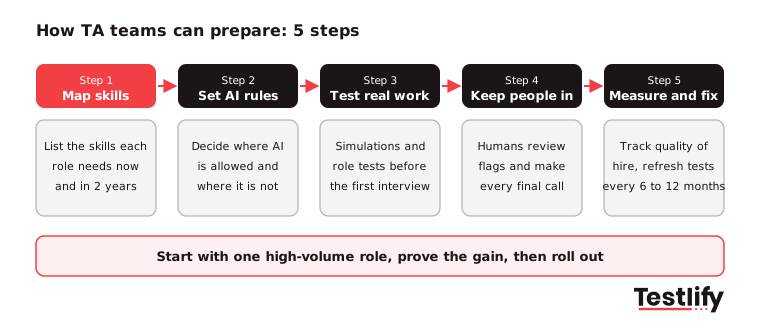
Organizations need to move beyond traditional resume screening and build hiring processes that prioritize practical skills, responsible AI use and human judgment. Here are five steps to future-proof your recruitment strategy:
- Map the skills: List the three to five skills each priority role needs today and the ones it will need in two years. Retire requirements nobody can explain.
- Set AI rules per role: Decide which tasks allow AI and which are AI-free, and write it into the candidate instructions.
- Test real work early: Put a short role test or simulation before the first interview. Today only 6.9% of organizations assess skills at that stage, which is the clearest gap to close.
- Keep people in the loop: Let AI rank and summarize, and have a person review flags, borderline scores and every final decision.
- Measure and refresh: Track completion rate, time to hire and quality of hire, and refresh each test every 6 to 12 months as roles change.
How does Testlify fit the future of skills assessment?
Testlify fits the future of skills assessment by putting role tests, simulations, AI interviews and integrity checks in one place, with people making the final call. The Testlify skills assessment platform covers the trends above in practice:
- AI test builder: Generates a custom assessment from a job description in under a minute, with AI-suggested competencies and scoring criteria.
- Test library: 3,500+ tests across tech and non-tech roles, including cognitive, situational judgment, language and personality tests.
- AI interviews and simulations: Video AI, Voice AI and Chat AI interviews, plus Microsoft Office, Google Workspace, chat and live coding simulations.
- Integrity: 20+ proctoring checks, including AI assistance detection, copy and paste blocking and speech authenticity detection for voice and video answers.
- Fit with your stack: 100+ ATS and HRIS integrations with two-way sync, and assessments in 15+ languages.
Ready to test the skills that matter next?
Browse the Testlify test library to find a test for your next role, or book a demo to see AI-built tests, simulations and AI interviews on one of your own job descriptions. Pricing is credit-based, so you pay only when a candidate starts, and the free trial needs no credit card.
Frequently asked questions (FAQs)

Founder and CEO, Testlify
Abhishek Shah is the Founder and CEO of Testlify, a pre-employment assessment platform used by 1,500+ companies globally to hire fairly and at scale. He focuses on skills-based, bias-free hiring technology. Testlify is part of the SHRM Labs 2026 WorkplaceTech Accelerator.
LinkedInRelated resources
View all
Skill assessment
How to conduct a remote technical interview that hires the right engineers
Skill assessment
What to do when a top candidate fails a skills assessment

Skill assessment
Choosing a programming skills assessment: How and why?
Skill assessment
Why cognitive reasoning matters for a future-proof workforce

Skill assessment
How to create skills assessment tests for different roles

Skill assessment
Improve performance management with skill assessment results
Get started.
Hire on proof, not resumes.
Run your first skills-based assessment free — no credit card required.