
Top 15 TestDome Alternatives and Competitors in 2026
Discover 15 powerful TestDome alternatives to streamline your hiring process and assess candidates with confidence.
The strongest TestDome alternatives in 2026 are Testlify, The Talent Games, Predictive Index, Vervoe and Codility. TestDome handles work-sample coding tests well. It gets thin the moment you hire outside engineering, which is why most teams start looking: they need one platform that covers developers, designers, sales and support without buying a second tool.
Test-library size is the number every vendor leads with, and it's close to the least useful one. What separates these platforms is whether every candidate for a role gets the same questions, scored the same way, by a rule you set before anyone applied. That's the thing this comparison keeps score on.
 ChatGPT
 Gemini
 Claude
 Grok
Grok Perplexity
TL;DR
- TestDome is good at developer work samples and limited almost everywhere else, so the switch is usually about role coverage, not test quality.
- Testlify is the broadest replacement here: 3,500+ tests spanning technical and non-technical roles, plus conversational AI interviews, from $198/month.
- Pick for consistency, not catalogue size. Structured, consistently scored evidence is what selection research keeps finding beats an unstructured read of the same candidate.
- If you only hire engineers, a specialist coding tool may still beat a broad suite. Breadth costs you depth, and that trade is real.
- Watch the pricing model, not the sticker price. Per-candidate and per-test billing is where these tools get expensive at volume.
- No assessment platform fixes retention on its own. It changes who you hire, not what happens to them afterwards.

Common TestDome issues reported by G2 users
Feedback from G2 reviewers highlights several recurring limitations that hiring teams encounter when using TestDome, especially as their hiring needs evolve beyond basic screening.
- Limited languages and skill coverage: G2 reviewers note the lack of support for additional languages and newer frameworks, tools, and programming languages
- No question difficulty indicators: The absence of difficulty ratings makes it challenging to balance assessment difficulty and benchmark candidate performance accurately.
- Missing advanced test support features: Reviewers mention the lack of helper files and built-in cheat sheets, which limits the ability to simulate real-world work scenarios.
- Manual scoring: Some tests default to a "fail" status and require manual review, adding administrative overhead and slowing hiring decisions.
- Limited test customization: Users highlight restricted customization options and a narrower range of skill categories, reducing flexibility for role-specific assessments.
- Escalating costs: Pricing tied to candidate or test volume can become expensive over time, especially for smaller teams or budget-constrained hiring plans.
Because of these gaps, organizations are increasingly turning to more scalable and feature-rich TestDome competitors. Here's a quick comparison of the best TestDome alternatives available today.
How we evaluated these TestDome alternatives
Every tool below was scored on five things: how many roles it can actually assess (not how many tests it lists), whether scoring is consistent across candidates, anti-cheating controls, how it prices at volume, and whether it connects to the ATS you already run.
Two of those deserve more weight than they usually get. Consistency comes first, because a platform that lets each reviewer weight answers differently reintroduces the bias the assessment was bought to remove. Pricing model comes second, because per-candidate billing looks cheap at 20 hires and stings at 400.
Pro tip: before you compare catalogues, count the job families you hired for last year. Teams that hire across four or more families almost always save money consolidating onto one broad platform, and teams hiring only engineers usually don't. That single number settles most of this shortlist before you book a demo.
Tool Name | Starting Price | Standout Features | Core Limitations |
|---|---|---|---|
Testlify | $198/month | 3,500+ role-specific tests and conversational AI interviews | Short free trial |
The Talent Games | Custom | Gamified assessments for aptitude and soft skills | High cost and limited use beyond campus hiring |
Predictive Index (PI) | Custom | Scientifically validated psychometric assessments | No technical or role-based skills tests |
Vervoe | Custom | Automated grading and real-world task simulations | Limited depth for advanced technical assessments |
Codility | $1,200/year | Live coding interviews and role-based coding tests | Limited non-technical assessments |
Mercer Mettl | Custom | Strong proctoring and large multilingual question bank | Expensive for SMBs and no transparent pricing |
iMocha | $1,100/year | 3,500+ skills tests with AI analytics | Feature-heavy platform with a learning curve |
Hirevue | Custom | On-demand video interviews and AI assessments | Very expensive and enterprise-focused |
Coderbyte | $199/month | Unlimited coding challenges with auto-grading | Primarily coding-focused |
Hiremojo | Custom | End-to-end recruiting workflows and analytics | Not a dedicated skills assessment platform |
HackerEarth | $99/month | 25,000+ coding questions and hackathon tools | Rigid time limits and limited non-tech tests |
HackerRank | $198/month | Role-based coding assessments and IDE | Costly for small teams |
TestInvite | $37/month | Highly flexible test builder with proctoring | Limited users and tests on entry plans |
eSkill | Custom | 600+ assessments and job simulations | Dated interface and unclear pricing |
Canditech | $150/month | Realistic work-sample assessments with benchmarks | Smaller ecosystem and fewer integrations |
Now we will dive into each alternative in detail, covering key features, pros and cons, customer feedback, and pricing and G2 ratings, to help you determine which platform is best equipped to replace TestDome for your hiring needs.
Which TestDome alternatives cover non-developer roles?
Testlify, Vervoe, The Talent Games and Predictive Index all assess beyond engineering. TestDome, Codility, Coderbyte, HackerEarth and HackerRank are built around code, so a product manager or a designer either gets a generic aptitude test or no real assessment at all.
Hiring platforms like TestDome or Codility, but for product and design roles too
This is the single most common reason teams leave, and it's worth being blunt about the shape of the problem. Developer-first platforms model a task with one correct output, which is exactly what code review needs and exactly what a design critique isn't. Judgment roles need a work sample plus a structured rubric, not a pass or fail.
For product and design hiring, look for scenario questions with written or recorded answers, a scoring guide each reviewer fills in the same way, and portfolio review that sits inside the same scorecard rather than in somebody's inbox. Testlify and Vervoe both do this. Most of the coding-first tools on this list do not, and no amount of test-library growth changes that, because the format itself is the limit.
1. Testlify
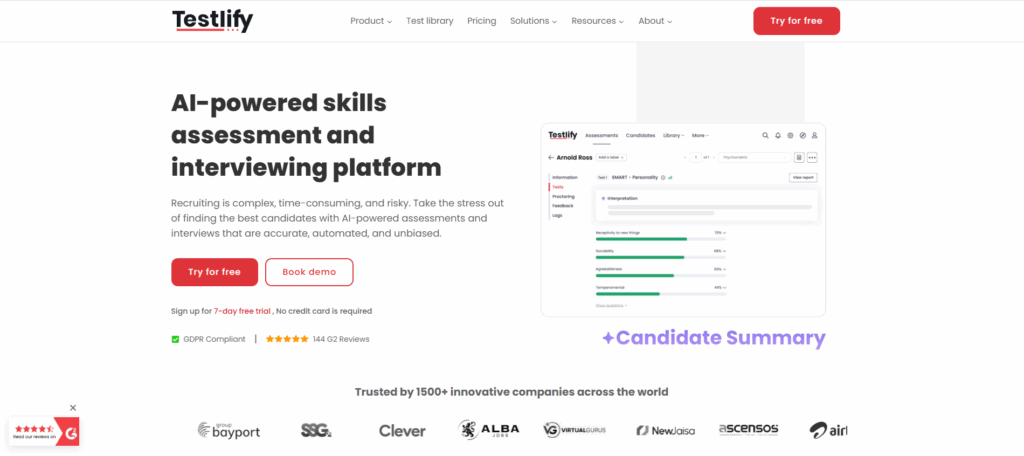
Testlify is a leading AI-powered skills assessment and interviewing platform that features 3,500+ role-specific tests available in 8+ languages, enabling companies to hire confidently across global talent markets.
In addition to technical and role-based assessments, Testlify also offers a full suite of psychometric tests to help evaluate candidates' cognitive abilities, personality traits, and job fit.
The platform is considered a strong fit for both fast-growing startups and enterprises seeking an affordable and flexible solution to support their global hiring needs. This makes Testlify the best TestDome alternative available in 2026.
Key features
- 3,500+ role-specific tests for technical and non-technical hiring
- 25+ custom question types, including video, voice, and conversational AI
- Conversational AI interviews simulating real job scenarios
- Psychometric and behavioral assessments
- AI-generated candidate insights and summaries
- 20+ anti-cheating and proctoring measures
- 100+ ATS integrations
Best for: Teams that need a complete skills assessment + conversational AI interview platform, suitable for mid-size and enterprise hiring.
Pros
- Massive library of 3,500+ role-specific assessments
- Conversational AI interviews that simulate real job scenarios
- Advanced proctoring with multi-layer anti-cheating controls
- AI-powered candidate insights, summaries, and ranking
- Supports soft skills, cognitive, and technical assessments
- 100+ ATS integrations
- Multilingual support for global hiring
Cons
- Feature richness can lead to a steeper learning curve
- Short free trial compared to competitors
- Some advanced analytics features require higher-tier plans
- Candidate UI may be unfamiliar initially for non-tech roles
What customers are saying
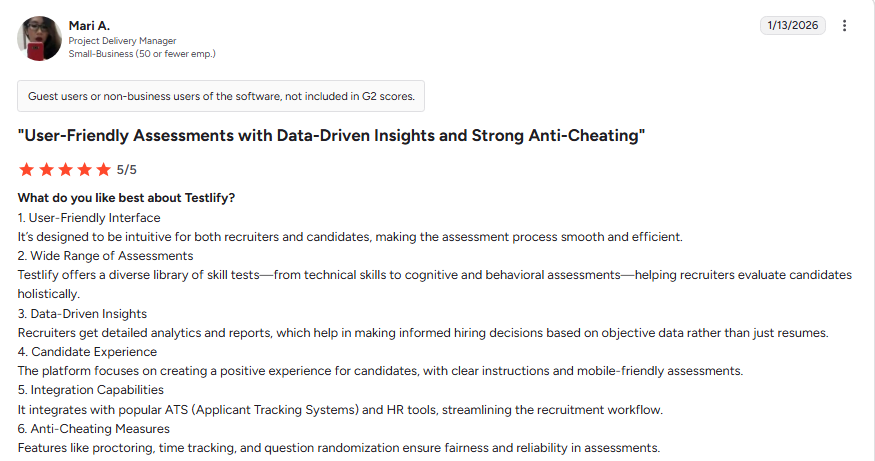
According to the majority of users, Testlify stands out for its intuitive interface that works equally well for recruiters and candidates. Users appreciate the platform's wide range of assessments covering technical, cognitive, and behavioral skills, which gives a fuller view of each candidate.
Many also highlight the data-driven insights and detailed reports that support objective, informed hiring decisions rather than resume-based judgments.
In addition, users frequently mention the positive candidate experience, citing clear instructions and mobile-friendly assessments. Integrations with ATS and HR tools come up just as often, because they cut the manual handoff between screening and scheduling.
Finally, strong anti-cheating measures such as proctoring, time tracking, and question randomization are valued for maintaining fairness and assessment integrity.
G2 rating: 4.7/5 (500+ reviews)
Testlify pricing
Testlify offers flexible pricing plans that scale with your business, providing everything from basic assessments for startups to advanced features for enterprise-level hiring.
- Starter plan:Ideal for small teams and startups, this plan starts at $139/month (billed at $1,663/year) and includes 100 candidate credits at $17 per credit with support for 3 users.
- Starter: Designed for growing businesses, the Starter starts at $279/month (billed at $3,343/year) and includes 300 credits at $11 per credit with support for 5 users.
- Starter: Built for scaling teams, this plan costs $699/month (billed at $4,192/year) and includes 1,000 credits at $8 per credit with 10 users.
- Premium plan:Suited for high-growth organizations, the Premium plan includes 3,000 credits and supports 20 users, with pricing available upon contacting the sales team.
- Enterprise plan: Designed for large enterprises, this plan includes 10,000 credits and supports 30 users, with pricing available upon contacting the sales team.
- Enterprise plus plan: Designed for large-scale hiring programs, this plan includes 25,000 credits and supports up to 40 users, with pricing details available upon contacting the sales team.
- Unlimited plan:For companies seeking unrestricted access, Testlify offers an unlimited plan that includes unlimited candidate credits and full platform functionality, with pricing available on request from the sales team.
2. The Talent Games
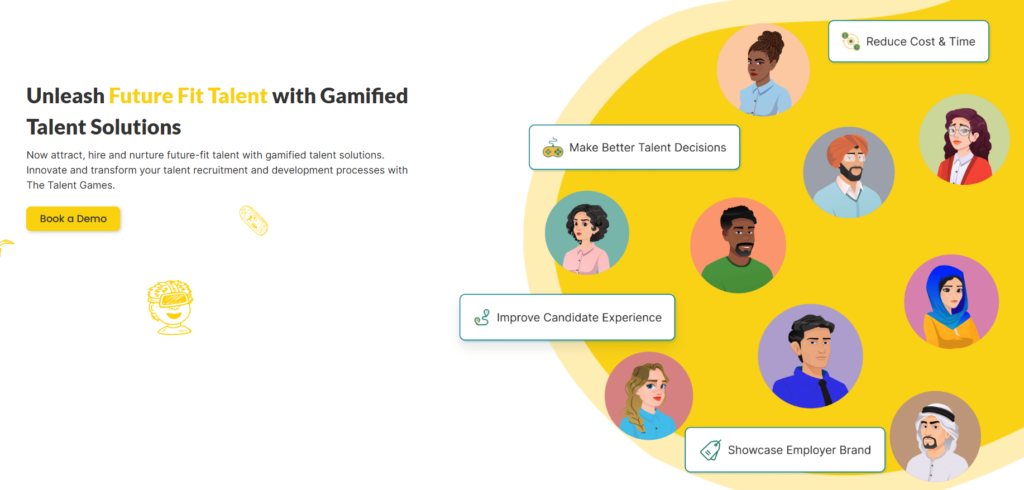
The Talent Games offers gamified assessments that help companies engage and evaluate candidates, especially during large-scale or campus hiring. Instead of traditional tests, it uses interactive games to measure aptitude, personality, and cultural fit.
Best for: Campus and early-career hiring focused on engagement and culture fit.
Key features
- Gamified assessments for measuring aptitude, culture-fit, and problem-solving skills.
- Situational judgment tests to evaluate decision-making and behavioral tendencies.
- Role-specific tests tailored to different job functions and industries.
- Employer branding tools to showcase a company's culture and values.
- AI-generated reports yo hiring teams identify top talent quickly.
Best for: Campus and early-career hiring focused on engagement and culture fit.
Best for: Campus and early-career hiring focused on engagement and culture fit.
Pros
- Highly engaging gamified assessments
- Strong candidate experience
- Useful for screening large student cohorts
- Measures aptitude and behavioral traits
- Employer branding benefits
Cons
- Expensive for small-scale hiring
- Limited technical or role-specific tests
- Not suitable for experienced hires
- Requires complementary tools for skill testing
What customers are saying
Hiring teams say candidates enjoy the experience, but cost and limited role depth are common concerns.
G2 Rating: 4.1/5 (5 reviews)
Pricing: Custom pricing based on volume and assessment type.
3. Predictive Index (PI)
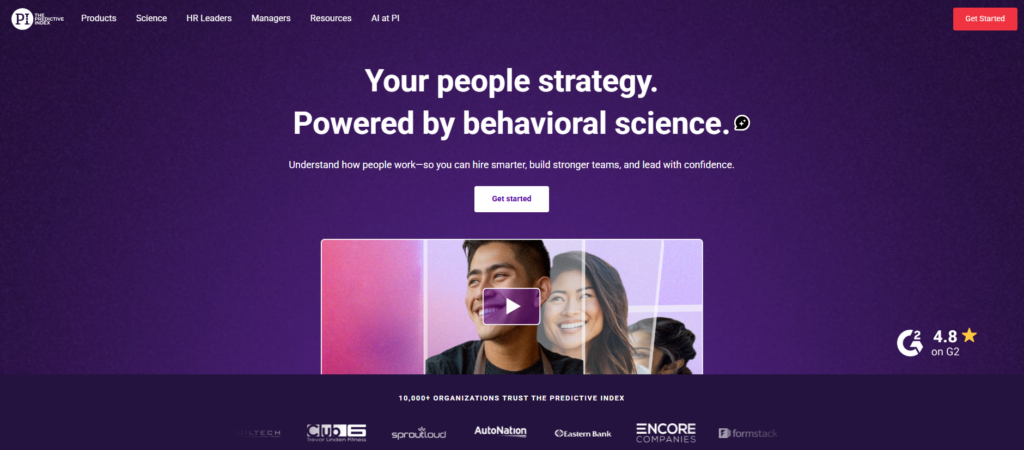
The Predictive Index is a well-established talent optimization and psychometric assessment platform used by enterprises to improve hiring accuracy, employee performance, and team alignment.
Compared to TestDome, it does not assess technical skills but is valuable for culture-fit and team alignment decisions.
Key features
- Behavioral assessments measuring Dominance, Extraversion, Patience, and Formality
- Cognitive ability tests covering numerical, verbal, and abstract reasoning
- Job targeting tools to define ideal behavioral and cognitive role profiles
- Team discovery tools to visualize team dynamics and identify skill gaps
- Talent optimization features supporting onboarding, leadership development, and employee coaching.
Best for: Behavioral and cognitive assessments to evaluate culture and team fit.
Pros
- Scientifically validated psychometric models
- Simple and fast candidate experience
- Strong behavioral insights
- Useful beyond hiring (coaching, development)
- Trusted by large organizations
Cons
- No technical or job-specific skill testing
- Must be paired with another assessment tool
- Pricing can be high
- Limited customization for role-specific skills
What customers are saying
Customers value the depth of behavioral insights but agree it's not sufficient as a standalone hiring tool.
G2 Rating: 4.7/5 (28 reviews)
Pricing: Not publicly disclosed; requires contacting the sales team for a custom quote.
4. Vervoe
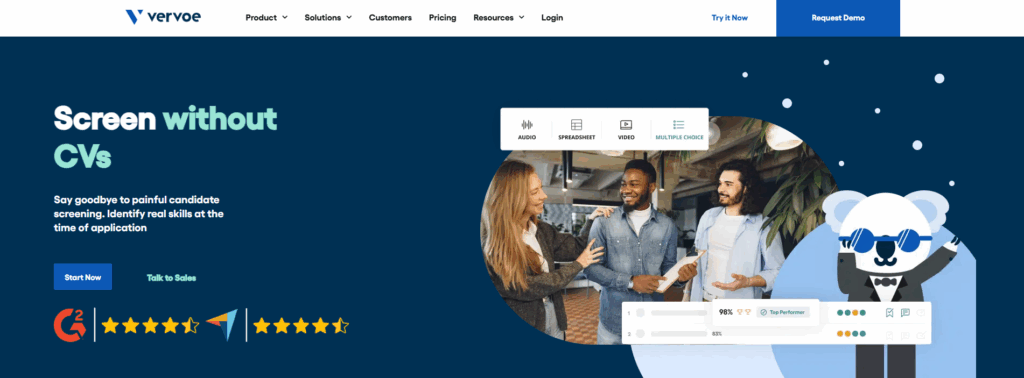
Vervoe is a platform whose mission is to make hiring about merit rather than resumes. It enables employers to see candidates perform job-related tasks and uses AI to automatically grade and rank their responses.
Compared to TestDome, Vervoe places a stronger focus on practical, role-specific exercises but offers fewer advanced proctoring and analytics features for large-scale hiring.
Key features
- 300+ ready-made job simulation templates
- Custom assessment and test creation tools
- Real-world job simulations for skills-based evaluation
- Multiple question formats (MCQs, video, text, file, and audio responses)
- AI-powered grading and candidate ranking
- Basic anti-cheating measures, including plagiarism detection and time limits
Best for: Teams that want to assess candidates using real-world work samples and skills-based tasks instead of resumes.
Pros
- Focuses on practical, job-relevant assessments rather than theoretical questions
- Easy-to-use assessment builder with customizable tasks
- Supports both technical and non-technical roles
- AI-based scoring helps reduce manual screening effort
Cons
- Lacks advanced proctoring and anti-cheating features
- Smaller assessment library compared to enterprise-grade platforms
- Reporting and analytics are relatively basic compared to competitors
G2 Rating: 4.6/5
Pricing:Follows a pay as you go model, that can be ideal for organizations that have even hiring cycles or want to finely control costs. The entry plan starts at $300 per year for 10 candidates, with pricing increasing as more candidates are added."
5. Codility
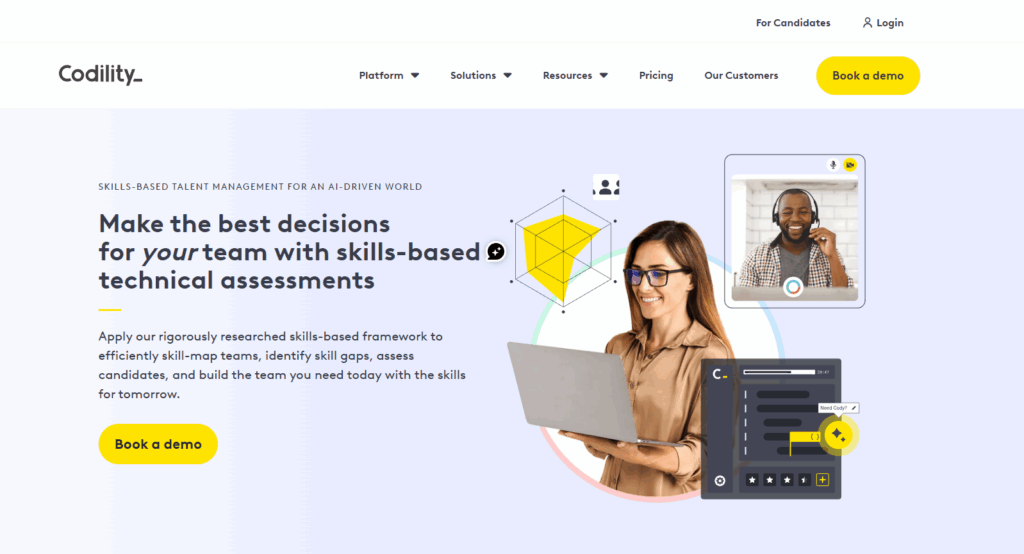
Codility is built for companies that want structured, skill-based evaluations for software engineers. It is commonly used by mid-sized and enterprise tech teams. Compared to TestDome, Codility provides more advanced technical testing but lacks flexibility for non-technical or mixed-role hiring.
Key features
- Library of 1,100+ coding tasks
- Live coding interviews with a collaborative editor
- Automated scoring and performance insights
- Anti-plagiarism and test security tools
- ATS integrations
Best for: Engineering and developer hiring teams that need structured coding assessments and live technical interviews to evaluate real-world programming skills.
Pros
- Strong live coding interview environment with pair programming
- Standardized scoring helps reduce interviewer bias
- Supports multiple programming languages and real-world tasks
- Reliable plagiarism detection and test integrity controls
- Good ATS integrations for enterprise workflows
Cons
- Limited coverage beyond technical roles
- Entry-level plans are expensive for smaller teams
- Test customization can feel rigid
- Not suitable for soft skills or behavioral evaluation
What customers are saying
Customers praise Codility's realistic coding environment and structured evaluations but often cite pricing and lack of non-technical assessments as drawbacks.
G2 rating: 4.6/5
Pricing: Codility is sold in tiered packages. The Starter plan is priced at around $1,200/year, the Scale plan at $6,000/year, and enterprise customers can obtain custom pricing for broader usage and additional features.
6. Mercer Mettl
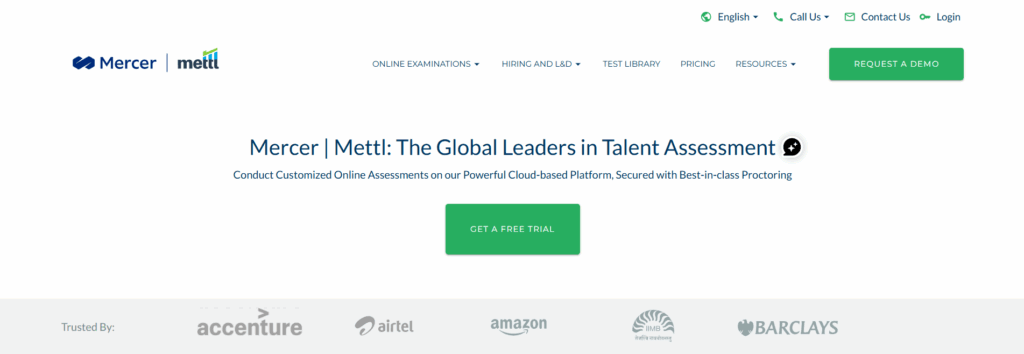
Mercer Mettl is a widely used online assessment platform, especially popular for campus hiring and high-volume recruitment. It offers a broad range of tests along with strong remote proctoring features.
As a TestDome alternative, Mercer Mettl is more suitable for large-scale assessments but can feel heavy and expensive for smaller teams.
Key features
- A large library of assessments covering aptitude, technical skills and psychometric tests
- Strong remote proctoring options, including AI monitoring and webcam tracking
- Custom branding options such as logos, themes, and custom domains
- Detailed reports with score breakdowns, benchmarks, and recommendations
- Support for multiple languages for global hiring
Best for: Large-scale campus recruitment and high-volume hiring programs.
Pros
- Enterprise-level proctoring (remote + live)
- Large validated test bank
- Strong compliance and security standards
- Extensive branding and customization
- Multi-language support
Cons
- Pricing often outside SMB budgets
- Less intuitive interface for small teams
- Setup can be time-intensive
- Reporting varies by plan level
What customers are saying
Recruiters value Mettl's secure testing environment and scalability, but mention that the UI feels less modern than newer competitors.
G2 rating: 4.4/5
Pricing: Mercer Mettl's pricing is customized. Organizations need to contact Mettl for a quote, as costs depend on the number of tests, candidates, and features.
7. iMocha
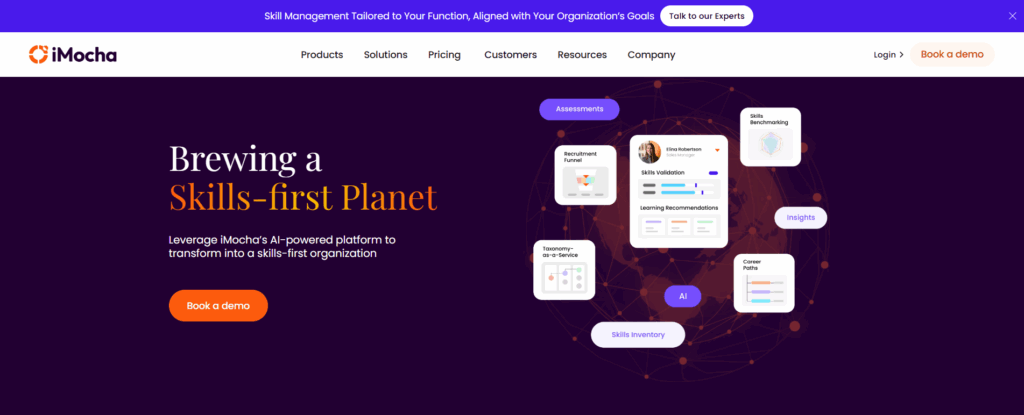
iMocha is an AI-powered skills assessment platform that supports both pre-employment testing and workforce upskilling for large organizations. As a TestDome alternative, iMocha offers a much larger test library and more detailed reports, but it can feel complex and expensive for smaller teams.
Key features
- Library of 3,500+ pre-built assessments
- Custom test creation
- AI-powered conversational interviews
- Advanced proctoring features
- Detailed analytics dashboards with benchmarking and skill-gap analysis
- Integrations with ATS and LMS platforms
Best for: Enterprises that need deep skills intelligence, and analytics for strategic hiring decisions.
Pros
- Very large skills library (3,500+ tests)
- AI-powered analytics and hiring recommendations
- Strong test and question customization
- Strict proctoring and secure testing options
- Benchmarks against global talent pools
- Supports role-based skill taxonomies
Cons
- Higher cost relative to mid-market tools
- Interface can feel complex initially
- Requires training for full feature utilization
- Candidate experience can feel rigid
What customers are saying
Users emphasize iMocha's analytic depth and enterprise governance, though some note that setup and learning can be time-intensive.
G2 rating: 4.4/5
Pricing: Starts at $1,100/year
8. Hirevue
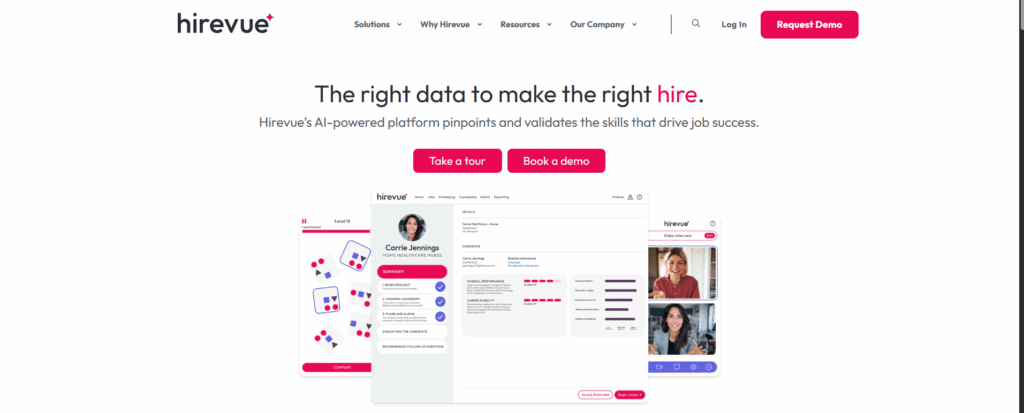
HireVue is a pioneer in the digital interviewing space that has expanded into assessments. It offers a video interviewing platform combined with game-based assessments to measure cognitive ability and personality traits of candidates.
As a TestDome alternative, HireVue is better suited for high-volume enterprise hiring but is significantly more expensive and complex.
Key features
- IO Science content library with validated, role-specific interview content
- On-demand and live video interviews with structured scoring rubrics
- AI analysis of verbal responses and non-verbal cues
- Game-based assessments to measure cognitive, communication, and coding skills
- Automated interview scheduling and candidate engagement
- ATS integrations that shorten the hiring loop
Best for: Large enterprises running high-volume hiring with video interviews and AI-assisted evaluations.
Pros
- On-demand and live video interviewing
- AI-powered analysis of responses
- Strong enterprise compliance and security
- Scales well for global hiring
- Structured interview frameworks
Cons
- Very expensive for SMBs
- Setup and change management can be complex
- Limited customization for assessments
- Concerns around transparency of AI scoring
What customers are saying
Enterprises appreciate HireVue's ability to scale interviews, while smaller teams feel it's overengineered and costly.
G2 rating: 4.1/5
Pricing: Hirevue offers three plan tiers, but pricing is not publicly disclosed and requires booking a demo for details.
9. Coderbyte
Coderbyte is a technical assessment platform primarily geared towards startups and mid-sized companies for hiring developers and data scientists. The platform gives hiring teams the tools to test candidates with real coding challenges, interactive projects, and live technical interviews.
As a TestDome alternative, Coderbyte offers more depth for coding assessments but is limited to technical roles only.
Key features
- 1,000+ coding challenges covering 100+ skills across 30+ programming languages
- Multiple question types, including MCQs, SQL queries, take-home projects, and case studies
- Live technical interviews with real-time code sharing, video chat, spreadsheets, and whiteboards
- Detailed analytics with code replay, performance scoring, code quality evaluation, and benchmarking
Best for: Startups and small tech teams that want unlimited coding assessments at a predictable monthly cost.
Pros
- Unlimited coding challenges and candidate invites
- Simple and fast test setup
- Solid library for algorithms, backend, and frontend roles
- Built-in IDE for coding challenges
- Cost-effective compared to enterprise coding tools
Cons
- No support for non-technical roles
- Limited proctoring and anti-cheating features
- Basic analytics and reporting
- Lacks behavioral or soft skills evaluation
What customers are saying
Users like Coderbyte's simplicity and pricing but note that it's best suited only for straightforward technical screening.
G2 rating: 4.4/5
Pricing: Coderbyte pricing is subscription-based. Plans start at around $199/month, which allows unlimited candidates and tests. (Discounted annual plans are available for organizations that prefer yearly billing.)
10. Hiremojo
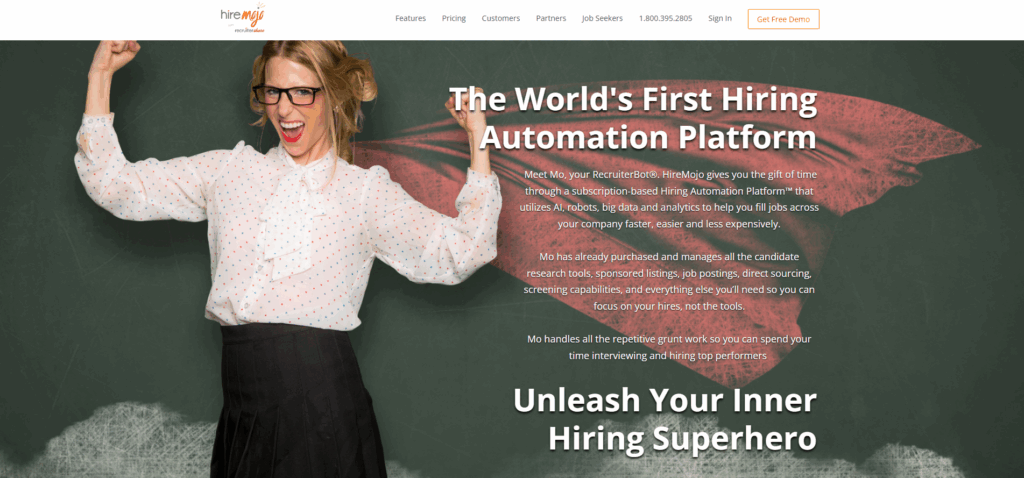
HireMojo positions itself as the industry's first hiring automation platform, aiming to automate the entire recruitment process. It handles everything from writing job descriptions and posting jobs to pre-screening applicants, scheduling interviews, and managing communications.
As a TestDome alternative, HireMojo focuses more on automating the hiring workflow rather than deep skill assessments.
Key features
- Automated job posting across multiple job boards and hiring platforms
- Candidate pre-screening and scoring using a patented online interview process
- Automated ranking of candidates based on interview responses
- Job and interview content library with customizable, expert-built templates
- Built-in candidate management system to track applicants, resumes, and pipeline stages
- Interview scheduling and automated candidate communication, including rejection emails
Best for: Teams looking for hiring automation and ATS functionality rather than pure assessments.
Pros
- End-to-end hiring workflow automation
- Built-in ATS and candidate management
- Automated screening and scheduling
- Reduces manual recruiter workload
- Unlimited user access
Cons
- Not assessment-centric
- Limited testing and evaluation depth
- Relies on third-party tools for skills testing
- UI feels dated
What customers are saying
Users appreciate HireMojo's automation capabilities but note that assessment features are basic.
G2 Rating: 4.5/5
Pricing: HireMojo does not publicly disclose pricing. Interested companies need to contact their sales team for a custom quote. Pricing is likely tailored to the organization's size, hiring volume, and specific features needed.
11. HackerEarth
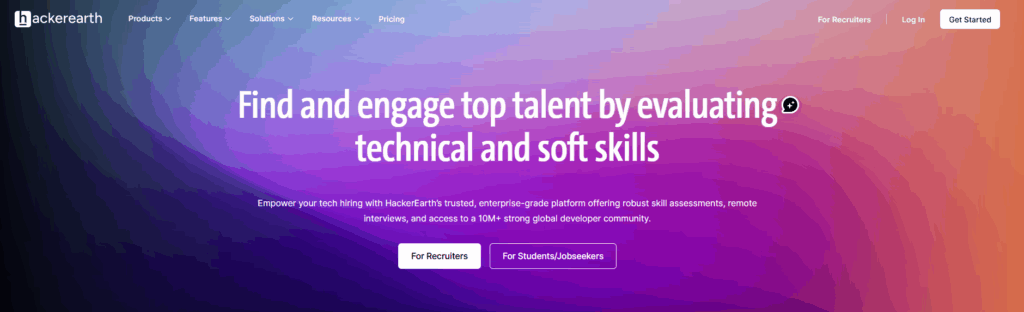
HackerEarth is an AI-powered tech hiring platform purpose-built for developer assessments, offering tools that support everything from entry-level coding tests to advanced technical interviews.
As a TestDome alternative, HackerEarth is more suitable for large-scale technical hiring but less flexible for non-technical roles.
Key features
- Technical test library with 25,000+ questions across 25+s
- Support for multiple-choice, project-based, and data science assessments
- Advanced proctoring with AI-powered webcam monitoring and plagiarism detection
- FaceCode live coding interviews with built-in IDE, whiteboard, and video chat
- Detailed analytics and skill reports with AI-generated performance summaries
Best for: Technical hiring teams that want coding tests, hackathons, and live technical interviews.
Pros
- Very large coding question library
- Supports hackathons and challenges
- Built-in live coding interviews
- Strong plagiarism detection
- Suitable for large-scale developer hiring
Cons
- Rigid time limits can hurt candidate experience
- Interface is less intuitive than competitors
- Limited soft skills assessment
- Advanced features locked behind higher plans
What customers are saying
Customers like the depth of technical content but often mention strict timers and UX limitations.
G2 Rating: 4.5/5
Pricing: HackerEarth offers scalable pricing plans designed to grow with your business. Pricing plans starts at $99 per month with higher-tier plans available to support larger teams and advanced hiring needs.
12. HackerRank
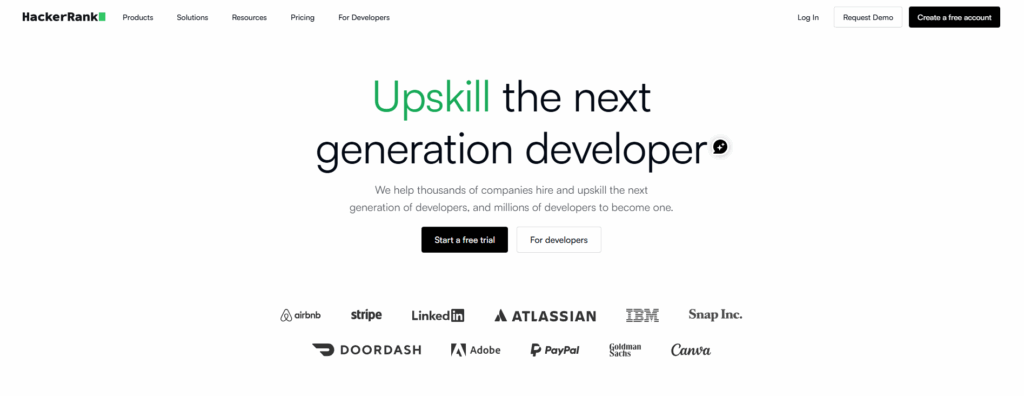
HackerRank is a well-known technical assessment platform used mainly for hiring developers. It focuses heavily on coding challenges and technical interviews. While HackerRank is strong for developer hiring, it lacks the broader role coverage that many TestDome alternatives provide.
Key features
- Large library of coding challenges across multiple programming languages
- Tools for coding tests, live technical interviews, and pair programming
- Plagiarism detection and test integrity checks
- Candidate performance reports and skill-based scoring
- ATS integrations that shorten the hiring loop
Best for: Tech teams looking for deep coding assessments and real-time coding interview support.
Pros
- Extremely strong coding challenge library
- Real-time collaborative coding interview IDE
- Plagiarism detection and auto-scoring
- Community-validated challenge bank
- Recognized by tech hiring teams globally
Cons
- Limited assessments beyond technical roles
- More coding focus than behavioral/soft skills
- Can feel expensive for smaller teams
- No built-in video interview feature without add-ons
What customers are saying
Users like HackerRank's depth of coding challenges and interview tools but wish for better soft skills or non-technical screening support.
G2 rating: 4.6/5
Pricing: HackerRank uses a flexible, usage-based pricing model. The Starter plan begins at roughly $198/month, with higher-tier plans and enterprise licensing available to accommodate larger hiring needs.
13. TestInvite
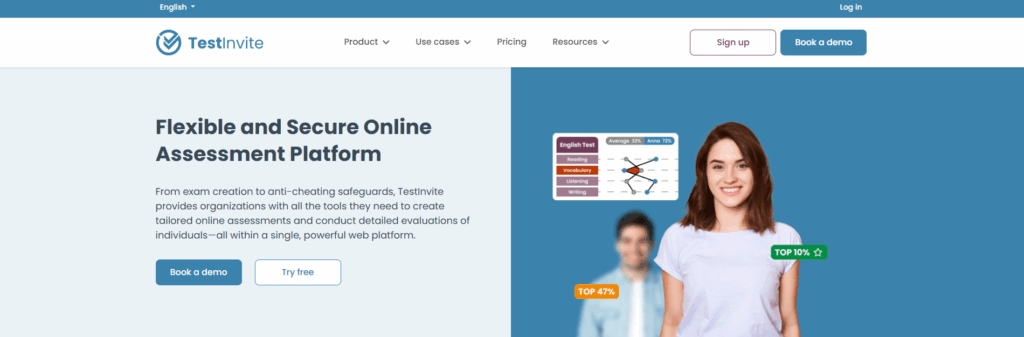
TestInvite is a broad online exam and assessment software built to run secure, highly customizable testing for a variety of purposes, including corporate hiring, educational exams, and professional certification.
As a TestDome alternative, TestInvite offers greater control over test creation and security but requires more setup and configuration.
Key features
- Custom test builder with a wide range of question types
- Pre-built assessment library for common and role-specific skills
- Advanced reporting with custom scoring logic and benchmark comparisons
- Ability to categorize scores and add interpretations for different score ranges
- Anti-cheating and proctoring measures, including lockdown browsers, AI detection, and question randomization
Best for: Organizations that need highly customizable exams and secure online testing.
Pros
- Very flexible test builder
- Strong anti-cheating and security controls
- Affordable entry-level pricing
- Useful for certifications and formal exams
- Reliable performance for remote testing
Cons
- Limited analytics and insights
- Not designed for end-to-end hiring workflows
- Fewer role-specific templates
- UI feels dated compared to newer tools
What customers are saying
Users appreciate TestInvite's flexibility and customer support but want better reporting and modern UI improvements.
G2 Rating: 4.7/5
Pricing: Starts at around $37 per month for the Starter. Higher-tier plans with more features and greater capacity are available at increased price points.
14. eSkill
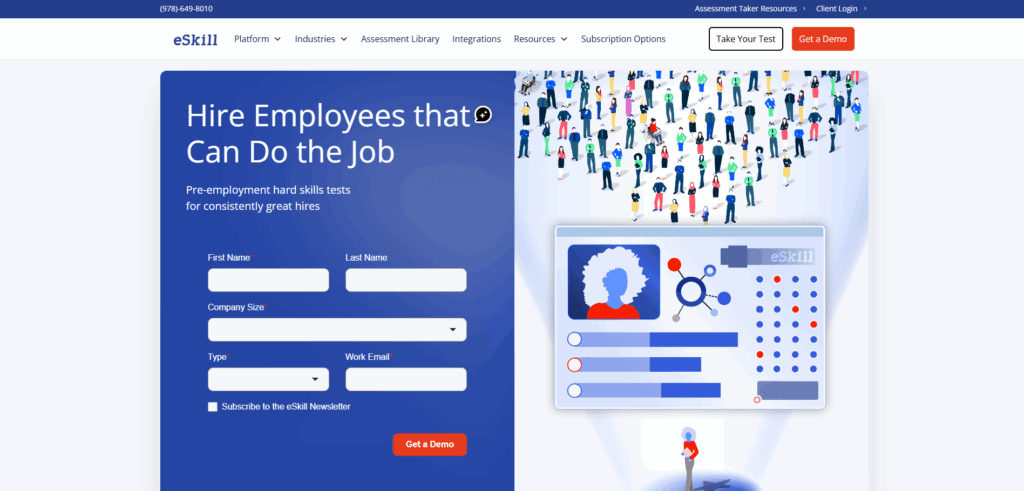
eSkill is a long-established pre-employment testing platform known for its vast variety of skills tests. It offers both an extensive library of ready-made assessments and tools for creating custom tests.
As a TestDome alternative, eSkill provides broader role coverage but has a more dated interface and less modern analytics.
Key features
- Extensive test library with 600+ ready-to-use assessments
- Custom assessment creation
- Interactive job simulations for real-world skill evaluation
- Advanced proctoring with monitoring for copy-paste and tab switching
- Real-time flagging of suspicious candidate behavior
- Detailed reporting and analytics with score and performance breakdowns
Best for: Entry-level, clerical, and administrative role assessments.
Pros
- Broad library of basic skills tests
- Custom test creation available
- Covers clerical, software, and language skills
- Flexible assessment formats
- Long-standing market presence
Cons
- Dated user interface
- Limited AI-driven insights
- Not ideal for senior or technical roles
- Candidate experience feels outdated
What customers are saying
Users value eSkill's breadth of assessments but frequently point out the outdated UI and lack of modern analytics.
G2 Rating: 4.5/5
Pricing: eSkill does not disclose its pricing publicly. Recruiters need to get in touch with the sales team to get a custom quote
15. Canditech
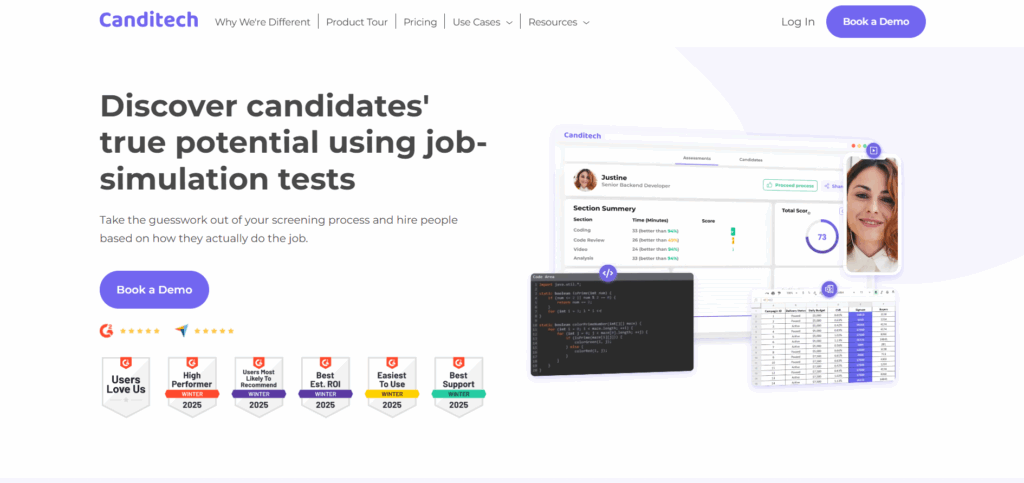
Canditech is a newer entrant in the skills assessment space that has quickly gained acclaim, boasting a perfect 5.0 rating on G2. The platform specializes in job simulation assessments, enabling employers to evaluate candidates through realistic work scenarios rather than standard quizzes.
As a TestDome alternative, Canditech offers more immersive simulations but operates as a smaller platform with fewer integrations.
Key features
- Custom and expert-built assessments with access to 500+ pre-designed tests
- Realistic job simulations focused on work-sample tasks and role-specific scenarios
- Support for coding, Excel analysis, written responses, and situational tasks
- Automated scoring and candidate ranking to reduce manual bias
- Benchmarking analytics to compare results against industry or job-specific standards
Best for: Companies that prefer realistic job simulations over traditional tests.
Pros
- Strong focus on real-world work simulations
- High candidate engagement rates
- Automatic scoring and benchmarking
- Easy-to-use assessment builder
- Useful for operational and customer-facing roles
Cons
- Smaller assessment library
- Limited advanced proctoring features
- Fewer ATS integrations
- Not ideal for deep technical hiring
What customers are saying
Customers highlight Canditech's realistic assessments but mention the need for stronger integrations and reporting flexibility.
G2 rating: 5.0/5
Pricing: Team plan starts at $150/month for 100 candidates
What actually predicts a good hire?
Structured evidence, gathered the same way for every candidate, and combined by a rule rather than a hallway conversation. That is the most consistent finding in selection research, and it should drive this decision more than any feature grid.
The 2022 reanalysis of selection-method validity by Sackett and colleagues revised many long-quoted numbers downward, and the exact coefficients are still argued over in print. The shape that survives every reanalysis is the ranking: structured methods beat unstructured ones. A separate meta-analysis of mechanical versus clinical data combination found that adding up assessment scores by a fixed formula predicts outcomes at least as well as experts re-weighing the same information by feel.
Read together, those two say something uncomfortable for a buying process that fixates on test count: the scoring discipline matters more than the catalogue. A 500-test platform used consistently will out-hire a 5,000-test platform where every hiring manager grades their own way.
That is the idea behind Testlify's Multi-Signal Talent Evaluation Model, which combines several role-relevant signals (assessments, interviews, simulations, references and reviewer feedback) into one comparable view rather than trusting any single score. AI assists the evaluation. People still make the call.
One caveat worth stating plainly, because no vendor page will. A better assessment changes who you hire, not what happens to them after they start. Gallup finds turnover in low-engagement teams runs 18% to 43% higher than in highly engaged ones, and no screening tool on this list touches that number. If people are leaving in month seven, the problem isn't your test.
Which is the best TestDome alternative?
When considering all these options, Testlify stands out as the top alternative to TestDome for both mid-sized companies and large enterprises.
Explore the full comparison in our article: Testlify vs TestDome
Testlify features an extensive test library (over 3,500 tests), AI-powered candidate evaluations, and conversational AI interviews for creating realistic job simulations at scale. It also supports 100+ ATS integrations out of the box.
Whether you're looking for pre-employment testing tools or a conversational AI powered interview platform for high-volume hiring, Testlify excels at delivering everything you need without overwhelming your budget.
Ready to replace TestDome?
If your shortlist keeps coming back to role coverage, start with the 3,500-test library and check the job families you actually hire for. Pricing is published on the plans page, and you can book a walkthrough to see the scoring setup on one of your own roles before you migrate anything.
Key takeaways
- Role coverage is the real switching trigger. TestDome is competent at developer work samples, so teams rarely leave over test quality. They leave when they start hiring designers, PMs or support staff and discover there is nothing appropriate to send them. Count your job families before you compare anything else.
- Scoring consistency beats catalogue size. Selection research keeps finding that structured, uniformly combined evidence predicts performance better than expert judgment applied loosely. A platform that lets each reviewer weight answers their own way gives back the bias you paid to remove.
- Breadth has a real cost. A broad suite covering fifteen job families will not match a specialist coding platform on deep engineering assessment. If you only hire engineers, staying specialist is a defensible answer and this list is mostly noise for you.
- Price the model, not the sticker. Per-candidate and per-test billing is where these platforms diverge sharply at volume. Rerun every quote against last year's actual candidate count, not the seat count.
- Check the ATS path before you commit. A tool that cannot push scores back into your ATS creates the manual reconciliation work the purchase was meant to remove.
- Assessment is a hiring lever, not a retention lever. It improves who joins. Engagement, management and onboarding decide who stays, and those sit outside every tool reviewed here.
Frequently asked questions (FAQs)

Director of Marketing
Akash Patange is the Director of Marketing at Testlify, where he works closely with HR leaders and recruiters to help organizations improve hiring outcomes. He writes about talent assessment, recruitment technology, and data-driven hiring practices.
LinkedInRelated resources
View all
Alternatives
Top 15 Hirevue Alternatives and Competitors
Alternatives
Top 15 iMocha Alternatives and Competitors in 2026
Alternatives
Top 15 Mercer Mettl Alternatives and Competitors
Alternatives
Top 15 Codility Alternatives and Competitors
Alternatives
Top 15 Adaface Alternatives and Competitors
Alternatives
Top 15 TestGorilla Alternatives and Competitors
Get started.
Hire on proof, not resumes.
Run your first skills-based assessment free — no credit card required.