
Benefits of employment testing: 9 gains for hiring teams
Nine ways pre-hire tests improve hiring, from quality of hire to time saved, plus the mistakes that cancel them out and how to track it.

The benefits of employment testing come from one change: every candidate shows what they can do on the same job-related task, scored the same way, before anyone books an interview. That gives hiring teams better hires, faster shortlists, fairer decisions and fewer early exits. Employment testing covers skills tests, cognitive ability tests, personality questionnaires, situational judgment tests and work samples. This guide focuses on what those tests change for the business, how to measure it, and what stops the gains from showing up.
TL;DR:
- The main benefits of employment testing are better quality of hire, faster shortlists, lower hiring cost, fairer and more defensible decisions, lower early turnover and a wider talent pool.
- Tests add signal that AI-polished resumes and unstructured interviews no longer give: proof that a candidate can do the work.
- Only 25% of TA teams feel highly confident they can measure quality of hire, according to LinkedIn. Test scores give them a baseline to compare against later performance.
- Tests are legal in the US when they are job related. The EEOC expects any test that screens out a protected group to be justified by business necessity.
- Most failed programs fail for the same reasons: tests that are too long, not tied to the job, unproctored, or with cutoffs nobody checked.
- Track time to shortlist, interview-to-offer ratio, 90-day attrition, hiring manager ratings and pass rates by group to prove the benefits.
 ChatGPT
 Gemini
 Claude
 Grok
 Perplexity
What are the benefits of employment testing?
The benefits of employment testing are better quality of hire, fewer bad hires, lower early turnover, a faster time to shortlist, lower cost per hire, better interviews, fairer comparisons, decisions that are easier to defend and a wider talent pool. Each one comes from testing job skills early and scoring every candidate on the same scale.
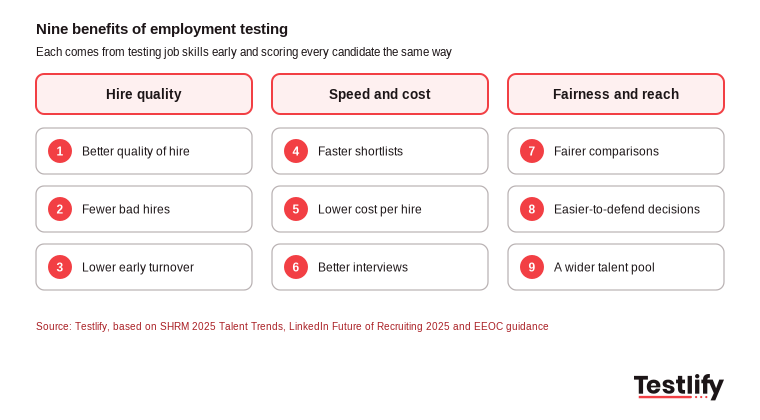
- Better quality of hire: Scores show who can actually do the core tasks, so fewer people are hired on confidence alone.
- Fewer bad hires: Skill gaps show up before the offer, not in the first month.
- Lower early turnover: People hired for the right skills and work style are less likely to leave or be let go in their first 90 days.
- Faster shortlists: Recruiters review a ranked list instead of reading every resume.
- Lower cost per hire: Fewer interviews per hire means less recruiter and hiring manager time. See how to calculate cost per hire.
- Better interviews: Interviewers spend the hour probing weak areas the test revealed, instead of re-checking basics.
- Fairer comparisons: Every candidate gets the same questions, time and scoring.
- Easier-to-defend decisions: A documented, job-related score explains why one person moved forward and another did not.
- A wider talent pool: Candidates without the "right" degree or employer can prove their skills.

Why do resumes and interviews fall short on their own?
Resumes and unstructured interviews fall short because neither shows whether a candidate can do the job. A resume shows how someone describes their experience, and with AI writing tools most applications for a role now read almost the same. An unstructured interview depends on which questions each interviewer asks and how they feel about the answers.
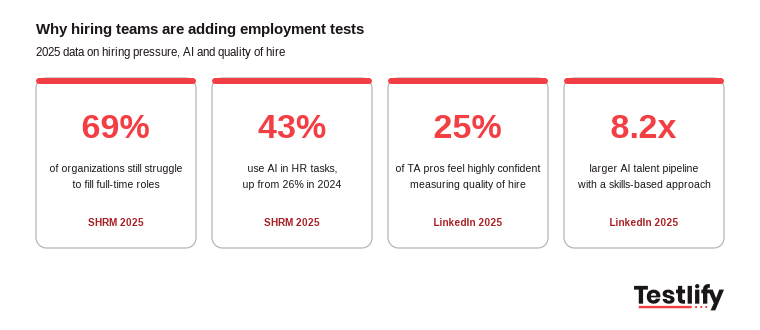
That gap is growing. The SHRM 2025 Talent Trends report found that AI use in HR tasks climbed to 43% in 2025, up from 26% a year earlier. Candidates are using the same tools on their side, so recruiters get more applications that look strong on paper and say less about real ability.
Employment tests close the gap with a work-like task. A sales candidate handles an objection, an analyst cleans a dataset, a developer fixes a bug. The result is evidence, not description. Pairing the test with a structured interview gives the hiring manager two consistent signals instead of one impression.
How does testing improve quality of hire?
Testing improves quality of hire by moving candidates forward on proven skill rather than on how well they write a resume or perform in a conversation. When the test measures the tasks that drive success in the role, the people who score well are more likely to perform well once hired.
Quality of hire is now the metric TA leaders care about most and trust least. In LinkedIn's Future of Recruiting 2025, 89% of TA professionals said measuring quality of hire will become more important, but only 25% felt highly confident they could measure it well. Test scores help with both sides: they raise the bar at the start, and they give a baseline to compare with performance reviews later.
Pro tip: Before you set a pass mark, ask a few of your current strong performers to take the test. If they do not score well, the test is measuring the wrong things for your role.
How does testing cut time-to-hire and hiring cost?
Testing cuts time-to-hire and hiring cost by screening a large applicant pool in one step, without a recruiter call for every candidate. Candidates take the test when it suits them, scoring is automatic, and only the top group reaches interviews, so each hire needs fewer interview hours.
The time pressure is real. The time to hire for hard roles stretches when recruiters are buried in applications, and SHRM found that 69% of organizations still struggle to fill full-time roles in 2025. For volume hiring in BPO, retail or customer support, testing is often the only practical way to look at every applicant instead of the first few hundred.
The savings show up in three places:
- Recruiter time: No manual resume triage for the first cut.
- Hiring manager time: Fewer first-round interviews with candidates who were never a fit.
- Rework: Fewer failed hires to replace, which avoids paying for the same role twice.
How does testing make hiring fairer and easier to defend?
Testing makes hiring fairer because every candidate answers the same job-related questions under the same conditions and is scored against the same criteria. It makes decisions easier to defend because the reason for each decision is written down: a score on a task the job requires.
US law supports testing when it is done properly. The EEOC fact sheet on employment tests says tests can be a very effective way to find the most qualified applicants. It also warns that a test which disproportionately screens out a protected group must be job related and consistent with business necessity, and scores cannot be adjusted by race, sex or other protected traits.
Fairness is not automatic, so check it:
- Job relatedness: Map every test section to a task in the job description. If you cannot name the task, drop the section.
- Adverse impact: Compare pass rates by group and review any cutoff that screens out one group far more than others. The glossary entry on adverse impact explains the four-fifths rule.
- AI scoring rules: If you hire in New York City, Local Law 144 requires a bias audit and candidate notice for automated employment decision tools. Testlify published its own NYC bias audit.
- Accommodations: Offer extra time or other formats for candidates with disabilities.
For a deeper look at the compliance side, read these benefits of EEOC-compliant pre-employment testing.
How does testing widen the talent pool?
Testing widens the talent pool because it lets employers judge candidates on skills instead of filtering them out by degree, job title or past employer. People who learned on the job, changed careers or come from smaller companies get a fair chance to prove they can do the work.
LinkedIn's data shows how large the effect can be. LinkedIn Economic Graph's 2025 Skills Signal report found that companies can grow their AI talent pipeline by 8.2 times when they use a skills-based approach instead of titles and degrees. Testing is how that approach works in practice: once you drop a degree filter, you need another way to sort applicants, and a short skills test does that. More data is in these skills-based hiring statistics.
Which tests bring which benefits?
Different tests bring different benefits, so the best results come from combining two or three that match the role. Skills tests and work samples prove job ability, cognitive tests predict how fast someone learns, and personality and situational judgment tests show how a candidate is likely to work with others.
Test type | Main benefit | Best for | Watch out for |
|---|---|---|---|
Role-specific skills test | Proves the candidate can do the core tasks now | Most roles, especially technical and specialist | Keep it to the skills the job uses |
Shows reasoning and learning speed | Roles with complex or changing work, graduate hiring | Check pass rates by group | |
Shows judgment in real work scenarios | Customer-facing roles, managers | Scenarios must match your workplace | |
Shows work style and team fit | Sales, support, leadership | Never use as the only filter | |
Shows real coding ability in a live IDE | Developers, data and QA roles | Proctor it and watch for AI help | |
Work sample or simulation | Closest preview of on-the-job performance | Writers, designers, analysts, support agents | Keep it short, or pay for large tasks |
For a full list of formats, see these types of pre-employment tests.
What can go wrong, and how do you avoid it?
Testing can go wrong when the test is too long, not tied to the job, easy to cheat on, or used as a rigid cutoff nobody has checked. Each of these cancels out the benefits, so build the fix in from day one.
Problem | What it costs you | Fix |
|---|---|---|
Test is too long | Strong candidates drop out | Keep it to about 30 to 45 minutes for most roles |
Questions are not job related | Weak prediction and legal risk | Map every section to a job task |
No proctoring | Scores reflect AI tools or outside help | Use anti-cheating and proctoring checks |
Cutoff set by guesswork | Good people rejected, weak ones passed | Set it from current employee scores and review it each quarter |
Test replaces judgment | Hiring managers stop thinking | Use scores to shortlist, then interview |
Poor candidate communication | Test anxiety and a weaker employer brand | Explain what the test covers, how long it takes and how results are used |
A good candidate experience matters here. Candidates accept a test more readily when it looks like the job and they know what happens next.
How do you get the benefits in practice?
You get the benefits by testing for the few skills that matter most, early in the process, with a clear plan for how scores feed the decision. The six steps below work for a single role or a full hiring program.
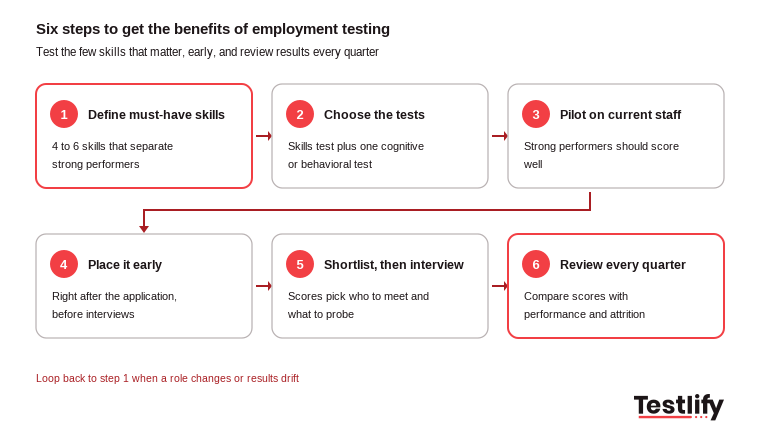
- Define the must-have skills: Pick the four to six skills that separate strong and weak performers in the role.
- Choose the tests: Combine a role-specific skills test with one cognitive or behavioral test where it adds signal.
- Pilot on current employees: Check that strong performers score well before candidates see the test.
- Place it early: Send the test right after the application or resume screen, before interviews.
- Shortlist, then interview: Use scores to pick who to interview and to plan follow-up questions.
- Review every quarter: Compare scores with performance and attrition, and adjust tests and cutoffs.
For more on designing a fair program, read this guide to fair and effective employment tests.
How do you measure the benefits of employment testing?
You measure the benefits of employment testing by comparing a few hiring metrics before and after you add tests, for the same roles. Track speed, quality, retention and fairness together, so a gain in one area does not hide a loss in another.
Metric | What it shows | Good sign after testing |
|---|---|---|
Time to shortlist | Speed of the first cut | Days, not weeks |
Interview-to-offer ratio | How well the shortlist matches the role | Fewer interviews per offer |
Hiring manager satisfaction at 90 days | Early quality of hire | Higher ratings for tested hires |
90-day and first-year attrition | Fit and retention | Fewer early exits (employee turnover) |
Test score vs performance rating | Whether the test predicts success | Higher scorers perform better |
Pass rates by group | Fairness | No group screened out far more than others |
Test completion rate | Candidate experience | Most invited candidates finish |
Key takeaway: Pick three of these metrics, record a baseline this month, and review them after one quarter of testing. That gives you a business case built on your own data rather than vendor claims.
How does Testlify help hiring teams get these benefits?
Testlify helps hiring teams get these benefits by turning a job description into a role-specific assessment, scoring every candidate automatically and ranking them, so recruiters start from a shortlist. Teams pick from a library of 3,500+ tests covering technical and non-technical roles, and add their own questions using 25+ question types, including coding, video and AI interviews.
- Speed: The AI test builder creates a custom assessment from a job description, and Testlify reports 55% faster time-to-hire for its customers.
- Quality: AI candidate insights give a per-skill breakdown for every candidate, with suggested follow-up questions for the interview.
- Fairness and integrity: 20+ proctoring checks, including AI assistance detection, tab tracking and webcam snapshots, plus benchmarking and reporting and analytics to review pass rates.
- Fit with your stack: Integrations with 100+ ATS and HRIS tools, including Workday, Greenhouse, Lever and SmartRecruiters, with scores synced back to the candidate record.
- Reach: Tests in 15+ languages for global hiring.
Ready to see the benefits in your own hiring?
Pick one open role, add a short skills test before the first interview, and compare the shortlist with your last hire for that role. Browse the Testlify test library and start a 7-day free trial, no credit card required. Hiring at scale? Book a demo to see a tailored assessment for your roles.
FAQs

Content Writer
Yashika Khandelwal is a Content Writer with 3+ years of experience creating research-backed content on hiring, talent assessment, and HR technology. She is a registered Organizational Psychologist and subject matter expert who combines behavioral science with practical recruitment insights to produce accurate, evidence-based content.
LinkedInRelated resources
View all
HR & recruitment
Best practices for designing and implementing employment assessments

HR & recruitment
5 benefits of integrating employment assessments into your hiring process

HR & recruitment
What are employment assessments? Types, uses and how to choose

HR & recruitment
Top 25 employment assessment tools in 2026
HR & recruitment
Effective strategies for pre-employment testing

HR & recruitment
Unbiased Assessments: An HR Guide to Fair Hiring and Reviews
Get started.
Hire on proof, not resumes.
Run your first skills-based assessment free — no credit card required.