
What are talent assessments?
Discover how talent assessments improve hiring accuracy, reduce bias, and build stronger, data-driven recruitment frameworks.

A talent assessment is a structured test that measures what a candidate can actually do, their skills, reasoning, behavior, and fit for a specific role, before you hire them. It replaces guesswork from a resume or a single interview with evidence you can compare across every applicant.
TL;DR
- A talent assessment measures what a candidate can actually do (skills, aptitude, behavior, and job fit) instead of trusting a resume.
- They help you screen large applicant pools fairly and decide on evidence, not gut feel.
- The four main types are cognitive ability, personality, situational judgment, and role-specific skills tests. Most teams combine a few.
- Used well, they cut bias, shorten screening, and improve who you hire and how long they stay.
- A simple framework (map the competencies, pick job-relevant tests, score everyone the same way) is what makes results fair and repeatable.
- Platforms like Testlify run, customize, and scale this so a small team can assess hundreds of candidates without losing rigor.
Hiring on resumes alone is expensive when it goes wrong. Gallup puts the cost of replacing one employee at one-half to two times their annual salary, and voluntary turnover costs U.S. businesses about $1 trillion a year. A good assessment is one of the cheapest ways to lower that risk before someone is on the payroll.
 ChatGPT
 Gemini
 Claude
 Grok
Grok Perplexity
What is a talent assessment?
A talent assessment is a structured method for measuring a candidate’s skills, knowledge, behavior, and potential for a specific role. Instead of reading a resume and hoping, you give every applicant the same job-relevant tasks and score them the same way, so the shortlist reflects ability rather than how well someone writes about themselves.
Think of it as a test drive for a hire. A resume tells you what someone says they have done. An assessment shows you how they think and work right now, on tasks that look like the job. That shift, from claims to evidence, is the whole point.

Why do talent assessments matter?
They matter because the cost of a wrong hire is high and the job itself keeps changing. The World Economic Forum’s Future of Jobs Report 2025 expects 39% of workers’ core skills to change by 2030, with a net 78 million new jobs created as roles shift. When the skills a role needs move that fast, screening on a past job title tells you less and less.
Better hiring decisions, backed by data
An assessment gives you a score you can compare, not a hunch. You can see who solves the problem, who handles the tricky customer, who writes clean code, and rank candidates on that instead of on a gut read from a 30-minute chat. For a deeper view, see our roundup of skills-based hiring statistics. The data backs this up: SHRM research found organizations using structured talent assessments see a 24% improvement in quality of hire, and a separate SHRM study found comprehensive skill assessments drive a 32% increase in successful hires.
Lower cost of a bad hire
Most hiring costs hide on the back end: lost productivity, a re-run of the whole search, and the drag a poor fit puts on a team. Catching fit early, before an offer, is far cheaper than fixing it after. That is why screening on evidence pays for itself fast on high-volume roles.
Stronger engagement and retention
People who are matched to work that fits their strengths tend to stay and do better. The stakes are real: Gallup found only 20% of employees worldwide are engaged at work, and low engagement costs the global economy around $10 trillion a year, roughly 9% of global GDP. Hiring for genuine fit is where that number starts to move. LinkedIn reports that organizations using pre-hire assessments see 36% lower turnover among new hires, since candidates are matched to roles based on skills, expectations, and cultural fit from the start.
Fairer, less biased screening
When everyone takes the same job-relevant test and is scored against the same criteria, decisions rest on what people can do, not where they studied or who they remind you of. The catch: a poorly designed test can add bias instead of removing it, so the design matters as much as the tool. More on that below.
What are the main types of talent assessments?
There are four main types of talent assessment: cognitive ability, personality, situational judgment, and role-specific skills tests. Each measures something different, and most hiring teams combine two or three, so they see ability, behavior, and job-specific skill together rather than one slice on its own.
Assessment type | What it measures | Best for |
|---|---|---|
Cognitive ability | Reasoning, problem-solving, learning speed | Roles where people must learn fast or handle complex decisions |
Personality | Work style, traits, behavioral tendencies | Team fit, customer-facing and leadership roles |
Situational judgment | Judgment in realistic on-the-job scenarios | Service, sales, and management roles |
Role-specific skills | Hands-on ability in the actual job tasks | Technical, finance, design, and other specialist roles |
Cognitive ability tests
Cognitive ability tests measure reasoning, problem-solving, and how quickly someone learns. They are a strong signal for roles where people face new problems often, because raw learning speed predicts how fast a new hire gets up to speed.
Personality assessments
Personality assessments map work style and behavioral tendencies, like how someone handles pressure or collaborates. Use them to understand fit, not to screen people out on personality alone, which is where teams most often misuse them.
Situational judgment tests
Situational judgment tests put a candidate in realistic on-the-job scenarios and ask what they would do. They work well for service, sales, and management roles where judgment in the moment matters more than textbook knowledge.
Role-specific skills tests
Role-specific skills tests check hands-on ability in the actual tasks of the job: coding, financial modeling, writing, design and more. These are the closest thing to watching someone do the work, so they tend to predict performance best for specialist roles.
Job simulations and structured interviews
Beyond the four core test types, many teams add job simulations, which replicate key tasks and workflows a candidate would face in the role (coding a feature, handling a customer query, presenting ideas), and structured interviews, which use predefined questions and a shared scoring rubric so every candidate is evaluated the same way. Both work best paired with a skill or behavioral assessment rather than as a replacement for one.
Pro tip: Do not bolt on tests one by one. Pick the two or three that map to the skills the role truly needs, then keep the total under 40 minutes. A focused 30-minute assessment beats an hour-long battery that good candidates abandon halfway.
What is a talent assessment framework?
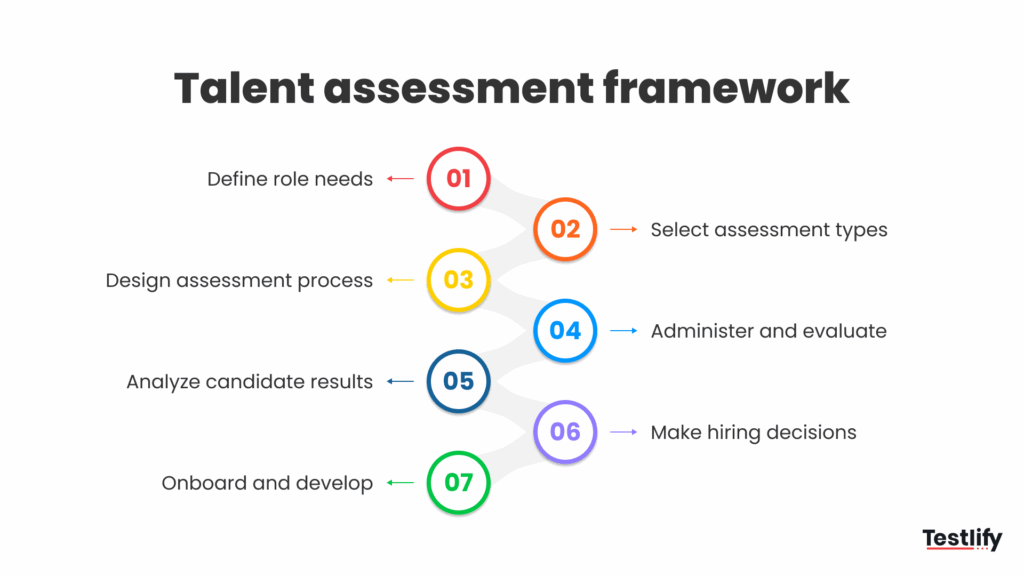
A talent assessment framework is the repeatable system that decides which skills you test, which tools you use, and how you score, for every role and every candidate. Without one, each hiring manager improvises, and you lose the fairness and comparability that made assessments worth running in the first place.
How do you build a talent assessment framework?
You build a talent assessment framework in six steps: set the hiring goal, define the role’s competencies, pick job-relevant tests, standardize scoring, communicate clearly with candidates, then review and refine. Done once per role family, it pays back on every hire after.
- Set the goal: Decide what a good hire looks like for this role and what you are screening for. A vague goal produces a vague test.
- Define competencies: List the few skills and traits that actually drive performance. Our guide to competency mapping walks through how.
- Choose job-relevant tests: Match each competency to a test type, not the other way round. Browse the test library to find ones that fit.
- Standardize and calibrate: Same tests, same scoring rubric, same pass marks for every candidate. This is what makes results fair.
- Communicate with candidates: Tell candidates what to expect, how long it takes, and why. A clear, short process protects your time-to-hire and your brand.
- Review and refine: Check whether scores actually predicted performance, then adjust. A framework you never revisit slowly drifts out of date.
What are the core components of a talent assessment?
Every solid talent assessment rests on three components: competency mapping (what to measure), assessment design (how to measure it), and data interpretation (how to act on the result). Skip any one and the other two stop being useful.
Competency mapping
Name the handful of skills and behaviors that separate a strong performer from an average one. Test those, and nothing extra. Most weak assessments fail here, by measuring what is easy to test instead of what matters.
Beyond core technical and cognitive skills, a few frequently overlooked competencies are worth mapping in on their own: time management and prioritization (how a candidate handles multiple tasks and deadlines under a fast-paced workload), continuous learning and adaptability (willingness to acquire new skills and adjust as the role or industry shifts), and cultural fit and alignment (how a candidate's values and work style match the team, distinct from personality alone).
Assessment design
Pick formats that mirror the real work and set a clear scoring rubric before anyone takes the test. Good design is also where you build in fairness, with job-relevant content and consistent scoring.
Reading the results
A score is only worth as much as the decision it drives. Compare candidates against the rubric, not against each other’s resumes, and use the result to guide the interview rather than replace it.
How do you design candidate-friendly assessments?
You design candidate-friendly assessments by keeping them short, relevant, and transparent. The goal is to measure skill without punishing people’s time, because a clumsy process costs you the very candidates you most want to hire.
- Keep it relevant. Test the job, not trivia. Candidates accept tasks that clearly relate to the role.
- Keep it short. 20 to 40 minutes is the sweet spot. Longer assessments lose strong applicants who have other offers.
- Give feedback. A short result or next step respects the candidate’s effort and protects your candidate experience.
- Make it accessible. Mobile-friendly, screen-reader friendly, and reasonable time limits so the test measures skill, not stamina.
Key takeaway: An assessment that candidates resent is a hiring tax. Treat the test as part of your employer brand: short, clearly job-relevant, and respectful of people’s time will get you more completions and better data than a long, generic one ever will.
How does technology scale talent assessments?
Technology turns a manual, one-off process into something a small team can run at scale and keep consistent. Testlify’s talent assessment framework structures the whole flow, mapping competencies to a validated test library, scoring every candidate the same way, and surfacing results as a shortlist you can defend.
The core of it is the Testlify Skills-Fit Scorecard: one view that scores each candidate against the competencies the role needs, so a hiring manager can compare ten people on evidence in minutes instead of re-reading ten resumes. A 500-person company hiring 20 support reps a quarter could screen the whole pool with a situational judgment test and a short role-specific task before the first call, which turns a slow resume sift into a ranked shortlist on day one.
Final thoughts
If there’s one thing worth remembering, it’s this: stop guessing who can do the job and start measuring it. Give candidates a chance to show their skills, score everyone the same way, and keep checking whether your process matches real-world performance.
Ready to see what your candidates can actually do? Build a job-relevant assessment in minutes, score every applicant the same way, and book a walkthrough with our team to set up your first one.
Frequently asked questions (FAQs)

Founder and CEO, Testlify
Abhishek Shah is the Founder and CEO of Testlify, a pre-employment assessment platform used by 1,500+ companies globally to hire fairly and at scale. He focuses on skills-based, bias-free hiring technology. Testlify is part of the SHRM Labs 2026 WorkplaceTech Accelerator.
LinkedInRelated resources
View all
Candidate assessment
Candidate Skills Testing: The 2026 Guide for HR Leaders

Candidate assessment
How to assess technical skills effectively for job positions in tech

Candidate assessment
How to Hire Technical Talent: A 2026 Guide for Enterprise Hiring Teams

Candidate assessment
What tools support voice responses for language proficiency testing?

Candidate assessment
How do ATS-integrated assessments streamline hiring workflows?
Candidate assessment
How to assess financial modeling and accounting skills pre-hire?
Get started.
Hire on proof, not resumes.
Run your first skills-based assessment free — no credit card required.