
12 innovative ideas for remote working teams in 2026
Twelve practical ideas that help distributed teams stay clear, connected and creative, with a cost table and a simple 90-day rollout plan.

Innovative ideas for remote working are practical changes to how a distributed team plans, talks, connects and learns, so people do their best work without sharing an office. The ideas that last are rarely gadgets or perks. They are habits: a written working agreement, async-first updates, random coffee pairings, meetups with a purpose, async brainwriting and protected focus time.
TL;DR / Key Takeaways
- The best ideas for remote working fix a specific problem: unclear goals, weak connection, few new ideas, no focus time or stalled growth.
- Gallup found fully remote employees are the most engaged group (31%), yet only 36% are thriving and 57% are watching for a new job.
- Clarity is the first gap to close. Only 46% of US employees strongly know what is expected of them at work, and the drop has been steeper for remote staff.
- Start with three free ideas: a team working agreement, weekly written updates and random coffee pairings.
- Meet in person once or twice a year with a clear agenda. A meetup without a reason to be together is just travel.
- Roll ideas out in 90 days: take a baseline pulse, run three ideas for six weeks, then keep only what moved the numbers.
- Remote culture starts at the hire. Test for written communication, time management and collaboration before people join.
 ChatGPT
 Gemini
 Claude
 Grok
 Perplexity
What are innovative ideas for remote working?
Innovative ideas for remote working are low-cost practices that replace what an office gives a team by accident: overheard context, quick feedback, casual friendships and visible progress. Each idea below targets one of five problems remote teams report most: clarity, connection, new ideas, focus and growth.
Remote work is now a normal part of how US companies run. According to the BLS telework trends report, 22.9% of people at work teleworked in the first quarter of 2024, about 35.5 million people, and 47.9% of them worked all their hours from home. For a definition of the arrangement itself, see the Testlify remote working glossary entry.
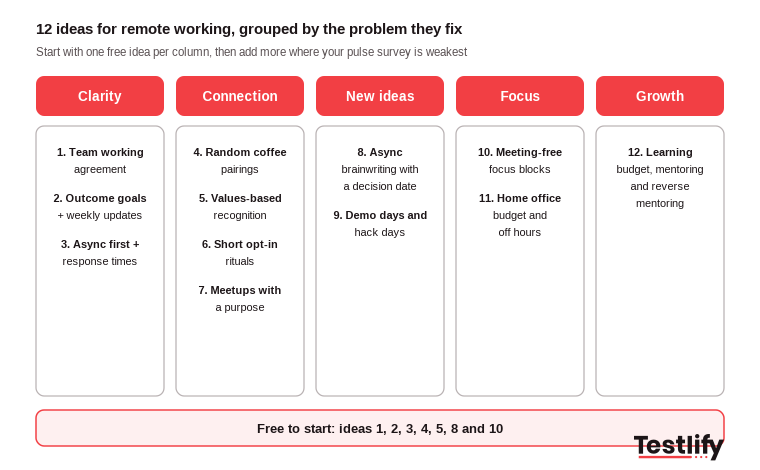

Which ideas give remote teams clear goals and expectations?
Remote teams get clear goals and expectations from three ideas: a written working agreement, outcome goals with weekly written updates, and async-first communication with agreed response times. Clarity comes first because every other idea fails when people are unsure what good work looks like.
The data backs this up. Gallup's Q3 2026 engagement update found US engagement fell to 29%, the lowest since 2011, and only 46% of employees strongly agree they know what is expected of them. Gallup also notes that clarity fell about twice as much among hybrid and fully remote employees as among on-site workers from 2020 to 2023.
1. Write a team working agreement
A working agreement is a one-page document the team writes together. It answers the questions an office answers without anyone asking:
- Core hours: The two to four hours when everyone is reachable, set across time zones.
- Channels: What goes in chat, what goes in email, what needs a call and where decisions are written down.
- Response times: For example, chat within four working hours, email within one working day, urgent issues by phone.
- Camera norms: When video is expected and when camera-off is fine.
Review it every quarter. New hires read it in week one, which makes it one of the cheapest onboarding tools a remote team has.
2. Set outcome goals and share weekly written updates
Track results, not online status. Give each person two or three outcomes per quarter, then ask for a short written update every Friday: what moved, what is blocked, what is next. Written updates create the visible progress an office gives for free, and managers spot blockers days earlier than in a status meeting.
3. Go async first, with agreed response times
Async first means work moves through written messages, shared documents and short recorded videos, and live meetings are kept for decisions, conflict and relationships. Harvard Business Review's March 2024 guide to asynchronous communication suggests keeping a running list of questions, scheduling messages for the recipient's workday and recording screen videos to explain problems. For the tools that make this easier, see this guide to remote work collaboration tools.
Pro tip: Before booking a meeting, ask whether a two-minute recorded video and a comment thread would get the same result. On most teams the answer is yes for status updates and walkthroughs.
Which remote culture ideas keep people connected?
Remote culture ideas that keep people connected create small, regular moments of contact: random coffee pairings, a recognition channel, short opt-in rituals and in-person meetups with a clear purpose. Connection matters because remote employees can be engaged in their work and still feel alone.
Gallup's remote work paradox research shows the gap clearly. Fully remote employees were the most engaged group at 31%, against 23% for hybrid workers. Yet only 36% of fully remote employees were thriving, against 42% of hybrid workers, and 57% were actively looking or watching for a new job. Engaged and thriving remote workers were far less likely to look, at 38%.
4. Run random coffee pairings
Pair two people from different teams for a 20-minute video chat every two weeks, with no agenda. A chat app plug-in or a simple spreadsheet shuffle works. Pairings rebuild the weak ties that used to form at the coffee machine, and those ties are how people find help outside their own team.
5. Start a recognition channel tied to team values
Create one channel where anyone can thank a colleague, and ask people to name the value or result the work supported. Specific praise ("your test plan caught the billing bug before release") teaches the whole team what good looks like. Managers should post weekly, but peers should post most of it.
6. Keep team rituals short and opt in
Ten-minute trivia at the end of a weekly call, a monthly show and tell, a photo thread on Fridays. Keep rituals short, make them optional and rotate who hosts. Forced fun after hours is one of the most common complaints in manager forums, so schedule rituals inside working time. This guide to virtual team building has more activity ideas.
7. Meet in person on purpose
Bring the team together once or twice a year, and give the meetup a job: plan the next half year, kick off a big project or onboard a group of new hires. Spend most of the agenda on work that is hard to do remotely, such as strategy debates and relationship building, and leave routine updates for async.
Which ideas help remote teams come up with new ideas?
Remote teams come up with more new ideas when idea generation is written, open to everyone and tied to a decision. Async brainwriting and regular demo or hack days do this well, because they give quieter people and other time zones the same voice as whoever speaks first on a call.
8. Use async brainwriting with a decision date
Post one clear problem in a shared document or board. Everyone adds ideas on their own for 48 hours, then the team votes, and the owner commits to a decision by a set date. Brainwriting removes the anchoring that happens when the most senior person speaks first, and the decision date stops the board from becoming a graveyard of ideas nobody acts on.
9. Hold demo days and hack days
Once a month, give each team ten minutes to show something real: a feature, a new process, an experiment that failed and what it taught them. Twice a year, run a one-day hack day where people work on any problem they choose. Demo days make remote work visible across the company, and hack days surface ideas that never fit into a quarterly plan.
Key takeaway: New ideas need two things remote teams often lack: a written place to share them and a named person who decides what happens next.
How can you protect focus and wellbeing in a remote environment?
A remote environment protects focus and wellbeing when the team guards deep work time and draws a clear line between work and home. Meeting-free focus blocks, a home office budget and agreed off hours do this without new software.
10. Block meeting-free focus time
Set one or two meeting-free half days per week for the whole team, and put them on everyone's calendar so they are visible. Pair this with a rule that meetings need an agenda and end five minutes early. Focus blocks cost nothing and are one of the easiest ideas to measure: ask people each month how many hours of uninterrupted work they got.
11. Fund the home office and agree on off hours
Give a one-time setup budget for a proper chair, desk and screen, plus a small monthly allowance for internet. Then agree on off hours: no expected replies after a set time, scheduled sending for late messages and managers who model it.
The ability to work from home keeps spreading. Data from the Bureau of Labor Statistics shows that 36.9% of wage and salary workers could work at home in 2024 to 2025, up from 28.8% in 2017 to 2018. Clear off hours stop that flexibility from turning into always-on work. For how remote policies shape hiring and retention, see this guide to remote work and talent acquisition.
How do you keep remote employees growing?
Remote employees keep growing when learning is funded, visible and tied to real work. A personal learning budget, a mentoring match and reverse mentoring give remote staff the growth that often happens by watching colleagues in an office.
12. Combine a learning budget with mentoring and reverse mentoring
Give each person a yearly learning budget and ask them to share one thing they learned at a team call or demo day. Match new and junior staff with a mentor outside their reporting line. Add reverse mentoring, where junior people coach leaders on tools and habits, so knowledge flows both ways. Ask about growth in regular stay interviews, because remote employees who feel stuck often leave without raising it.
How do you implement remote work ideas without overloading the team?
Implementing remote work ideas works best as a 90-day test, not a launch of twelve programs at once. Take a baseline, pick three ideas that match your biggest problem, run them for six weeks, then keep, change or drop each one based on the results.
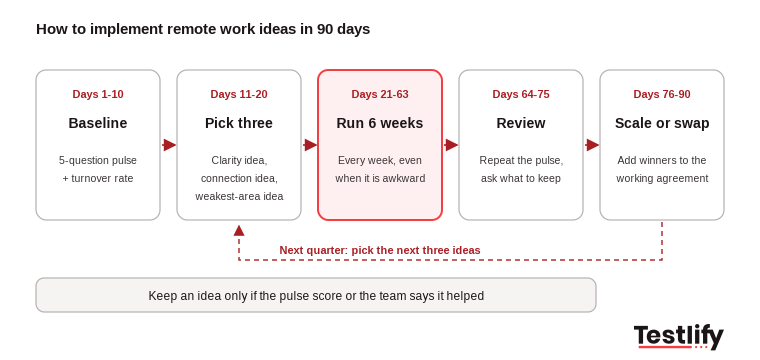
- Days 1 to 10, baseline: Run a five-question pulse survey on clarity, connection, focus, growth and workload, and note current regretted turnover.
- Days 11 to 20, pick three: Choose one free clarity idea, one connection idea and one idea for your weakest area. Name an owner for each.
- Days 21 to 63, run for six weeks: Keep the ideas going every week, even when attendance dips. Most habits feel awkward for the first three weeks.
- Days 64 to 75, review: Repeat the pulse survey and ask the team what to keep. Compare the scores with your baseline.
- Days 76 to 90, scale or swap: Write the ideas that worked into the team working agreement, drop the rest and pick the next three.
For the manager habits that keep these ideas running, read this guide on how to manage a remote team.
Why does a strong remote culture start with hiring?
A strong remote culture starts with hiring because the ideas above depend on people who write clearly, plan their own time and work well with colleagues they rarely see. Hiring for those skills makes every remote idea easier to run, and skipping them makes every idea harder.
Resumes rarely show these skills, so many teams test for them. Testlify's test library has 3,500+ tests, including a communication test, a time management test and a collaboration test. Candidates can take them from anywhere, in 15+ languages, with 20+ proctoring checks, and one-way video interviews show how someone explains their work on camera. The remote hiring guide covers the full process.
Ready to hire people who thrive remotely?
Browse the Testlify test library and build an assessment for your next remote role from its job description. Start a 7-day free trial, no credit card required, or book a demo to see how teams screen for remote-ready skills.
Frequently asked questions

Content Writer
Yashika Khandelwal is a Content Writer with 3+ years of experience creating research-backed content on hiring, talent assessment, and HR technology. She is a registered Organizational Psychologist and subject matter expert who combines behavioral science with practical recruitment insights to produce accurate, evidence-based content.
LinkedInRelated resources
View all
Remote hiring
Remote hiring statistics 2026: Assessment & global hiring trends

Remote hiring
Remote assessment: how it works and how to use it in hiring

Remote hiring
System compatibility check: how to prevent online assessment failures

Remote hiring
How to foster team cohesion and engagement in a remote workforce

Remote hiring
Remote Hiring Tools: Build Your 2026 Hiring Stack

Remote hiring
How to overcome geographical and cultural barriers in remote hiring
Get started.
Hire on proof, not resumes.
Run your first skills-based assessment free — no credit card required.