
The importance of candidate experience: 2026 data and fixes
Why candidate experience decides who finishes your process, accepts the offer and stays, with 2026 data, fixes by stage and metrics.

Candidate experience is how job seekers feel about your company after every step of your hiring process, from the job ad to their first day. The importance of candidate experience comes down to a simple fact: strong candidates have choices, and they judge your company by how you treat them before they ever join. Slow replies, long forms and silence after interviews push good people toward other offers.
TL;DR:
- Candidate experience decides whether strong applicants finish your process, accept the offer and stay after they join.
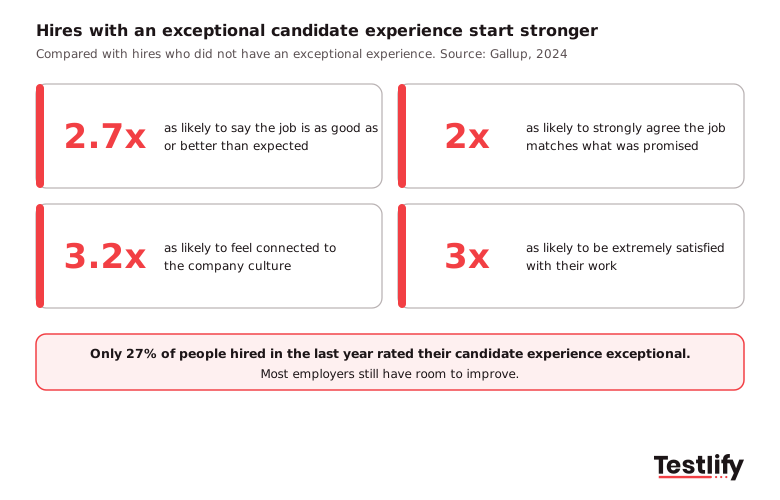
- Gallup found hires with an exceptional candidate experience were 2.7 times as likely to say the job was as good as or better than expected, yet only 27% of recent hires rated their experience exceptional.
- Silence is the biggest problem: in a 2026 Greenhouse survey, 81% of job seekers said they were rejected in the past year without ever being contacted.
- Poor communication was the top reason candidates withdrew in Monster's 2024 research (47%), ahead of interviewer behavior (46%).
- AI can help or hurt: only 26% of candidates trust AI to evaluate them fairly, so tell candidates when AI is used and keep a person in the decision.
- Track six numbers: application completion, stage drop-off, time to first response, time in stage, offer acceptance and candidate NPS.
 ChatGPT
 Gemini
 Claude
 Grok
 Perplexity
What is candidate experience?
Candidate experience is the sum of every interaction a person has with your hiring process and the impression those interactions leave, whether or not they get the job. Candidate experience in recruitment covers the career site, the application, screening tests, interviews, the offer or rejection, and the hand-off into onboarding. For a short definition, see the candidate experience glossary entry.
People sometimes ask "what is recruitment experience?" The phrase usually means the same thing seen from the job seeker's side: what it was like to apply, be assessed and hear back from an employer. Recruiters also use it for their own work history, but in hiring strategy it describes the candidate journey.
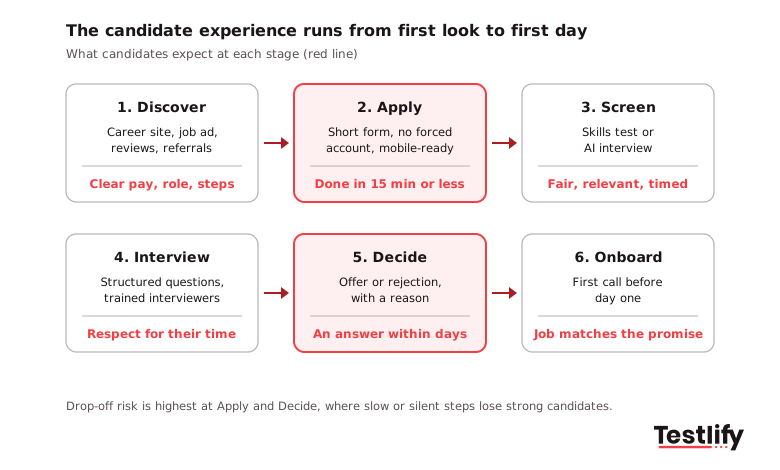
Candidates do not grade each stage separately. They remember the slowest step, the most confusing instruction and whether anyone told them where they stood. One unanswered email after a final interview can undo a smooth application.

Why does the importance of candidate experience keep growing?
The importance of candidate experience keeps growing because more of the hiring process now happens without a person in it, and candidates notice. Automated screening, high application volumes and lean recruiting teams mean many applicants never hear back at all.
The numbers from 2025 and 2026 show the gap clearly:
- Silence is common: A Greenhouse survey of more than 2,800 job seekers in the US, UK, Ireland, Germany and Australia, reported by HR Dive in October 2026, found 81% had been rejected in the past year without ever being contacted. Of those who reached an interview, 96% had at least one complaint, and 45% of them said they were ghosted.
- Candidates are gaming the screen: The same survey found 62% tried tactics to get past AI screening, and 96% wanted a way to show employers more than an application allows.
- Hiring is still hard: SHRM's 2025 Talent Trends research found 69% of employers struggle to fill full-time roles and 51% report too few applicants.
So employers are short of good applicants while the applicants they do attract feel ignored. That combination is why candidate experience recruitment work has moved from a "nice to have" to a hiring-results problem that TA leaders now own.
What does the importance of candidate experience mean for hiring results?
Candidate experience shapes three results every TA team reports on: how many strong candidates finish the process, how many accept offers, and how well new hires settle in. A good experience is not only courtesy; it shows up in the numbers after the hire.
Gallup's research on candidate experience found that recent hires who had an exceptional candidate experience were twice as likely to strongly agree that their job matched what they were promised, and 2.7 times as likely to say the job was as good as or better than expected. Employees who changed jobs with an exceptional experience were 3.2 times as likely to feel connected to the company culture and three times as likely to be extremely satisfied with their work.
Speed matters to offer decisions too. Gallup reported that 25% of employees said turnaround time had the greatest influence on accepting an offer, after pay, up from 22% a year earlier. A slow process does not just annoy candidates; it hands them time to accept someone else's offer. You can check your own rate with the job offer acceptance rate calculator.
Key takeaway: Candidate experience is a quality-of-hire lever, not only an employer brand project. People who were treated well during hiring start the job with more accurate expectations and stronger ties to the team.
What does a poor candidate experience cost a business?
A poor candidate experience costs a business lost hires, wasted recruiter hours and a weaker employer brand. The cost is easy to miss because it is spread across stages instead of showing up on one invoice.
Here is a simple worked example for a team hiring 50 customer support agents:
Step | With a slow, silent process | With a fast, clear process |
|---|---|---|
Applicants who start the form | 2,000 | 2,000 |
Finish the application | 1,200 (60%) | 1,600 (80%) |
Complete the skills screen | 720 (60%) | 1,120 (70%) |
Accept the offer when made | 70% | 85% |
Offers needed for 50 hires | 72 | 59 |
The slow process loses 400 finished applications and 400 completed skills screens, then needs 13 more offers, plus the interview rounds behind them, to fill the same 50 seats. The percentages are illustrative, so swap in your own funnel numbers. Every extra offer adds days to time to hire and more hours from hiring managers.
The damage also reaches people who never got close to an offer. Talent Board research covered by SHRM in 2024 found 36% of US candidates had not heard back one to two months after applying. Each of those applicants can leave a review, tell friends or stop buying from the company. For more on that side of the cost, read how poor candidate experience affects a business and the guide to your employer branding.
Why does candidate engagement matter as much as experience?
Candidate engagement is the active, two-way contact that keeps a candidate interested from application to offer. The importance of candidate engagement is that experience describes how the process feels, while engagement decides whether the candidate is still there at the end of it.
Ghosting now runs both ways. SHRM's 2025 Talent Trends release found that 41% of organizations say candidates ghost them during the interview process. Employers who go quiet for a week often find the candidate has stopped replying too. The candidate ghosting guide covers why it happens and how to stop it.
Engagement does not need to be heavy. It looks like:
- A date, not a promise: "You will hear from us by Thursday" beats "We will be in touch."
- One named contact: Candidates reply faster to a person than to a no-reply inbox.
- Updates on bad news too: A delay message keeps a candidate warm; silence makes them look elsewhere.
- Channels they read: Text or WhatsApp updates often reach hourly and frontline candidates faster than email.
For more ways to keep candidates involved, see candidate engagement for successful talent acquisition.
Where do candidates drop out, and what fixes each stage?
Candidates drop out where the process asks for effort without giving information back. Research from the 2024 Monster Work Watch report, covered by SHRM, found 47% of candidates named poor communication as the top reason they withdrew, 46% left because of an interviewer's attitude or behavior, and 35% quit when asked to write a long presentation or business case.
Stage | What usually goes wrong | Fix | Metric to watch |
|---|---|---|---|
Discover | Vague job ad, no pay range, no process outline | List the steps, the timeline and the pay range | Apply rate from job page |
Apply | Long form, forced account, resume retyping | Keep it under 15 minutes; parse the resume | Application completion rate |
Screen | Generic test, no time estimate, no reason given | Short role-based skills test with the time shown up front | Screen completion rate |
Interview | Unprepared or inconsistent interviewers | structured interviews with trained panels | Drop-off after interview |
Decide | Weeks of silence, no feedback | Decision dates; short feedback for finalists | Time to decision, offer acceptance |
Onboard | Nothing between offer and day one | Hiring manager call before the start date | Offer-to-start drop-off |
Notice that most fixes cost time and planning, not budget. Telling candidates how long a test takes, or when they will hear back, removes most of the anxiety that drives withdrawals. For a full list of tactics, see creating a positive candidate experience.
Pro tip: Put a time estimate on every step you send. "This skills test takes 25 minutes" sets an expectation the candidate can plan around, and candidates who know the length are less likely to abandon halfway.
How can AI improve candidate experience instead of hurting it?
AI improves candidate experience when it makes the process faster and fairer and candidates know it is being used. AI hurts when it rejects people silently or feels like a black box.
Trust is the gap to close. A Gartner survey of 2,918 job candidates, reported in August 2025, found only 26% trust AI to evaluate them fairly, and 25% said they trust an employer less when AI evaluates their information.
Yet candidates are not against AI itself. In the 2026 Greenhouse survey, nearly half of job seekers had sat an AI interview; 70% of them said it let them show their skills, and only 7% said they would refuse one outright. Recruiters see the upside as well: in LinkedIn research with 1,000 US and UK TA professionals in September 2025, 64% of recruiters using AI said it improves the candidate experience.
What candidates want is openness. In the Greenhouse survey, 88% wanted a legal requirement to disclose AI in interviews, and 55% wanted advance notice. Some rules already go that far: New York City's Local Law 144 requires a bias audit and candidate notice before an automated tool is used to screen candidates.
Practical rules for using AI without losing trust:
- Tell candidates up front: Say where AI is used, what it scores and who makes the final call.
- Score skills, not keywords: A job-related skills test or structured AI interview gives every candidate the same chance to show ability, which addresses the 96% who want to show more than a resume.
- Keep a person in the decision: Let reviewers see the evidence behind each score and override it.
- Use the time saved on people: Spend the hours AI frees on faster replies and feedback for finalists.
How do you measure candidate experience?
Candidate experience is measured with a mix of funnel data and direct feedback. Funnel data shows where candidates leave; feedback shows why. Track both by stage, role and source so you can find the exact step that is failing.
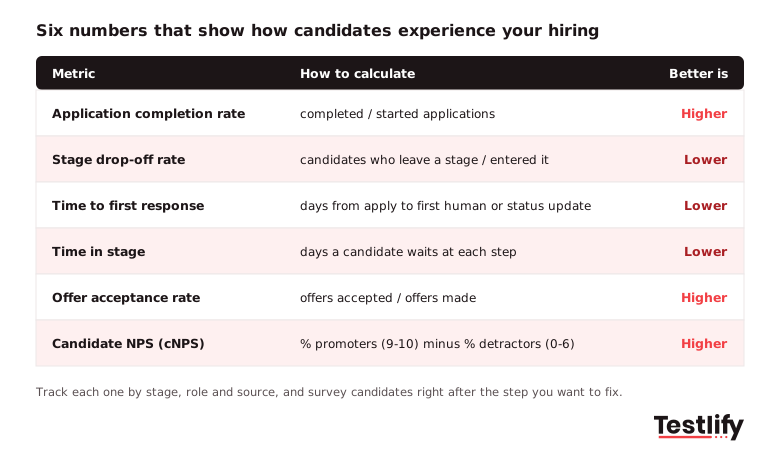
The six numbers worth tracking:
- Application completion rate: Completed applications divided by started applications.
- Stage drop-off rate: Candidates who leave a stage divided by candidates who entered it.
- Time to first response: Days from application to the first human reply or status update.
- Time in stage: Days a candidate waits at each step. Talent Board found the highest-rated employers historically moved candidates forward within three to five days of applying.
- Offer acceptance rate: Offers accepted divided by offers made.
- Candidate NPS (cNPS): Ask "How likely are you to recommend applying here?" on a 0 to 10 scale. Subtract the percentage of detractors (0 to 6) from the percentage of promoters (9 and 10).
Send short surveys right after the step you want to improve, including to rejected candidates, since their view is the one most teams never hear. A recruitment analytics setup that joins ATS stage data with survey scores makes the trends easy to spot.
How does Testlify support a better candidate experience?
Testlify supports candidate experience at the screening stage, where many processes lose people to long, generic or unfair tests. The platform turns a job description into a role-specific assessment, so candidates answer questions that relate to the job they applied for.
- Relevant, varied tests: 3,500+ validated tests and 25+ question types, from coding and simulations to video and chat answers, so candidates show real skills instead of retyping a resume. Browse the test library.
- Faster decisions: Automated scoring and a ranked shortlist help teams reply to candidates sooner, and Testlify reports 55% faster time-to-hire for its customers.
- Candidates in their own language: Multilingual assessments run in 15+ languages, and the platform features the capabilities to send them to candidates via WhatsApp invites and e-mail..
- Fair and transparent: 20+ proctoring checks protect honest candidates, and the matching model completed a third-party NYC bias audit.
- No extra logins for recruiters: 100+ ATS and HRIS integrations sync results back to the systems your team already uses.
Testlify reports 94% candidate satisfaction with its assessments. More on the candidate side is on the candidate journey page.
Ready to give candidates a better hiring experience?
Start with the screening step. Browse the Testlify test library, pick a role-based test and try it on your next opening with a 7-day free trial, no credit card required.
Frequently asked questions (FAQs)

People and Talent Partner
Arushi Shah runs day-to-day talent acquisition and candidate experience at Testlify. She writes on interviewing, structured hiring, and giving candidates a fair, fast process.
LinkedInRelated resources
View all
HR & recruitment
Why you need diversity in the workplace?

HR & recruitment
Resume verification process: a step-by-step guide for 2026

HR & recruitment
The ultimate guide to problem solving in the workplace

HR & recruitment
How skills assessments can improve your recruitment process

HR & recruitment
Best recruitment tools for hiring teams in 2026: 25 picks by stage

HR & recruitment
How to determine a candidate's cultural fit: a 7-step guide
Get started.
Hire on proof, not resumes.
Run your first skills-based assessment free — no credit card required.