
How to improve candidate assessment beyond traditional tests
Why quiz-style tests miss real skills, which candidate assessment methods work better, and how to build, run and measure a fair process.

Candidate assessment is how a hiring team collects evidence that a person can do the job, using tests, work samples, simulations and structured interviews scored against the same criteria for everyone. Traditional tests still have a place, but on their own they now miss too much, and AI tools make them easy to game.
TL;DR:
- Candidate assessment means gathering job-related evidence on every applicant and scoring it the same way, so the hiring decision rests on proof instead of a resume and a gut feeling.
- Quiz-style tests alone are no longer enough. A 2026 SHRM Labs article reports that 59% of hiring managers suspect candidates use AI tools during live assessments.
- The methods that predict best mirror the job: work samples, job simulations, situational judgment tests and structured interviews with a scorecard.
- Use two or three methods in sequence, from a short skills test at the top of the funnel to a structured interview for the shortlist.
- Every method must be job-related, consistent for all candidates and open to accommodations, which is what the EEOC expects of employment tests.
- Check the process with quality-of-hire data such as 90-day performance, retention and hiring manager ratings, then cut any step that does not predict them.
 ChatGPT
 Gemini
 Claude
 Grok
 Perplexity
What is candidate assessment?
Candidate assessment is the structured process of testing whether applicants have the skills, judgment and working style a role needs, then comparing them on the same scored criteria. It usually combines a skills test, a practical task and a structured interview, so no single score decides the outcome.
A good candidate assessment answers three questions for the hiring team:
- Can this person do the work: Skills tests, practical tasks and simulations show the skill in action.
- How will they handle the job's real situations: Situational judgment questions and structured interviews show judgment and behavior.
- How do they compare with other applicants: Shared scoring criteria turn every answer into evidence a second reviewer would score the same way.
Candidate evaluation is the last step of the same process: reading the scores, the reviewer notes and the interview evidence together before deciding. A clear candidate assessment report keeps that evidence in one place for the debrief.

Why do traditional tests fall short now?
Traditional tests fall short because they mostly check what a candidate can recall under time pressure, not what they can do on the job, and recall is now the easiest thing for an AI tool to supply. A multiple-choice quiz or a take-home exercise with no follow-up can be passed by someone who cannot do the work.
Four problems show up most often:
- They test recall, not application: Knowing the right answer to a coding or accounting question is not the same as fixing a broken script or closing the books with messy data.
- They are easy to game: SHRM Labs reports that 38.5% of about 20,000 interviewed candidates showed signs of cheating between July 2025 and January 2026, rising to 48% in technical roles, based on data from an AI interview platform.
- They cover a narrow slice of the job: Communication, prioritizing, customer handling and working with incomplete information rarely appear in a timed quiz.
- They add stress without adding signal: Long, generic tests with no link to the role push strong applicants to drop out, especially those with other offers.
Testlify platform data shows assessments that normally take 25 to 30 minutes finished in under 10, and lower accuracy on scenario questions than on multiple-choice ones. Applying knowledge is harder to copy from a chatbot than picking an answer.
The cost of getting it wrong is high. SHRM research puts the cost of replacing a bad hire at 50% to 200% of the role's salary, depending on seniority.
Which candidate assessment methods work better than traditional tests?
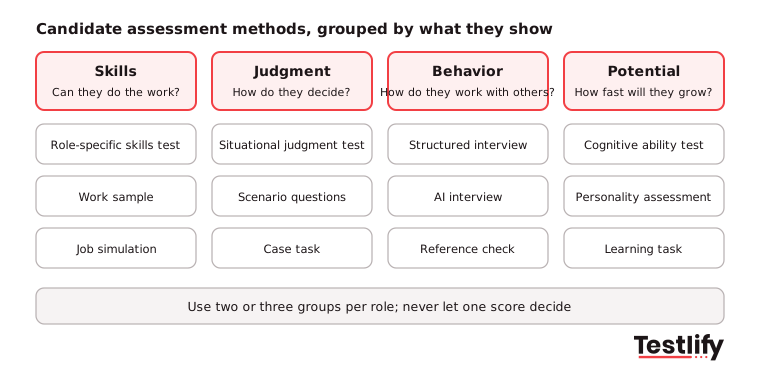
The candidate assessment methods that work better than traditional tests are the ones that look like the job: work samples, job simulations, situational judgment tests, structured interviews and AI-led interviews scored against a rubric. Cognitive and personality tests still help, but as one input among several, never the only one.
Method | What it shows | Best stage | Effort for the team | Exposure to AI-assisted answers |
|---|---|---|---|---|
Role-specific skills test | Hard skills for the role, at the right level | First screen | Low, scored automatically | Medium, lower with scenario questions |
Work sample or practical task | Quality of real output (a fixed bug, a drafted email, a cleaned dataset) | After the screen | Medium | Medium, low when followed by questions |
Job simulation | How the candidate works through a real task in a realistic tool | Screen or shortlist | Low to medium | Low |
Situational judgment test | Judgment in the role's common situations | First screen | Low | Low |
Structured interview with scorecard | Behavior, communication, motivation | Shortlist | High | Low in live rounds |
AI interview (chat, voice or video) | Communication and reasoning, asked the same way for everyone | First or second round | Low | Medium, checked by authenticity signals |
Cognitive ability test | Problem solving and learning speed | First screen | Low | Medium |
Personality or culture assessment | Working style and preferences | Alongside other methods | Low | Low, but weak on its own |
A short guide to each:
- Role-specific skills tests: Pick tests built for the job title and level rather than one generic aptitude test. The Testlify test library lists tests by role and skill.
- Work samples: Ask for a small piece of real work, scored against a rubric agreed in advance. Keep it to an hour or less, and always follow it with a few questions about how the candidate did it.
- Job simulations: A job simulation puts the candidate in a realistic version of the work, such as a spreadsheet task, a support chat or a coding environment.
- Situational judgment tests: Situational judgment tests show how someone would handle the role's common dilemmas, like an angry customer or two competing deadlines.
- Structured interviews: Every candidate gets the same questions and the same interview scorecard. The difference from an informal chat is covered in structured vs unstructured interviews.
- Cognitive ability tests: Cognitive ability tests help for roles where learning fast matters, used next to role-specific evidence.
The CIPD selection factsheet makes the same point: use several methods, and never let one test result be the sole basis for a selection decision.
How do you build a candidate assessment process?
A candidate assessment process is built in five steps: define what the role needs, pick a method for each requirement, set the scoring rules, run the stages in order and review results against real job performance. Each step takes the guesswork out of the one after it.
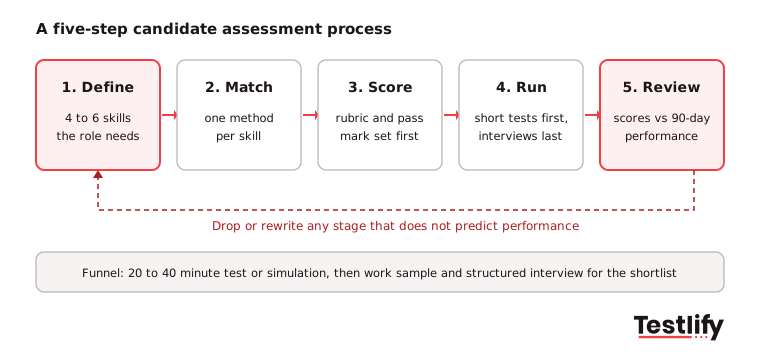
- Define what the role needs: List the 4 to 6 skills and behaviors that separate a strong hire from an average one. Ask the hiring manager what a great first 90 days looks like, not just what the job ad says.
- Pick one method per requirement: Match each skill to the method that shows it best: a coding task for debugging, a simulation for spreadsheet work, a structured question for stakeholder handling.
- Set scoring rules before anyone applies: Write what a 1, 3 and 5 answer looks like for every question and task. Agree the pass mark and the weight of each section.
- Run the stages in order: Put the short, automated methods first (a 20 to 40 minute skills test or simulation), then the time-heavy ones (work sample review, structured interview) for the shortlist only.
- Review results against performance: After 90 days, compare assessment scores with how hires are doing. Drop or rewrite any question or stage that does not predict it.
Pro tip: Keep the first assessment under 40 minutes. Candidates with options rarely finish long, generic tests, and the best applicants are the ones most likely to have options.
How do you keep candidate assessment fair and compliant?
Candidate assessment stays fair and compliant when every method is tied to the job, every candidate gets the same questions and scoring, adjustments are offered up front and a person reviews the decisions. The rules apply whether a human or an AI tool does the scoring.
- Test only what the job needs: The EEOC guidance on employment tests and selection procedures says a test that screens out a protected group must be job-related and consistent with business necessity, and the employer stays responsible even when a vendor built the test.
- Offer accommodations before the test: Ask every candidate about adjustments such as extra time or a screen reader, rather than waiting for requests.
- Use the same structure for everyone: Same questions, same time limits, same rubric. Inconsistency is where bias creeps in.
- Check outcomes by group: Compare pass rates across groups at each stage and look into any stage where one group drops sharply.
- Follow AI hiring rules where you hire: New York City's Local Law 144 requires a bias audit and candidate notice before an automated employment decision tool is used. A third-party NYC Local Law 144 bias audit of the Testlify matching model was completed on June 16, 2023.
- Keep a human in the loop: Let AI scoring rank and summarize, but have a recruiter or hiring manager review rejections and final decisions.
How do you stop cheating without hurting the candidate experience?
Cheating is best stopped by assessment design first and monitoring second: questions that ask candidates to apply knowledge, follow-up questions on their own answers and a few combined integrity signals. Heavy surveillance alone frustrates honest candidates and still misses tools that run on a second device.
- Ask for application, not recall: Scenario questions, simulations and "explain how you reached this" prompts are harder to answer with a chatbot.
- Follow up on the work: In the next round, ask candidates to walk through their test or task answers. A gap between a perfect score and a weak explanation is a strong signal.
- Read signals together: Tab switching, very fast completion, copy and paste and face or voice checks mean little alone. Several together are worth a closer look.
- Tell candidates the rules up front: An honesty agreement and a clear explanation of what is monitored cut cheating and keep trust.
- Keep it short and relevant: Candidates accept a role-specific, 30-minute assessment far more readily than a 90-minute generic battery.
Testlify includes 20+ proctoring checks, such as full-screen enforcement, tab and copy-paste tracking, webcam snapshots, AI assistance detection and speech authenticity detection for voice and video AI interviews. The anti-cheating and proctoring features let teams set how many violations are tolerated before a test ends. For more on keeping the process candidate-friendly, see improving candidate experience with smart assessments.
How do you know your candidate assessment is working?
A candidate assessment is working when the people who score well also perform well, stay and satisfy their hiring managers. Track a small set of quality-of-hire and process metrics for every role, review them each quarter and change the steps that do not predict performance.
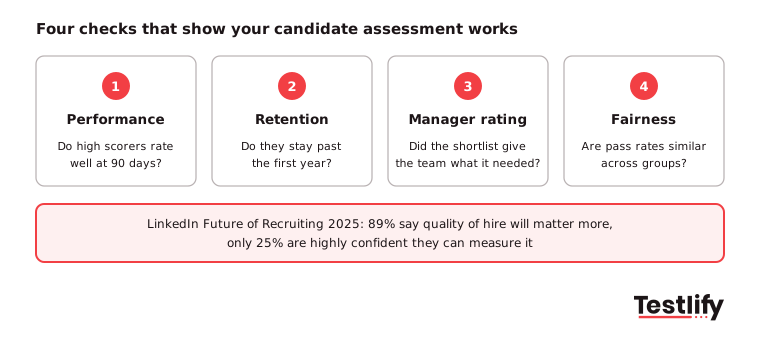
The LinkedIn Future of Recruiting 2025 report found that 93% of talent acquisition professionals say accurately assessing skills is crucial to improving quality of hire, and companies with the most skills-based searches are 12% more likely to make a quality hire. The same report found that 89% expect measuring quality of hire to grow in importance, yet only 25% are highly confident they can measure it.
Metric | What it tells you | When to check |
|---|---|---|
Score vs 90-day performance rating | Whether high scorers turn into strong performers | 90 days after start |
First-year retention by score band | Whether the assessment screens for fit and staying power | 6 and 12 months |
Hiring manager satisfaction | Whether the shortlist matches what the team needed | After each hire |
Assessment completion rate | Whether the test is too long or off-putting | Weekly |
Pass rate by stage and group | Whether any stage screens out one group unfairly | Each quarter |
Time from application to shortlist | Whether the process is fast enough to keep strong candidates | Weekly |
Key takeaway: If a stage does not predict 90-day performance or retention, it only adds time and drop-off. Shorten it or replace it with a method that mirrors the job more closely.
How does Testlify support candidate assessment?
Testlify supports candidate assessment by combining skills tests, simulations and structured AI interviews in one workflow, with the same scoring for every candidate and results that sync to the ATS. Hiring teams use it to replace quiz-style screening with role-specific evidence.
- Tests for the role: 3,500+ tests across technical and non-technical roles, plus an AI test builder that drafts an assessment from a job description.
- Many ways to show a skill: 25+ question types, including coding, file upload, typing, Microsoft Office and Google Workspace tasks, and audio and video answers.
- Structured AI interviews: Chat AI interviews, voice AI and video AI interviews that ask every candidate the same role-based questions, alongside one-way video interviews.
- Scoring you can explain: Automated scoring, per-skill breakdowns and AI-written strengths and gaps, with weighted sections and benchmarks.
- Fit with your stack: 100+ ATS and HRIS integrations with two-way sync, in 15+ languages for global hiring.
To compare platforms side by side, see the guide to candidate assessment tools.
Ready to assess candidates on real work?
Swap one quiz-style screen for a role-specific test or simulation and compare the shortlist it produces. Browse the test library to find tests for your open roles, start a 7-day free trial with no credit card, or book a demo to see the full candidate assessment workflow.
Frequently asked questions (FAQs)

Content Writer
Yashika Khandelwal is a Content Writer with 3+ years of experience creating research-backed content on hiring, talent assessment, and HR technology. She is a registered Organizational Psychologist and subject matter expert who combines behavioral science with practical recruitment insights to produce accurate, evidence-based content.
LinkedInRelated resources
View all
Candidate assessment
Typing Speed and Accuracy in the Workplace: What Good Looks Like

Candidate assessment
How psychometric tests reduce employee turnover

Candidate assessment
How to use psychometric tests to improve employee performance

Candidate assessment
How to Use Typing Tests to Assess Job Candidates

Candidate assessment
Psychometric tests: 8 types and how to use them in hiring

Candidate assessment
Resilience assessment: how to measure it when you hire
Get started.
Hire on proof, not resumes.
Run your first skills-based assessment free — no credit card required.