
How to accurately assess attention to detail skill in candidates?
Learn how to assess attention to detail in candidates using tests, interviews, and tools to reduce errors and boost workplace efficiency.

Did you know that 88% of employees believe that attention to detail is critical for job performance, yet only 23% of hiring managers have a structured way to assess it?
A candidate with strong attention to detail can spot errors, follow rules to the letter, and deliver high-quality work consistently. Yet, screening candidates for the attention to detail skill during hiring is one of the hardest challenges for recruiters. Many candidates claim to be detail-oriented, but only a structured evaluation process reveals the truth.
Even more surprising, a study by SHRM found that poor attention to detail costs companies an average of $5,000 per employee annually in errors, rework, and missed opportunities.
These numbers highlight a major gap in hiring. Many companies overlook this crucial skill, leading to costly mistakes. So, how can you accurately assess candidates’ attention to detail and ensure you hire people who minimize errors and maximize efficiency?
In this blog, we will explore why attention to detail is so important, how to assess it during the recruitment process, and the tools you can use to evaluate this skill more effectively.
 ChatGPT
 Gemini
 Claude
 Grok
Grok Perplexity
What is attention to detail?
Attention to detail is the ability to complete tasks thoroughly and accurately, paying careful attention to the nuances, specifics, and components of a task. It involves being meticulous and precise in your work while ensuring that even the smallest elements of a project are properly executed.
Attention to detail can be involved in many different ways, including:
- Proofreading documents and ensuring that there are no errors
- Following detailed instructions with precision
- Managing multiple tasks without losing track of important details
- Analyzing and identifying discrepancies or inconsistencies in data or reports
While this skill is often associated with roles that require high levels of accuracy, such as accountants, editors, or designers, it’s valuable in nearly every position. Someone with strong attention to detail can be counted on to reduce mistakes, deliver high-quality work, and improve organizational efficiency.

Why is attention to detail important in the workplace?
Attention to detail influences every part of workplace performance, from daily execution to long-term business outcomes. Employees who consistently produce reliable work help teams reduce errors, improve efficiency, and maintain higher professional standards across the organization.
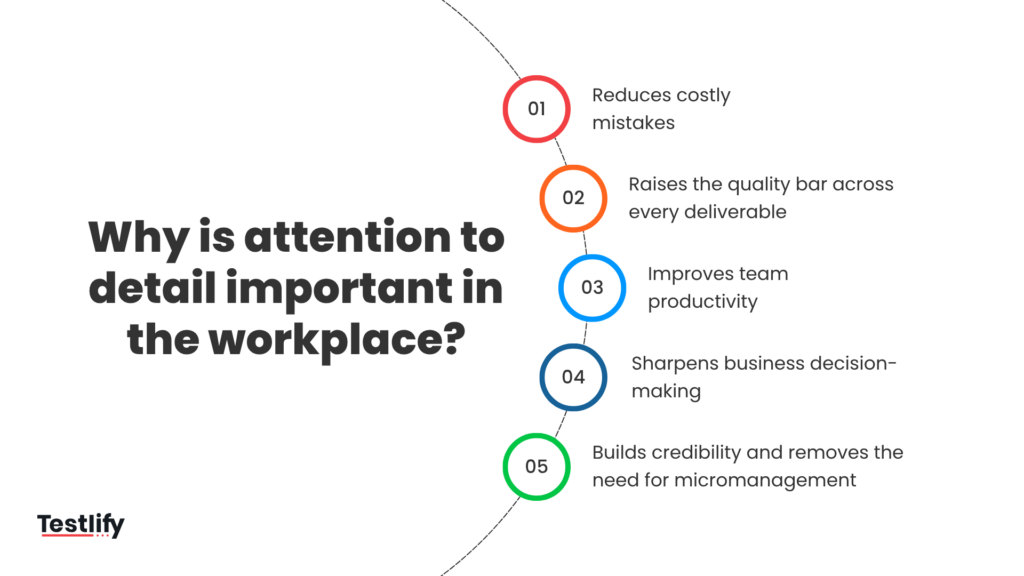
Reduces costly mistakes
Detail-oriented employees prevent the operational errors that pile up across data entry, internal reporting, customer communication, and day-to-day processes. A single weak link in the team often triggers customer churn or material financial loss before anyone notices the problem.
SHRM places the cost of a single bad hire near $4,700 in direct expenses, while IBM estimates that poor data quality costs U.S. businesses roughly $3.1 trillion every year. Hiring for attention to detail is the cheapest insurance against both numbers.
Raises the quality bar across every deliverable
Employees with strong attention to detail ship polished, consistent, and professional work in every format they touch. This habit lifts the overall quality standard for the wider team and protects the brand from sloppy outputs ever reaching customers.
Gartner research shows that 89% of talent leaders track quality of hire as a top metric heading into 2025. Strong attention to detail lifts that score directly through fewer revisions and cleaner first drafts.
Improves team productivity
Detail-focused hires submit clean work the first time and waste almost no cycles fixing avoidable errors after the fact. This habit compounds across the team and produces measurable gains in throughput, sprint velocity, and overall project delivery times.
Forbes coverage of high performers notes that detail-oriented employees deliver up to 21% higher productivity in operational roles. The flywheel effect is real and shows up inside the first quarter.
Sharpens business decision-making
Detail-oriented employees spot patterns, discrepancies, and subtle data shifts that less observant peers miss completely. This habit feeds leadership highly reliable inputs at every decision point.
McKinsey reports that companies in the top quartile for execution quality outperform peers by roughly 30% on operating margin. Sharp inputs at the front line drive that outperformance every time.
Builds credibility and removes the need for micromanagement
Employees who consistently deliver thorough, error-free work earn deep trust from leadership, customers, and cross-functional partners alike. This trust strengthens team dynamics and frees managers from the time drain of constant double-checking.
LinkedIn’s Global Talent Trends survey found that 92% of talent leaders rank soft skills as equal to or more important than technical skills. Attention to detail consistently sits in the top five soft skills employers screen for today.
How do you measure attention to detail skills in candidates?
Recruiters can measure attention to detail through job-relevant skill tests, scored work samples, and structured behavioral interviews scored against a single rubric.
Follow these five steps to build a defensible assessment process.
- Define the details in the role: List five tasks where small errors create real cost. Use those tasks as the test brief.
- Deploy a validated skill test. Pick a pre-employment assessment that measures speed and accuracy under time pressure. The test must mirror real work.
- Add a scored work sample. Give the candidate a 30-minute task pulled directly from the role. Score the output against a clear rubric.
- Run a structured interview. Ask three behavioral questions tied to past detail-driven wins. Score answers on specificity, outcome, and process.
- Combine scores into one decision. Weight the skill test at 50%, the work sample at 30%, and the interview at 20%. Hire only candidates who clear a pre-set threshold.
This stack predicts performance better than any trick question. Korn Ferry research confirms that structured assessments lift quality of hire by up to 24% over unstructured methods.
A simple scoring rubric keeps decisions consistent across the panel. The rubric below captures the core dimensions hiring teams should track.
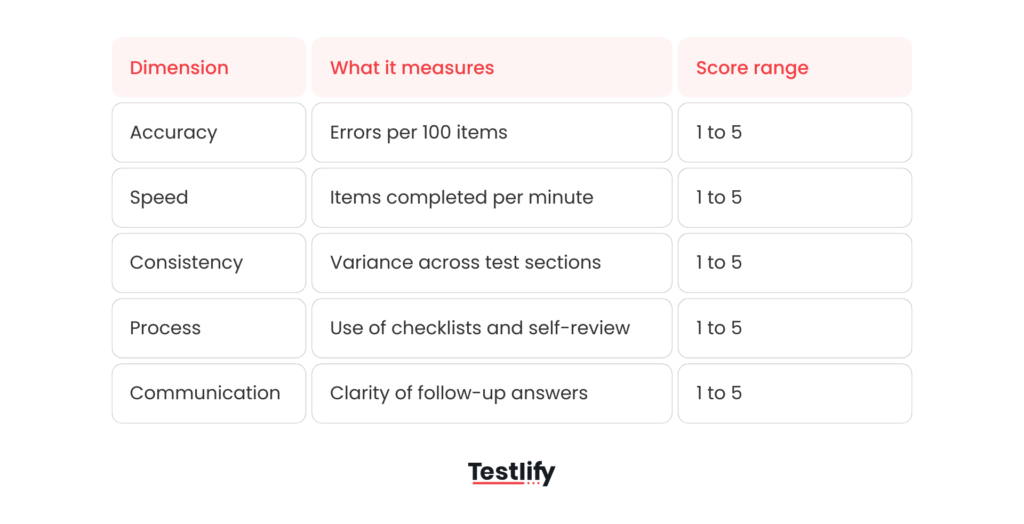
Hiring teams that adopt this rubric cut hiring bias and create an audit trail for every decision.
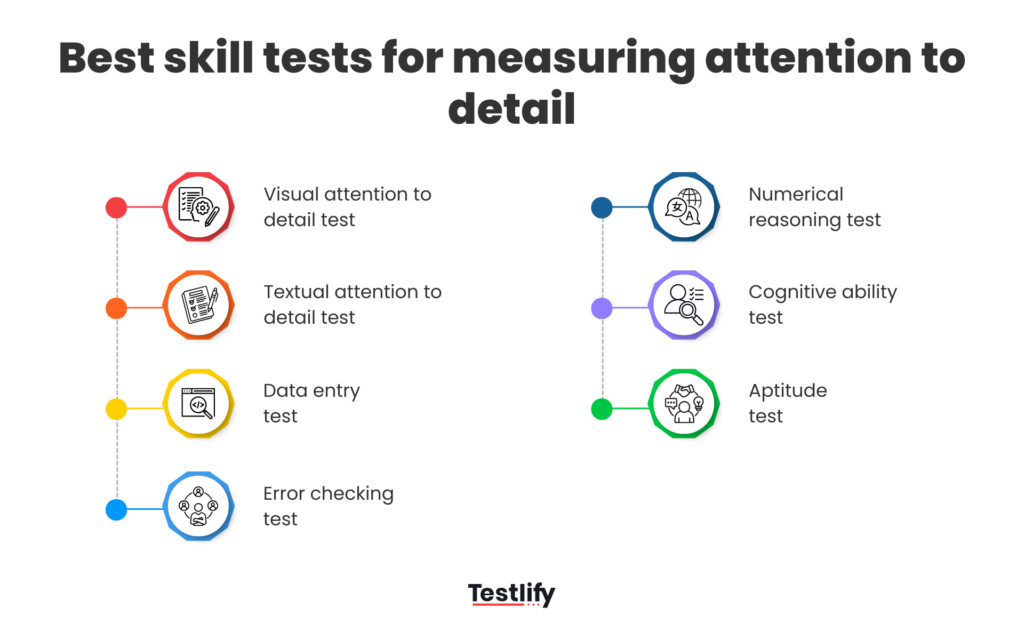
Which are the best skill tests for measuring attention to detail?
The best tests combine visual checking, textual proofreading, data accuracy, and error spotting in timed formats with clear scoring models.
The right test depends on the role you are filling and the type of detail work the candidate will perform daily. The seven assessments below cover the most common detail-heavy roles in any modern organisation.
Visual attention to detail test
Visual attention to detail tests evaluate how reliably a candidate spots small differences between images, layouts, or data visualisations. The format usually presents two near-identical visuals and asks the candidate to mark every variation under a strict time limit.
This assessment predicts performance in roles that involve quality assurance, design review, and operational oversight. Designers, QA analysts, warehouse supervisors, and manufacturing inspectors all rely on this skill every single day.
Testlify offers a dedicated visual attention to detail test that scores both accuracy and speed against role-specific norms.
Textual attention to detail test
Textual attention to detail tests measure how well a candidate proofreads written material and follows multi-step instructions without losing accuracy.
The test typically includes documents seeded with grammatical errors, factual inconsistencies, and formatting issues that the candidate must flag within a fixed window.
Compliance officers, paralegals, content editors, and customer support agents all need this skill to protect the business from costly written errors. A single missed clause in a contract or a wrong figure in a customer email can damage trust within minutes.
Testlify offers an attention to detail (textual) test that benchmarks textual accuracy and instruction-following discipline against role-specific baselines.
Related Read: Importance of attention to detail in the workplace
Data entry test
Data entry tests evaluate how accurately and quickly a candidate transcribes structured information from one format into another. Candidates type numbers, names, codes, or addresses into a target field while the test tracks both error rate and overall throughput.
This assessment is essential for finance teams, administrative roles, healthcare records functions, and analytics support teams. Even a single transposed digit in a financial record can trigger downstream reporting failures that take weeks to unwind.
Testlify offers a data entry test that grades both accuracy and throughput against industry benchmarks for each role family.
Error checking test
Error checking tests measure how reliably a candidate spots inconsistencies inside structured records such as invoices, customer profiles, or compliance forms.
Audit teams, customer support functions, and healthcare administration teams all depend on this skill to prevent regulatory fines and patient safety incidents. The cost of a missed inconsistency often dwarfs the entire cost of running the assessment in the first place.
Testlify offers role-specific tests that surface top talent who possess strong attention to detail in their respective roles.
Numerical reasoning test
Numerical reasoning tests assess how confidently a candidate interprets figures, percentages, and ratios under timed conditions. The test usually includes charts, tables, and short calculations that mirror real business reporting tasks pulled from finance, sales, and operations dashboards.
Finance teams, sales operations leaders, and analytics functions need this skill to spot reporting errors before those errors reach the leadership team. A misread percentage in a board deck can trigger the wrong strategic decision and cost the business millions over time.
Testlify offers a numerical reasoning test tuned specifically for detail-heavy quantitative roles across finance and analytics.
Cognitive ability test
Cognitive ability tests measure working memory, pattern recognition, and processing speed across mixed problem types. These assessments predict how well a candidate handles detail-heavy situations on the job, especially when the task type changes mid-day.
Knowledge workers, leadership pipeline candidates, and graduate hires benefit most from this assessment because their work spans many task types in a single week. The score correlates strongly with first-year performance ratings across most professional roles, according to Korn Ferry research.
Testlify offers a cognitive ability test used by HR teams worldwide to screen for general detail-orientation potential at scale.
Aptitude test
Aptitude tests combine logical reasoning, verbal comprehension, and numerical skills into a single composite assessment. The mix surfaces candidates who can apply attention to detail across varied tasks rather than only in one narrow lane.
Graduate hiring programmes, rotational schemes, and high-volume early-career hiring all use these tests to identify high-potential candidates quickly. A strong aptitude score signals a candidate who will adapt across multiple roles without losing accuracy or pace.
Testlify offers an aptitude test designed specifically for early-career and high-volume hiring scenarios.
For more advanced screening, hiring teams can layer situational judgment tests and personality assessments on top of these core skill tests. The combination predicts on-the-job performance with greater accuracy than any single test used in isolation.
What are the common red flags when assessing attention to detail?
Direct answer: Watch for sloppy applications, vague behavioral answers, rushed test responses, and inconsistent scores across formats.
These signals predict on-the-job errors with high reliability across most professional roles.
- Typos in the resume or cover letter signal weak self-review habits, especially when more than two errors slip through what should be the candidate’s most polished document of the entire process.
- Vague interview answers without metrics indicate shallow recall of past work, while strong candidates name specific errors they caught and quantify the dollar or hour impact every single time.
- Speed without accuracy on tests reveals candidates who race through tasks to look productive, but will create costly rework patterns once they join the team full-time.
- Skipped application instructions, such as missing portfolio links or ignored short-answer prompts, predict the same disregard for instructions on real project briefs after the offer.
- Inconsistent test scores across formats, such as a high visual score paired with a low textual score, often signal a fundamental role-fit mismatch worth probing during the interview.
- Generic answers without measurable outcomes suggest the candidate is recycling rehearsed stories rather than recalling actual, detail-driven wins from their past roles.
- No clarifying questions about edge cases marks a candidate who jumps straight into work without scoping risks, a habit that produces avoidable errors at scale.
BambooHR research shows that roughly 30% of new hires leave within six months of joining. The most common driver is a mismatch in core skills, including attention to detail.
Spotting these flags early saves the cost of replacement and protects the candidate experience for the rest of the pipeline.
What are the key indicators of strong attention to detail in candidates?
Direct answer: Strong candidates show high accuracy under time pressure, cite specific examples, present clean materials, and use process-oriented language.
Hiring teams should look for these five traits during screening, work samples, and interviews.
- High accuracy under timed conditions marks candidates who protect quality even when the clock tightens, a trait that translates directly into deadline-heavy work environments.
- Specific and quantified examples in interviews show candidates who track their own outcomes carefully and cite exact errors they caught alongside the dollars or hours they saved the business.
- Clean and consistent application materials reflect candidates who treat every deliverable as a chance to demonstrate care, from resume formatting through to email signatures and portfolio polish.
- Process-driven language during interviews reveals candidates who naturally describe checklists, peer reviews, and double-check rituals without any prompting from the interviewer.
- Curiosity about edge cases and project risks shows candidates who ask insightful questions before diving in, a habit that prevents costly rework on ambiguous briefs later on.
Indeed’s hiring research notes that top performers in detail-heavy roles outproduce average peers by a wide margin year after year. The five indicators above surface that profile in any structured interview.
Ambition Box workplace data shows that employees who score highly on attention to detail tests during hiring receive higher performance ratings during their first year. The signal during assessment carries through to real on-the-job performance.
A strong job fit score combined with these traits predicts long-term retention. Hiring teams that track both metrics build stronger talent pipelines and lift overall recruiter productivity.
Final thoughts
Attention to detail decides who ships clean work and who creates costly rework. Hiring teams that test the skill with structured tools beat teams that rely on hunch and clever trick questions every time.
Trick questions reward candidates who think fast on their feet, not candidates who deliver accurate work day after day. Validated tests, scored work samples, and structured interviews tell you who will actually perform once they sit at the desk.
Testlify gives you a full library of validated attention to detail tests, work samples, and structured interview kits. You launch a complete assessment in minutes, score candidates against role-specific benchmarks, and hire with hard evidence on your side.
Ready to hire detail-oriented talent without the guesswork?
Book a free demo today and see how we can help your organization cut bad hires while simultaneously helping you identify top talent at scale.
Frequently asked questions (FAQs)

Content Writer
Yashika Khandelwal is a Content Writer with 3+ years of experience creating research-backed content on hiring, talent assessment, and HR technology. She is a registered Organizational Psychologist and subject matter expert who combines behavioral science with practical recruitment insights to produce accurate, evidence-based content.
LinkedInRelated resources
View all
Skill assessment
HR playbook for assessing communication skills in 2026

Skill assessment
Pre-hire assessments for retail industry

Skill assessment
The role of technology in skill assessments and its impact on the recruitment process

Skill assessment
How pre-hiring assessments can help recruiters make better hiring decisions

Skill assessment
The excel edge: how assessing advanced excel skills can give your hiring process a boost

Skill assessment
How to Conduct a Structured Job Interview (2026 Guide)
Get started.
Hire on proof, not resumes.
Run your first skills-based assessment free — no credit card required.