
Loan assistant interview questions: 40 questions and what to look for
40 interview questions for loan assistant roles, with what strong answers sound like, red flags, a scorecard and tests to pair them with.

Good loan assistant interview questions test five things: accuracy with documents, organization across many open files, clear communication with borrowers and loan officers, working knowledge of lending compliance, and comfort with loan software. They should also check that the candidate knows where clerical support ends and licensed loan origination begins. This list gives hiring teams 40 questions in four groups, what a strong answer sounds like, the red flags to listen for and a simple scorecard.
TL;DR:
- Loan assistant interview questions should test document accuracy, file organization, borrower communication, compliance basics and loan software, in that order of weight.
- A loan assistant (also called a loan officer assistant or loan processing assistant) gathers, checks and moves loan information. In mortgage lending, offering or negotiating rates and terms is work for a licensed loan originator, not an unlicensed assistant.
- Treat any answer that describes quoting rates or advising borrowers on loan terms without a license as a red flag, however friendly it sounds.
- Ask the same core questions to every candidate and score each answer on a 1 to 5 scale against a written scorecard.
- Pair the interview with a short data entry or attention to detail test and a 20 minute file audit exercise. The test shows accuracy that an interview cannot.
- O*NET reports a 2025 median wage of $50,020 for loan interviewers and clerks, and 99% of workers in the role say being exact is extremely important.
 ChatGPT
 Gemini
 Claude
 Grok
 Perplexity
What does a loan assistant do?
A loan assistant helps individuals or businesses through the process of applying for and obtaining a loan. They act as a link between the borrower, the bank or financial institution, and sometimes the loan officer. Their main responsibility is to make the loan application process smoother and ensure all necessary documentation and checks are completed. The key responsibilities of a loan assistant are listed below.
- Handling loan applications: Collect applications from customers and enter their details into the bank's system.
- Document verification: Check documents such as Aadhaar, PAN, bank statements, salary slips and income proofs.
- Customer support: Answer questions about required documents, repayment steps and application status. Pass questions about eligibility and interest rates to the loan officer.
- Credit checks: Help review credit scores, repayment history and other financial information.
- Loan processing: Coordinate with loan officers, banks and other departments to move applications forward.
- Follow-ups: Contact customers to collect missing documents or provide updates.
- Record management: Maintain accurate customer records and loan-related paperwork.

Which skills should loan assistant interview questions test?
Loan assistant interview questions should test six skills: document accuracy, organization, borrower communication, compliance awareness, numeracy and loan software. Each skill needs a different kind of question, and two of them (accuracy and numeracy) are better measured with a short test than with talk.
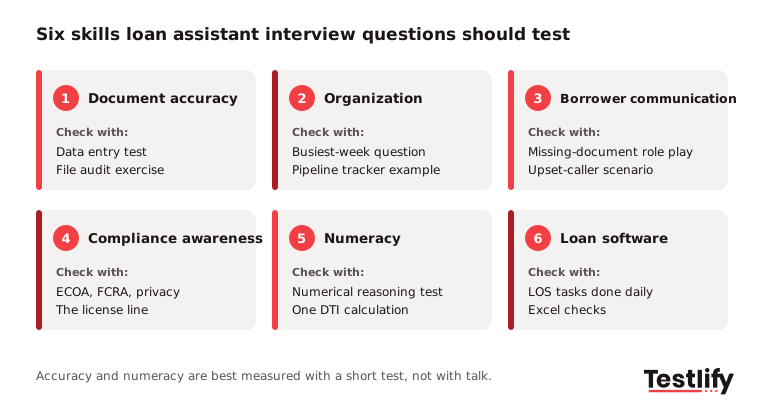
Skill | Why it matters | Best way to check it |
|---|---|---|
Document accuracy | Small errors delay closings and create compliance risk | Data entry or attention to detail test, file audit exercise |
Organization | Assistants often juggle 20 or more open files | Behavioral question about a heavy week |
Borrower communication | Borrowers send documents faster when requests are clear | Role play: ask for a missing bank statement |
Compliance awareness | Fair lending, privacy and disclosure rules apply to every file | Technical questions on ECOA, FCRA and privacy |
Numeracy | Income, debt-to-income and fees need quick checks | Numerical reasoning test, one DTI calculation |
Loan software | Encompass, Calyx Point, Desktop Underwriter and Excel are common | Ask what they did in the system, not which logos they know |
Soft skills still count. A loan assistant spends much of the day on the phone and by email with borrowers, real estate agents, title companies and underwriters, so calm, clear and polite communication is part of the job, not a bonus.
Look for these red flags:
- Quoting rates: "I tell borrowers which rate they qualify for" from someone with no NMLS ID.
- Steering: "I recommend the best loan product for them" instead of "I pass the question to the loan officer".
- Skipping supervision: No mention of a loan officer or processor who reviews their work.
- Vague privacy habits: No clear answer on how they store, send and destroy borrower documents.
Key takeaway: A good answer sounds like "If a borrower asks about their rate, I tell them the loan officer will call them today, I note the question in the file and I message the loan officer right away."
What general questions should you ask a loan assistant?
General questions should confirm the candidate's lending background, the loan types and systems they have used, and why they want a support role. Use them in the first 10 minutes to set context for the deeper questions.
- Walk me through your last role in lending. What loan types did you support, and roughly how many files did you handle at once?
- Which loan origination system have you used, and what did you do in it every day?
- What does a complete file look like for the loan type you know best, before it goes to underwriting?
- Who did you work with most: loan officers, processors, underwriters, closers or borrowers? How did you split the work?
- Do you hold an NMLS ID, or do you plan to get licensed? Why or why not?
- What part of a loan assistant's job do you find hardest, and how do you handle it?
- How do you keep track of conditions and deadlines across many files?
- Why do you want a support role in lending rather than a sales or origination role?
- What would your last loan officer say is your biggest strength and one thing you could improve?
- What do you want to learn in your first year in this role?
What to look for: Specific numbers (files, loan types, systems), a clear picture of a complete file and honest answers about licensing. Vague answers such as "I did a bit of everything" usually mean light exposure.
Which technical and compliance questions should you ask?
Technical and compliance questions should check that the candidate can spot missing or inconsistent documents, do simple income and debt checks, and protect borrower data. They do not need a compliance officer's depth, but they must know which rules touch their work.
- A borrower's pay stub shows a different employer name than the application. What do you do?
- What is a debt-to-income ratio? A borrower earns $6,000 a month before tax and pays $1,800 in monthly debts including the new housing payment. What is the ratio?
- Which documents do you usually need to verify income for a salaried borrower, and for a self-employed borrower?
- What does the Equal Credit Opportunity Act mean for how you treat applicants and their information?
- What is the TRID rule, and why do disclosure dates matter to a loan assistant?
- When is it acceptable to pull a borrower's credit report, and what consent do you need under the Fair Credit Reporting Act?
- How do you send and store files with Social Security numbers and bank statements?
- What would you do if you suspected a document had been altered?
- What is a condition from underwriting, and how do you clear one?
- Which Excel functions do you use to check figures or track a pipeline?
Non-bank mortgage lenders and brokers are covered by the FTC Safeguards Rule. The FTC's Safeguards Rule guide for businesses requires encryption of customer information, multi-factor authentication and, since May 2024, a notice to the FTC within 30 days of a breach involving 500 or more consumers. Question 17 tells you whether a candidate's habits fit that standard.
What to look for: For question 12, the answer is 30% ($1,800 divided by $6,000). For question 18, the right move is to stop, document and escalate to the processor or compliance team, never to "fix" the document or confront the borrower alone.
Which behavioral questions work best for loan assistants?
Behavioral questions work best when they ask for one real example with a clear result. Ask the candidate to describe the situation, what they did and what changed, and follow up until you hear numbers or names of steps.
- Tell me about a time you caught an error in a loan file before it reached underwriting. What was it, and what happened next?
- Describe your busiest week in your last job. How many files were open, and how did you decide what to do first?
- Tell me about a borrower who was slow to send documents. What did you do to get them?
- Describe a time a loan officer and an underwriter wanted different things from you. How did you handle it?
- Tell me about a closing that was at risk of slipping. What did you do, and did it close on time?
- Give an example of a process you improved, such as a checklist, a template or a tracker.
- Tell me about a mistake you made on a file. How did you find it and fix it?
- Describe a time you had to learn a new system or a new rule quickly.
- Tell me about a time you had to say no to a borrower or a real estate agent.
- Describe a time you protected a borrower's private information when it would have been easier not to.
What to look for: Real details (file counts, days saved, the exact document), ownership of mistakes and a habit of escalating early. Answers that only describe what "the team" did hide the candidate's own part.
Which situational questions should you ask a loan officer assistant?
Situational questions show how a loan officer assistant would act in common moments you can predict. They are useful for candidates with little lending experience, because they test judgment rather than history.
- A borrower calls and asks if they can get a lower rate if they pay points. What do you say?
- It is 4 pm, a closing is tomorrow and the appraisal has not arrived. What do you do in the next hour?
- A real estate agent asks you to confirm the borrower's approval amount to a seller. How do you respond?
- You notice a deposit on a bank statement that the borrower has not explained. What is your next step?
- A borrower emails a photo of their driver's license and tax return to your personal email. What do you do?
- Two loan officers both need your help on urgent files at the same time. How do you decide?
- A borrower is upset that you have asked for the same document twice. How do you handle the call?
- The loan origination system is down for the afternoon. How do you keep files moving?
- A colleague asks you to backdate a disclosure "just this once". What do you do?
- You join on Monday with 25 files in progress. How do you get up to speed in your first week?
What to look for: For question 31, a strong unlicensed candidate does not discuss pricing and routes the borrower to the loan officer. For question 39, the only acceptable answer is to refuse and tell a manager or compliance.
What do strong answers to loan assistant interview questions sound like?
Strong answers to loan assistant interview questions are specific, follow a clear order of steps and end with a result. These five sample answers show the level to expect, what to look for and the red flag to avoid.
1. "Tell me about a time you caught an error in a loan file."
Sample answer: "A borrower's W-2 showed $58,000, but the application said $68,000. I checked the pay stubs, which matched the W-2, and told the loan officer the same day. We corrected the application before it went to underwriting, so the file was not suspended."
Look for: A real document, a cross-check and a fast handoff. Red flag: "I just fixed the number myself" without telling anyone.
2. "Describe your busiest week."
Sample answer: "In March I had 28 open files. Every morning I sorted them by closing date and by what was missing, then sent all borrower requests before 10 am so they had the whole day to reply. Two files were at risk, so I flagged them to the processor on Monday, and all 28 stayed on schedule."
Look for: A system, not just effort. Red flag: "I just work late until it's done."
3. "A borrower asks about a lower rate with points. What do you say?"
Sample answer: "I'd say that's a great question for their loan officer, who can walk through the options. I'd note the question in the file and message the loan officer so the borrower hears back the same day."
Look for: A clear handoff and a follow-up. Red flag: Explaining point pricing or quoting a rate without a license.
4. "How do you send and store files with sensitive data?"
Sample answer: "Only through the secure portal or encrypted email our company approves. I never use personal email or USB drives, I lock my screen when I step away, and I shred paper copies once they are scanned to the file."
Look for: Named tools and habits. Red flag: "I'm careful" with no specifics.
5. "Tell me about a borrower who was slow to send documents."
Sample answer: "A self-employed borrower kept sending partial tax returns. I sent a short checklist with each page we needed, called to go through it, and booked a 15 minute call the next day to confirm. We had everything within two days."
Look for: A clear request, a follow-up date and patience. Red flag: Blaming the borrower without changing the approach.
How should you score loan assistant interviews?
Loan assistant interviews should be scored with the same written scorecard for every candidate, each answer rated 1 to 5 against weighted criteria. A shared scorecard keeps panel members comparing the same things and makes the decision easy to explain later.
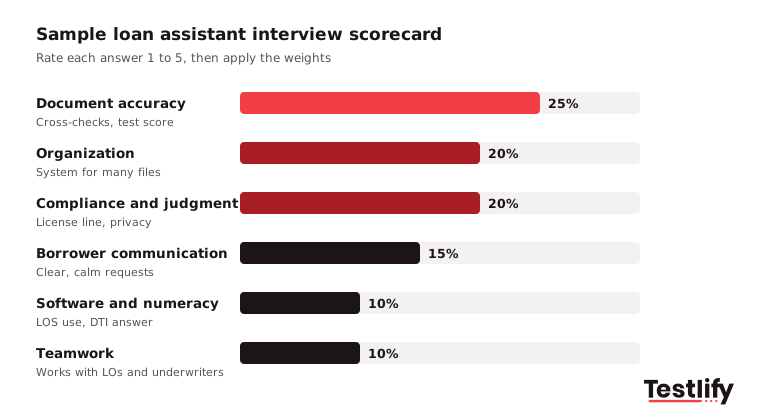
A simple weighting that fits most lenders:
- Document accuracy (25%): Evidence of cross-checking and catching errors, plus the test score.
- Organization (20%): A clear system for many files and deadlines.
- Compliance and judgment (20%): Knows the license line, privacy habits, escalates concerns.
- Borrower communication (15%): Clear, polite requests and calm handling of upset callers.
- Loan software and numeracy (10%): Real system use and a correct DTI answer.
- Teamwork (10%): Works well with loan officers, processors and underwriters.
Write down evidence next to each score during the interview, not afterwards from memory. Our guide to the interview scorecard has a template, and the case for structured interviews explains why the same questions in the same order give fairer results.
Quality of hire is getting more attention from TA teams. In LinkedIn's Future of Recruiting report, LinkedIn found that 89% of TA professionals expect measuring quality of hire to become more important, but only 25% feel highly confident they can do it. A scorecard tied to job performance is a practical first step.
Which skills tests should you pair with the interview?
Skills tests should come before the interview so you spend interview time only on candidates who can do the core work. For a loan assistant, a 30 to 40 minute assessment that combines accuracy, numbers and banking basics, followed by a short file audit exercise, gives a clear signal.
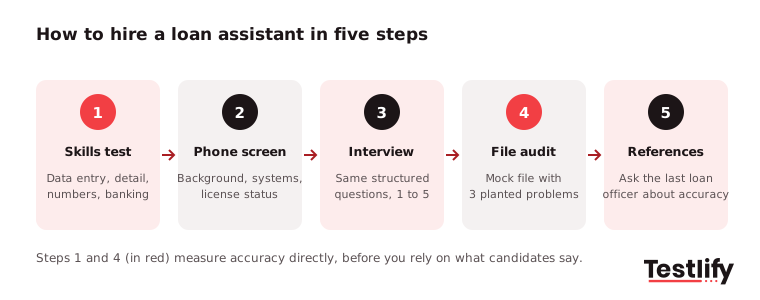
Useful tests from the Testlify library:
- Accuracy: The data entry test and the attention to detail test show how a candidate handles forms and small discrepancies.
- Numbers: A numerical reasoning test covers percentages and ratios such as DTI.
- Banking basics: The banking compliance test checks awareness of the rules that apply to loan files.
- Customer contact: The customer service advisor (bank) test fits roles with heavy borrower contact.
- Spreadsheets: The Microsoft Excel test for teams that track pipelines in Excel.
File audit exercise: Give finalists a mock loan file with 10 to 12 documents (application, two pay stubs, a W-2, two bank statements, an ID, a purchase contract) and three planted problems, such as a name mismatch, an unexplained deposit and an expired document. Ask them to list what is missing or wrong and draft one email to the borrower. Twenty minutes is enough, and the result tells you more than any question about attention to detail.
Pro tip: Use the same mock file and the same three problems for every finalist, and score it with a simple key: one point per problem found, one point for a clear borrower email.
Testlify runs the test stage for you: candidates take the assessment online with 20+ proctoring checks, answers are scored automatically and the hiring team gets a ranked shortlist. You can add your own questions, such as the DTI calculation above, to any assessment.
How is a loan assistant different from a loan processor or loan officer?
A loan assistant supports the file, a loan processor owns the file through underwriting and a loan officer owns the borrower relationship and the loan terms. The roles overlap at smaller lenders, so match your question set to the work the person will really do.
Loan assistant | Loan processor | Loan officer | |
|---|---|---|---|
Main job | Collect, check and enter documents; keep borrowers updated | Build the complete file, clear underwriting conditions, prepare for closing | Find borrowers, take applications, offer and negotiate terms |
License (US mortgage) | Not needed for clerical work as an employee under a licensed originator | Not needed as an employee doing clerical work; needed as an independent contractor | NMLS license or registration required |
Talks rates and terms | No | No | Yes |
Interview focus | Accuracy, organization, communication, the license line | Underwriting guidelines, conditions, timelines | Sales, pipeline, product knowledge, compliance |
If you are hiring for the senior role that owns the full file, use our loan processor interview questions and the loan processor job description. For the originator role, see the loan officer interview questions and the loan officer hiring guide.
Ready to hire your next loan assistant?
Ready to stop guessing from resumes? Build a loan assistant assessment from the Testlify test library in minutes, combining data entry, attention to detail, numerical reasoning and banking compliance, then bring your top candidates in for the 40 questions above.
Testlify connects with 100+ ATS and HRIS tools and is used by 1,500+ talent teams; see how it fits lending teams on the financial industry page. Start a 7-day free trial with no credit card, or book a demo.
Frequently asked questions

Wordpress Developer
Yash Patel is a Wordpress and SEO Specialist at Testlify with 3+ years of experience in technical SEO, on-page optimization, and content strategy. He works on improving Testlify's organic presence and produces content focused on hiring, talent assessment, and HR technology.
LinkedInRelated resources
View all
HR & recruitment
60 Billing Clerk interview questions to ask job applicants

HR & recruitment
25 Financial Planner Assistant interview questions to ask job applicants

HR & recruitment
60 Demand Planner Assistant interview questions to ask job applicants

HR & recruitment
Best network technician interview questions

HR & recruitment
60 Database Analyst interview questions to ask job applicants

HR & recruitment
60 Trainer interview questions to ask job applicants
Get started.
Hire on proof, not resumes.
Run your first skills-based assessment free — no credit card required.