
Remote Hiring Tools: Build Your 2026 Hiring Stack
Explore top tools for efficient remote hiring, including applicant tracking systems, video interviewing platforms, and AI-powered solutions, to build high-performing remote teams.

The best remote hiring tools cover seven jobs: an applicant tracking system to organize candidates, a skills assessment platform like Testlify to test real ability, video interview software, job boards to source talent, global payroll and employer-of-record tools to hire and pay people legally anywhere, onboarding and collaboration tools to connect new hires, and scheduling software to keep candidates engaged. Get those working together and you can run a fair, fast hiring process without a single in-person meeting.
Remote hiring is no longer the exception. SHRM’s 2024 Employee Benefits Survey found 63% of employers offered hybrid work to most employees in 2023. When the talent pool is that spread out, the right software is what keeps hiring organized, objective, and quick.
This guide breaks down the seven tool categories that make up a modern remote hiring stack, shows how to match them to your team size, and points out where evidence-based screening fits in. For the wider process, see our complete guide to remote hiring.
 ChatGPT
 Gemini
 Claude
 Grok
Grok Perplexity
TL;DR: the remote hiring stack at a glance
- Remote hiring runs on a connected stack, not one app: tracking, skills assessments, video interviews, sourcing, payroll and EOR, onboarding, and scheduling.
- Test skills before the first call. Assessments cut bias and shorten screening when you cannot read a room over video.
- Match tools to team size. Startups need a lean, low-setup set; enterprises need integration and compliance.
- Keep humans in charge. AI should rank and summarize; recruiters still decide, the idea behind the Testlify Hiring Workflow Method.
- Data protection is part of the stack. Favor tools with GDPR support and explainable AI over black-box scoring.

What changed about hiring when it went remote?
Three things changed at once: reach, communication, and fairness. The talent pool went global, casual desk-side chats disappeared, and every candidate now meets you through a screen. That combination is why recruiters lean on shared tools and documented feedback instead of memory and gut feel.
Start with reach. A single job post can pull hundreds of applications from across continents and time zones, so a structured talent pool and a system to track it become essential, not optional.
Then there is scale of the shift itself. Among workers in teleworkable jobs, SHRM reports 76% now work from home at least part of the time. Distributed teams are the default now, so your hiring process has to work for someone you may never meet in person.
Fairness is the third change. Without body language or an office visit, bias creeps in through inconsistent notes and first impressions. Structured assessments and clear scoring keep every candidate on the same footing. Onboarding counts too: an offer is the start, not the finish, so plan how a new hire joins a digital team with an onboarding checklist.
How does technology make remote hiring faster and fairer?
Technology does the heavy lifting in two ways: it automates repetitive work and it turns hiring into measurable data. Automation handles posting jobs, parsing resumes, and interview scheduling across time zones, which frees recruiters to spend time on judgment calls, not calendar math.
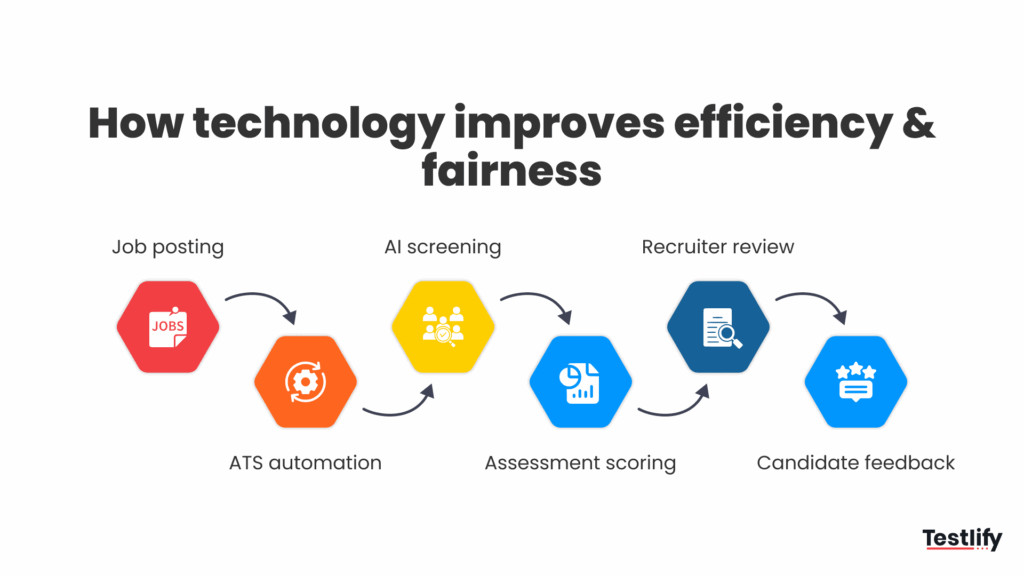
The second gain is the data layer. A modern applicant tracking system (ATS) shows how long each stage takes, where candidates drop off, and which sources perform. You manage the process instead of guessing at it.
Fairness improves because you can standardize evaluation. Online assessments and AI-driven interview tools score everyone against the same criteria. The skills you hire for keep shifting, too: SHRM’s 2025 Talent Trends research projects skills will change by 50% globally by 2030, with generative AI accelerating that shift to 68%, and 31% of employers already list AI as a top-3 required skill in job postings. That churn is why testing current, role-specific ability beats trusting a resume.
Technology does not replace human judgment here; it sharpens it. Recruiters still make the final calls. Tools handle the volume and protect objectivity so those calls are based on evidence.
What are the 7 core remote hiring tool categories?
A remote hiring stack has seven categories, each solving one part of the process: applicant tracking, skills assessment, video interviews, sourcing, global payroll and compliance, onboarding and collaboration, and scheduling. You rarely need every tool on day one, but you do need each job covered. Here is what each category does and where it fits.
1. Applicant Tracking Systems (ATS): the control center
An ATS is the recruiter’s command post. It keeps job listings, applications, interview notes, and hiring decisions in one place, which is what stops candidates slipping through the cracks when three recruiters and two hiring managers work across time zones. Systems like Greenhouse, Workable, or Recruitee reduce manual error and make team collaboration easier.
Tool | Best for | Key benefit |
|---|---|---|
Greenhouse | Mid to large teams | Structured interview scorecards and integrations |
Workable | SMBs and startups | Easy job posting and one-click sourcing |
Recruitee | Collaborative teams | Visual pipelines and team comments |
Zoho Recruit | Growing firms | Built-in AI resume parsing |
Breezy HR | Remote hiring | Automation for outreach and scheduling |
2. Skills assessment platforms: hiring beyond the resume
Remote hiring removes the face-to-face read, so testing real ability matters more, not less. Among remote hiring tools, skills assessment platforms such as Testlify evaluate technical and soft skills through role-based online tests, then feed the scores straight into your ATS so the shortlist is ranked before the first call.
This is the slice Testlify owns. Instead of one test, the Testlify Multi-Signal Talent Evaluation Model combines several role-relevant signals, skills tests, cognitive and personality assessments, and AI interviews, so a candidate advances when the evidence agrees, not because one score looked good. Skills-based hiring keeps working even for roles that barely exist yet; HBR notes a growing share of employers are dropping degree-first, resume-led screening in favor of proof of ability.
The payoff is fairer, data-backed decisions instead of resume-keyword guesswork. Testlify alone covers 3,500+ tests across 4,500+ job roles and 50+ industries, and connects to 100+ ATS platforms, so scores land in the same pipeline recruiters already use. For distributed teams, a scored shortlist also cuts the back-and-forth that usually slows remote screening down.
Remote assessment also created a problem most stacks do not cover: candidates using a second screen, a stand-in test-taker, or a generative AI tool to answer live. Testlify runs 20+ proctoring checks per assessment, webcam and screen monitoring, tab-switch and copy-paste detection, ID verification, and plagiarism scanning, so a score reflects the candidate’s own work, with flags surfacing straight in the recruiter’s dashboard. Treat proctoring as core to the assessment step, not an add-on, once hiring crosses borders.
Identity fraud is a related risk worth building into this step: in a fully remote process, candidates can apply, interview, and test under fake profiles, manipulated credentials, or a proxy test-taker standing in for them. Layered candidate verification, email and phone verification, document checks, face matching, live interview confirmation, and multi-step authentication, closes that gap, and the checks should scale with the role: a senior finance, engineering, data, or security hire generally warrants stronger verification than an entry-level role with limited system access.
3. Video interviewing tools: real conversations, no time zones
Video tools close the distance. Live platforms like Zoom or Microsoft Teams let you meet candidates face to face across time zones. For interviewers who'd rather stay focused on the conversation than type notes during the call, AI note-takers for Microsoft Teams transcribe and summarize the interview automatically, leaving a clean record for the hiring team to review afterward. Async tools like Willo or SparkHire let candidates record answers on their own time, which removes most scheduling friction.
Where standard video stops, AI interviews go further. Testlify pairs one-way video with an AI review of tone, clarity, and communication patterns. Recruiters still make the call, but the AI surfaces soft-skill signals that are easy to miss on a busy day, which makes shortlisting faster and more consistent.
Tool | Type | Key benefit |
|---|---|---|
Testlify | AI and async | Scores communication and soft skills with AI insights; saves screening time |
SparkHire | One-way and live | Flexible recording and branded interview experience |
Willo | Async | Simple setup for candidates and hiring teams |
Zoom | Live | Reliable live interviews with easy access |
Microsoft Teams | Live | Integrates with calendars and internal workflows |
4. Talent sourcing and job boards: finding people where they are
Niche boards like We Work Remotely, Himalayas, and FlexJobs focus on people who already work well outside an office. Many add salary benchmarking and filters for time zone and experience, so you target the right candidates instead of sorting through everyone.
Platform | Focus | Key benefit |
|---|---|---|
We Work Remotely | Global | Large pool of remote-ready professionals |
FlexJobs | U.S.-heavy | Curated remote and hybrid listings |
Himalayas | Global startups | Transparent pay data and filters |
LinkedIn Recruiter | Global | Smart filters and AI recommendations |
AngelList Talent | Tech startups | Direct access to founders and early-stage hires |
5. Global payroll and compliance: hiring anywhere, staying lawful
When your team crosses borders, compliance gets complicated fast. Tools like Deel and Remote.com handle contracts, payroll, and local tax rules, and their Employer of Record (EOR) services let you hire legally in countries where you have no local entity. For HR leaders, that turns a legal headache into a routine step.
Tool | Core feature | Key benefit |
|---|---|---|
Deel | Global payroll and EOR | Hire legally in 100+ countries |
Remote.com | Payroll and contractor management | Tax compliance and localized benefits |
Papaya Global | Cross-border payments | Automated global payroll |
Rippling | HR and IT automation | Combines HR, payroll, and device management |
Oyster | Global hiring | Cost calculator and compliance guardrails |
6. Onboarding and collaboration: keeping new hires connected
A signed offer is only the start. Platforms like BambooHR, Notion, or Slack make onboarding structured and human: they centralize documents, automate checklists, and help new hires meet their team before day one. In a remote setting, that early connection is what makes people stay.
Tool | Use case | Key benefit |
|---|---|---|
Notion | Team documentation | Custom onboarding pages and wikis |
Slack | Daily communication | Channels for culture and connection |
ClickUp | Task management | Visual progress tracking |
BambooHR | HR records | Onboarding workflows and self-service |
7. Scheduling and engagement: keeping candidates warm
Engagement tools close the communication gap. Software like Calendly, GoodTime, or Paradox automates scheduling, reminders, and follow-ups so candidates never feel forgotten. Small touches like these cut ghosting and protect your employer brand, which matters most when the whole relationship happens over email and video.
Tool | Function | Key benefit |
|---|---|---|
Calendly | Scheduling | Auto time-zone detection and invites |
GoodTime | Interview coordination | Smart interviewer matching |
Chili Piper | Booking and routing | Instant scheduling from the careers page |
Paradox Olivia | AI recruiting assistant | Chat-based scheduling and reminders |
Zapier | Automation bridge | Connects tools for instant updates |
How do you choose the right remote hiring stack?
Start with your biggest bottleneck, then match tools to your hiring volume, and only add software that connects to what you already run. Choosing the right remote hiring tools is about balance, not chasing every new option. Five rules keep it simple.
1. Start with your bottleneck, not the market
Before buying anything, find the step that slows you down most: screening, scheduling, or the handoff between recruiters and hiring managers. Fix that first. Buying five tools to solve one bottleneck just adds cost and overhead without moving your quality-of-hire or time-to-fill.
2. Match tools to your hiring volume
- Startups and SMBs: pick lean, easy-to-integrate tools that need little setup. Affordable platforms like Workable, Calendly, and Slack can cover hiring start to finish at this stage.
- Mid-market and growing teams: add structure with an ATS such as Recruitee or Greenhouse, paired with an assessment tool like Testlify for role-based evaluation.
- Enterprises: focus on integration and compliance. Larger teams benefit from suites that connect ATS, HRIS, and payroll for cleaner reporting and audit control.
Company size | Recommended focus | Example tools |
|---|---|---|
Startup / SMB | Flexibility and ease | Workable, Calendly, Slack |
Mid-market | Structure and fairness | Recruitee, Greenhouse, Testlify |
Enterprise | Compliance and scale | SAP SuccessFactors, Deel, Remote.com |
3. Prioritize integration and data flow
Disconnected tools cause more harm than help. Look for software that shares data automatically. When your assessment platform (like Testlify) feeds results directly into your ATS, recruiters stop copying data between dashboards and candidate records stay consistent. Connected tools save time and prevent errors.
Integration gaps are also a security risk, not just an efficiency one: when recruiters manually copy candidate details between platforms, data silos, duplicate candidate records, inconsistent access permissions, and outdated records left in systems where they should have been removed all become more likely. Connected systems that support access controls and reduce manual handling protect candidate privacy as much as they save recruiter time.
4. Do not ignore data protection and ethics
With hiring now mostly digital, compliance is non-negotiable. Choose platforms that are clear about how they handle candidate data, support GDPR and similar standards, and let you control data retention. AI tools should come with explainable logic, not black-box scoring. The goal is to improve fairness, not hand the decision to a machine.
Cross-border hiring adds a layer most teams underestimate: privacy laws, consent requirements, retention rules, and data storage expectations differ by market, and a process that works in one country may not hold up in another, especially once identity documents, assessment recordings, interview notes, or background-screening information are involved. Rather than treating data privacy as a one-time checkbox, define upfront what data is collected, why it is needed, who can access it, how long it is retained, and how candidates are informed. This is a practical starting point, not a substitute for legal advice.
5. Build gradually and review annually
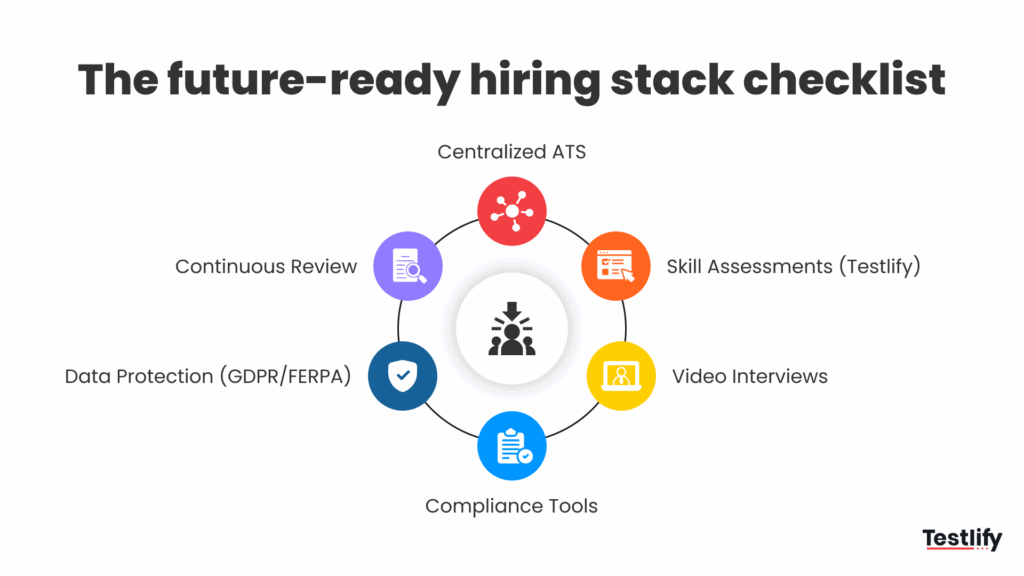
A hiring stack is never finished. Treat it as a workflow, not a shopping list. The Testlify Hiring Workflow Method runs evidence-based hiring across the journey, define role skills, assess, verify integrity, review with AI-assisted insights, then decide with human accountability, so tools serve a process instead of piling up. Schedule a yearly audit and ask three questions: are our tools still saving time, are candidates happy, and are we using the data? If the answer is no, refine or replace.
Pro tip: Before you add a tool, write down the single hiring metric it should move, time-to-hire, cost-per-hire, or quality-of-hire. If a tool cannot point to a number it improves, it is overhead, not part of your stack.
Build a skills-first remote hiring stack with Testlify
Testlify brings the evaluation core of your remote stack together: role-based skills assessments, cognitive and personality tests, and AI video interviews that score communication, all feeding your ATS. Recruiters keep the final call; the evidence just makes it easier and faster. Teams running Testlify report 94% candidate satisfaction, a 55% drop in time-to-hire, and 6x recruiter efficiency.
Key takeaways
- Build a stack, not a pile. Remote hiring needs seven connected jobs covered; tools that do not talk to each other recreate the manual work you were trying to remove, so weigh integration over feature lists.
- Test skills before you talk. Over video you lose body language and hallway impressions, so an early skills assessment keeps screening objective and shortens the loop because the shortlist is scored before the first call.
- Size dictates the stack. A five-person startup and a 5,000-person enterprise need different tools; startups win with lean, low-setup apps, enterprises with integrated, compliant suites, so copying another company’s stack usually wastes money.
- Keep AI assistive, humans accountable. AI ranks candidates and summarizes interviews well, but it should inform a decision, not make it, which is exactly how the Testlify Hiring Workflow Method keeps hiring defensible.
- Treat compliance as core. Global hiring means GDPR, local tax, and candidate-data rules; picking EOR and assessment tools with explainable logic protects both your legal position and candidate trust.
- Review the stack yearly. Hiring needs shift as you grow, so a short annual audit tells you what to keep, replace, or drop before unused tools quietly drain budget.
Keeping remote hiring secure as you scale globally
A connected stack still needs security built in, especially once hiring crosses borders. Distributed recruiters and hiring managers access candidate data from different locations, networks, and devices, one person reviewing candidates from home, another approving offers from a regional office, so the stack needs approved devices, strong authentication, and limited, role-based access permissions alongside the tools themselves.
AI-based risk detection can help here too: beyond proctoring, some platforms flag unusual assessment patterns, repeated answers, suspicious timing, or signs of content reuse for recruiter review. Treat a flagged result as a prompt for human review, not an automatic disqualification, the same human-in-the-loop principle behind the Testlify hiring workflow method.
A few practices keep security from working against candidate experience:
- Explain why verification is needed before asking for sensitive information
- Ask only for data that is necessary for the role or hiring stage
- Use clear consent language without excessive legal complexity
- Keep assessments relevant to the actual job
- Avoid overly invasive monitoring when lighter controls are enough
- Offer support when candidates face technical issues
Frequently asked questions (FAQs)

Content Writer
Yashika Khandelwal is a Content Writer with 3+ years of experience creating research-backed content on hiring, talent assessment, and HR technology. She is a registered Organizational Psychologist and subject matter expert who combines behavioral science with practical recruitment insights to produce accurate, evidence-based content.
LinkedInRelated resources
View all
Remote hiring
How to overcome geographical and cultural barriers in remote hiring

Remote hiring
5 practical ways to evaluate job candidates remotely

Remote hiring
The role of communication in remote job interviews

Remote hiring
Best practices for remote employee management

Remote hiring
How to improve employee experience in a remote workplace?

Remote hiring
How to manage a remote team?
Get started.
Hire on proof, not resumes.
Run your first skills-based assessment free — no credit card required.