
Top 14 Applicant Tracking Systems (ATS) for Enterprise HR in 2026
A structured comparison of 8 ATS platforms for enterprise HR teams, ranked across integrations, compliance, assessment depth, and automation.

 ChatGPT
 Gemini
 Claude
 Grok
Grok Perplexity
TL;DR
- Enterprise ATS selection is permanent in practice — the average replacement cycle runs 4 to 6 years, and the downstream cost of a misfit platform compounds through recruiter friction, data migration, and retraining long after the initial contract is signed
- ATS platforms with native pre-hire assessment integration reduce mis-hire rates by up to 36%, yet fewer than 20% of enterprise ATS deployments include structured assessment checkpoints before the offer stage — the configuration gap, not the software, is where most value is lost (Testlify, 2024)
- The global ATS market was valued at $2.3 billion in 2023 and is projected to grow at 7% CAGR through 2028 — vendor consolidation is accelerating, which means the platform purchased today may look structurally different within two renewal cycles (MarketsandMarkets, 2023)
- 98% of Fortune 500 companies use an ATS, yet only 1 in 4 applicants passes initial screening — the primary risk is not missing candidates but misconfigured filters that reject qualified ones before a human ever sees them (Jobscan, 2024)
- Enterprise ATS pricing spans $6,000 to $100,000+ per year — seat count, compliance module depth, and API access tiers are the three variables most frequently renegotiated at contract renewal
- Among platforms evaluated, Greenhouse, Ashby, and SmartRecruiters lead on structured hiring support for mid-enterprise teams; Workday and SAP SuccessFactors lead on compliance depth for organizations operating across multiple jurisdictions
- No ATS delivers value independent of the process behind it — platforms return the highest hiring quality when paired with standardized scorecards, defined stage gates, and pre-offer assessment checkpoints built into every requisition from day one

What is an applicant tracking system and how does it work in 2026?
An applicant tracking system (ATS) is software that automates the full-cycle recruitment workflow — collecting applications, parsing resumes, filtering candidates, coordinating interviews, and managing offer letters — within a single platform. Enterprise ATS tools also handle compliance documentation, structured hiring workflows, and integration with pre-hire assessment and HRIS systems.
At its core, an ATS functions as a candidate database paired with a workflow engine. When a job requisition opens, the platform publishes the role to job boards, aggregates inbound applications, parses resume data into structured fields, and routes candidates through defined stages. Hiring managers access their specific pipelines without touching raw data. Recruiters manage volume, compliance, and candidate communications from a single dashboard.
In 2026, the distinction between legacy and modern ATS platforms has sharpened around three capabilities: AI-assisted screening, pre-hire assessment integration, and compliance automation. Legacy systems parse keywords and sort resumes. Modern enterprise platforms score candidates against structured criteria, flag bias risk in job descriptions, auto-schedule interviews, and generate audit-ready reports for EEOC and OFCCP review — all within the same workflow.
The Society for Human Resource Management reports that organizations using structured ATS workflows reduce time-to-hire by up to 40% compared to manual processes. The driver is not automation for its own sake — it is the elimination of handoff delays between sourcing, screening, and scheduling stages that account for most of the elapsed time between application and offer.
Enterprise ATS platforms differ from SMB tools in three meaningful ways. First, compliance depth: enterprise systems carry built-in EEOC, GDPR, OFCCP, and data residency controls that smaller tools either lack or bolt on as paid modules. Second, integration architecture: enterprise ATS platforms connect to payroll, HRIS, background check providers, and assessment tools via documented APIs rather than one-way data exports. Third, approval workflow depth: enterprise hiring involves multiple stakeholders, legal review, compensation benchmarking, and headcount approval chains that SMB platforms cannot model without workarounds.
Understanding what an ATS does — and what it cannot do — is the foundation for selecting the right platform. An ATS manages workflow and data. It does not assess candidate quality, predict job fit, or remove bias from hiring decisions without explicit configuration and tool integration. The evaluation methodology below addresses how those gaps were scored across 14 platforms.
One distinction worth making before comparing platforms: the ATS is not the hiring process. It is the system that runs the process. Organizations that purchase an ATS hoping the platform will impose structure on an unstructured hiring program consistently underperform against the platform’s documented benchmarks. The platforms that appear in analyst reports as delivering measurable quality-of-hire improvement are all operating in environments where structured scorecards, defined evaluation criteria, and consistent stage gates were in place before — or built in parallel with — the ATS implementation. The software enables the process; it does not replace it. This distinction should inform both the vendor selection decision and the implementation resource plan.
How did we evaluate these 14 ATS platforms? The Testlify ATS Selection Matrix
Every platform in this ranking was evaluated using the Testlify ATS Selection Matrix — a five-dimension framework built from the hiring outcomes that enterprise HR teams most frequently cite as underserved by their current ATS. The matrix weights each dimension by its impact on measurable hiring outcomes, not by the vendor’s own feature marketing.
Dimension | What was evaluated | Weight |
|---|---|---|
Integration depth | ATS connector count, API documentation quality, HRIS compatibility, Testlify and assessment tool native support | 25% |
Candidate experience | Application flow friction, mobile UX quality, automated communication depth, candidate portal | 20% |
Compliance coverage | EEOC, GDPR, OFCCP tooling, audit trail depth, data residency controls, consent management | 20% |
Pre-hire assessment capability | Native assessment library, third-party integration depth, scoring automation, anti-bias tooling | 20% |
Automation breadth | Workflow automation, AI screening logic, interview scheduling, offer management automation | 15% |
Integration depth carries the highest weight because disconnected systems are the single most common source of ATS failure in enterprise environments. A platform that does not connect cleanly to the existing HRIS, background check provider, and pre-hire assessment tool creates manual reconciliation work that erodes the productivity gains the ATS was purchased to deliver.
Pre-hire assessment capability was evaluated at 20% because structured, skills-based hiring consistently outperforms resume screening as a predictor of job performance. Organizations that build assessment checkpoints into their ATS workflow before the offer stage reduce mis-hires by up to 36% and report 55% faster time-to-hire when using Testlify’s 100+ ATS integrations to connect assessment data to hiring decisions (Testlify, 2024).
Compliance coverage was scored independently of integration because it reflects a fundamentally different risk surface. A platform with strong HRIS connectors but a weak EEOC audit trail creates legal exposure that a workaround cannot fix. For enterprise teams operating across multiple countries, GDPR data residency and localized consent management are non-negotiable requirements, not optional modules.
Candidate experience was evaluated from the application stage through offer acceptance because employer brand and offer acceptance rate are both downstream of ATS configuration. Research from LinkedIn Talent Solutions shows that 83% of talent acquisition leaders report candidate experience as a top driver of offer acceptance in competitive talent markets (LinkedIn Talent Solutions, 2024).
Key Takeaway: The Testlify ATS Selection Matrix weights integration depth at 25% because a disconnected ATS creates more manual work than it eliminates. Score each vendor against your existing tech stack before comparing feature lists.
ATS vs HRIS vs HCM: which does your enterprise actually need?
Before evaluating individual ATS platforms, enterprise HR teams frequently struggle to distinguish between three overlapping system categories: ATS, HRIS, and HCM. Buying the wrong category is more expensive than buying the wrong vendor within the right category. The table below maps each system type against the decisions that matter at purchase.
Capability | ATS | HRIS | HCM |
|---|---|---|---|
Primary function | Recruiting workflow automation | Employee records and core HR | Full workforce lifecycle management |
Core users | Recruiters, talent acquisition teams | HR administrators, payroll teams | CHRO, all HR functions |
Key capabilities | Job posting, pipeline management, offer letters | Onboarding, payroll, benefits, time tracking | All HRIS plus performance, L&D, compensation |
Best fit | Teams with 50+ active requisitions per year | Companies centralizing employee records | Enterprises wanting one HR system of record |
Typical cost | $6,000-$100,000+/year | $5-$20/employee/month | $25-$80/employee/month |
Integration need | Connects to HRIS via API | Connects to ATS via API | ATS often built into the platform |
Examples | Greenhouse, iCIMS, Ashby | Rippling HRIS, Personio, BambooHR | Workday, SAP SuccessFactors, Oracle HCM |
The critical distinction: HCM platforms like Workday and SAP SuccessFactors include ATS functionality as one module within a larger suite. That integration is an advantage for organizations already committed to the HCM ecosystem — and a significant constraint for those that are not. Purpose-built ATS platforms like Greenhouse and Ashby offer deeper recruiting-specific functionality at lower total cost, but require API integration with separate HRIS systems.
For enterprise teams with 1,000+ employees and a stable HRIS already in place, the question is whether to extend the existing HCM or deploy a purpose-built ATS alongside it. The answer depends primarily on the volume and complexity of recruiting activity. High-volume or highly structured hiring programs — technology, retail, healthcare — typically benefit from a dedicated ATS. Low-volume senior executive hiring often does not justify the configuration cost of a standalone platform.
What are the top 14 applicant tracking systems for enterprise HR in 2026?
The 14 platforms below represent the full spectrum of enterprise ATS options — from large HCM suites with embedded recruiting modules to purpose-built talent acquisition platforms and mid-market tools scaling toward enterprise feature depth. Each entry follows a consistent evaluation format covering description, key features, strengths, limitations, and current pricing. Platforms are ranked by overall Testlify ATS Selection Matrix score, with HCM suite platforms grouped at the top given their dominance in large-enterprise deployment.
1. Workday Recruiting
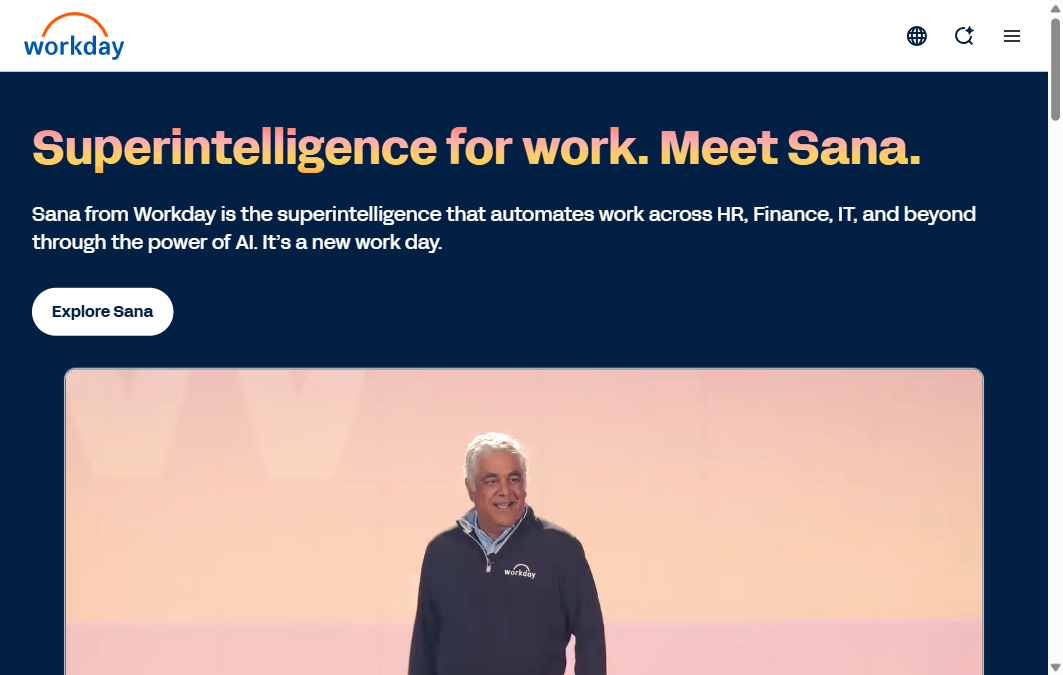
Workday Recruiting is the talent acquisition module within the Workday Human Capital Management suite, built for large enterprises that have standardized on Workday as their system of record. It handles the full hiring lifecycle — requisition approval through offer and onboarding — within the same data model used for workforce planning, compensation, and performance management. For organizations already operating on Workday HCM, the platform eliminates the need for a separate ATS and the data synchronization overhead that comes with it. Workday’s native connection to workforce planning data means hiring managers can open requisitions directly against approved headcount, view internal mobility candidates alongside external applicants, and route offers through compensation benchmarking without leaving the Workday environment.
The compliance framework supports EEOC, OFCCP, GDPR, and data residency requirements across more than 40 countries, making it a common choice for multinational enterprises with complex regulatory footprints. Integration with pre-hire assessment tools is handled through Workday’s marketplace and documented REST API. Testlify integrates with Workday Recruiting to push assessment scores directly into the candidate profile, enabling structured evaluation data to appear alongside recruiter notes and interview scores within the same pipeline view.
Key features:
- Global compliance management across 40+ countries
- Native workforce planning and headcount integration
- Internal mobility candidate visibility tools
- AI-assisted candidate matching and scoring
- Configurable multi-stage approval workflows
Pros: Unmatched depth for organizations already on Workday HCM — single data model eliminates sync errors between recruiting and HR; strongest compliance coverage for global enterprises; executive reporting and workforce analytics built in without additional tooling.
Cons: Implementation timelines of 6-12 months are standard; recruiting module is not sold independently and requires full Workday HCM commitment; limited flexibility for teams that want purpose-built recruiting UX outside the Workday ecosystem; per-seat cost scales steeply with headcount.
Pricing: Custom enterprise pricing; typical deployments for organizations with 1,000-5,000 employees start at $150,000/year inclusive of the full Workday HCM suite. Recruiting-only pricing is not available — the module is bundled with HCM.
2. SAP SuccessFactors Recruiting
SAP SuccessFactors Recruiting is the talent acquisition component within the SAP SuccessFactors Human Experience Management suite, positioned for large enterprises in manufacturing, retail, logistics, and financial services that have standardized on SAP ERP or SAP S/4HANA. The platform delivers full-cycle recruiting from requisition through offer, with particularly strong capabilities in localized compliance for European and Asia-Pacific markets where SAP has deep regulatory coverage. SuccessFactors differentiates through its global localization depth — supporting hiring workflows in more than 50 countries with locale-specific consent management, data residency controls, and employment law compliance built into the base platform.
For multinationals managing complex cross-border hiring across SAP-integrated HR systems, this removes compliance overhead that would otherwise require custom development or third-party middleware. The platform integrates with the broader SuccessFactors suite including Learning, Performance, and Compensation modules, giving HR operations a connected talent data layer from candidate to long-tenured employee. Pre-hire assessment integration is available via SAP’s integration center or direct API connections to external assessment providers including Testlify.
Key features:
- SAP ERP and S/4HANA native data integration
- Global compliance across 50+ countries and locales
- Career site builder with multilingual localization
- Automated interview scheduling and coordination
- Advanced recruiting analytics and workforce dashboards
Pros: Deepest global localization of any platform reviewed; native SAP ecosystem integration removes middleware complexity; full HXM suite connection across learning, performance, and compensation; GDPR and OFCCP compliance built in at the data model level.
Cons: UI is less modern than purpose-built ATS platforms — recruiter experience is a consistent weakness in analyst reviews; implementation complexity and total cost of ownership are high; limited value for organizations not committed to the SAP ecosystem; partner-dependent implementation can extend timelines to 9-18 months.
Pricing: Custom enterprise pricing; typical annual investment ranges from $80,000 to $200,000+ depending on headcount, module selection, and implementation partner fees. Gartner positions SuccessFactors as a Leader in HCM with Recruiting as a core module, not a standalone product.
3. Oracle HCM Recruiting
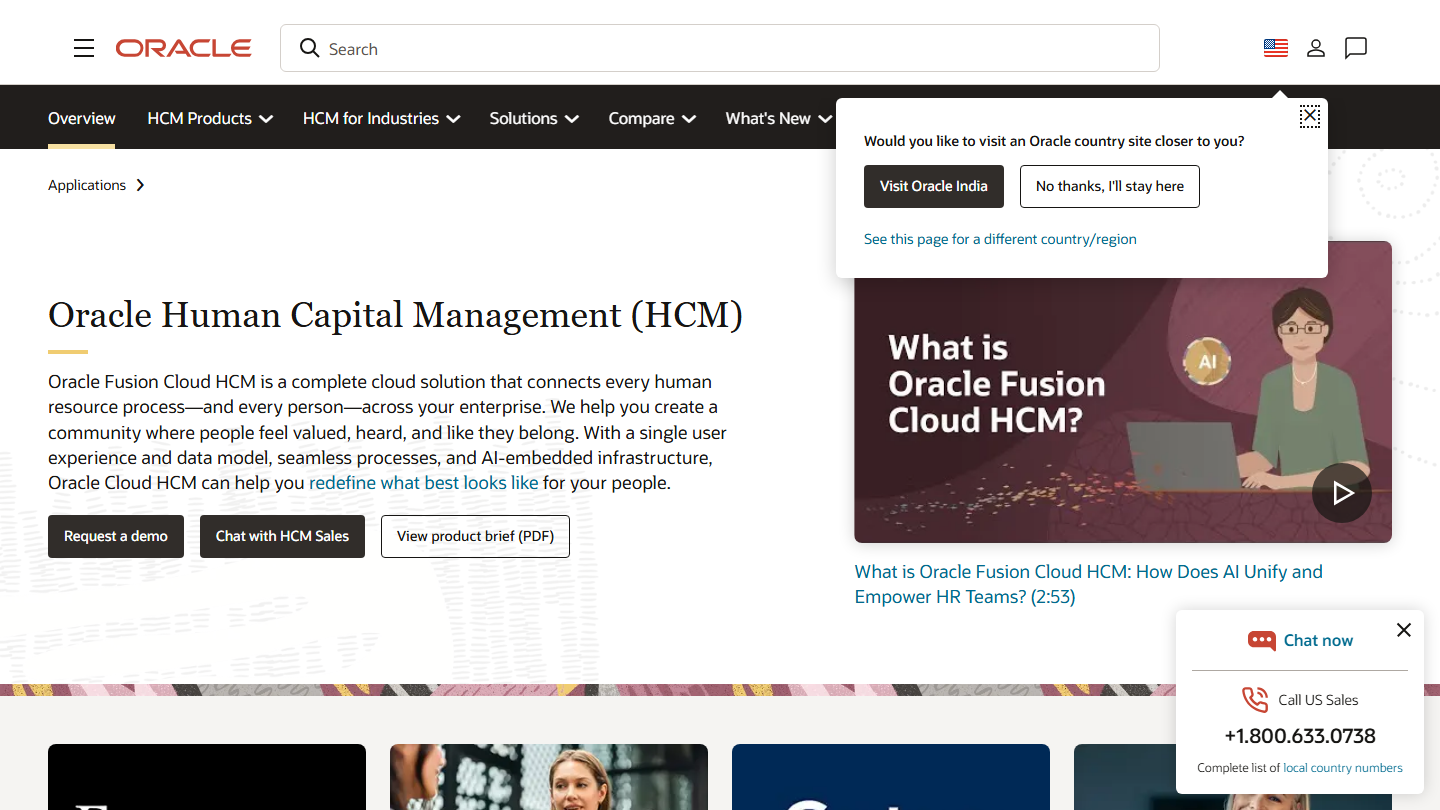
Oracle HCM Recruiting is the recruiting module within Oracle Cloud Human Capital Management, designed for large enterprises in finance, healthcare, manufacturing, and the public sector that have standardized on Oracle ERP or Oracle EBS. The platform covers requisition management, job publishing, candidate evaluation, interview coordination, offer creation, and onboarding handoff within the Oracle HCM data model. For Oracle ERP customers, the native financial and headcount data integration is the primary reason to evaluate Oracle Recruiting over a standalone ATS — the connection eliminates the middleware layer that most ATS-to-ERP integrations require.
Oracle’s recruiting module benefits from the company’s AI and machine learning investments in candidate scoring and job match recommendations. The Oracle Digital Assistant can automate candidate screening conversations, schedule interviews, and answer FAQ queries from applicants, reducing recruiter time on transactional coordination tasks. Compliance tooling covers EEOC, GDPR, and country-specific employment law requirements through Oracle’s global data residency architecture.
Key features:
- Oracle ERP and EBS native data integration
- AI-driven candidate matching and recommendations
- Digital assistant for automated candidate screening
- Configurable offer and approval workflow management
- Global compliance and data residency architecture
Pros: Deep Oracle ecosystem integration eliminates data synchronization overhead; strong compliance architecture for regulated industries including healthcare and financial services; AI screening capabilities have materially improved in recent releases; headcount and requisition data tied directly to Oracle Financials.
Cons: Recruiter UX consistently rated lower than Greenhouse, Ashby, and SmartRecruiters; implementation complexity requires Oracle-certified partners; limited competitive advantage outside existing Oracle ERP environments; reporting requires customization that adds implementation cost.
Pricing: Custom enterprise pricing; typical annual investment starts at $100,000+ for large deployments. Oracle HCM Recruiting is not available as a standalone module — it requires the Oracle HCM Cloud subscription.
4. iCIMS Talent Cloud
iCIMS Talent Cloud is a purpose-built enterprise ATS with more than 20 years of focus on talent acquisition for North American mid-market and enterprise organizations. The platform covers job requisition management, career site hosting, candidate relationship management, video interviewing via iCIMS Video Studio, and onboarding — all built on a unified candidate data model. iCIMS is one of the most widely deployed enterprise ATS platforms in North America, with particular strength in high-volume hiring for retail, healthcare, and financial services. The platform’s standout feature is its integration marketplace: iCIMS maintains more than 700 pre-built connectors to background check providers, HRIS systems, job boards, assessment tools, and communication platforms.
This breadth makes iCIMS a practical default for enterprise organizations with complex tech stacks that require point-to-point integrations without custom development. Testlify’s integration with iCIMS enables assessment data to appear directly in the candidate record, reducing the manual step of cross-referencing scores between systems. Compliance tooling covers EEOC, OFCCP, GDPR, and country-specific requirements through iCIMS’s global hiring framework. The platform also includes TextRecruit for SMS-based candidate engagement, which is particularly effective for high-volume frontline hiring where email response rates are low.
Key features:
- 700+ pre-built integration connectors marketplace
- Built-in video interviewing and candidate portal
- CRM for passive candidate relationship management
- SMS-based candidate engagement via TextRecruit
- EEOC and OFCCP compliance reporting built in
Pros: Largest integration marketplace of any purpose-built ATS reviewed; strong compliance library for North American regulatory requirements; 700+ connector count reduces custom development cost significantly; high-volume hiring engine built for enterprise scale.
Cons: Pricing scales steeply with seat count and module additions; UI improvements have been incremental — recruiter experience trails Greenhouse and Ashby; reporting requires custom configuration to surface actionable metrics without additional BI tools.
Pricing: Custom enterprise pricing; annual contracts typically range from $6,000 for smaller enterprise deployments to $100,000+ for large organizations with the full module suite. Pricing is based on seat count, active requisition volume, and required modules.
5. SmartRecruiters
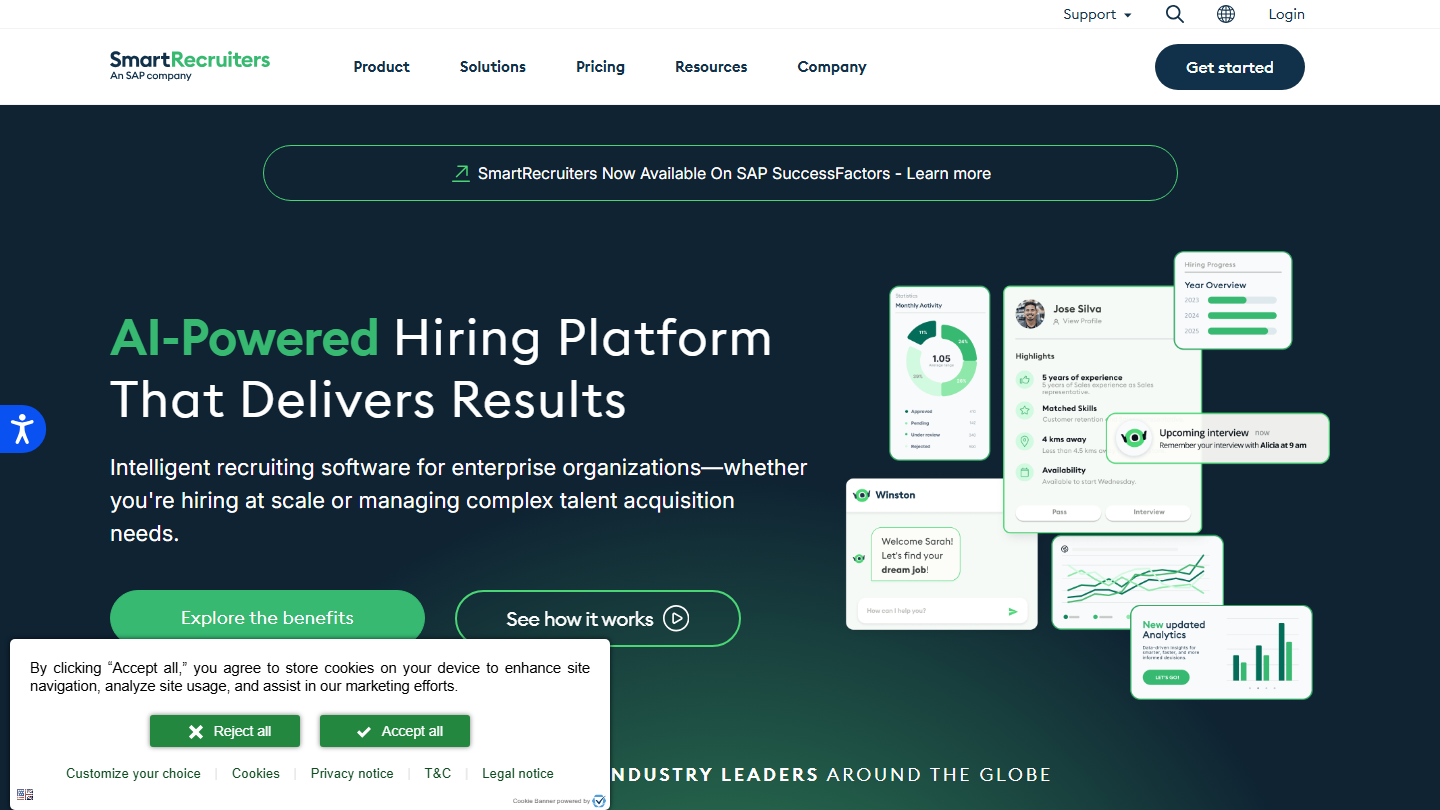
SmartRecruiters is a collaborative hiring platform built for high-volume enterprise recruiting, with particular strength in structured hiring support and multi-stakeholder evaluation workflows. The platform is used by organizations including VISA, Bosch, and Skechers for large-scale talent acquisition programs where consistency of evaluation across multiple hiring managers is a compliance and quality priority. SmartRecruiters positions itself as the “hiring success platform” — a distinction from workflow-focused ATS tools that centers on structured evaluation outcomes rather than process automation alone. The platform’s structured hiring capabilities are among the deepest of any ATS reviewed: native scorecard templates, AI-assisted candidate ranking based on structured criteria, and manager collaboration tools that enable multi-stakeholder evaluation without email chains.
The zero-cost job board network aggregates postings across more than 700 job boards, reducing sourcing costs for high-volume programs without requiring a separate programmatic advertising budget. SmartRecruiters’ integration with pre-hire assessment platforms including Testlify enables assessment scores to appear directly in the hiring stage view, giving recruiters and hiring managers a combined evaluation record covering both structured interview data and objective skills assessment results in the same interface.
Key features:
- Native structured interview scorecard templates
- AI-assisted candidate ranking against job criteria
- 700+ job board zero-cost posting network
- Multi-stakeholder collaborative evaluation workflows
- Offer management with configurable approval routing
Pros: Strongest structured hiring support among enterprise platforms reviewed; zero-cost job board aggregation reduces sourcing overhead; collaborative evaluation model reduces hiring manager friction; strong track record in high-volume enterprise hiring programs.
Cons: Advanced analytics require the Business Intelligence add-on, adding cost to the base platform; enterprise implementation timeline of 3-6 months is standard; pricing is not published — requires direct quote process.
Pricing: Custom enterprise pricing; estimated annual investment ranges from $10,000 for smaller enterprise teams to $60,000+ for large deployments with full module access. SmartRecruit plan is available for growing teams under 250 employees.
6. Greenhouse
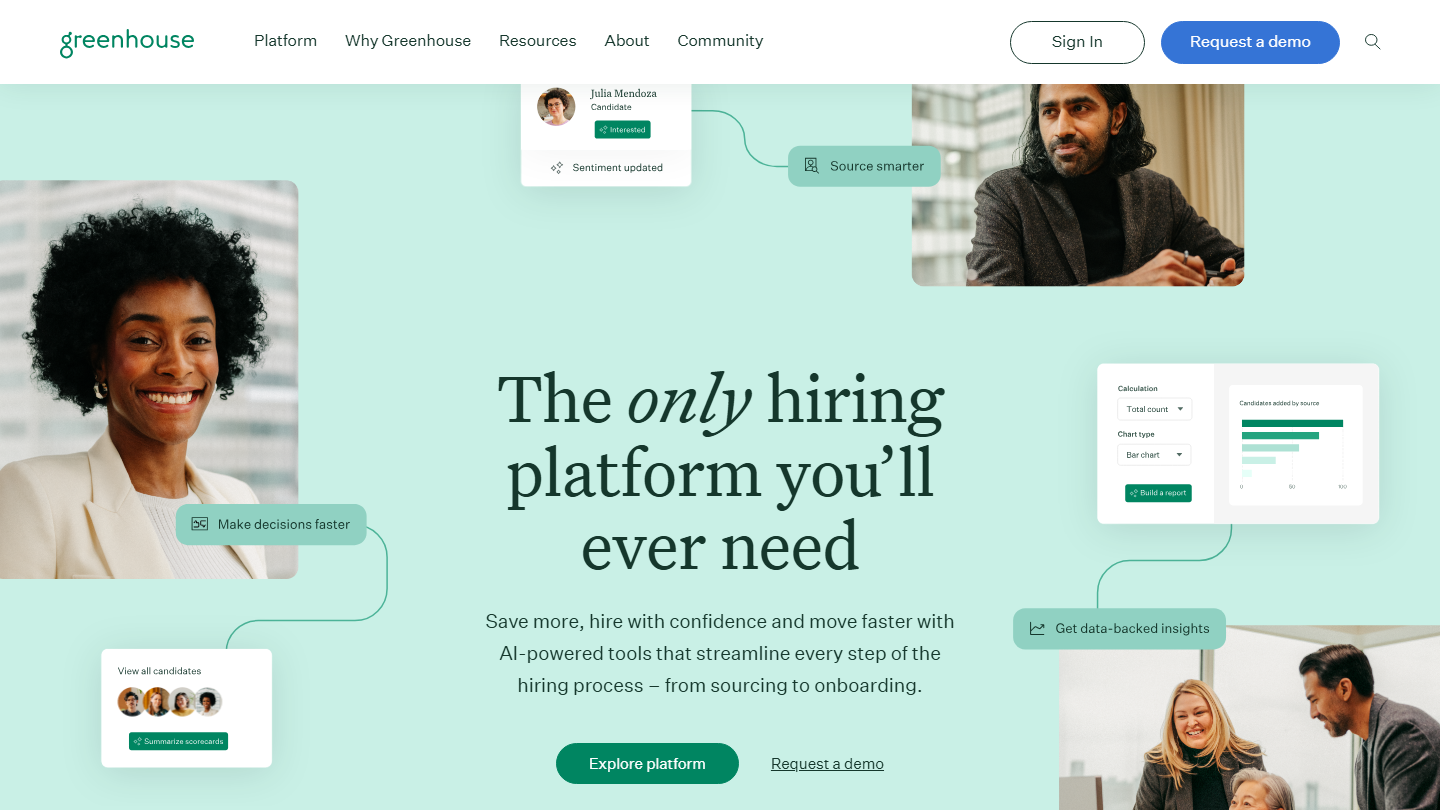
Greenhouse is the market standard for structured hiring in technology companies, high-growth startups, and mid-enterprise organizations that prioritize repeatable, bias-aware evaluation processes. The platform is built around the concept of structured hiring — every role has a defined interview plan, scorecard, and assessment sequence before the first candidate is screened. This approach is not an optional feature in Greenhouse; it is the architecture of the platform itself. Organizations that adopt Greenhouse without building structured processes around it underutilize it significantly.
Greenhouse is particularly strong on API quality and third-party integration depth. The Greenhouse API is one of the most documented and widely implemented in the ATS market, which is why it is the default integration target for most assessment tools, HRIS platforms, and background check providers. Testlify’s native Greenhouse integration pushes assessment scores into the candidate record automatically, enabling hiring teams to evaluate candidates against both skills data and structured interview scores within the same interface. Diversity and inclusion reporting is built into the base platform rather than sold as an add-on.
Key features:
- Structured interview kit and scorecard builder
- Diversity and inclusion pipeline reporting
- 450+ pre-built job board integrations
- Documented REST API for custom integrations
- Blind resume review and bias reduction tooling
Pros: Among the strongest structured hiring toolsets of any ATS reviewed; strongest API for custom integration development; transparent pipeline analytics at every hiring stage; blind resume review built into base product; widely adopted in tech — reduces onboarding friction when hiring technical roles where candidates already know the platform.
Cons: No native onboarding module — requires integration with a separate HRIS for post-offer experience; pricing premium for small teams relative to per-seat value; reporting UI requires training to configure non-standard reports; more setup time required to realize value compared to out-of-the-box tools.
Pricing: Custom pricing based on headcount and seat count; typically $6,000-$25,000/year for teams up to 200 employees; enterprise plans scale to $50,000+/year for larger organizations. Greenhouse does not publish pricing publicly — a demo and custom quote are required.
7. Lever (Employ)
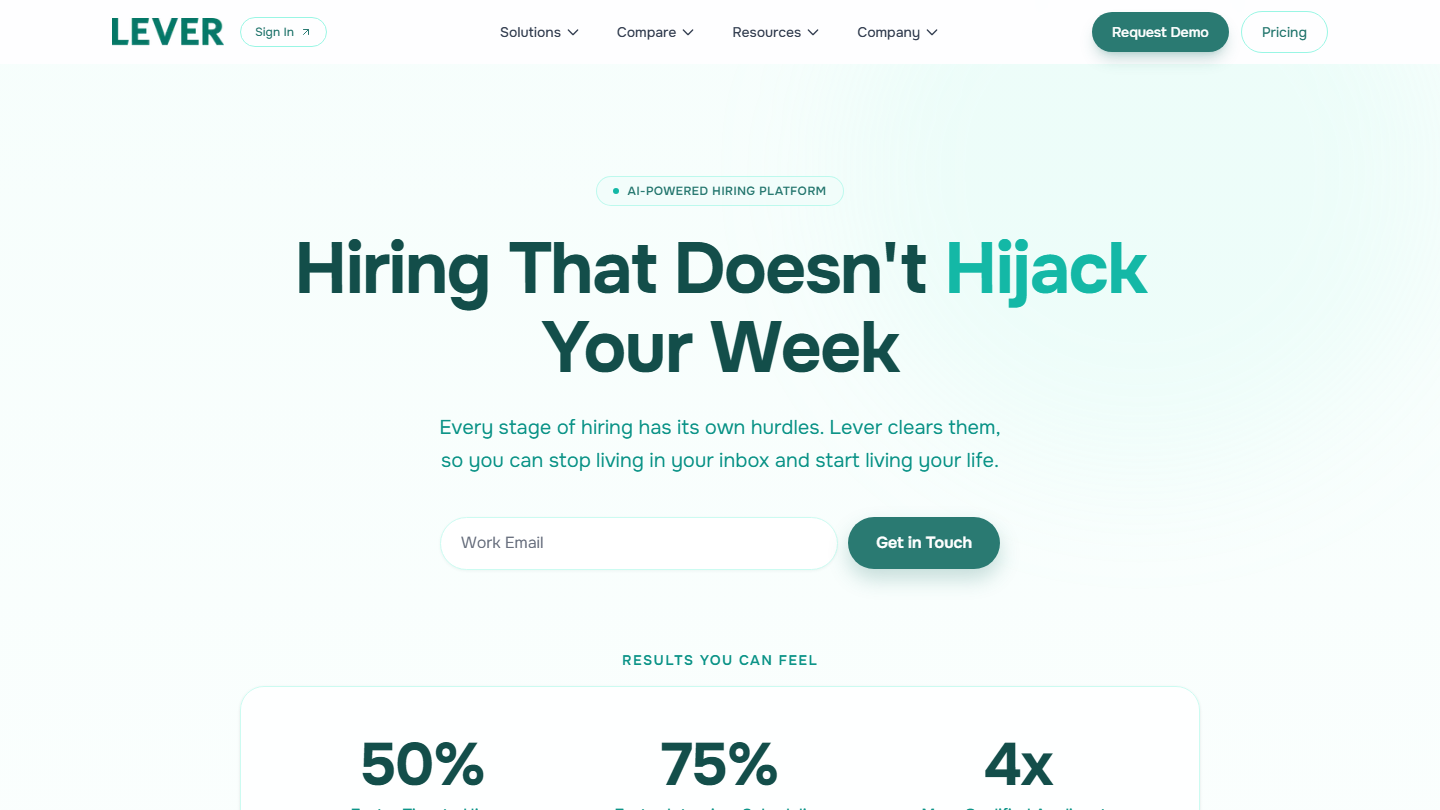
Lever combines applicant tracking and candidate relationship management in a single platform, making it a practical choice for talent teams that manage both active requisitions and passive candidate pipelines without operating two separate systems. Lever is part of the Employ Inc. portfolio alongside Jobvite and JazzHR, which means product investment is shared across multiple ATS brands — a consideration for teams evaluating long-term product roadmap commitment. Despite the multi-brand structure, Lever maintains a distinct product identity centered on relationship-based recruiting rather than high-volume workflow management.
The platform’s visual pipeline is one of its clearest differentiators: hiring managers see a board-style view of candidate progress that reduces the need for status update meetings and email check-ins. Lever’s CRM functionality supports nurture campaigns, talent community management, and sourcing outreach — capabilities that most standalone ATS platforms require a separate CRM tool to replicate. Lever supports Diversity Surveys at the application stage and includes reporting on demographic representation at each pipeline stage. Integration with Testlify is available via API, enabling assessment data to appear alongside recruiter notes and interview evaluations in the candidate record.
Key features:
- Built-in CRM for passive candidate pipelines
- Nurture campaign and outreach automation tools
- Visual hiring pipeline for hiring managers
- Diversity survey and demographic pipeline reporting
- Two-way email and calendar sync integration
Pros: ATS and CRM combination reduces tool count for recruiting teams managing passive pipelines; visual pipeline interface reduces hiring manager friction; strong passive candidate engagement capabilities; good fit for relationship-driven recruiting in competitive talent markets.
Cons: Reporting is less analytically deep than Greenhouse or SmartRecruiters; product updates may be slower given the multi-brand Employ Inc. portfolio structure; less suitable for high-volume transactional hiring where CRM depth is not a priority.
Pricing: Custom pricing; typically $5,000-$20,000/year depending on seat count and module selection. Enterprise plans are available on request with dedicated support and implementation assistance.
8. Ashby
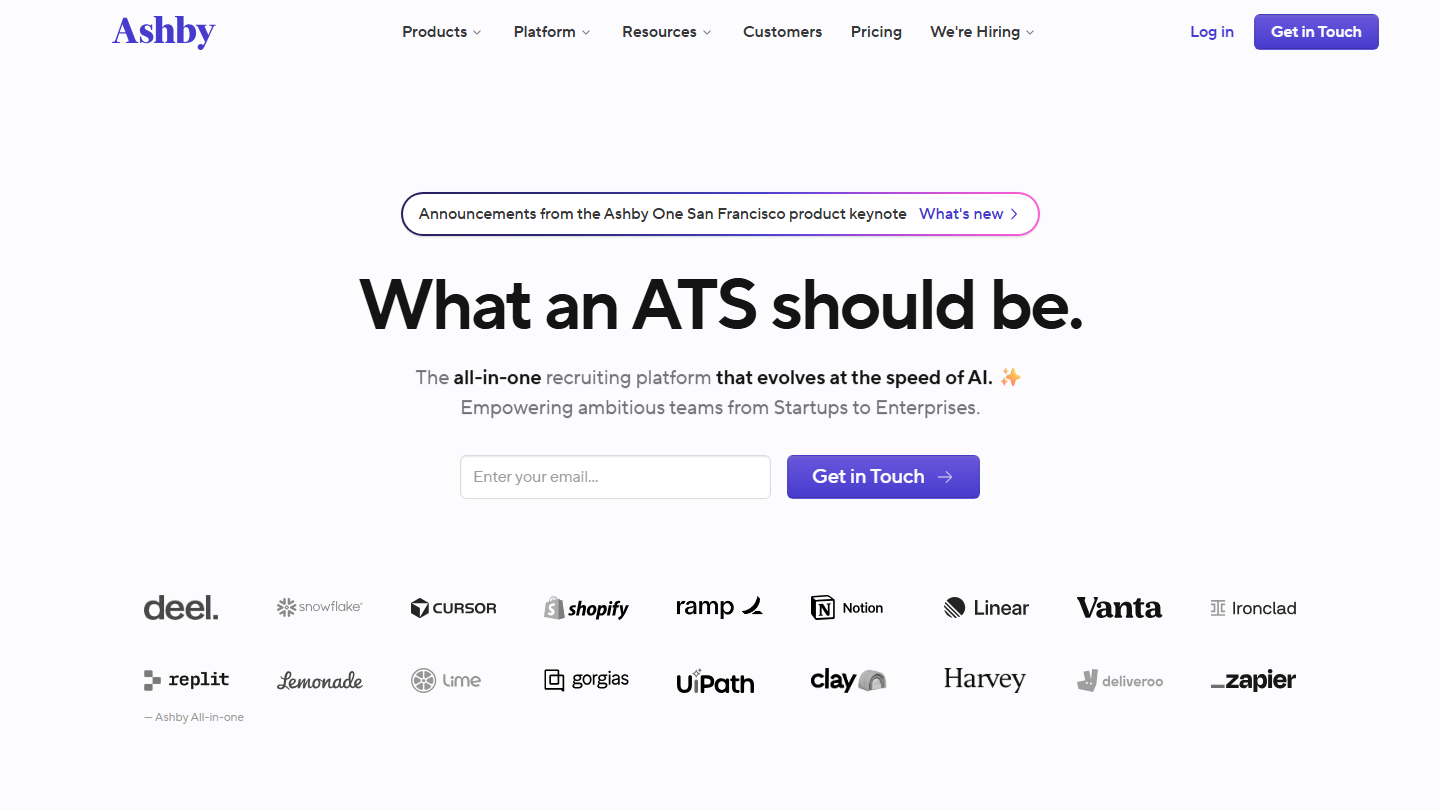
Ashby is an analytics-first ATS designed for data-driven talent teams, and it has gained significant adoption in the technology sector among organizations that treat recruiting metrics as seriously as they treat product or revenue metrics. The platform’s reporting capabilities are the most sophisticated of any ATS reviewed: recruiters can build custom dashboards tracking funnel conversion, interview-to-offer ratios, source quality, and time-in-stage — without a separate BI tool or SQL access. For talent operations teams that run regular recruiting reviews with metrics-based decision-making, Ashby eliminates the spreadsheet layer that most ATS platforms still require for serious analysis.
Ashby’s interview scheduling functionality is the fastest of any platform reviewed: the tool handles complex multi-interviewer, multi-timezone coordination in fewer steps than comparable platforms, which compounds into meaningful time savings for recruiting teams scheduling dozens of interviews weekly. The structured interview builder supports scorecards, interview templates, and note-taking within a single interviewer interface. The platform is API-first, which supports deep integration with pre-hire assessment tools including Testlify. Ashby’s product iteration pace is faster than legacy ATS incumbents — the team ships weekly updates — which means the platform’s capability profile changes rapidly relative to point-in-time reviews.
Key features:
- Custom analytics dashboards without separate BI tools
- Fast multi-interviewer scheduling automation
- Structured scorecard and interview note builder
- API-first architecture for custom integrations
- Granular pipeline conversion and source reporting
Pros: Most powerful analytics of any ATS reviewed — no separate BI tool required; fastest interview scheduling workflow; modern UX with high user satisfaction scores; weekly product iteration is faster than most enterprise incumbents.
Cons: Smaller integration marketplace than iCIMS or Greenhouse; compliance library is less mature for OFCCP and multi-country requirements; enterprise deployment track record is shorter than incumbents; per-recruiter pricing model becomes expensive at scale.
Pricing: $400-$800/month per recruiter; enterprise pricing available on request with volume discounts. Free tier available for very early-stage teams with limited seats.
9. Jobvite
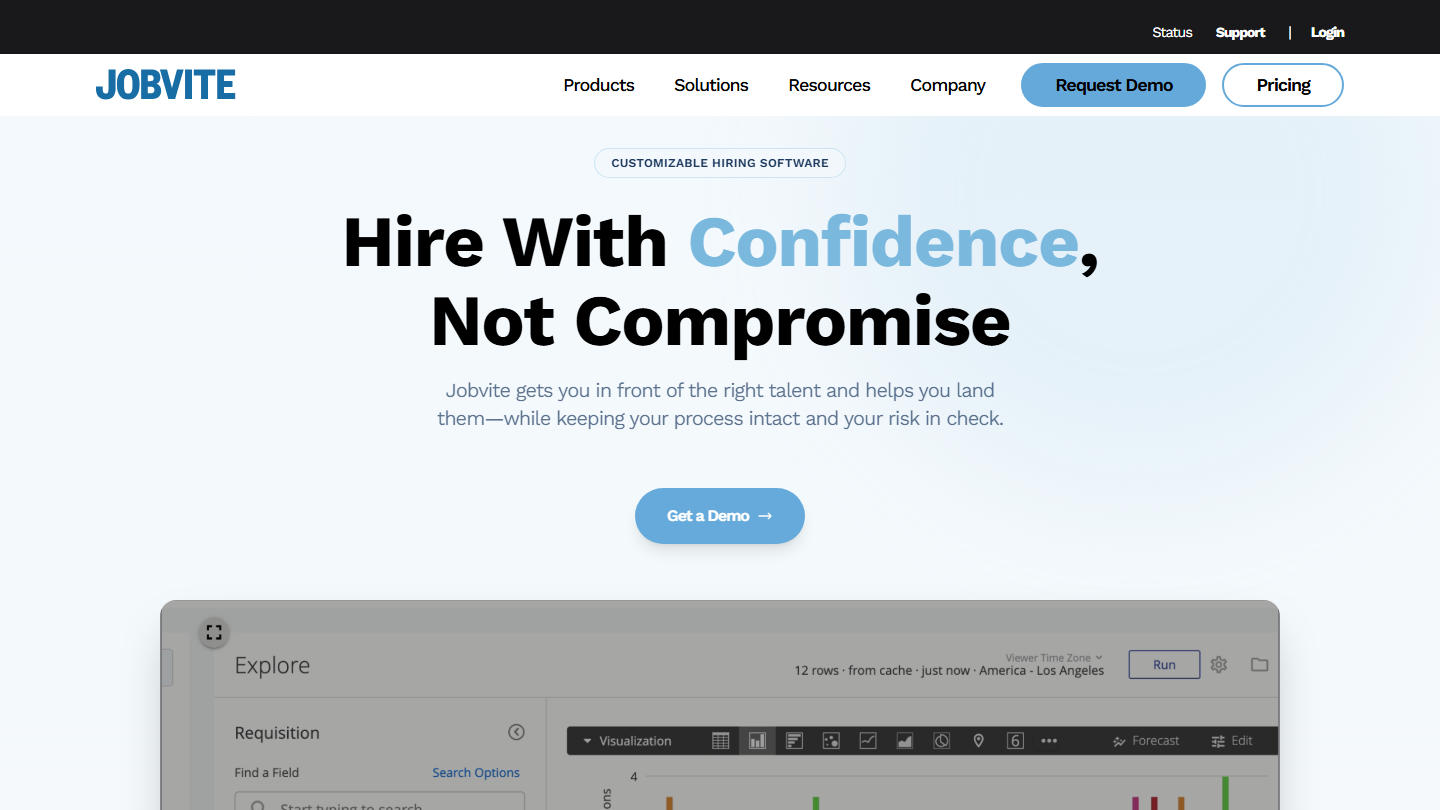
Jobvite is a talent acquisition platform with strong recruitment marketing capabilities, now part of the Employ Inc. portfolio alongside Lever and JazzHR. The platform covers the full hiring lifecycle from employer brand management and job advertising through applicant tracking, interview coordination, and onboarding — a broader scope than most purpose-built ATS platforms. Jobvite’s recruitment marketing functionality is the strongest within the Employ family: the platform includes programmatic job advertising, social recruiting tools, employee referral management, and employer brand analytics in a single interface.
For organizations that treat talent acquisition as an ongoing marketing and sourcing program rather than a purely reactive workflow, Jobvite’s recruitment marketing layer provides pipeline visibility from awareness through hire that most ATS platforms achieve only through separate CRM or marketing automation tools. The employee referral engine is particularly mature, with automated tracking, reward management, and referral analytics built into the base product. Integration with pre-hire assessment platforms is supported via API, enabling Testlify assessment scores to be incorporated into the candidate evaluation record. Jobvite’s onboarding module extends the candidate experience through the new hire’s first 90 days, covering document completion, task management, and day-one logistics without a separate HRIS handoff.
Key features:
- Programmatic job advertising and social recruiting
- Employee referral engine with automated reward tracking
- Employer brand analytics and career site management
- Full onboarding workflow from offer through day 90
- Text recruiting and automated candidate communications
Pros: Strongest recruitment marketing functionality in the Employ portfolio; unified platform from employer branding through onboarding reduces tool count; employee referral engine is mature and well-integrated; good fit for organizations with active employer brand investment programs.
Cons: Recruiter interface is less polished than Greenhouse or Ashby in day-to-day usability; analytics depth is below Ashby and SmartRecruiters for pipeline metrics; product investment is shared across the multi-brand Employ portfolio, which affects roadmap concentration.
Pricing: Custom pricing; typically $10,000-$50,000/year for mid-enterprise teams based on seat count and module selection. Full platform pricing covering recruitment marketing, ATS, and onboarding is available on request.
10. Teamtailor
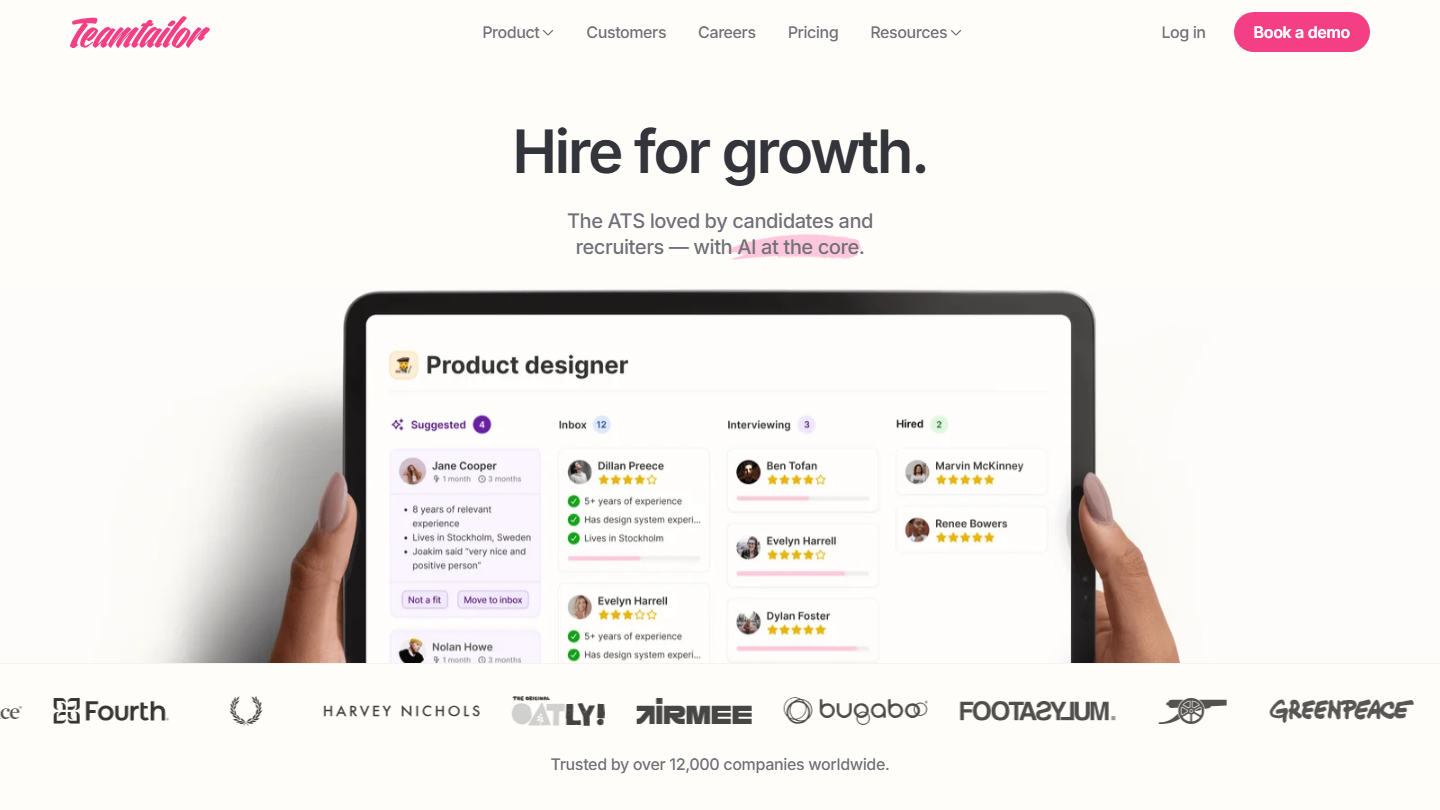
Teamtailor is a career site builder and ATS combination platform with strong employer branding capabilities, built for organizations that treat the candidate experience and employer brand as primary recruiting assets. The platform is particularly strong in Europe, where it has built significant market share by pairing GDPR-first data architecture with no-code career site design tools that do not require web development resources to maintain. Teamtailor is gaining adoption in North America among mid-market organizations that want modern candidate experience tooling without enterprise ATS complexity or pricing.
The career site builder is the clearest differentiator: organizations can create fully branded, responsive career sites with job listings, culture content, team pages, and application forms without touching code. Dynamic candidate nurture campaigns, automated status updates, and a built-in talent community allow recruiting teams to maintain relationships with past applicants and silver-medal candidates without a separate CRM tool. GDPR compliance is architecturally embedded, not bolted on — consent management, data deletion requests, and retention policy automation are standard features. Teamtailor’s video job ads feature — allowing hiring managers to record short video introductions to roles — has shown measurable impact on application completion rates for companies in competitive talent markets.
Key features:
- No-code career site builder with full brand controls
- GDPR-first data architecture and consent management
- Talent community and automated candidate nurture
- Video job ads with hiring manager introductions
- Team collaboration and structured candidate evaluation
Pros: Best career site builder of any ATS reviewed — no web development required; GDPR-first design is a material advantage for European hiring programs; strong candidate experience metrics out of the box; competitive pricing for mid-market organizations.
Cons: Advanced analytics are lighter than Ashby or SmartRecruiters; enterprise scalability for organizations with 5,000+ employees is less proven; US compliance modules for EEOC and OFCCP are less mature than North American-first platforms.
Pricing: From EUR 279/month for smaller organizations; enterprise pricing available on request. A 14-day free trial is available for teams evaluating the platform before committing to an annual contract.
11. BambooHR
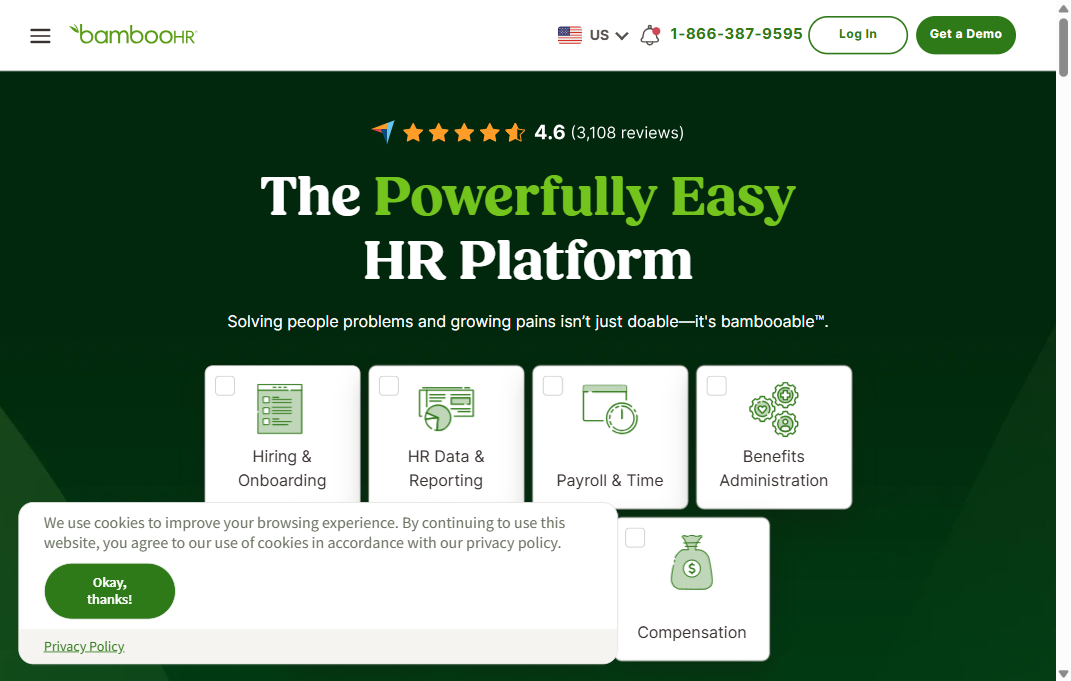
BambooHR is an HRIS-first platform with a built-in ATS, designed for SMB and mid-market companies that want HR and recruiting management in a single system without the implementation complexity or cost of enterprise HCM suites. The ATS module handles job posting, pipeline management, interview scheduling, and offer management within the BambooHR environment — which also includes onboarding, performance management, time tracking, and payroll in the same subscription. For organizations with fewer than 500 employees that want to avoid managing a separate ATS alongside a separate HRIS, BambooHR eliminates the integration overhead at a competitive per-employee price point.
BambooHR’s recruiting module consistently earns high user satisfaction scores for ease of use — the interface is intuitive enough for hiring managers who are not daily platform users to evaluate candidates without training. The platform’s reporting covers standard recruiting metrics including time-to-hire, source of hire, and pipeline conversion, though it does not reach the analytical depth of Ashby or SmartRecruiters for teams running formal recruiting operations reviews. Integration with Testlify enables pre-hire assessment data to appear within the BambooHR candidate record, supporting skills-based candidate screening alongside the standard application review workflow.
Key features:
- HRIS and ATS combined in single subscription
- Onboarding workflow and document management
- Employee self-service portal integration
- Performance management and goal tracking
- Time tracking and payroll processing built in
Pros: HRIS and ATS in one affordable platform reduces tool count and integration overhead; fastest time-to-value of any platform reviewed — deployment measured in days, not months; consistently high user satisfaction scores for recruiter and hiring manager experience.
Cons: ATS feature depth is materially less than dedicated platforms — structured hiring, advanced compliance, and high-volume workflows are not a fit; not designed for enterprise recruiting scale beyond 500 active requisitions per year; global hiring and OFCCP compliance tooling is limited.
Pricing: Custom pricing based on employee count; typically $8-$16/employee/month depending on module selection. The HR platform includes ATS access — there is no standalone recruiting-only SKU.
12. Workable
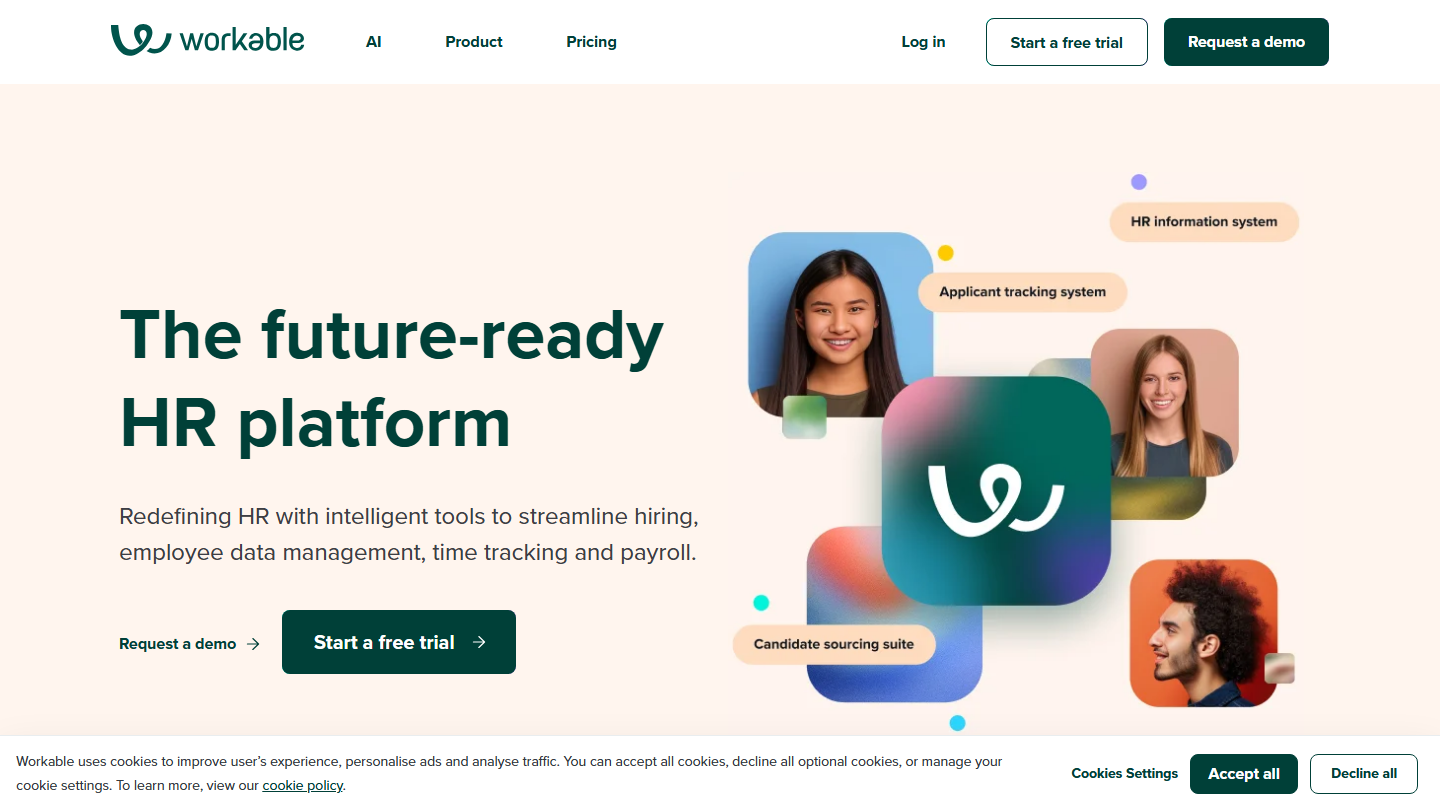
Workable is a full-cycle hiring platform covering sourcing, screening, interviewing, and offer management, with particular strength in AI-powered passive candidate sourcing and broad job board coverage. The platform is used by mid-market companies scaling their hiring teams rapidly and needing fast time-to-value over configuration depth. Workable’s sourcing AI proactively surfaces passive candidates from a database of more than 400 million profiles, reducing the recruiter time spent on outbound sourcing for individual roles. The mobile hiring app is one of the platform’s clearest practical advantages: hiring managers can review candidate profiles, leave interview feedback, and approve offers from a smartphone without logging into a desktop interface.
For companies where hiring managers are frequently in the field or not desk-bound, this removes a common friction point that delays evaluation cycles. Workable also includes a structured interview question library with 700+ vetted questions organized by role type and competency, giving hiring managers a starting point for consistent evaluation without requiring formal interview training. Pre-hire assessment integration with Testlify is available via Workable’s marketplace, enabling skills assessment data to complement the AI-sourcing and screening workflow at the mid-funnel stage.
Key features:
- AI-powered passive candidate sourcing engine
- 200+ job board integrations and one-click posting
- Mobile hiring app for on-the-go evaluations
- Structured interview question library (700+ questions)
- Offer management and e-signature capabilities
Pros: Fastest time-to-value of dedicated ATS platforms reviewed; strong AI sourcing for passive candidates reduces outbound sourcing effort; competitive and transparent pricing model; mobile-first design is practical for hiring managers who are not desk-bound.
Cons: Advanced analytics and compliance reporting are less deep than enterprise platforms; not suitable for organizations with complex multi-stage approval workflows or OFCCP reporting requirements; enterprise compliance library is lighter than iCIMS or SmartRecruiters.
Pricing: Starter at $189/month; Standard at $313/month; Premier at $599/month. Annual plans offer a discount. Pricing scales by plan tier rather than seat count, which is advantageous for teams with multiple hiring managers accessing the platform.
13. Pinpoint
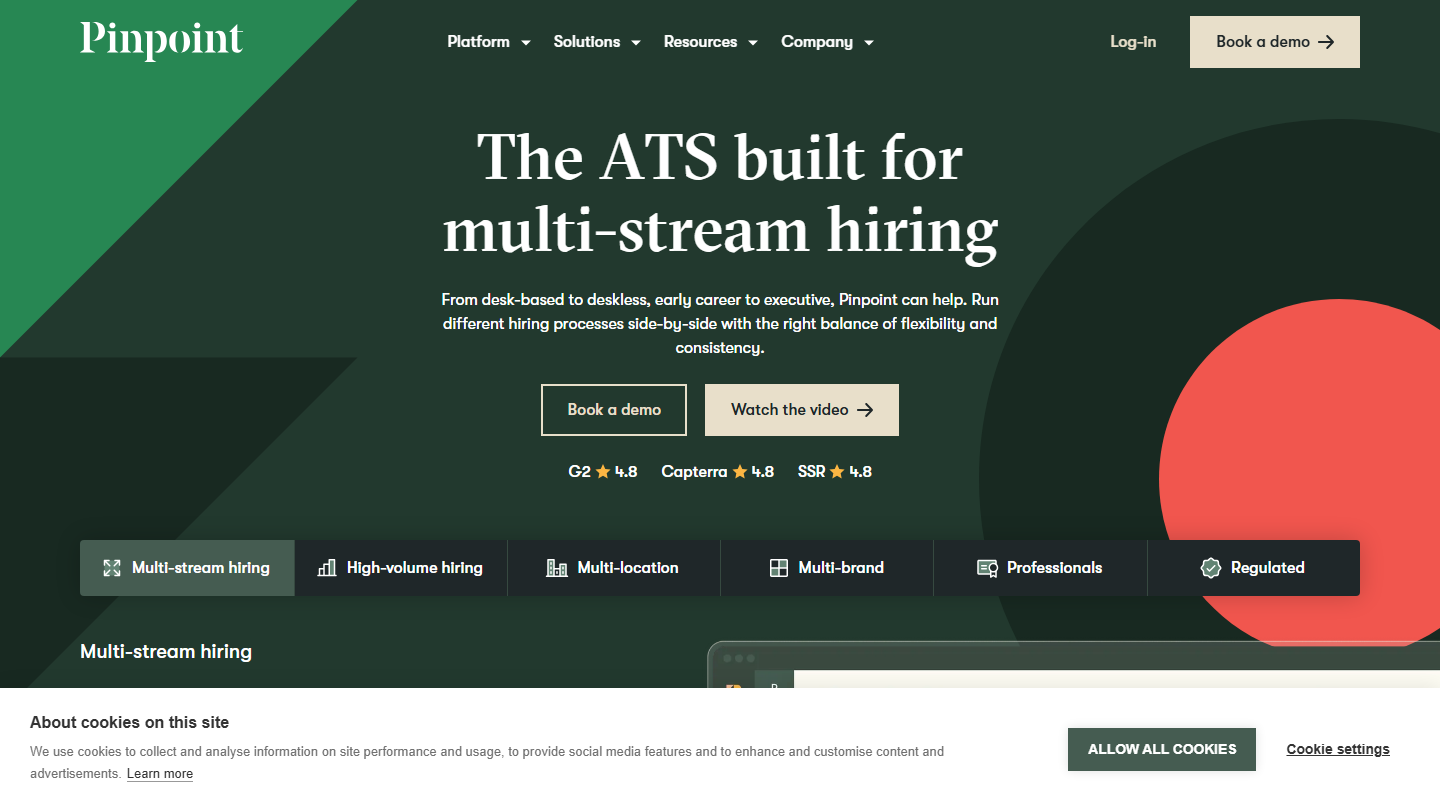
Pinpoint is a talent acquisition platform built for in-house talent teams at mid-market and growth-stage companies, with a deliberate product focus on candidate experience and recruiter usability over enterprise compliance depth. The platform covers the full application-to-offer workflow including branded career sites, structured screening questionnaires, collaborative candidate evaluation, and offer management. Pinpoint differentiates by explicitly targeting in-house recruiting teams rather than agency or RPO workflows, which shapes the product’s interface design and default workflow assumptions in ways that reduce friction for teams managing their own talent acquisition programs without agency support.
The platform’s automated screening questionnaire builder allows recruiting teams to define structured screening criteria at the requisition level, automatically advancing or declining candidates based on defined threshold responses without manual review. This is particularly effective for high-volume roles where a significant portion of applicants do not meet minimum qualifications — it reduces the time recruiters spend on unqualified profiles without creating the candidate experience friction of a generic keyword screen. Integration with Testlify supports pre-hire assessment delivery from within the Pinpoint application flow, connecting skills assessment data to the candidate evaluation record for structured comparison across applicants.
Key features:
- Branded application portal and career site builder
- Automated screening questionnaire with threshold logic
- Collaborative candidate evaluation and structured feedback
- Diversity and inclusion data collection built in
- Offer management with e-signature integration
Pros: Candidate experience-first design; strong onboarding workflow connection from offer acceptance; built explicitly for in-house talent teams, not an agency workflow adapted for internal use; automated screening questionnaire reduces manual review of unqualified applicants.
Cons: Smaller integration marketplace compared to iCIMS or Greenhouse; limited enterprise compliance depth for OFCCP or complex global hiring; lower brand recognition may affect vendor stability evaluation for risk-averse enterprise procurement teams.
Pricing: From $800/month for smaller teams; enterprise pricing available on request. Demo-only evaluation process — no self-serve free trial is available.
14. Rippling Recruiting
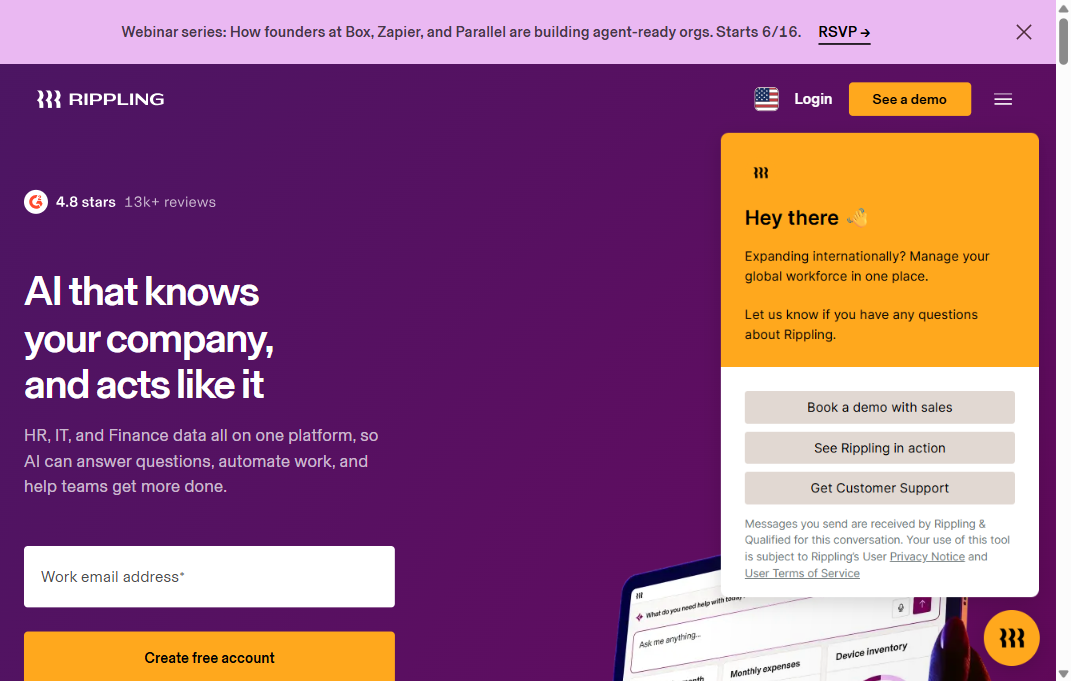
Rippling Recruiting is the hiring module within Rippling’s unified workforce management platform, which combines HR, IT, and finance administration into a single system of record. The core value proposition of Rippling Recruiting is not ATS feature depth but system unification: a new hire approved in Rippling Recruiting can have their payroll, benefits, laptop provisioning, and software access configured automatically on the day the offer is accepted — without data re-entry between systems or IT tickets. For organizations running Rippling as their primary HR platform, adding the recruiting module eliminates the API synchronization overhead between ATS and HRIS that most hiring stacks require.
The recruiting module handles job requisition management, custom application forms, interview scheduling, structured evaluation, and offer management within the Rippling interface. Approval workflows connect directly to Rippling’s headcount management and compensation planning data, which reduces the manual routing steps that extend offer timelines in organizations with layered approval chains. Global hiring support allows requisitions and offers to be managed across multiple countries within a single Rippling account. Pre-hire assessment integration with Testlify is available via API, connecting skills assessment data to the candidate record within the recruiting workflow.
Key features:
- Unified HR, IT, and payroll system integration
- Automated new hire provisioning on offer acceptance
- Global hiring workflow across multiple countries
- Custom approval routing tied to headcount data
- Single system of record from recruiting through offboarding
Pros: Unique HR-IT unification — new hire laptop and software provisioned on offer day without IT tickets; fastest onboarding experience of any platform reviewed for organizations already on Rippling; one system of record eliminates ATS-to-HRIS sync errors; strong global hiring support.
Cons: Recruiting module feature depth is less mature than dedicated ATS platforms — structured hiring, advanced analytics, and compliance reporting trail Greenhouse and SmartRecruiters; best value as an add-on for existing Rippling customers rather than as a standalone ATS selection; limited presence in pure ATS evaluations.
Pricing: Rippling’s base platform starts at $8/employee/month; Recruiting module pricing is custom and added to the base subscription. Full pricing requires a custom quote based on headcount and selected modules. For organizations already running payroll and IT management on Rippling, the marginal cost of adding the recruiting module is typically the most cost-efficient path to ATS coverage without adding a second vendor relationship.
The table below summarizes all 14 platforms across the dimensions most relevant to enterprise ATS selection decisions.
ATS | Best for | Pricing tier | Testlify integration | Compliance depth |
|---|---|---|---|---|
Workday Recruiting | Workday HCM enterprises | $150,000+/year | Yes (API) | Global / Highest |
SAP SuccessFactors | SAP ecosystem, global enterprise | $80,000-$200,000+/year | Yes (API) | Global / Highest |
Oracle HCM Recruiting | Oracle ERP enterprises | $100,000+/year | Yes (API) | Global / High |
iCIMS Talent Cloud | North America enterprise | $6,000-$100,000+/year | Yes (native connector) | EEOC / OFCCP / High |
SmartRecruiters | High-volume enterprise | $10,000-$60,000+/year | Yes (API) | EEOC / GDPR / High |
Greenhouse | Tech and growth companies | $6,000-$50,000+/year | Yes (native) | EEOC / GDPR / Strong |
Lever (Employ) | Relationship-based hiring | $5,000-$20,000+/year | Yes (API) | Standard |
Ashby | Analytics-driven talent teams | $400-$800/recruiter/mo | Yes (API) | Standard |
Jobvite | Employer brand programs | $10,000-$50,000+/year | Yes (API) | Standard |
Teamtailor | Employer branding, Europe | EUR 279+/month | Yes (API) | GDPR / Strong |
BambooHR | SMB and mid-market | $8-$16/employee/month | Yes (API) | Basic |
Workable | Scaling mid-market teams | $189-$599/month | Yes (marketplace) | Standard |
Pinpoint | In-house talent teams | $800+/month | Yes (API) | Standard |
Rippling Recruiting | Existing Rippling customers | $8/employee/month+ | Yes (API) | Good |
How do enterprise HR teams migrate to a new ATS without disrupting active hiring?
ATS migration is one of the most underestimated operational challenges in enterprise HR. Most implementations fail not because the new platform lacks capability but because the migration plan does not account for data continuity, active requisition carryover, and recruiter re-training across multiple time zones simultaneously. Understanding the migration variables before committing to a vendor is as important as understanding the feature set.
The first variable is data portability. Before signing a contract with any ATS vendor, request a documented data export specification: which candidate fields are exportable, in what format, and whether historical assessment scores and structured interview data can be exported alongside application records. Platforms that lock candidate relationship data in proprietary formats — a practice more common in older CRM-adjacent ATS tools — create migration overhead that adds months to the transition timeline and cost to the implementation budget. Greenhouse and iCIMS both export full candidate histories in structured formats. HCM suite platforms like Workday and SAP SuccessFactors require certified partner support for data migration, which is a significant budget line in the transition plan.
The second variable is active requisition carryover. Enterprise recruiting programs with 50+ active requisitions at any given time cannot simply halt hiring while the new platform is configured and populated. The standard migration approach is a parallel-run period of 4-8 weeks during which new requisitions open in the new platform while active pipelines complete in the old one. This doubles recruiter administrative workload during the transition window, which requires explicit planning for recruiter support coverage — not just IT and HRIS bandwidth.
The third variable is integration re-connection. Every integration the current ATS has with background check providers, assessment tools, HRIS, and job boards must be rebuilt or re-authenticated in the new platform. For organizations using Testlify, this is straightforward — Testlify’s integrations with all 14 platforms reviewed here mean that the assessment workflow re-connects in hours rather than weeks. Background check providers and HRIS systems typically require IT involvement and a vendor re-authorization process that adds 2-4 weeks to the integration timeline.
The fourth variable is structured process re-configuration. If the current ATS has years of custom stages, scorecards, approval routing, and automation rules built into it, those configurations do not migrate automatically. They must be rebuilt from scratch in the new platform — an opportunity to audit and improve the hiring process, but also a significant configuration project that most implementation timelines underestimate. Organizations that have invested in structured hiring frameworks should document their current configuration in platform-agnostic terms (stage names, scorecard dimensions, evaluation criteria) before beginning a migration, so the configuration can be rebuilt deliberately rather than recreated from memory.
Pro Tip: Run a full audit of your current ATS configuration — active integrations, custom stages, scorecard templates, automation rules, and compliance settings — before signing with a new vendor. The audit output becomes the migration specification document, and gaps discovered after go-live are significantly more expensive to fix than gaps discovered before.
How does ATS and pre-hire assessment integration affect hiring quality?
The gap between ATS workflow management and actual hiring quality is where most enterprise recruiting programs lose value. An ATS that organizes applications, routes candidates through stages, and generates compliance reports does not, by itself, predict which candidates will succeed in the role. That prediction requires structured evaluation data — and the most reliable source of structured evaluation data is a validated pre-hire assessment integrated directly into the ATS workflow.
Organizations using pre-hire assessments within their ATS pipeline reduce mis-hire rates by up to 36% relative to resume-and-interview-only evaluation processes, based on structured hiring research. The mechanism is not assessment scores replacing human judgment — it is assessment data giving recruiters and hiring managers a common, objective reference point that reduces the influence of resume presentation and interview performance variability on the final decision. The average cost per hire in the US is $4,683 according to SHRM’s 2022 Talent Acquisition benchmark. A 36% reduction in mis-hires across an annual hiring plan of 200 people compounds into a material reduction in replacement hiring cost.
Testlify’s library of 3,500+ assessments across 4,500+ job roles integrates directly with all 14 ATS platforms reviewed in this post. The integration model varies by platform: Greenhouse, iCIMS, and Workday support native API connections that push assessment scores into the candidate record automatically, appearing alongside interview scorecards in the hiring manager’s evaluation view. Other platforms use webhook-based integrations that trigger assessment invitations at defined pipeline stages and return results to the candidate record upon completion.
The practical workflow operates as follows: a candidate completes a first-round application via the ATS. The platform automatically sends a Testlify assessment invitation when the candidate reaches the screening stage. The candidate completes the assessment; results are pushed into the ATS candidate profile. The recruiter and hiring manager review interview scorecard, assessment results, and work samples in the same interface — and the hiring decision is made against a complete structured evaluation record rather than a resume and a single interview impression.
Organizations using this workflow with Testlify report a 55% reduction in time-to-hire and a 94% candidate satisfaction rate, driven by faster screening cycles and a more relevant assessment experience compared to generic skills tests. The time-to-hire improvement comes from two sources: faster recruiter screening — assessment data reduces the number of phone screens required to identify qualified candidates — and faster hiring manager decisions, where objective data reduces back-and-forth deliberation at the offer stage.
The assessment-ATS integration also creates a feedback loop for sourcing optimization. When ATS data on source of hire is paired with Testlify assessment scores at the sourcing stage, recruiting teams can identify which job boards and sourcing channels produce candidates who score highest on role-relevant assessments — not just candidates who complete the application. According to Deloitte’s Global Human Capital Trends research, data-driven talent acquisition decisions are associated with 2x higher likelihood of improving quality of hire over a three-year period. This insight shifts sourcing budget toward channels that produce hire-ready candidates rather than application volume.
Pro Tip: Configure Testlify assessment invitations to trigger automatically at the ATS screening stage rather than sending them manually. Automation reduces the average time between application and assessment completion by 2-3 days, which compounds across hundreds of requisitions annually into meaningful time-to-hire improvement.
For enterprise teams evaluating which assessment capabilities to prioritize in an ATS integration, Testlify’s talent acquisition integration guide covers role-specific assessment libraries, ATS trigger configuration, and score reporting formats for each supported platform.
ATS pricing comparison: what enterprise teams actually pay in 2026
Enterprise ATS pricing rarely reflects total cost of ownership at the headline contract level. The per-seat or per-employee price understates actual first-year investment by 40-60% when implementation fees, integration development, training, and annual renewal escalations are factored in. The table below shows realistic pricing ranges for all 14 platforms reviewed, based on vendor documentation and analyst source data available as of Q2 2026.
ATS | Starting price | Pricing model | Free trial |
|---|---|---|---|
Workday Recruiting | $150,000+/year | HCM suite contract | No |
SAP SuccessFactors | $80,000+/year | HXM suite contract | No |
Oracle HCM Recruiting | $100,000+/year | HCM cloud contract | No |
iCIMS Talent Cloud | $6,000+/year | Seat-based annual | No |
SmartRecruiters | $10,000+/year | User-based annual | No |
Greenhouse | $6,000+/year | Per-seat annual | No |
Lever (Employ) | $5,000+/year | Per-seat annual | No |
Ashby | $400/recruiter/month | Per-recruiter monthly | No |
Jobvite | $10,000+/year | Per-seat annual | No |
Teamtailor | EUR 279/month | Monthly or annual | 14-day trial |
BambooHR | $8/employee/month | Per-employee monthly | 7-day trial |
Workable | $189/month | Tiered monthly or annual | 15-day trial |
Pinpoint | $800/month | Monthly or annual | Demo only |
Rippling Recruiting | $8/emp/month base+ | Per-employee modular | No |
Implementation fees are the most frequently underestimated cost category. Enterprise HCM suite implementations for Workday, SAP SuccessFactors, and Oracle HCM typically require certified implementation partner engagements that add $50,000-$500,000+ to the first-year total cost, depending on configuration complexity and data migration scope. Purpose-built ATS platforms like Greenhouse and iCIMS carry shorter implementation timelines but still carry professional services costs for enterprise deployments that are not reflected in per-seat pricing. The only platforms in this review with genuinely self-serve setup paths are Workable, BambooHR, and Teamtailor.
What should HR leaders evaluate when choosing an ATS in 2026?
ATS selection is a multi-year infrastructure decision, not a software subscription. The evaluation framework that produces a good outcome is different from the one used to select a point solution like a scheduling tool or survey platform. The five criteria below are the ones that most frequently determine whether an ATS implementation delivers its intended value — or becomes a replacement project within two contract cycles.
1. Integration fit with your existing tech stack
The ATS that integrates cleanly with your existing HRIS, background check provider, and pre-hire assessment tool will deliver more value than a feature-rich platform that requires custom middleware to connect. Before evaluating platforms on their own merits, map the integrations your recruiting workflow requires: HRIS for post-hire data transfer, assessment tools for structured screening, background check for compliance, and calendar systems for scheduling. Evaluate each ATS against that map specifically — not against the platform’s total connector count. Testlify’s integration with all 14 platforms reviewed here ensures that assessment data flows into whichever ATS your organization selects without a custom development project.
2. Compliance coverage for your specific jurisdiction mix
EEOC, OFCCP, GDPR, and CCPA compliance requirements vary by hiring location and role type. A platform with strong North American compliance and weak GDPR data residency controls is a mismatch for organizations hiring in Europe. Evaluate compliance coverage against the specific jurisdictions where your requisitions are concentrated, not against a generic “global compliance” marketing claim. Ask vendors to document how their platform handles data deletion requests, audit trail retention, and consent management in each of your active hiring jurisdictions before signature.
3. Total cost of ownership over a 3-year contract
Year-one contract value understates the total cost of an ATS implementation for enterprise teams. Implementation fees, integration development, training hours, and annual renewal escalations routinely add 40-60% to the headline contract price over a standard 3-year term. Build a 3-year total cost model before comparing platforms, and include the cost of any dedicated ATS administrator headcount required to maintain the configuration. Platforms with lower implementation complexity — Workable, Pinpoint, BambooHR — often carry lower total cost of ownership even when their per-seat price appears similar to enterprise alternatives.
4. Structured hiring and assessment integration capability
An ATS that supports structured interview scorecards, automated assessment delivery at defined pipeline stages, and consolidated evaluation views for hiring managers is architecturally different from a workflow tool that routes resumes. The structured hiring capability gap is where most ATS implementations fail to deliver on their quality-of-hire promise. Evaluate whether the platform’s scorecard builder allows role-specific criteria weighting, whether pre-hire assessment integrations push data into the candidate record automatically, and whether hiring managers can see a consolidated evaluation view without toggling between tools. Skills-based hiring requires assessment data inside the ATS workflow — not in a separate tab.
5. Implementation timeline and internal resource requirements
Enterprise ATS implementation timelines range from 2 weeks for Workable and BambooHR to 18 months for Workday and SAP SuccessFactors. The implementation timeline is not only a deployment consideration — it is a direct function of the configuration depth the platform requires to deliver its value. Platforms that require long implementation timelines to be useful also require ongoing administration resources to maintain that configuration as your hiring workflows evolve. Factor implementation resource requirements into your ATS administrator headcount plan before selecting a platform, not after signature.
A commonly missed resource requirement is the internal HR operations bandwidth needed to configure structured hiring frameworks within the new platform. Enterprise ATS implementations that fail to deliver quality-of-hire improvement almost always have the same root cause: the platform was configured with default stages and generic workflows rather than role-specific evaluation criteria, weighted scorecards, and pre-offer assessment checkpoints tailored to each job family. Allocate dedicated HR operations or talent ops resources to configuration alongside IT during implementation — the structured hiring configuration is where the platform either earns its contract value or fails to deliver it. This is separate from the vendor’s implementation support, which covers technical setup, not process design.
Key Takeaway: Map your integration requirements before evaluating ATS features. The platform that connects cleanly to your HRIS, assessment tool, and background check provider without custom development will outperform a feature-rich platform that requires middleware to function in your specific tech stack.
For enterprise teams starting the ATS evaluation process, Gartner’s annual Magic Quadrant for Cloud HCM Suites provides analyst-level vendor positioning for the HCM-embedded ATS category. For structured hiring evidence, Harvard Business Review’s research on data-driven talent acquisition provides the evidence base for evaluating which platform features deliver measurable quality-of-hire improvement versus which are differentiating marketing claims.
Frequently Asked Questions About Applicant Tracking Systems

Content Writer
Yashika Khandelwal is a Content Writer with 3+ years of experience creating research-backed content on hiring, talent assessment, and HR technology. She is a registered Organizational Psychologist and subject matter expert who combines behavioral science with practical recruitment insights to produce accurate, evidence-based content.
LinkedInRelated resources
View all
HR & recruitment
Top 7 recruitment trends in sales manager hiring

HR & recruitment
Common examples of unfair hiring practices & how to avoid them

HR & recruitment
Effective ways to identify hiring needs

HR & recruitment
How to build a successful recruitment team

HR & recruitment
Bridging communication gaps in the gig economy

HR & recruitment
How to enhance communication at every stage of recruitment
Get started.
Hire on proof, not resumes.
Run your first skills-based assessment free — no credit card required.