
Purple squirrel in recruitment: Are they worth the hype?
Discover whether pursuing “purple squirrels”—ideal candidates with the perfect mix of skills and experience—is worth the effort.

A purple squirrel is a candidate who matches every single line of a job description: every skill, every tool, every year of experience, the industry background, the degree, and the salary band. Recruiters named it after an animal nobody expects to see, which tells you what they think of the odds.
So the honest answer to "are they worth the hype" is: the candidate sometimes exists, and the hunt for one is usually a symptom of a badly written job spec rather than a tight talent market. Those two situations need opposite fixes, and most hiring teams cannot tell which one they are in.
TL;DR
- A purple squirrel is a candidate who meets 100% of a job posting's requirements. The term is a quiet complaint about the posting, not a compliment to the candidate.
- Most purple squirrel searches are a requirements defect. When a spec lists 14 skills, the pool does not shrink, it empties.
- Occasionally the narrow role is real (a regulated licence, one piece of legacy infrastructure, a rare language pair). Then the honest move is to pay for scarcity or train for it, not to keep reposting.
- Separate must-haves from nice-to-haves before you post, and weight them instead of treating all 14 as pass or fail.
- Evidence beats the checklist. A structured, job-relevant evaluation predicts performance better than credential matching does, and the research puts real numbers on that gap.
 ChatGPT
 Gemini
 Claude
 Grok
Grok Perplexity
What is a purple squirrel? Meaning and origin
A purple squirrel is recruiting shorthand for a candidate whose skills, experience, qualifications and salary expectations line up exactly with a job description. The phrase comes from the recruiting industry around the turn of the 2000s, and it has always carried a note of sarcasm aimed at the person who wrote the requirements, not at the person applying.
Two related terms get used alongside it. "Unicorn" usually means the same thing in a startup context, and "rockstar" is the version that ends up in the job ad itself. All three tend to describe someone who is not job hunting at all, which makes them a passive candidate problem as much as a requirements problem.
What matters is the direction of the complaint. When a recruiter says a role is a purple squirrel hunt, they are not praising the standard. They are saying the requirements and the market disagree, and somebody needs to move.

Does purple squirrel recruiting actually work?
Rarely, and the failure is mathematical rather than motivational. Each additional hard requirement multiplies against the others. If ten requirements each independently rule out 40% of a pool, roughly 0.6% of it is left standing, and that is before salary, location and notice period. The spec has not raised the bar. It has closed the door.
Skills move faster than specs do, which makes this worse every year. The World Economic Forum found that employers expect 39% of workers' core skills to change by 2030, down from 44% in its previous edition. A requirement list written against last year's tool stack is already describing fewer people than it did when it was written. The classic version of this error is asking for 10 years of experience in a platform that has existed for 5.
There is a wider pattern here worth noticing. Plenty of employers say they have loosened their requirements, and far fewer actually have. In a study of 11,300 roles at large firms, the Burning Glass Institute and the Harvard Business School Project on Managing the Future of Work found that roughly 45% of firms dropped degree requirements in name only, with no change in who they actually hired. Requirement discipline is harder than announcing it.
What purple squirrel recruitment really costs
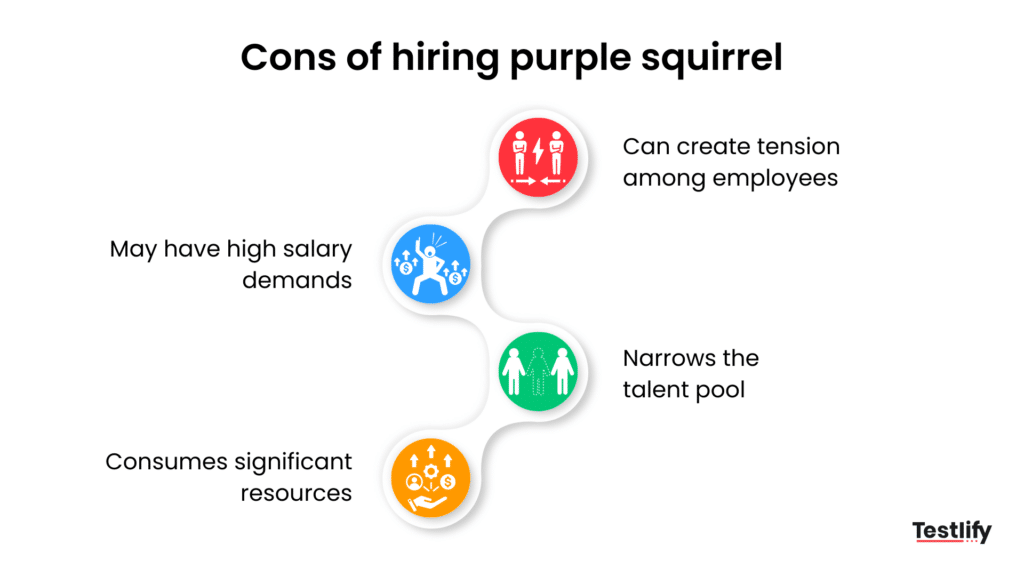
The cost is not the search time. It is everything that happens while the role sits open, and almost none of it lands in the recruiting budget.
- The role stays open in a market that is already slow to fill. US job openings ran at 7.1 million against 5.2 million hires in August 2026, so the vacancy is competing for a shrinking pool of people who are actually moving.
- Good candidates get rejected for the wrong reason. The person who clears 11 of your 14 boxes is filtered out by a screen, not by a human decision, and they do not come back when you loosen the spec three months later.
- The team absorbs the gap. Someone covers the open desk, usually the strongest person on the team, which is how one unfilled role turns into two.
- The salary conversation gets harder, not easier. A candidate who genuinely meets every requirement knows it, and prices accordingly. Check the salary range you published against what that profile actually commands before you go looking for it.
- Comparison bias creeps in. Once a hiring panel holds an imaginary perfect candidate in mind, every real candidate gets measured against a person who is not in the process. Strong applicants start looking mediocre by comparison.
That last one is the expensive one, and it is invisible on any dashboard. A hiring team can run a clean, fair process and still reject everybody, because the benchmark was never a person.
Should you be a purple squirrel hunter?
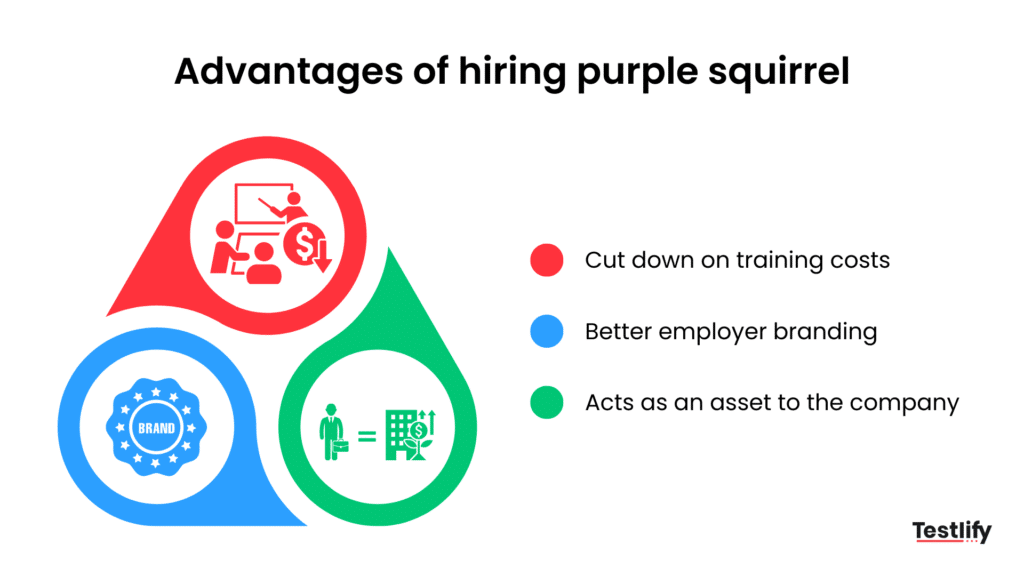
Sometimes, yes. This is where most advice on the term goes soft, so here is a position: the narrow search is legitimate when the narrowness comes from the work rather than from the wish list. Three cases qualify.
- A hard credential gate. A licence, a clearance, or a regulator-mandated certification is not a preference. You cannot train around it on a hiring timeline.
- One genuinely rare pairing. A specific legacy system plus a specific domain, or an uncommon language pair, where the overlap really is a few hundred people.
- A role where a mistake is catastrophic and slow to detect. Safety-critical and financial-control work earns a longer search.
Outside those three, the hunt is usually a wish list that nobody pushed back on. And the test for which one you are in takes about fifteen minutes: make the hiring manager name, for each requirement, what goes wrong in the first 90 days if the hire does not have it. Requirements that survive that question are real. Most do not survive it.
Pro tip: run that exercise with the person who will manage the hire, not with the person who wrote the job ad. The gap between the two lists is the whole problem, and it is usually about half the requirements.
Must-have skills vs nice-to-have skills
Sorting requirements into two buckets is the single highest-return thing a hiring team can do before posting, and it takes one meeting. The sort is not about importance. It is about what you can verify, and what you can teach.
Requirement type | Test before hiring? | Teachable on the job? | How to handle it |
|---|---|---|---|
Hard credential (licence, clearance, certification) | Verify the document | No | True must-have. Screen it out first. |
Core role skill the job needs in week one | Yes, with a role-based assessment | Slowly, at real cost | Must-have. Weight it heavily and set a cutoff. |
Specific tool or platform experience | Yes, but it ages fast | Usually in 20 to 40 hours | Nice-to-have. Weight it low. |
Industry or sector background | Not really | Yes, through onboarding | Nice-to-have, unless regulated. |
Years of experience | No, it is a proxy | Not applicable | Drop it. Measure the skill it stands in for. |
Degree in a named field | Verify the document | Not applicable | Keep only where it gates the licence. |
Years of experience is the row that causes the most argument and deserves the least. It is a proxy for skill, and a weak one, because it measures time served rather than what somebody can do. If the skill matters, measure the skill directly and let the years fall where they fall.
How to fix an over-specified job spec
Four steps, in order, and the order matters because step 1 is the one teams skip.
- Write the first 90 days before you write the requirements. Name the three outcomes the hire owns. Requirements that do not serve one of those three outcomes are not requirements.
- Cap the must-haves at five. An arbitrary cap works better than a debate, because it forces a trade instead of an addition. Everything else moves to nice-to-have, which is a job description decision, not a hiring standard decision.
- Replace every proxy with the thing it stands for. "5 years in SaaS sales" becomes "can run a discovery call and qualify against a budget". One is checkable. The other is a guess. Testlify's job description templates are a reasonable starting point if the current spec is beyond saving.
- Decide the cutoff before the first candidate. Write down the score or standard that advances someone. Teams that set the bar after seeing applicants move it to fit whoever they liked most, which is how comparison bias gets in.
The Testlify Competency-to-Evidence Matrix is the structured version of this: map the role to the competencies that genuinely matter, then connect each competency to evidence you can actually collect through assessments, work samples, interviews and structured reviewer feedback. It starts with the role, not with a test. The point is that every requirement has to produce evidence or it does not get to be a requirement.
How can skills assessments narrow the search?
A skills assessment does not find the purple squirrel. It does something more useful: it tells you whether the candidate who missed three boxes is actually better at the job than the one who ticked all of them. That is the question a resume cannot answer.
The evidence on this is unusually clear. A 2022 re-analysis in the Journal of Applied Psychology by Sackett and colleagues corrected decades of validity estimates downward and still put structured interviews at 0.42 and cognitive ability tests at 0.31 for predicting job performance, against the 0.51 that had been assumed for cognitive ability since 1998. Lower than the old numbers, and still far ahead of reading credentials off a page. Structured, job-relevant evaluation wins. Checklist matching does not.
Practically, three things in an assessment platform change how a narrow search runs. Weighted scoring is the first: in Testlify you can set a weight from x0 to x5 per test, so the must-have skill counts five times what the nice-to-have counts, instead of both acting as a gate. Second, skill-level breakdowns show which specific competency a candidate is short on, which turns "not qualified" into "needs 30 hours on one tool". Third, benchmarking and percentile ranks show how a candidate scored against everyone else who took the same assessment, so a shortlist gets argued from evidence rather than from who felt most impressive. There is a test library covering coding, cognitive, role-specific and situational judgement areas to build that from, and the same scoring applies whether you are hiring one person or twenty.
This matters most for the teams least likely to have a recruiting department. An agency owner, a construction firm, or an accounting practice hiring its next ten people usually has one person doing hiring alongside their actual job. They do not need a bigger funnel. They need to know, in an afternoon, which three of the eleven applicants can do the work. That is also the honest limit here: an assessment tells you what someone can do, not whether your requirements made sense in the first place. The requirement discipline is still yours.
Even a legitimately narrow search benefits, because testing lets you widen the pool on purpose: drop the proxy requirement, measure the underlying skill, and look again at the applicants your resume screen discarded.
Hire on evidence, not on a checklist
Pick one open role this week, cap its must-haves at five, and put a short role-based assessment in front of everyone who applies. You will know within a fortnight whether the candidate you were waiting for was ever the problem.
You can book a demo to see how weighted scoring and benchmarking work on a role you are hiring for right now, or start with the power skills behind the requirements you are about to cut.
FAQs

Related resources
View all
HR & recruitment
What is human resource development? A 2026 guide for HR and TA teams

HR & recruitment
What Is an HR Toolkit? Components, Tools, and How to Build One

HR & recruitment
What is predictive hiring? How it works, benefits and risks

HR & recruitment
Top 8 HR communities recruiters should join

HR & recruitment
10 best recruitment books every recruiter should read in 2026
HR & recruitment
What is talent intelligence? Definition, benefits, and implementation guide
Get started.
Hire on proof, not resumes.
Run your first skills-based assessment free — no credit card required.