
Social media recruiting: Benefits, steps and best practices
Master social media recruiting with this guide, platforms, strategies, tools, and tips to attract talent, build your brand, and hire faster.

If you’re still relying only on job boards to find great candidates, you’re leaving a massive opportunity on the table. Social media recruiting has fundamentally changed how companies attract, engage, and hire talent, and HR teams that haven’t adapted are already falling behind.
This guide breaks down everything you need to know about social media recruiting: what it is, why it works, which platforms to use, and how to build a recruitment strategy that actually delivers results. Whether you’re just starting out or looking to sharpen your existing approach, this is the playbook you need.f
 ChatGPT
 Gemini
 Claude
 Grok
Grok Perplexity
What is social media recruiting?
Social media recruiting, also called social recruiting, is the practice of using social media platforms to find, attract, and hire candidates. It goes beyond simply posting a job opening on LinkedIn. It includes:
- Building an employer brand that makes people want to work for you
- Proactively sourcing passive candidates who aren’t actively job hunting
- Engaging with potential hires through content and conversations
- Screening candidates using their public social profiles
- Promoting your company culture through authentic storytelling
Think of it as the difference between putting up a flyer and having an ongoing conversation with your talent community. One is transactional. The other builds relationships.

Why social media recruiting matters for HR?
Here’s the honest truth: most of the best candidates aren’t browsing job boards. They’re scrolling through LinkedIn during lunch, watching Instagram Reels after work, and engaging in X threads about their industry. If you want to reach them, you have to go where they already are.
According to SHRM, over 84% of organizations use social media for recruiting, and that number has only grown since remote work normalized digital-first hiring. The data makes a compelling case:
A LinkedIn survey found that companies with strong employer brands see a 50% reduction in cost-per-hire and a 28% reduction in turnover. Your social presence is directly tied to your talent economics.
Beyond cost savings, social media recruiting gives you access to passive candidates, people who aren’t actively looking but would consider the right opportunity. This pool is often where your highest-quality hires come from.
Benefits of social media recruiting
Before we get into the how, let’s be clear on the why. Here’s what social media recruiting actually delivers for HR teams:
1. Wider talent reach
Traditional job postings reach active job seekers. Social media lets you reach everyone, including passive candidates who make up roughly 70% of the global workforce, according to LinkedIn Talent Solutions. That’s the majority of the talent market you’re currently missing if you’re not on social.
2. Stronger employer branding
Every post, every employee story, every response to a candidate comment is a branding touchpoint. Over time, your social presence tells the story of what it’s like to work at your company, and that story either attracts or repels talent.
3. Faster time-to-fill
When you’ve built a warm talent community through social media, you’re not starting from zero every time a position opens. You already have a pipeline of people who know and like your brand.
4. Better cultural fit
Social media gives candidates a window into your culture before they apply. That means people who do apply already have a realistic preview of the environment, leading to better alignment and lower early turnover.
5. Cost-effective sourcing
Organic social recruiting is free. Even paid social advertising on platforms like LinkedIn or Facebook typically delivers better cost-per-applicant ratios than traditional job boards for many roles.
Which social media platforms should HR teams use?
Not all platforms are equal when it comes to recruiting. The right choice depends on the roles you’re hiring for, your industry, and where your target candidates spend their time.
1. LinkedIn, the non-negotiable
If you’re only going to invest in one platform, make it LinkedIn. With over 1 billion members globally, it’s purpose-built for professional networking and hiring.
Best for: All professional roles, senior leadership, B2B industries, technical talent
Key LinkedIn recruiting tactics:
- Post jobs and boost them with LinkedIn Job Slots
- Use LinkedIn Recruiter or Recruiter Lite for proactive sourcing
- Build your company page and post consistent content
- Encourage employees to share job posts and engage with company content
- Join industry groups and participate in conversations
2. Facebook, surprisingly powerful for volume hiring
Facebook’s enormous user base (3+ billion monthly active users) makes it ideal for reaching a broad, diverse audience. Facebook Jobs and targeted ads can be very effective for high-volume, hourly, or local hiring.
Best for: Retail, hospitality, healthcare, logistics, entry-level roles, local hiring
Key Facebook tactics:
- Use Facebook Jobs to post open positions directly
- Run targeted recruitment ads using demographic and interest filters
- Post in local and industry-specific Facebook groups
- Share employee spotlights and behind-the-scenes content on your company page
3. Instagram, your employer brand showcase
Instagram is where your company culture can come alive visually. It’s particularly powerful for attracting younger talent (Gen Z and Millennials) and roles in creative, consumer, or lifestyle-oriented industries.
Best for: Creative industries, consumer brands, roles targeting Gen Z/Millennial candidates
Key Instagram tactics:
- Share employee-generated content and day-in-the-life Reels
- Use Stories for Q&As, polls, and “meet the team” segments
- Create a consistent visual identity that reflects your workplace culture
- Use relevant hashtags like #hiring, #careers, #[YourIndustry]Jobs
4. Twitter/X, for niche and tech talent
Twitter/X may have a smaller audience than LinkedIn or Facebook, but it’s highly concentrated in certain industries, especially tech, media, finance, and startup ecosystems. Its real-time nature makes it great for engaging in industry conversations.
Best for: Tech roles, startups, media, finance, thought leadership-driven industries
Key Twitter/X tactics:
- Tweet job openings with relevant hashtags
- Engage in industry conversations to build visibility
- Follow and interact with potential candidates
- Share company news, culture wins, and thought leadership content
5. TikTok, the new frontier for Gen Z recruiting
TikTok has exploded as a recruiting channel, especially for companies targeting Gen Z talent. #JobTok and #CareerTok have hundreds of millions of views. Authentic, behind-the-scenes content performs exceptionally well here.
Best for: Retail, hospitality, entertainment, entry-level roles, Gen Z hiring
Key TikTok tactics:
- Create short, authentic videos about your workplace
- Show a “day in the life” of your employees
- Answer common candidate questions in video format
- Jump on trending audio to make your content more discoverable
How to build a social media recruiting strategy from scratch?
A scattered presence on every platform is worse than a focused strategy on two or three. Here’s how to build yours systematically.
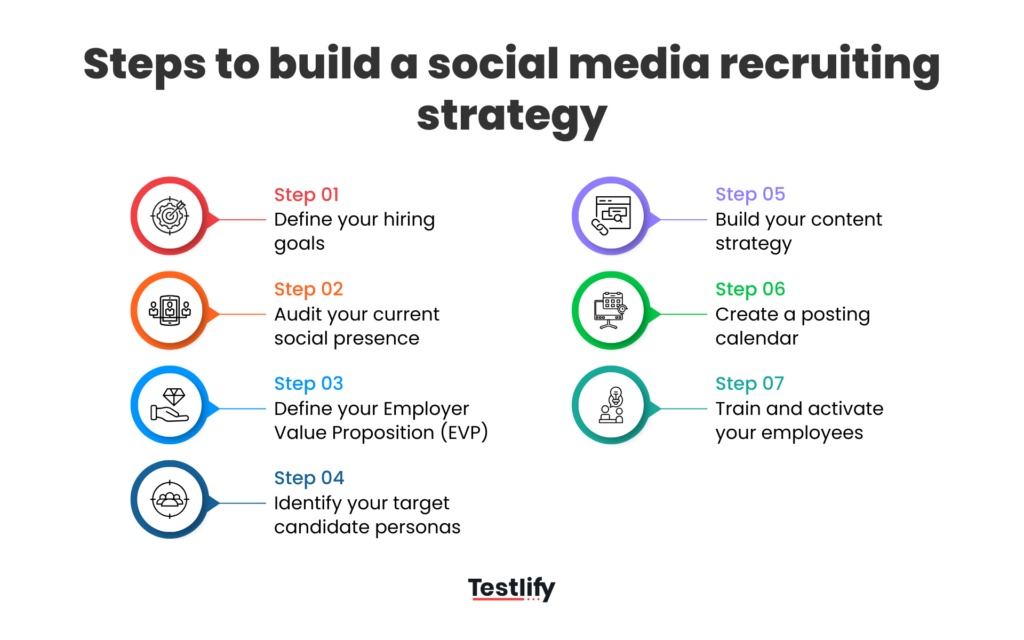
Step 1: Define your hiring goals
Start with clarity. What roles are you consistently hiring for? What types of candidates do you need to reach? Are you focused on volume hiring, executive search, or building a long-term talent pipeline? Your goals determine your platform choices, content mix, and messaging.
Step 2: Audit your current social presence
Before building forward, understand where you stand. Search your company name and see what comes up. Look at your LinkedIn company page, your Glassdoor reviews, and any existing social accounts. What story are they telling? Is it the story you want candidates to see?
Step 3: Define your Employer Value Proposition (EVP)
Your EVP is the core promise you make to employees, why someone should choose to work for you over a competitor. Before you create content, you need to be able to answer: What makes us a great place to work?
Your EVP might include things like:
- Growth and development opportunities
- Work-life balance and flexibility
- Mission and purpose
- Compensation and benefits
- Culture and team environment
Make your EVP specific and authentic. Vague claims like “great culture” mean nothing. Specifics like “we offer 20 days paid learning leave and an annual conference budget” are compelling.
Step 4: Identify your target candidate personas
Who exactly are you trying to hire? Build out candidate personas for your key roles:
- What’s their background and experience level?
- What platforms are they active on?
- What matters most to them in a job?
- What frustrates them about their current employer?
- What type of content do they engage with?
This exercise will inform everything from where you post to how you write your job descriptions.
Step 5: Build your content strategy
Social media recruiting isn’t just about posting jobs. The Content should support both social engagement and SEO performance to help increase organic candidate reach. AI SEO packages can help strengthen this by improving how your content performs in search. The 70-20-10 rule works well here:
- 70% employer brand content: Culture, team stories, employee spotlights, day-in-the-life content, behind-the-scenes
- 20% industry/value content: Trends, tips, thought leadership relevant to your target candidates
- 10% direct recruitment content: Job postings, calls to apply, referral requests
If you flip this ratio and lead with jobs, your audience will disengage fast. Build the relationship first.
Step 6: Create a posting calendar
Consistency beats frequency. It’s better to post three times a week, every week, than to flood the feed for two weeks and then go silent. Build a simple content calendar that maps out:
- What you’ll post each week
- Which platforms
- Who’s responsible for creating and publishing each post
- A bank of evergreen content to fill gaps
Step 7: Train and activate your employees
Your employees are your single most powerful social recruiting asset. A job posting shared by a recruiter gets far less traction than the same post shared by an enthusiastic team member. Their networks are full of people just like them, your ideal candidates.
Build an employee advocacy program:
- Make it easy for employees to share (provide pre-written captions)
- Recognize and reward employees who refer or share
- Create content that employees are genuinely proud to share
- Don’t force it, authenticity is the whole point
As advocacy initiatives grow, many HR teams also use collaborative platforms to manage social media projects, assign responsibilities, and keep recruitment campaigns aligned with employer branding goals.
According to the Nielsen Global Trust in Advertising report, 92% of people trust recommendations from people they know over branded content. Employee-shared content gets 8x more engagement than the same content shared from a brand account.
Social media recruiting best practices
Now that you have the framework, here are the tactics that separate good social recruiting from great social recruiting.
Write job postings for humans, not applicant tracking systems
On social media, candidates see your job before they see your ATS. Write job descriptions that are clear, engaging, and honest. Ditch the corporate jargon. Be specific about what the role involves day-to-day, what success looks like in 90 days, and what the team environment is really like.
Respond to every comment and message
If a candidate asks a question on your post and you don’t respond, you’ve just made a negative impression, not just on them, but on everyone who sees the unanswered comment. Responsiveness signals that you value candidates’ time and attention.
Use video whenever possible
Video consistently outperforms text and static images across every major platform. Job posts with video get 34% more applications, according to LinkedIn data. Even simple phone-recorded videos of a hiring manager talking about the role can dramatically increase engagement.
Be transparent about the hiring process
Candidates hate black holes. Use social media to communicate what your hiring process looks like, how many stages, what types of interviews, typical timelines. This builds trust and reduces candidate anxiety, which means fewer drop-offs in your funnel.
Tag and feature your employees
When you feature employees in your content, tag them (with permission). This extends your reach to their networks and adds authenticity. “Meet Sarah, our Head of Engineering” performs infinitely better than a stock photo with a generic caption.
How to use social media for candidate screening?
Social media can also be a useful screening tool, but it needs to be handled carefully to avoid legal risk and unconscious bias.
What you can legitimately look for?
When reviewing a candidate’s public social profiles, focus only on job-relevant information:
- Evidence of skills, expertise, and thought leadership (blog posts, talks, project showcases)
- Professional conduct and communication style
- Portfolio work shared publicly
- Consistency between their resume and public professional history
What to absolutely avoid?
Never make hiring decisions, even subconsciously, based on information that reveals protected characteristics:
- Race, ethnicity, or national origin
- Religion
- Gender or gender identity
- Age
- Disability status
- Pregnancy or family status
- Sexual orientation
- Political affiliation (in most jurisdictions)
Best practice: Have someone other than the final hiring decision-maker conduct social screening, and document the process. Better yet, consult your legal team to establish a formal social media screening policy before you start.
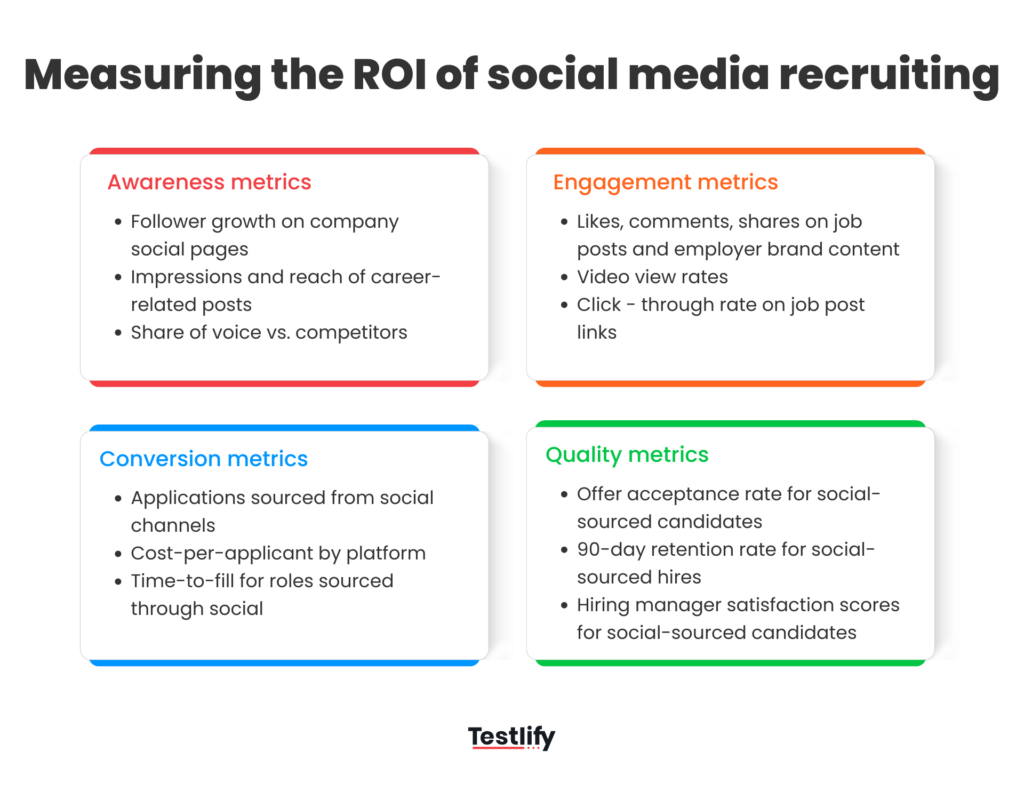
Most ATS platforms allow you to track application source, so make sure social media is set up as a distinct source so you can measure its contribution.
According to a Society for Human Resource Management (SHRM) report, employers who use social media recruiting reduce their time-to-fill by an average of 49% compared to traditional recruiting methods alone. That’s a significant competitive advantage in a tight labor market.
Common social media recruiting mistakes HR teams make
Even well-intentioned recruiting programs fall flat because of avoidable errors. Watch out for these:
Mistake 1: Only posting job openings
If every post is a job ad, you’re essentially running a classifieds column, not a social presence. Candidates will unfollow you fast.
Mistake 2: Ignoring comments and messages
Dark social pages with unanswered questions signal disorganization and indifference. Build response protocols into your process.
Mistake 3: Being inconsistent
Posting intensely when you have urgent openings and then going silent sends a chaotic signal about your organization. Consistency builds trust.
Mistake 4: Neglecting mobile optimization
The majority of social media is consumed on mobile. Make sure your job application process is mobile-friendly, or you’re losing candidates at the final step.
Mistake 5: Making it all about the company
The best employer brand content puts employees at the center, not the brand. Candidates want to see people they could imagine working with, not logo-heavy marketing materials.
Mistake 6: Skipping the strategy and just winging it
Posting random content with no defined audience, no goals, and no measurement plan is just noise. Even a simple one-page strategy makes a meaningful difference in outcomes.
Social media recruiting for specific hiring scenarios
Hiring for hard-to-fill technical roles
For software engineers, data scientists, and other technical professionals, LinkedIn and Twitter/X are your primary channels. Invest in thought leadership content: share technical blog posts, open-source projects, or your engineering team’s approach to solving hard problems. Tech talent is attracted to companies that respect their craft.
Hiring for entry-level and volume roles
Facebook, Instagram, and TikTok are your best bets for reaching younger or non-professional candidates at scale. Focus on authentic culture content, short application processes, and clear communication about compensation and schedules.
Diversity recruiting
Social media is a powerful tool for reaching underrepresented talent, but only if your content reflects your commitment authentically. Feature diverse employee voices, partner with affinity organizations on social, and audit your job post language for unintentional bias. Candidates from underrepresented groups will evaluate your social presence carefully before applying.
Executive and leadership hiring
For C-suite and VP-level roles, LinkedIn is the dominant channel. Outbound sourcing via LinkedIn Recruiter or direct InMail is typically more effective than posting. Build relationships with senior candidates over time through content and thoughtful engagement, not just when you have an opening.
Future of social media recruiting
A few trends reshaping what’s possible in the next few years:
AI-powered sourcing: Tools like LinkedIn’s AI features, HireEZ, and SeekOut are making it faster than ever to identify passive candidates at scale using social data. HR teams that adopt these tools early will have a significant competitive edge.
Short-form video as a recruiting channel: TikTok-style video job ads and employer brand content will continue to grow. Companies that get comfortable on camera will attract more candidates and build stronger employer brands.
Employee-generated content: Authentic employee storytelling will increasingly outperform polished corporate content. Building systems to capture and amplify employee voices is a high-leverage investment.
Conversational recruiting: Chatbots and AI-driven messaging on social platforms will allow companies to engage candidates 24/7, answer questions instantly, and move candidates through early funnel stages automatically.
Quick-start checklist for HR teams
Ready to get moving? Here’s your 30-day quick-start plan:
Week 1: Foundation
- Audit your current social presence
- Define or refine your Employer Value Proposition
- Identify your top 2-3 platforms based on hiring needs
- Optimize your LinkedIn company page (complete all sections, update banner, add Life tab photos)
Week 2: Content
- Build a 30-day content calendar
- Create a bank of 10 employer brand content ideas
- Film one employee spotlight video
- Write 3 authentic, culture-forward posts (no job postings yet)
Week 3: Activation
- Brief employees on your social recruiting goals
- Share a template they can use to post about open roles
- Post your first job with a compelling write-up (not just a job title and link)
- Set up source tracking in your ATS for social channels
Week 4: Measure and optimize
- Review engagement metrics on all posts
- Identify what content performed best
- Optimize your posting times based on platform analytics
- Schedule a monthly review cadence for social recruiting performance
Final thoughts
Social media recruiting isn’t a nice-to-have anymore, it’s a core competency for modern HR teams. The companies winning the talent war aren’t necessarily the ones with the biggest budgets. They’re the ones building authentic, consistent, human-centered social presences that make candidates want to join them.
Start where you are. Pick one platform, build a rhythm, and let the compound effect of consistent employer brand storytelling do its work. The best time to start was two years ago. The second best time is today.
Frequently asked questions (FAQs)

Content Writer
Yashika Khandelwal is a Content Writer with 3+ years of experience creating research-backed content on hiring, talent assessment, and HR technology. She is a registered Organizational Psychologist and subject matter expert who combines behavioral science with practical recruitment insights to produce accurate, evidence-based content.
LinkedInRelated resources
View all
HR & recruitment
Top tools for large-scale campus hiring assessments

HR & recruitment
Why a strategic recruitment plan is critical for business success

HR & recruitment
Different types of selection tests for HRM in large organizations

HR & recruitment
Free recruitment plan templates & examples

HR & recruitment
How to determine your recruitment KPIs in 2026
HR & recruitment
The ultimate guide to recruitment KPIs
Get started.
Hire on proof, not resumes.
Run your first skills-based assessment free — no credit card required.