
What are power skills and how to assess them?
Power skills, like communication and problem-solving, drive success. Discover how to assess these essential abilities for better hiring and team development.
Power skills are the human-centered abilities, communication, critical thinking, adaptability, collaboration, and leadership, that decide whether a hire actually works out, and they are what most hiring processes measure worst. You can verify a coding score in an afternoon. Judgment, the way someone handles a tense client call, takes more thought to test. This guide explains what power skills are, why they outrank technical skills for long-term success, and how to assess them with real evidence instead of a gut read in the interview.
The stakes are not small. Analytical thinking tops the World Economic Forum’s list of core skills employers need in 2025, with resilience, flexibility, and leadership close behind. On the recruiting side, communication ranks as the single most in-demand skill, and 9 in 10 executives say these human skills matter more than ever as AI takes over the routine work.
 ChatGPT
 Gemini
 Claude
 Grok
Grok Perplexity
TL;DR
- Power skills are transferable human abilities (communication, critical thinking, adaptability, collaboration, leadership) that apply across every role and rarely become obsolete.
- The name comes from analyst Josh Bersin, who argued in 2019 that “soft skills are hard” to build and deserve a stronger label.
- They are pulling ahead of technical skills because tools change fast while judgment, communication, and adaptability hold their value.
- The reason teams measure them badly is method, not difficulty: one unstructured interview is a weak signal.
- Assess them with evidence from several sources, a skills assessment, situational judgment tests, structured interviews, and a work sample, scored by more than one reviewer.

What are power skills?
Power skills are human-centered capabilities, like communication, critical thinking, emotional intelligence, and leadership, that shape how well a person works with others and adapts to change. Unlike technical skills tied to one job, power skills transfer across roles and industries. They are the renamed soft skills, reframed to reflect how much they actually drive performance.
The term has a clear origin. In 2019, industry analyst Josh Bersin made the case to retire “soft skills” with one line worth remembering: hard skills are soft, and soft skills are hard. His point was that technical skills age quickly and are relatively easy to teach, while skills like collaboration and judgment take years to build and never stop mattering. Calling them “soft” undersold them. “Power skills” fixed the framing.

Power skills vs soft skills vs hard skills
Power skills and soft skills describe the same thing, with power skills being the newer, more accurate label. Hard skills are the separate category: job-specific, teachable abilities like coding or financial modeling. The useful split is not power versus soft. It is human skills (how you work) versus technical skills (what you can do). Strong hiring measures both.
Dimension | Power skills (soft skills) | Hard skills |
|---|---|---|
Definition | Behavioral and interpersonal skills that influence how people work, communicate, and collaborate | Technical, role-specific knowledge and abilities required to perform a job |
Examples | Communication, teamwork, adaptability, leadership, problem-solving | Python, SQL, payroll processing, data analysis, graphic design |
Transferability | Highly transferable across industries and job roles | Usually specific to a role, tool, or industry |
How they develop | Built over time through experience, coaching, feedback, and real-world practice | Learned through education, certifications, training, and hands-on experience |
How they’re assessed | Behavioral interviews, situational judgment tests, role plays, personality assessments | Skills assessments, coding tests, technical interviews, certifications, and work samples |
Role in hiring | Indicates how well someone collaborates, communicates, leads, and adapts to change | Demonstrates whether someone has the technical expertise to perform the responsibilities |
What are examples of power skills?
The most sought-after power skills cluster around how people communicate, decide, and work with others. Here are twelve that show up across hiring scorecards, with what each one looks like on the job, so you know what you are actually trying to spot in a candidate.
Power skill | What it looks like in the workplace |
|---|---|
Communication | Clearly explains ideas, listens actively, and tailors messages to different audiences. |
Critical thinking | Evaluates information objectively, identifies risks, and makes well-reasoned decisions. |
Emotional intelligence | Understands and manages emotions while responding effectively to the emotions of others. |
Adaptability | Adjusts quickly to changing priorities, new technologies, and evolving business needs. |
Collaboration | Works effectively with colleagues, shares knowledge, and contributes to team goals. |
Leadership | Motivates others, takes initiative, and guides teams toward shared objectives, regardless of job title. |
Problem-solving | Identifies root causes, evaluates solutions, and resolves challenges efficiently. |
Time management | Prioritizes tasks effectively, meets deadlines, and balances multiple responsibilities. |
Conflict resolution | Addresses disagreements constructively and helps reach fair, productive outcomes. |
Decision-making | Makes informed, timely decisions by balancing available data, risks, and business priorities. |
Negotiation | Reaches mutually beneficial agreements while maintaining positive working relationships. |
Empathy | Understands different perspectives and considers employee or customer needs when making decisions. |
Notice these are not personality traits. They are behaviors you can watch for, which is exactly what makes them measurable if you build the right prompts. For deeper roles, pair this list with the specific interpersonal skills that matter for the job rather than testing all twelve at once.
Why do power skills matter in 2026 hiring?
Power skills matter because the half-life of technical skills keeps shrinking while human skills keep their value, and AI is widening that gap. When a model can write the first draft of code or a contract, the premium shifts to the person who can judge whether the output is any good, explain the tradeoff to a client, and adapt when the plan breaks. That is power-skill territory.
The data backs the shift. The World Economic Forum expects a net 78 million new jobs by 2030, and 39% of workers’ core skills will change along the way, yet the skills holding steady are human ones: resilience, flexibility, and leadership. LinkedIn’s research points the same way, with 91% of learning and development leaders saying human skills are growing more important across the board. A candidate who can learn fast and work well with people will outlast one hired purely for today’s tool stack.
Pro tip: Do not screen for power skills only at the end. A short situational judgment test before the first call tells you which candidates can actually reason through a people problem, so your interview time goes to the few worth a deeper look instead of the whole pile.
How do you assess power skills when hiring?
You assess power skills by collecting evidence from several independent sources and looking for agreement, not by trusting one interviewer’s impression. A polished 30-minute conversation rewards confidence, not competence. The fix is structure: define the two or three power skills the role actually needs, then gather a real sample of each.
This is where the Testlify Competency-to-Evidence Matrix earns its place. Instead of starting with a test, you start with the role: map each required competency (say, “handles conflict on a cross-functional team”) to a source of measurable evidence (a situational judgment test, a scored behavioral interview, a reference). AI assists by scoring and summarizing the signals; the hiring team makes the call. The matrix turns a fuzzy trait into something you can compare across candidates without guessing.
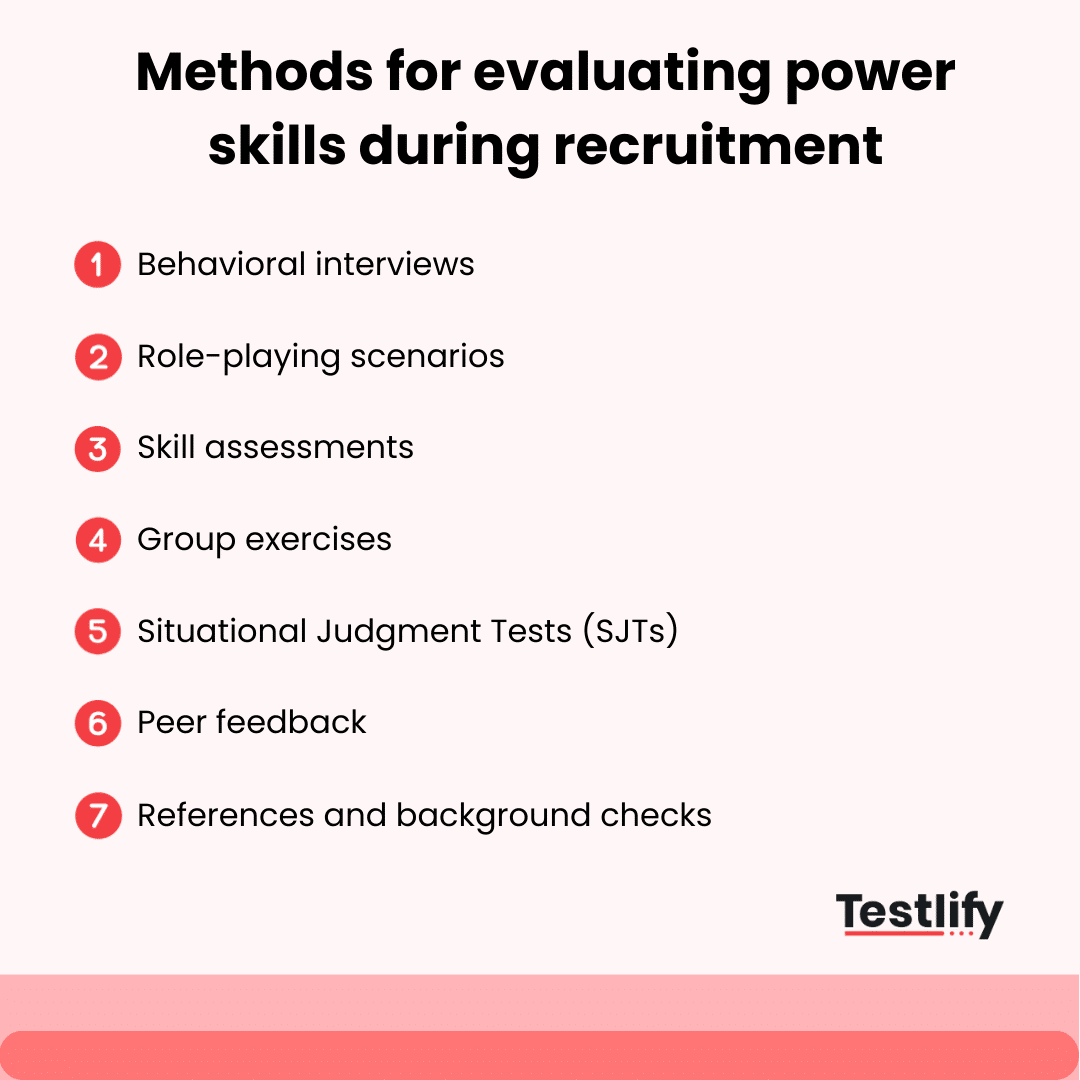
The methods worth combining, in rough order of signal strength:
- Skills assessments. A validated soft skills assessment measures communication, judgment, and personality consistently across every applicant, before anyone spends interview time. This is the most scalable signal and the one that removes the most bias.
- Situational judgment tests. Show candidates a realistic work scenario and ask what they would do. SJTs are strong for decision-making, adaptability, and conflict resolution because they reveal reasoning, not rehearsed answers.
- Structured behavioral interviews. Ask every candidate the same questions about real past situations (“tell me about a deadline you missed”). Structured interviews predict performance far better than free-form chats because you compare like with like.
- Work samples and role-play. A short simulation, a mock client call, a written brief, a group exercise, shows the skill in action. There is no better proxy for “can they actually do this” than watching them try.
- References and multiple reviewers. Ask referees about specific behaviors, not a general thumbs-up, and have more than one person score each candidate. Two reviewers catch what one misses, and the disagreement itself is useful.
The catch worth naming: more steps add friction, and a long process loses good candidates. So do not run all five for every hire. For high-volume roles, an assessment plus one structured interview is plenty. Save the full set for senior or high-stakes positions where a mis-hire is expensive. The goal is enough signal to decide with confidence, not a gauntlet.
How can you help employees build power skills?
Power skills grow through practice and feedback, not a one-off workshop. The teams that build them well treat development as part of the daily job rather than an annual training line item. A few moves that work:
- Give specific, frequent feedback. “You lost the room when you opened with numbers, lead with the story next time” beats a vague rating once a year.
- Pair people deliberately. Mentorship and cross-team projects put newer staff next to people who model the skill, which is how most of it actually transfers.
- Reward the behavior, not just the output. If you only celebrate the closed deal and never the person who defused a team conflict, you signal which skills count.
- Create real stakes to practice on. Give people a presentation to run or a negotiation to lead. Skills build under genuine pressure, not in role-play with no consequences.
Start by baselining where your team stands with the same assessments you use in hiring. You cannot build what you have not measured, and a clear starting point turns “be a better communicator” into a goal people can actually track.
Key takeaways
- Power skills are the new label for soft skills, and the label matters. Reframing them as “power” reflects that they drive performance more than most technical skills, which means they deserve real weight on your scorecard, not a quick gut check at the end.
- They are gaining value as AI absorbs routine work. With 39% of core skills set to change by 2030, judgment, communication, and adaptability are the durable bets, so hire for the ability to learn and work with people, not just today’s tools.
- The measurement problem is method, not mystery. Power skills feel hard to assess only because one unstructured interview is a weak signal, so the fix is to gather behavioral evidence you can compare across candidates.
- Combine independent signals and look for agreement. A skills assessment, an SJT, a structured interview, and a work sample scored by two reviewers beats any single source, because several signals pointing the same way is what real confidence looks like.
- Match the depth of the process to the stakes. Run a light assessment-plus-interview for high-volume roles and the full evidence set for senior hires, so you add rigor where a mistake is costly without driving good candidates away.
- Keep building after the hire. Power skills grow through specific feedback, deliberate pairing, and real practice, so baseline your team with the same assessments you hire on and track the change.
Frequently asked questions (FAQs)

Content Writer
Yashika Khandelwal is a Content Writer with 3+ years of experience creating research-backed content on hiring, talent assessment, and HR technology. She is a registered Organizational Psychologist and subject matter expert who combines behavioral science with practical recruitment insights to produce accurate, evidence-based content.
LinkedInRelated resources
View all
Skill assessment
Organizational Skills Test: How to Assess Candidates in 2026
Skill assessment
Types of skills assessment tests

Skill assessment
How to assess skills fairly and effectively

Skill assessment
How deductive reasoning test helps you screen candidates?

Skill assessment
How leadership assessment helps you screen candidates

Skill assessment
How to build your own culture fit assessment: Quick tips
Get started.
Hire on proof, not resumes.
Run your first skills-based assessment free — no credit card required.