
20 best job boards that you should know in 2026
Discover the 20 best job boards for 2024 to find top talent faster. From niche platforms to global sites, these boards can streamline and enhance your hiring process.

The top job boards for hiring in 2026 are Indeed for raw volume, LinkedIn Jobs for professional and passive candidates, Glassdoor for culture-led employer branding, Dice for technical roles, and Snagajob for hourly and shift work. The right one depends on the role, not on which board is biggest.
That answer needs a caveat, though, and it is the reason this page exists. Posting on more boards is no longer the hard part of hiring. Reading what comes back is. Greenhouse tracked 640 million applications across more than 6,000 companies and found the average job now draws 244 applications, up 111% since 2022, when the same measure sat at 116. Recruiting teams shrank 56% over the same period. So the board that wins is whichever one sends you candidates you can actually judge.
 ChatGPT
 Gemini
 Claude
 Grok
Grok Perplexity
TL;DR
- Pick boards by role type and audience, not by traffic. A general board with 10 times the reach is worse than a niche board if the niche board carries the people who can do the job.
- Volume is now the problem, not the goal. Applications per job climbed to 244 while recruiting teams shrank by more than half.
- Budget for two or three boards, not ten. Spreading a small budget across many boards buys weak placement everywhere.
- Free posting is a real strategy for local, hourly and high-turnover roles. It is a poor one for senior or scarce skills.
- Decide how you will screen before you post. A shortlist built from evidence beats a shortlist built from whoever applied first.
- One board on most 2024-era lists, including the earlier version of this page, has not existed since 2022. Check dates before you trust a list.

How we picked these job boards
Every board below was assessed on five things: who actually uses it, which roles it fills well, what the posting model costs in practice, what the employer tooling does, and whether the board still operates. That last one sounds trivial. It is not.
Job boards close, merge and rebrand more often than the average "best of" list admits. Stack Overflow Jobs, which sat on this page and on plenty of others, shut down on 31 March 2022. AngelList Talent is now Wellfound. Monster's India and Asia-Pacific business trades as Foundit. A list that has not been re-checked is not a list, it is a snapshot of a market that moved.
Market conditions shape the picks too. US job openings sat at 7.3 million in July 2026, with hires and separations both at 5.1 million, so this is a market where people are neither being hired quickly nor leaving quickly. Indeed's Job Postings Index stood at 101.0 on 30 June 2026, meaning postings are running at roughly pre-pandemic levels overall, with about one job opening per unemployed worker. Demand is uneven rather than absent, which is exactly the condition where board choice matters.
Quick comparison of the top job boards
Board | Best for | Primary audience | Posting model |
|---|---|---|---|
Indeed | Volume across almost any role | Broad, all levels | Free listings plus paid sponsorship |
LinkedIn Jobs | Professional and passive candidates | White collar, mid to senior | Pay per click or subscription |
Glassdoor | Culture-led employer branding | Research-driven candidates | Paid, bundled with Indeed |
Foundit | India and Asia-Pacific hiring | Entry to executive, regional | Paid packages |
CareerBuilder | Established US mid-market roles | Broad, US-centric | Subscription tiers |
ZipRecruiter | Small teams wanting distribution | Broad, SMB-heavy | Subscription with matching |
SimplyHired | Low-cost reach via aggregation | Broad, all levels | Free to post, pay per application |
Wellfound | Startup and equity-based roles | Startup talent | Free core posting |
FlexJobs | Vetted remote and flexible work | Remote-first candidates | Employer subscription |
We Work Remotely | Fully remote roles | Remote professionals | Flat fee per post |
Dice | Technical and IT roles | Developers, engineers, IT | Subscription tiers |
Snagajob | Hourly and shift work | Hourly workers | Per-post or subscription |
The Muse | Employer storytelling | Early to mid career | Content-led packages |
Ladders | Senior roles above six figures | Executive and senior | Paid postings |
LHH | Managed and outplacement hiring | Professional, mid to senior | Service engagement |
Jobvite | Running hiring, not just posting | Employer-side teams | Platform subscription |
VetJobs | Veteran and military-spouse hiring | Veterans, transitioning service members | Free to employers |
Stack Overflow Jobs | Closed in 2022, see alternatives | Formerly developers | No longer operating |
Behance | Design and creative hiring | Designers, creatives | Paid job listings |
Remote.co | Remote roles plus remote-work guidance | Remote candidates | Flat fee per post |
Published rates move constantly, so the table describes the posting model rather than a price that will be wrong by the time you read it. Check the current rate card on the board itself before you budget.
What are the best job boards for hiring?
For most employers, the shortlist is smaller than it looks. Three general boards cover the majority of roles: Indeed for reach, LinkedIn Jobs for professional and passive candidates, and one specialist board matched to the role. Everything else is a refinement of that pattern.
The specialist choice is where the gain is. Sector demand has split hard. Engineering and healthcare roles are posting around 30% above pre-pandemic levels, while marketing, data analysis and software development have fallen by roughly 30% or more since February 2020. Healthcare alone made up 11.4% of US nonfarm employment and 47.5% of all job growth in 2025. Hiring a nurse and hiring a front-end developer are not the same market, and a single general board treats them as if they were.
Budget concentration beats budget spread. A sponsored post that stays visible on two boards will out-hire a token spend on eight. Median time to fill for non-executive roles was 39 calendar days in SHRM's 2026 benchmarking, so a listing that goes stale after a week has spent most of its life invisible.
Hiring outside the US changes the answer again, because the big boards are not evenly strong everywhere. UK vacancies stood at 707,000 in the three months to July 2026, down slightly on the previous quarter. In the euro area the job vacancy rate was 2.3% in the first quarter of 2026, ranging from 2.0% in industry and construction up to 4.0% in the Netherlands. Tight local markets reward local boards, which is why Foundit matters in India and the Middle East in a way it never will in Ohio.
1. Indeed
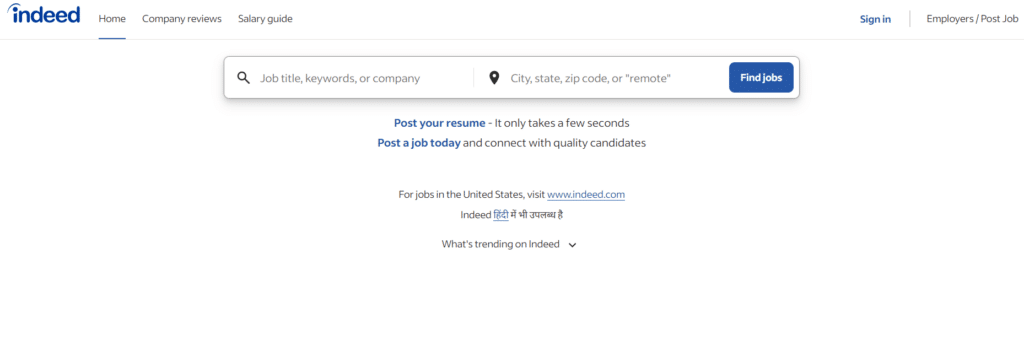
Indeed is the default first stop for most employers because it aggregates listings from company career pages and other boards as well as hosting its own. For a generalist role in a mid-sized city, it will almost always produce the largest raw candidate pool.
Key features:
- Very large candidate database with resume search
- Free job postings, with sponsorship to buy visibility
- Employer dashboard, screening questions and assessments
Pros:
- Reach no other single board matches
- Free posting makes it low risk to test a role
- Screening questions filter the obvious mismatches at source
Cons:
- Volume is the problem as often as it is the benefit
- Unsponsored posts sink quickly in busy categories
- Sponsored costs climb fast in competitive markets
Best for:
- Generalist, high-volume and locally recruited roles
Pricing:
- Free to post, with pay-per-click or daily-budget sponsorship for visibility
2. LinkedIn Jobs
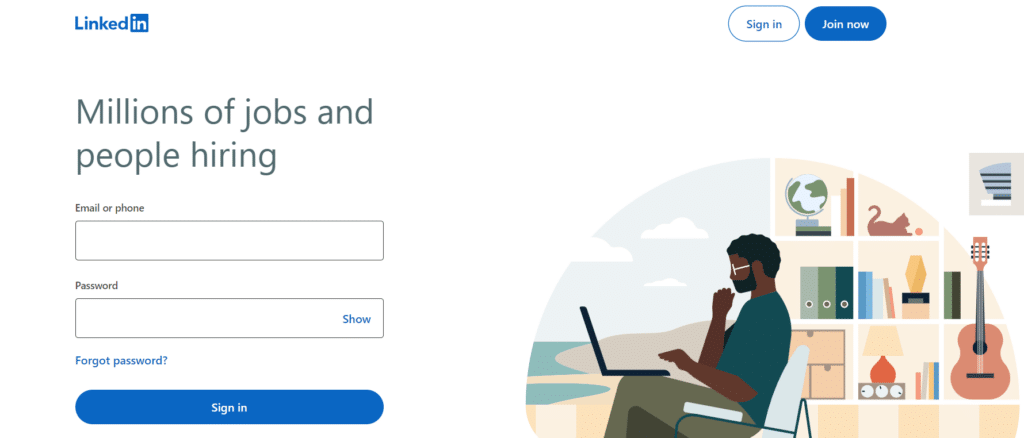
LinkedIn Jobs works differently from a traditional board because the candidate pool is a professional network that exists whether or not anyone is job hunting. That makes it the strongest option for passive candidates, the people who will move for the right role but are not scanning boards.
Key features:
- Job ads targeted using profile and behaviour data
- One-click apply from an existing profile
- Direct outreach to candidates who never applied
Pros:
- Reaches people no job board can reach
- Rich filtering on skills, employer history and seniority
- Employer brand and role sit side by side
Cons:
- Costs escalate quickly for smaller teams
- Weak fit for hourly, trade and shift roles
- Easy apply inflates application counts
Best for:
- Professional, technical and management roles, especially passive hiring
Pricing:
- Pay-per-click job ads with daily budgets, plus paid recruiter seats
3. Glassdoor
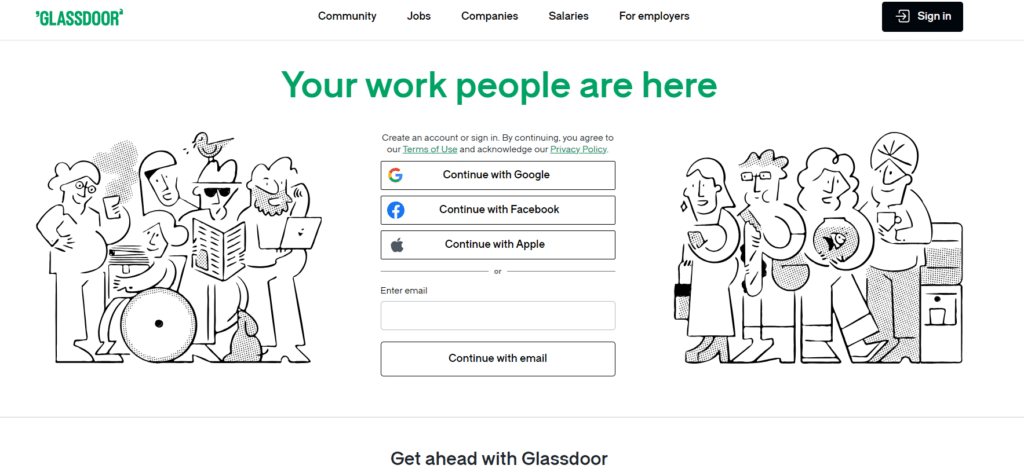
Glassdoor is a review site that also carries jobs, and that order matters. Candidates arrive already reading what your employees say about you, so the listing performs in proportion to the profile sitting behind it.
Key features:
- Reviews, salary data and ratings shown beside listings
- Employer profile and branding tools
- Listings distributed through Indeed
Pros:
- Attracts candidates who research before applying
- Salary transparency filters out mismatched expectations early
- Good employer brand compounds across every role you post
Cons:
- A poor review profile actively suppresses applications
- Little value if you have not invested in the profile
- Paid access needed for the useful employer tooling
Best for:
- Employers with a strong culture story and reviews to back it
Pricing:
- Paid job postings and branding packages, sold alongside Indeed
4. Foundit
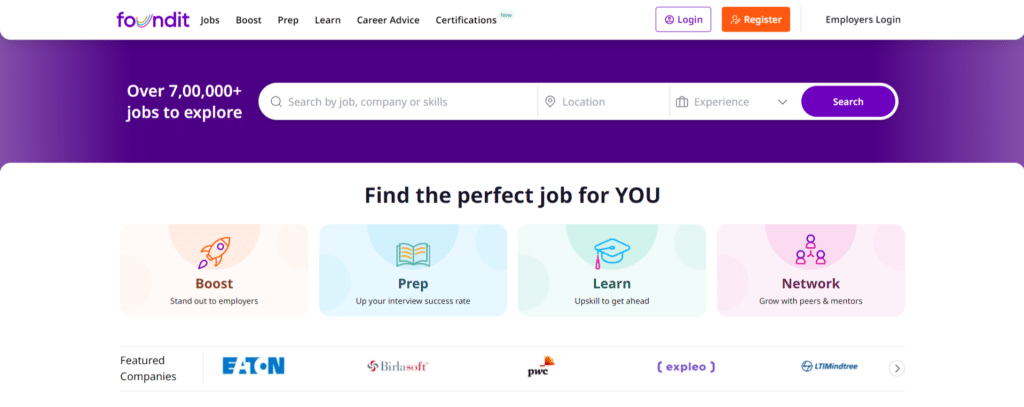
Foundit is the rebranded Monster business for India, the Middle East and Asia-Pacific, and it holds one of the deepest candidate databases in those markets. For employers hiring in Bengaluru, Dubai or Singapore, it reaches people the US-centric boards simply do not carry.
Key features:
- Large regional candidate database with resume search
- Role and location targeting across Asia-Pacific and the Middle East
- Employer branding and recruiter tooling
Pros:
- Regional depth that global boards lack
- Covers entry level through executive
- Established employer base and recognition
Cons:
- Limited value outside its core regions
- Database quality varies by city and sector
- Sold as packages rather than pay-as-you-go
Best for:
- Hiring in India, the Middle East and Asia-Pacific
Pricing:
- Paid posting and database-access packages, priced by region
5. CareerBuilder
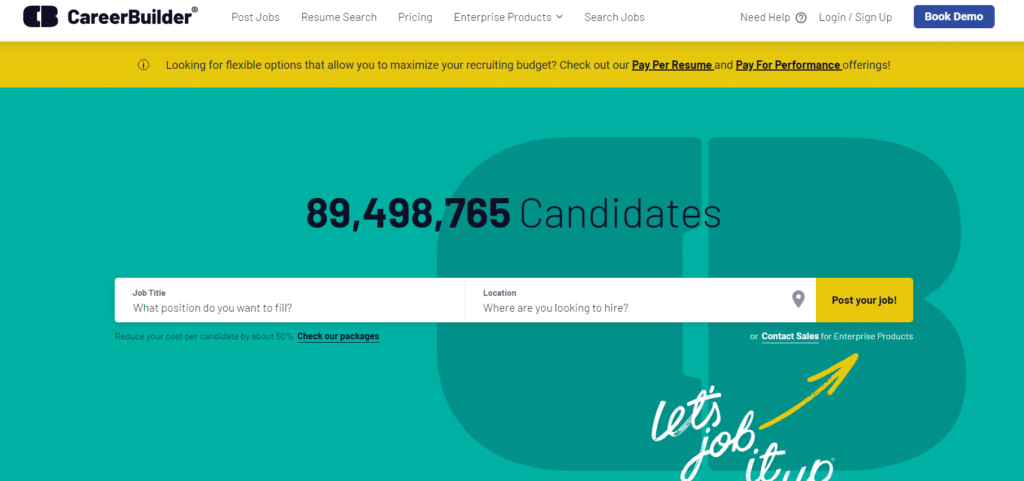
CareerBuilder is one of the oldest names in online recruiting and still carries a sizeable US resume database. It rarely wins on reach any more, but it does reach candidates who are not on LinkedIn and never opened a startup board.
Key features:
- Long-established US resume database
- Candidate matching and recommendation tools
- Job distribution across a partner network
Pros:
- Reaches an audience the newer boards miss
- Predictable subscription pricing
- Useful for administrative and operational roles
Cons:
- Smaller reach than Indeed in most categories
- Weak for technical and creative hiring
- Interface feels dated next to newer boards
Best for:
- US mid-market administrative, operational and support roles
Pricing:
- Subscription tiers based on posting volume and database access
6. ZipRecruiter
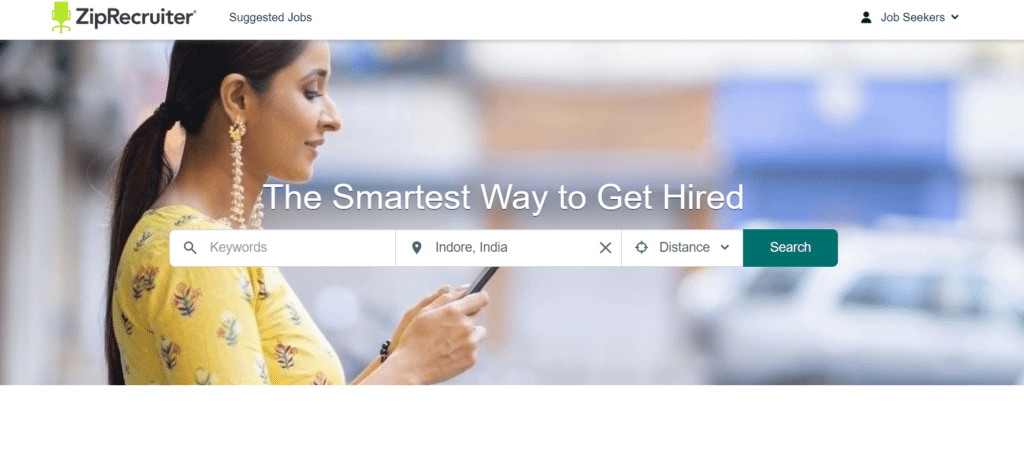
ZipRecruiter's pitch is distribution: post once and the role goes out across a wide partner network, with matching that pushes it at likely candidates rather than waiting for search traffic. For a small team without a recruiter, that automation is the product.
Key features:
- Distribution to a large partner network from one post
- Candidate matching and invite-to-apply
- Simple employer dashboard with ratings
Pros:
- Very little setup effort for a small team
- Matching surfaces candidates who would not have searched
- Good coverage of general and mid-skill roles
Cons:
- Subscription cost is hard to justify for one-off hires
- Match quality varies by role and location
- Less depth than a specialist board for scarce skills
Best for:
- Small teams that want reach without running a search themselves
Pricing:
- Subscription by number of active jobs, with a short free trial
7. SimplyHired
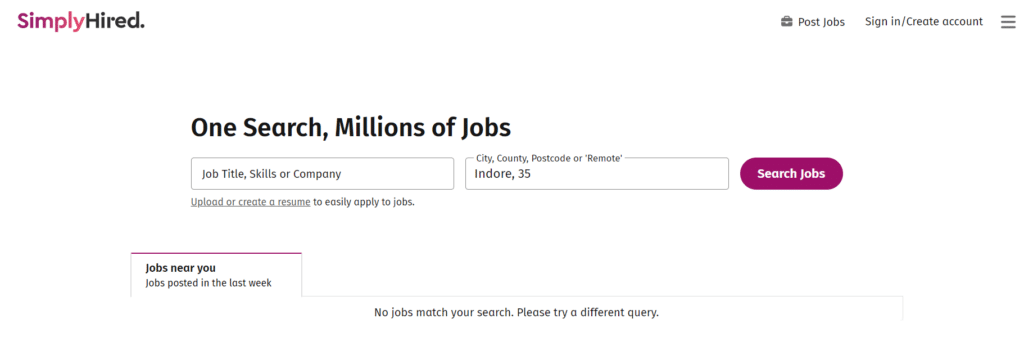
SimplyHired is an aggregator: it pulls listings from other boards and company sites rather than building its own loyal audience, which is how job aggregators work generally. Treated as an extra distribution channel, it is a cheap way to widen a net.
Key features:
- Aggregated listings from many sources
- Free posting with pay-per-application options
- Salary estimator and role research tools
Pros:
- Low cost of entry
- Extends reach without a second posting workflow
- Useful for local and hourly roles
Cons:
- Little audience of its own
- Thin employer tooling
- Overlaps heavily with Indeed
Best for:
- Widening distribution cheaply on general roles
Pricing:
- Free to post, with paid options charged per application
8. Wellfound
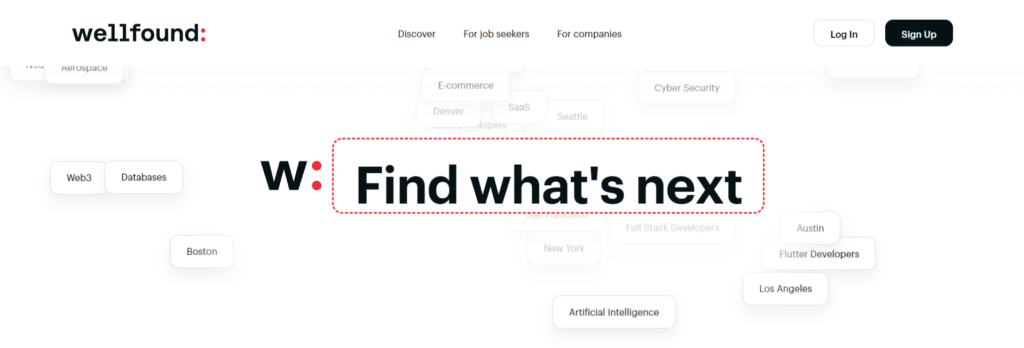
Wellfound, previously AngelList Talent, is where startup hiring happens. Candidates arrive expecting equity conversations and small teams, which removes an awkward filtering step for early-stage employers.
Key features:
- Startup-focused candidate pool
- Salary and equity ranges shown upfront
- Direct founder-to-candidate messaging
Pros:
- Candidates self-select for startup risk
- Core posting is free
- Transparent pay and equity reduces wasted conversations
Cons:
- Narrow outside tech and startups
- Small pools in non-hub cities
- Not suited to established enterprise hiring
Best for:
- Seed to Series B startups hiring engineers, product and growth
Pricing:
- Free core posting, with paid recruiting products available
9. FlexJobs
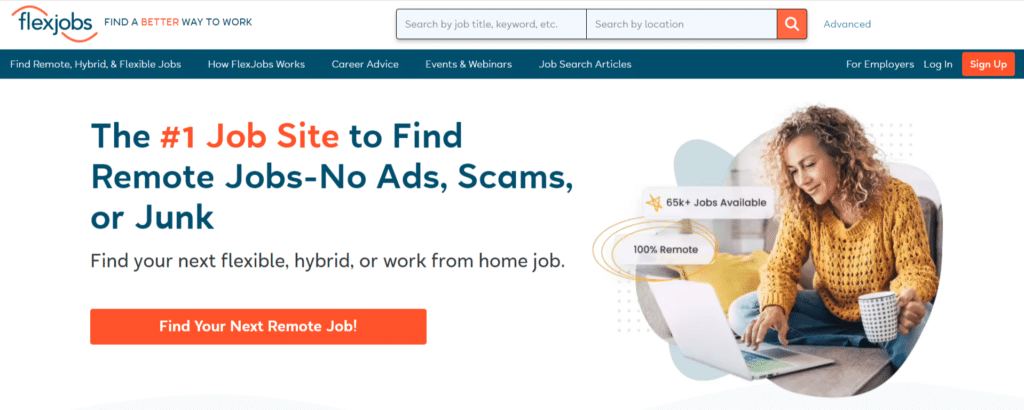
FlexJobs screens every listing before it goes live, which is unusual and is the whole reason candidates pay to use it. For an employer, that vetting means the applicants arriving have chosen a curated environment over an open one.
Key features:
- Human-reviewed listings, no unscreened posts
- Remote, hybrid, part-time and freelance focus
- Candidate subscription model filters casual applicants
Pros:
- Higher intent from candidates who pay to be there
- Strong fit for genuinely flexible roles
- Vetting reduces scam noise around remote work
Cons:
- Smaller pool than open boards
- Employer subscription required
- Poor fit for on-site roles
Best for:
- Remote, hybrid and part-time roles where quality beats volume
Pricing:
- Employer subscription, priced by posting volume
10. We Work Remotely
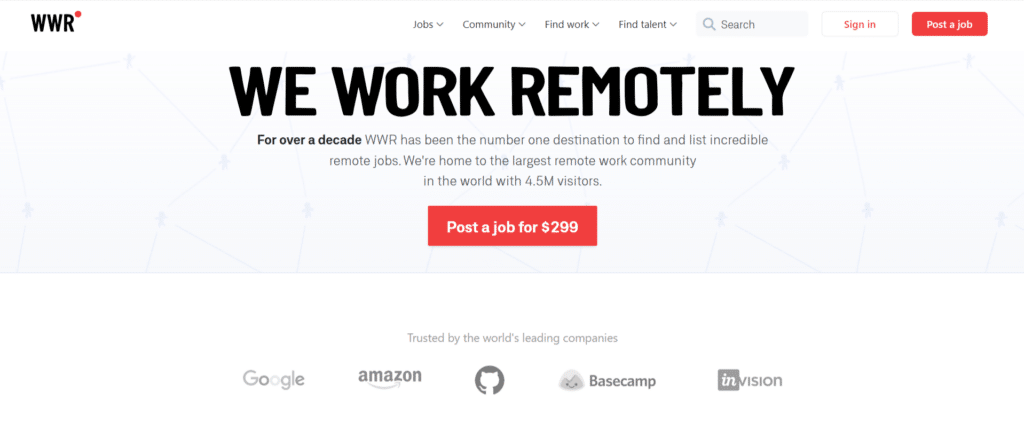
We Work Remotely is one of the largest boards carrying only fully remote roles, with a flat fee per post and no subscription. Simplicity is the appeal: one price, one listing, a defined audience.
Key features:
- Fully remote roles only
- Flat fee per listing
- Long listing duration and newsletter distribution
Pros:
- Audience that expects and wants remote work
- No subscription commitment
- Predictable single cost per role
Cons:
- Flat fee is steep for a single junior hire
- Heavily weighted to tech, design and marketing
- No use for on-site roles
Best for:
- Distributed teams hiring fully remote professionals
Pricing:
- Flat fee per job post, no subscription
11. Dice
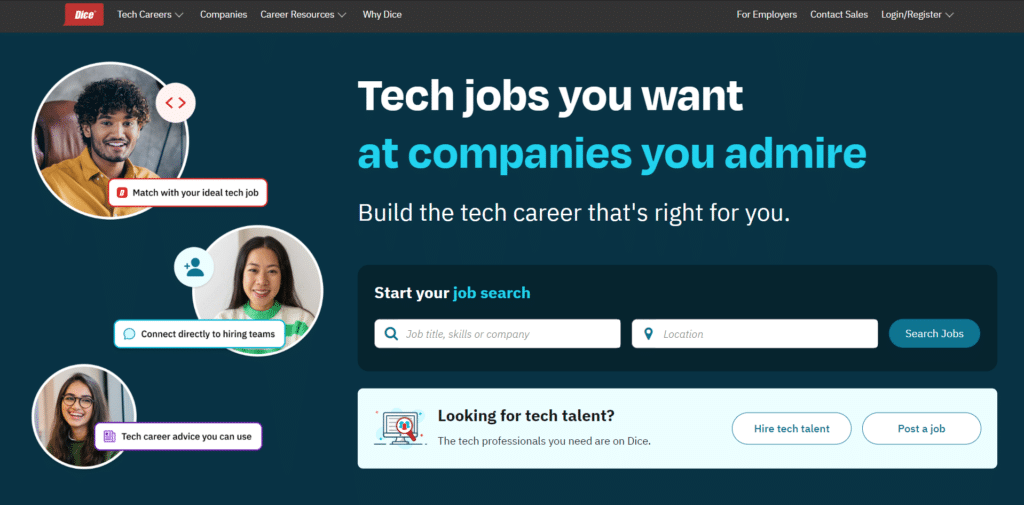
Dice has specialised in technology hiring for decades, and the candidate profiles reflect it: stack detail, clearance status and contract preferences that a general board never captures. With software postings well below their 2020 level, a technical board earns its place by depth rather than reach.
Key features:
- Technology-specific candidate profiles and search
- Skills, clearance and contract-type filters
- Tech salary and market data for employers
Pros:
- Filters built for how technical hiring actually works
- Strong for contract and cleared roles
- Candidates expect technical screening
Cons:
- Irrelevant outside technology roles
- Subscription pricing suits regular hiring, not one-offs
- Smaller pool than the general boards
Best for:
- IT, engineering, contract and security-cleared technical hiring
Pricing:
- Subscription tiers covering postings and database access
12. Snagajob
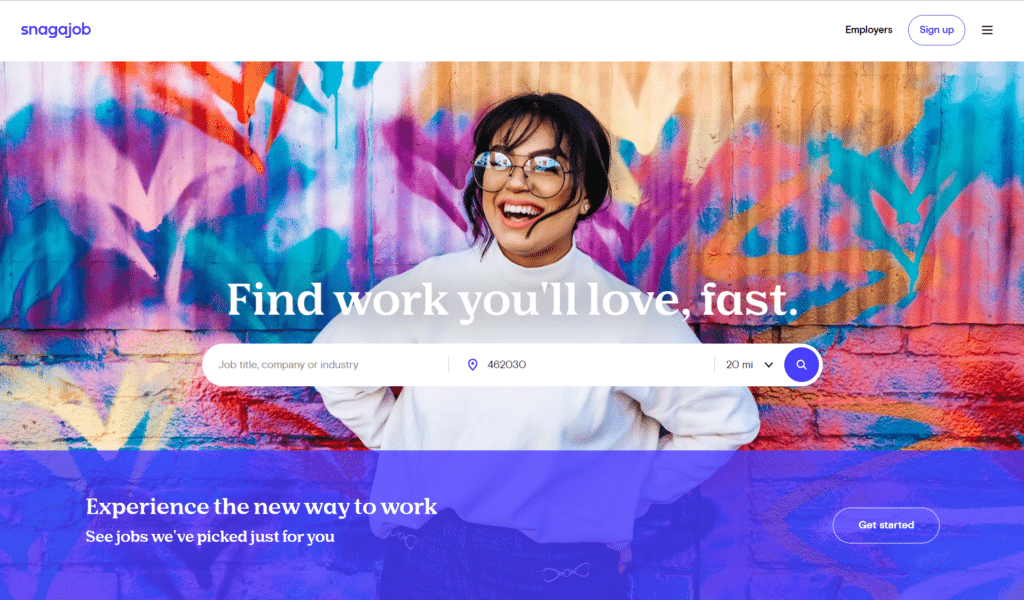
Snagajob is built for hourly work, and hourly hiring runs on different rules: speed matters more than polish, and the candidate is often applying from a phone between shifts. Retail and hospitality postings sit 7.4% below pre-pandemic levels, so competition for these workers has eased slightly, though turnover has not.
Key features:
- Hourly and shift-work focus
- Mobile-first application flow
- High-volume posting and scheduling tools
Pros:
- Reaches hourly workers other boards miss
- Fast application process suits high turnover
- Built for multi-location hiring
Cons:
- No use for salaried professional roles
- Application quality is variable by design
- US-focused
Best for:
- Retail, hospitality, warehouse and other hourly hiring
Pricing:
- Per-post or subscription pricing for multi-location employers
13. The Muse

The Muse sells employer storytelling more than job listings. Employers get profiles with video and day-in-the-life content, aimed at early and mid-career candidates who care what the workplace is actually like.
Key features:
- Employer profiles with video and editorial content
- Career advice audience alongside listings
- Early to mid-career candidate base
Pros:
- Communicates culture better than a job description can
- Reaches candidates in research mode
- Content keeps working after a role closes
Cons:
- Content packages cost more than a plain listing
- Weak for senior and specialist hiring
- Slower to produce than posting a role
Best for:
- Employers competing on culture for early-career talent
Pricing:
- Content-led employer branding packages
14. Ladders
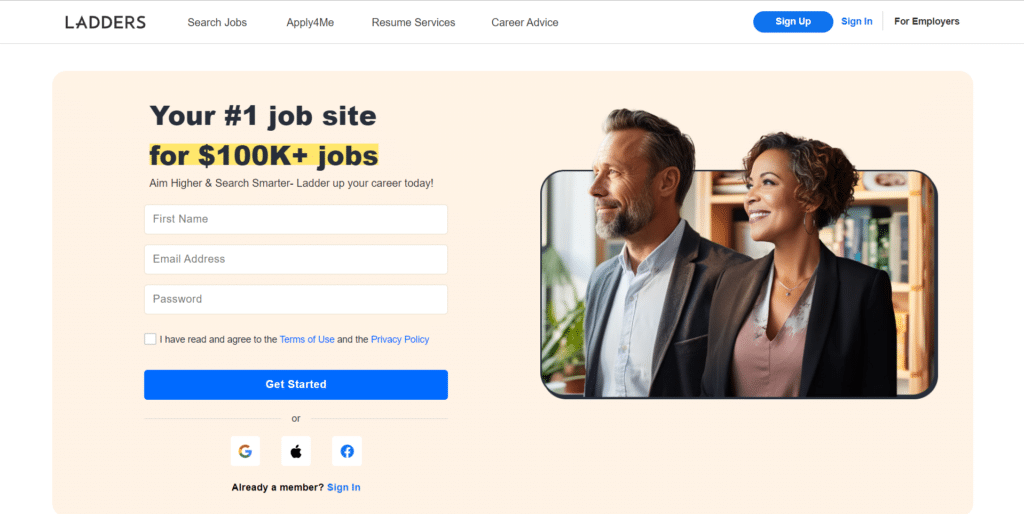
Ladders restricts itself to high-paying roles, historically six figures and above. The restriction is the product: it keeps the applicant pool to people who are plausibly in range for a senior salary.
Key features:
- High-salary roles only
- Verified senior candidate profiles
- Executive-level search and filtering
Pros:
- Filters out under-qualified applicants automatically
- Candidates expect senior compensation conversations
- Efficient for a small number of senior roles
Cons:
- No use below its salary threshold
- Small pool in narrow specialisms
- Paid posting only
Best for:
- Senior, director and executive hiring
Pricing:
- Paid postings priced per role
15. LHH

LHH is a talent solutions firm rather than a self-serve board, covering recruitment, career transition and outplacement. Employers use it when they want the search run for them, which is a different purchase from buying a listing.
Key features:
- Managed recruitment and executive search
- Career transition and outplacement services
- Global delivery network
Pros:
- Shortlist arrives pre-screened
- Useful for confidential or hard-to-fill searches
- Handles restructuring and hiring together
Cons:
- Far more expensive than posting a job
- Slower to start than a self-serve listing
- Overkill for routine roles
Best for:
- Confidential, senior or managed-volume searches
Pricing:
- Service engagement, quoted per search or programme
16. Jobvite
Jobvite is recruiting software rather than a job board, and it belongs on this list for one reason: at some point, posting to boards becomes a workflow problem rather than a reach problem. Jobvite distributes to boards and then manages what comes back.
Key features:
- Job distribution to multiple boards from one place
- Applicant tracking, CRM and employee referrals
- Recruitment marketing and analytics
Pros:
- One workflow instead of several board logins
- Referral tools often outperform paid boards
- Reporting shows which channel actually delivered hires
Cons:
- Platform commitment, not a per-post purchase
- More than a small team needs
- Implementation takes real time
Best for:
- Employer teams running continuous hiring across many roles
Pricing:
- Annual platform subscription
17. VetJobs
VetJobs connects employers with veterans, transitioning service members and military spouses, and it is free to employers. Military experience translates badly onto a civilian resume, which is precisely the gap a specialist board closes.
Key features:
- Veteran, service member and military-spouse candidate base
- Free employer posting
- Support translating military experience to civilian roles
Pros:
- Reaches candidates general boards routinely overlook
- No cost to post
- Supports formal veteran hiring commitments
Cons:
- Smaller pool than general boards
- Needs a real internal hiring commitment to work
- Coverage varies by role type
Best for:
- Employers with veteran hiring goals
Pricing:
- Free for employers
18. Stack Overflow Jobs
Stack Overflow Jobs no longer exists. It closed on 31 March 2022, taking listings, saved searches, applications and Developer Story with it. This entry stays on the page because plenty of "best job boards" lists still recommend it, including the earlier version of this one, and an employer following that advice loses a week finding out.
Key features:
- Discontinued in 2022, no employer functionality remains
Pros:
- None, the service is closed
Cons:
- Still listed as live on many outdated roundups
Best for:
- Nothing. For developer hiring, use Dice, Wellfound or a targeted technical assessment
Pricing:
- Not applicable, the board is closed
19. Behance
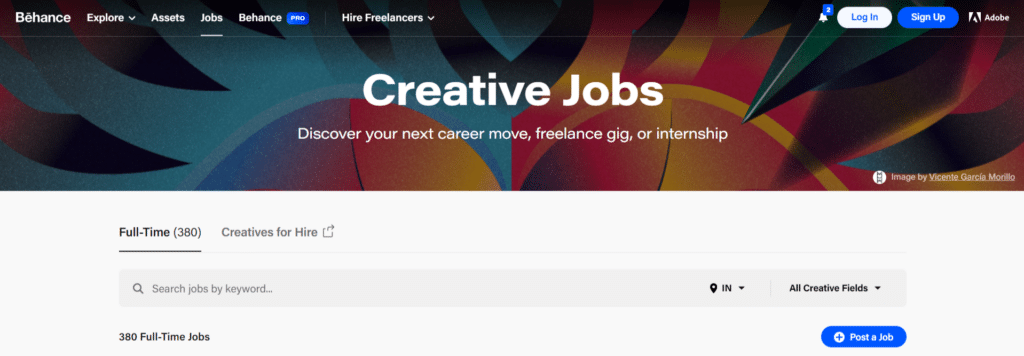
Behance is a portfolio platform with a job board attached, which suits creative hiring because the work is visible before the conversation starts. A designer's portfolio answers more than an interview usually does.
Key features:
- Portfolio-first candidate profiles
- Creative and design job listings
- Search by visual style and discipline
Pros:
- Evidence of skill is visible upfront
- Deep pool of designers and creatives
- Filtering by discipline is precise
Cons:
- Creative roles only
- Portfolio quality does not predict reliability or collaboration
- Limited employer tooling
Best for:
- Design, illustration, motion and other creative hiring
Pricing:
- Paid job listings
20. Remote.co
Remote.co pairs a remote job board with guidance on running distributed teams. The audience is smaller than the big remote boards, but it skews towards people who have worked remotely before rather than people who would like to try.
Key features:
- Curated remote job listings
- Remote-work guidance for employers and candidates
- Flat fee posting
Pros:
- Experienced remote candidates
- Simple flat-fee model
- Useful for employers new to distributed hiring
Cons:
- Smaller audience than the largest remote boards
- Remote roles only
- Limited advanced filtering
Best for:
- Companies hiring experienced remote workers
Pricing:
- Flat fee per job post
Where can you find jobs online?
Candidates find jobs online in four places: aggregators like Indeed and SimplyHired, professional networks like LinkedIn, niche boards tied to an industry or work style, and company career pages directly. Applying through the company site often beats applying through a board, because fewer people do it.
Two things are worth knowing before spraying applications. First, the odds per application have collapsed. With 244 applications arriving per job, a generic application is close to invisible. Second, the process itself has changed shape: 63% of candidates have now been interviewed by an AI, up 13 points in six months, and 70% were never told upfront that AI would evaluate them. That survey covered 2,950 candidates in May 2026.
The practical read: fewer, better-targeted applications beat volume, and a portfolio, a work sample or a completed skills test does more than a longer resume. For a wider view of how sourcing works from the employer side, the guide to talent search and sourcing covers the channels beyond boards.
Broadbean alternatives for job posting and distribution
Broadbean is multi-posting software: it pushes one job out to many boards at once and pulls the applications back into one place. Employers looking for alternatives usually want the same thing, which is to stop logging into six boards separately.
There are three honest options. A multi-posting tool such as Idibu or JobAdder does the same job as Broadbean. An applicant tracking system with built-in distribution, such as Jobvite or Greenhouse, folds posting into the system you already run. Or, for a small team, an aggregator like Indeed plus one specialist board covers most of the reach without buying distribution software at all.
The trade-off nobody mentions: multi-posting increases how many applications you receive without changing how many you can read. Distribution is a reach fix, and reach has not been the constraint for a while. If applications already outnumber the hours available to review them, the money is better spent on screening than on posting to more places. The difference between job advertising and job posting is worth understanding before buying either.
What happens after the applications arrive?
This is the part the job-board roundups skip. Boards solve reach. They do not solve judgement, and judgement is where the hours go.
Look at the numbers together, all from the same Greenhouse dataset of 640 million applications. Applications per job reached 244, up 111% since 2022. Applications per recruiter reached 746 a year, up 412%. Recruiting teams shrank 56% over the same window. Time to fill in that sample went up 37%, to just under 60 days, which runs longer than the 39-day SHRM median because it tracks a different set of employers. More reach, fewer readers, slower hiring. Buying more distribution into that pattern makes it worse.
The fix is deciding what counts as evidence before the applications land. The Testlify Hiring Workflow Method is the approach Testlify uses for this: define role competencies, build the assessment plan, invite candidates automatically, assess the skills the role actually needs, review AI-assisted insights, collect structured reviewer feedback, then compare candidates on consistent criteria before anyone books a call. AI assists the review. People still make the decision.
In practice that means a shortlist ordered by demonstrated skill rather than by application time. An illustrative case: a 60-person agency hiring three account managers, receiving roughly 240 applications each, could send a short role-relevant assessment at the point of application and review 15 scored candidates instead of 720 resumes. The work moves from reading to deciding.
Most teams already run an applicant tracking system, and that is the normal setup. Testlify connects to it as the screening and interviewing layer, with 100+ ATS integrations, and leaves the ATS as the system of record. For a team with no ATS at all, Testlify also includes a simple built-in hiring pipeline: create the job, publish it to job boards, collect applications, and move people through applied, reviewed, shortlisted and rejected. It is deliberately basic, meant for teams that do not want to buy a separate system.
Pro Tip: write the scoring criteria before the job goes live, not after the applications arrive. Criteria written while staring at real candidates tend to describe the person you already liked. Criteria written first describe the job.
Post the job, then screen with evidence
Pick two boards that match the role, write the criteria before you post, and put a short skills assessment at the point of application so the shortlist arrives scored. If you want to see how that works on a live requisition, book a demo and bring a role you are hiring for right now.
Key takeaways
- Match the board to the role, not to the traffic figure. Sector demand has split sharply, with engineering and healthcare postings around 30% above pre-pandemic levels while software and marketing sit roughly 30% below. A general board averages those markets together and hides which one you are hiring in, so a specialist board with a tenth of the reach frequently produces a better shortlist.
- Volume is now the constraint, not reach. The average job attracts 244 applications while recruiting teams have shrunk 56% since 2022. Any plan whose main idea is posting in more places adds work to the stage that is already overloaded, which is why time to fill rose 37% even as distribution got easier.
- Concentrate the budget on two or three boards. With median time to fill at 39 days for non-executive roles, a listing needs to stay visible for weeks. Spreading a small budget thinly buys bottom-of-page placement everywhere and sustained visibility nowhere.
- Check that a board still exists before you rely on a list. Stack Overflow Jobs closed in 2022 and still appears on current roundups. Verify the board, the pricing model and the audience before committing budget, because rate cards and ownership change often.
- Decide your screening method before the job goes live. Criteria set in advance produce a defensible shortlist; criteria invented mid-review produce a justification for a decision already made. This is the single change that most reduces time spent per hire.
- Hiring internationally means using local boards. Vacancy levels in the UK and the euro area move on their own cycle, independent of the US market the big boards are built around. A regional platform reaches candidates a global board never indexes, so budget the local board first and treat the global one as backup rather than the reverse.
FAQs

Content Writer
Yashika Khandelwal is a Content Writer with 3+ years of experience creating research-backed content on hiring, talent assessment, and HR technology. She is a registered Organizational Psychologist and subject matter expert who combines behavioral science with practical recruitment insights to produce accurate, evidence-based content.
LinkedInRelated resources
View all
HR & recruitment
Hiring process steps you should never skip

HR & recruitment
12 Executive Leadership Skills That Define C-Suite Performance (And How to Assess Them)

HR & recruitment
Conduct effective video interviews: Recruiter tips

HR & recruitment
Recruitment Management System: A 2026 Guide for HR

HR & recruitment
Empowering SaaS growth: the role of HR and CXOs in community building

HR & recruitment
Super skills vs micro-skills: a recruiter’s guide (2026)
Get started.
Hire on proof, not resumes.
Run your first skills-based assessment free — no credit card required.