
What are key KPIs for measuring assessment impact on hiring?
Measure hiring assessment impact with key KPIs like quality of hire, time-to-hire, candidate success rates, and retention.

If you’ve ever sat across a hiring manager who asked, “Are our pre-employment assessments actually working?,” and felt a little uncertain how to answer, you’re not alone. Learn how to choose the right pre-hire assessment platform for enterprises.
HR teams invest significant time, budget, and energy into candidate assessments. Skills tests, cognitive ability evaluations, personality profiling, situational judgment tests, the toolbox is full. But too often, these tools are deployed without a clear framework for measuring whether they’re delivering real results.
That gap between effort and evidence is exactly what the right KPIs can close.
In this guide, we’ll walk through the most important key performance indicators (KPIs) for measuring the impact of your assessments on hiring outcomes, what they are, why they matter, how to calculate them, and how to use the data strategically.
 ChatGPT
 Gemini
 Claude
 Grok
Grok Perplexity
Why does measuring assessment impact actually matters?
According to SHRM‘s Talent Trends Report, 54% of organizations use pre-employment assessments to gauge applicants’ knowledge, skills, and abilities, and 78% of those organizations report that assessments have improved the quality of their hires. That’s a strong signal. But the keyword is report. Are those organizations actually measuring improvement, or just assuming it?
There’s a big difference between gut-feel confidence and data-backed proof.
When you track the right KPIs around your assessment process, you get the ability to:
- Justify assessment-related spending to leadership
- Identify which assessment tools are predictive versus which are just busy work
- Improve your candidate experience and reduce drop-off
- Reduce bad hire rates and their downstream costs
- Build a consistent, defensible, and fair hiring process
And the cost of getting this wrong? It’s steep. According to SHRM, the average cost to hire an employee can be three to four times the position’s salary, and that’s just to get someone in the door. If they turn out to be a bad hire, you’ve lost both recruitment and training costs and have to start all over again.
Measuring your assessments isn’t a nice-to-have. It’s how you protect your organization from expensive, preventable hiring mistakes.
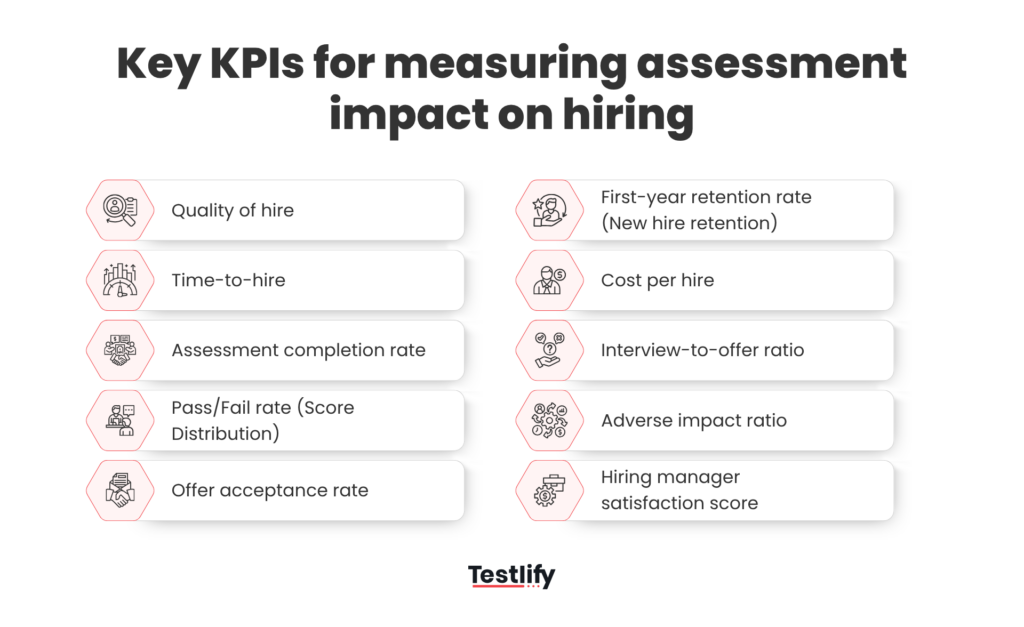

The 10 key KPIs for measuring assessment impact on hiring
1. Quality of hire
Quality of hire is arguably the most important KPI in your entire recruiting toolkit. It measures how well a new hire actually performs once they’re in the role, and whether they stay.
If your assessments are working, candidates who score well should perform better on the job. Tracking quality of hire over time, especially comparing assessment-screened hires versus those hired without assessments, tells you whether your tools are genuinely predictive.
How to measure it:
Quality of Hire (%) = (Performance Rating + Retention Rate + Hiring Manager Satisfaction) ÷ Number of Indicators
Use 90-day and 1-year performance reviews as your baseline data points. Sync with managers to rate new hire performance against role expectations. Then compare scores across cohorts, assessed vs. non-assessed hires.
What to watch for: If assessment scores correlate with strong quality of hire, your tools are working. If there’s no correlation, it’s time to re-evaluate the relevance of what you’re testing.
2. Time-to-hire
The number of days from when a job requisition is opened to when an offer is accepted.
Assessments can either speed up or slow down your hiring funnel. A well-designed assessment filters out poor-fit candidates early, reducing the number of interviews needed. A poorly designed one adds friction without adding value.
How to measure it:
Time-to-Hire = Date Offer Accepted − Date Job Requisition Opened
Benchmark to aim for: SHRM’s Human Capital Benchmarking data puts the average time to fill a position at 42 days. The goal isn’t necessarily to be faster than average, it’s to be appropriately fast given role complexity.
What to watch for: If time-to-hire increased after introducing an assessment, investigate where candidates are dropping off. The assessment itself may be too long, poorly timed in the funnel, or creating unnecessary friction.
3. Assessment completion rate
The percentage of candidates who actually complete an assessment after being invited to take it.
This is a canary-in-the-coal-mine metric. If completion rates are low, you’re either losing good candidates due to a bad assessment experience, asking candidates to complete assessments too early in the process, or the assessment is too long or confusing.
How to measure it:
Completion Rate (%) = (Number of Completed Assessments ÷ Number of Assessments Sent) × 100
Benchmark to aim for: A healthy completion rate is typically above 70–75%. Anything consistently below 60% warrants investigation.
What to watch for: Segment completion rates by job type, seniority level, and candidate source. You may find that completion drops specifically for senior candidates, a sign the assessment experience isn’t calibrated appropriately for that audience.
4. Candidate pass/Fail rate (Assessment score distribution)
The percentage of candidates who meet your defined threshold score on an assessment.
This tells you whether your assessments are appropriately calibrated. If 95% of candidates pass, the bar may be set too low. If only 5% pass, you may be filtering out good candidates with overly strict criteria.
How to measure it:
Pass Rate (%) = (Number of Candidates Who Met/Exceeded Score Threshold ÷ Total Candidates Assessed) × 100
What to watch for: Review pass/fail rates alongside eventual performance data. If high scorers don’t outperform low scorers in the role, the assessment isn’t measuring what matters. Also monitor for any demographic disparities in pass rates, which can signal potential adverse impact issues.
5. Offer acceptance rate
The percentage of job offers that candidates accept.
Offer acceptance rate is a proxy for candidate experience and employer brand health. If your assessment process is creating a poor experience, too long, too invasive, poorly explained, top candidates may drop out before the offer stage, or decline offers once made.
How to measure it:
Offer Acceptance Rate (%) = (Number of Offers Accepted ÷ Number of Offers Extended) × 100
Benchmark to aim for: A strong offer acceptance rate is typically above 85%.
What to watch for: If your offer acceptance rate declined after introducing an assessment step, survey declined candidates to understand why. Was the assessment a factor? This data is gold.
6. First-year retention rate (New hire retention)
The percentage of new hires who remain at the organization through their first year of employment.
Retention within the first year is one of the clearest indicators of hiring quality. If your assessments are good predictors of job fit, first-year retention rates among assessed hires should be meaningfully higher.
How to measure it:
First-Year Retention Rate (%) = (Number of New Hires Still Employed After 12 Months ÷ Total New Hires in the Same Period) × 100
Why this number hurts when it’s low: Harvard Business School notes that it typically takes six months or more for a business to break even on a new hire. Every early exit is a sunk cost.
What to watch for: Segment first-year retention by assessment score band. If employees in the top score quartile are retained at significantly higher rates than those in the bottom quartile, your assessment has predictive validity. That’s the data you want to show leadership.
7. Cost per hire
The total cost associated with filling a single open position, including all recruitment, assessment, and onboarding expenses.
Assessments add cost to the hiring process. The question is whether they reduce other costs, like repeat interviews, rework, or turnover, enough to generate a net positive return.
How to measure it:
Cost Per Hire = (Internal Recruiting Costs + External Recruiting Costs + Assessment Costs) ÷ Total Number of Hires
Benchmark to aim for: According to SHRM’s HR Benchmarking Survey, the average cost per hire is approximately $4,129. Your number will vary based on role type and seniority, but what matters most is the trend over time.
What to watch for: If assessments reduce the number of interviews per hire (by filtering earlier), they should be reducing cost per hire over time. Track this year-over-year to demonstrate ROI.
8. Interview-to-offer ratio
The number of interviews conducted for every offer extended.
Good assessments should narrow the candidate pool more effectively, reducing the number of interviews needed per hire. A high interview-to-offer ratio (say, 10:1) often signals that assessment filtering isn’t working properly.
How to measure it:
Interview-to-Offer Ratio = Total Number of Interviews ÷ Total Number of Offers Extended
What to watch for: Track this metric before and after introducing or revising an assessment. If the ratio drops after implementing a skills-based assessment, you’re getting better signal from the test and wasting less time on mismatched candidates.
9. Adverse impact ratio
A measure of whether your assessments are having a disproportionately negative impact on protected groups (based on gender, race, age, etc.).
This isn’t just a legal compliance metric, it’s a fairness KPI. Assessments that consistently filter out qualified candidates from protected groups are both ethically problematic and legally risky.
How to measure it:
Adverse Impact Ratio = Selection Rate for Protected Group ÷ Selection Rate for Majority Group
The EEOC’s “four-fifths rule” states that if the selection rate for a protected group is less than 80% of the selection rate for the highest-rated group, adverse impact may exist.
What to watch for: Run this analysis regularly. If adverse impact is detected, investigate whether it’s the assessment design, the scoring threshold, or the underlying job relevance of what’s being tested. Some adverse impact can be legally defensible if the assessment is demonstrably job-relevant, but it should never be ignored.
10. Hiring manager satisfaction score
A rating (typically via a short post-hire survey) of how satisfied hiring managers are with the quality of candidates the assessment process delivers.
Hiring managers are the end customers of your recruitment process. If they’re consistently frustrated by the caliber of candidates making it through assessment screens, something isn’t working, even if your other metrics look fine.
How to measure it:
Run a 3–5 question pulse survey with hiring managers 30–90 days after each hire. Ask: Did this hire meet expectations? Was the assessment process useful? Would you change anything?
Calculate a simple average score (e.g., out of 5) and track it over time by department, role type, and assessment tool used.
What to watch for: A low score in specific departments may indicate the assessment isn’t well-aligned with what that team actually needs. Use this data to customize assessments by role family rather than applying a one-size-fits-all approach.
How to actually use these KPIs (Not just track them)
Collecting data is the easy part. Using it to drive decisions is where most HR teams stumble. Here’s a practical approach:
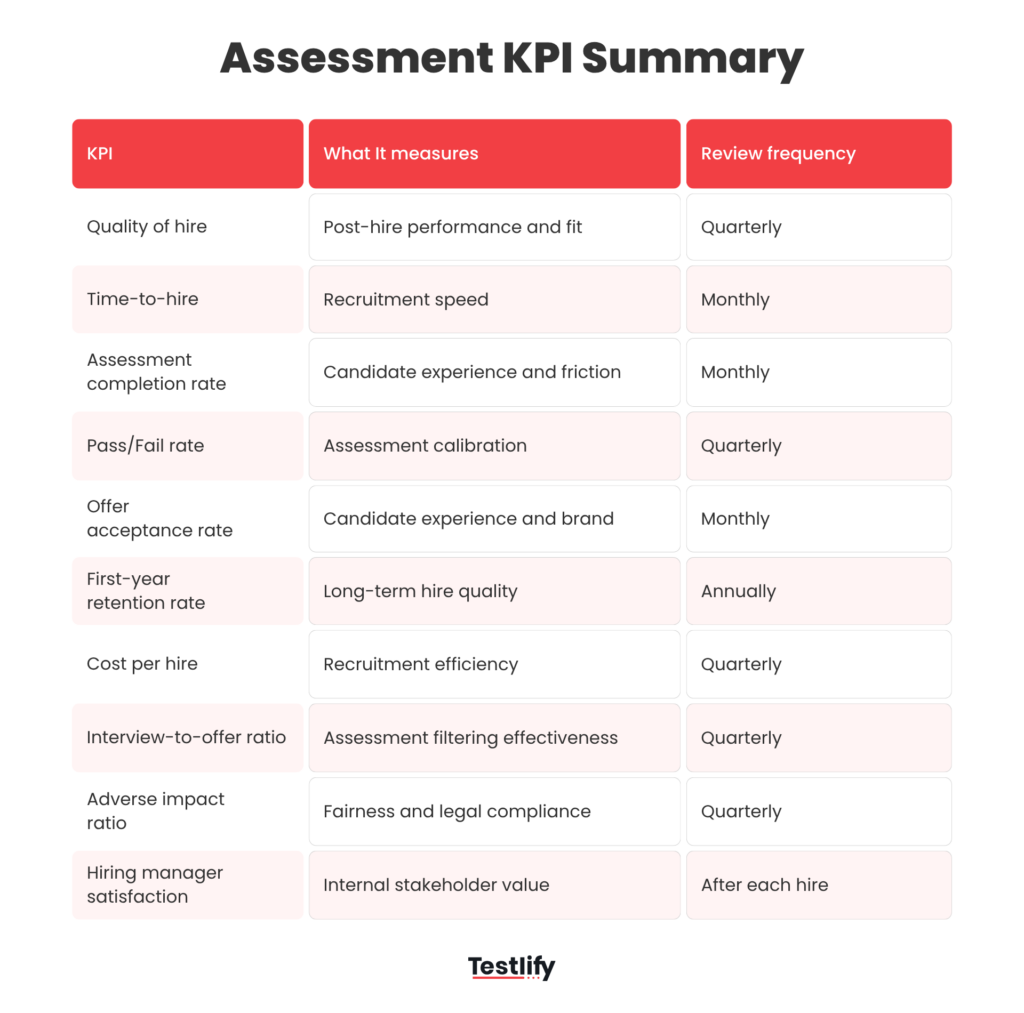
Build a simple assessment impact dashboard
Create a single view, even a spreadsheet works, that tracks your 5–7 most important KPIs month-over-month and by role type. The goal isn’t a perfect analytics platform. It’s visibility.
At minimum, include: Quality of Hire, First-Year Retention, Time-to-Hire, Completion Rate, and Adverse Impact Ratio.
Set a quarterly review cadence
Once a quarter, review assessment KPIs alongside business outcomes. Are departments with high-quality hires also hitting their targets? Are roles with strong retention correlated with specific assessment tools? This connects HR data to business impact, which is exactly the language leadership speaks.
Update your assessment scoring thresholds annually
As your role requirements evolve and you accumulate more outcome data, recalibrate score thresholds. An assessment cut-score that made sense two years ago may no longer be optimal. Use your quality-of-hire and retention data to validate whether your current thresholds are set correctly.
Share results with stakeholders
This one is underused. When assessments demonstrably improve hire quality, share that story, with data, to talent acquisition leaders, business unit heads, and the C-suite. This builds credibility for HR as a strategic function and secures continued investment in assessment tools.
Common mistakes HR teams make when measuring assessment KPIs
Measuring too many things at once. Start with 4–5 core KPIs and build from there. Tracking 20 metrics without clear owners or action plans creates noise, not insight.
Only measuring short-term outcomes. Time-to-hire is easy to track. First-year retention and quality of hire require patience. The most insightful longitudinal indicators, such as employee net promoter scores, turnover rates after 18 months, and internal mobility numbers, take time to accumulate but are far more powerful for spotlighting the long-term effectiveness of your assessments. Don’t abandon measurement because early data is thin.
Treating all roles the same. A cognitive ability assessment appropriate for a software engineer may be entirely wrong for a customer service representative. Segment your KPI analysis by role family, level, and function to get meaningful signal.
Ignoring candidate feedback. Post-assessment candidate surveys are a frequently missed data source. Asking candidates about their experience, was the assessment relevant, was it a fair representation of the role, was it too long?, surfaces UX issues that your internal metrics won’t catch.
Skipping adverse impact analysis. This is the KPI most HR teams neglect until there’s a problem. Make it a routine part of quarterly reviews, not a reactive investigation.
The bottom line
Pre-employment assessments are one of the most powerful tools in the modern HR toolkit, but only if you’re measuring whether they’re actually working.
The KPIs covered in this guide give you a structured, data-driven way to answer that question. Not just for your leadership team, but for yourself, so you can build hiring processes with genuine confidence.
Start simple. Pick four or five metrics that align with your organization’s current priorities. Build a habit of reviewing them consistently. Then let the data guide you.
Because in hiring, the organizations that measure well, hire well. And the ones that hire well, win.
Looking to implement skills-based assessments or refine your current hiring measurement framework? Start by auditing your existing KPI coverage against the list above, you might be surprised how many gaps are hiding in plain sight.
Frequently asked questions (FAQs)

Content Writer
Yashika Khandelwal is a Content Writer with 3+ years of experience creating research-backed content on hiring, talent assessment, and HR technology. She is a registered Organizational Psychologist and subject matter expert who combines behavioral science with practical recruitment insights to produce accurate, evidence-based content.
LinkedInRelated resources
View all
HR & recruitment
How to assess ethical judgment and decision-making in hiring?

HR & recruitment
Skills gap analysis tools: What HR teams should look for

HR & recruitment
Benefits of conducting a skills gap analysis

HR & recruitment
10 top social media recruiting tools

HR & recruitment
Social media recruiting: Benefits, steps and best practices

HR & recruitment
Top tools for large-scale campus hiring assessments
Get started.
Hire on proof, not resumes.
Run your first skills-based assessment free — no credit card required.