
Top tools for large-scale campus hiring assessments
Discover the top tools for large-scale campus hiring assessments

Campus hiring season brings one of the most intense recruiting challenges any HR team will face. You are dealing with thousands of applicants, compressed timelines, and the pressure to secure top graduates before your competitors do.
Manual screening simply does not scale at that volume. The right assessment platform can be the difference between a smooth hiring drive and a chaotic one.
This blog covers the top 10 tools for large-scale campus hiring assessments, with features, pros, cons, G2 ratings, and pricing for each. We also position the clear frontrunner for HR teams running volume recruitment programmes.
 ChatGPT
 Gemini
 Claude
 Grok
Grok Perplexity
What’s changed in Campus hiring
The old model was simple: visit 20 campuses, collect resumes, run on-site interviews, and make offers. Three things have broken that playbook.
Volume has exploded
Remote applications mean a single campus posting can attract thousands of candidates from schools you have never visited. SHRM reports that 58% of recruiters now cite limited time as their biggest constraint, not limited budget.
AI has changed what candidates can fake
Resumes are AI-written, cover letters are template-generated, and even take-home assignments can be handled by ChatGPT.
HR Dive’s 2026 hiring outlook flagged this explicitly: recruiters say one of the hardest challenges is evaluating what is real versus what was generated.
Candidate expectations have shifted
Gen Z candidates expect mobile-first, fast, low-friction assessments. A clunky login flow or an assessment that only works on desktop can cost you your best applicants before they even begin.
Therefore, the tool you pick for campus hiring matters more than ever.

What to look for in a campus hiring assessment tool
Before jumping into the tools, here is a quick checklist of what separates a great platform from an average one:
- Scalability: Can it handle thousands of concurrent candidates without running into technical problems?
- Test variety: Does it cover technical, psychometric, and role-specific assessments?
- Anti-cheating: Are the proctoring features good enough to ensure assessment integrity at scale?
- Candidate experience: Is it mobile-friendly and low-friction for first-time test takers?
- Analytics: Can you benchmark candidates and share reports with hiring managers quickly?
Top 8 tools for large-scale campus hiring
1. Testlify (Best overall)
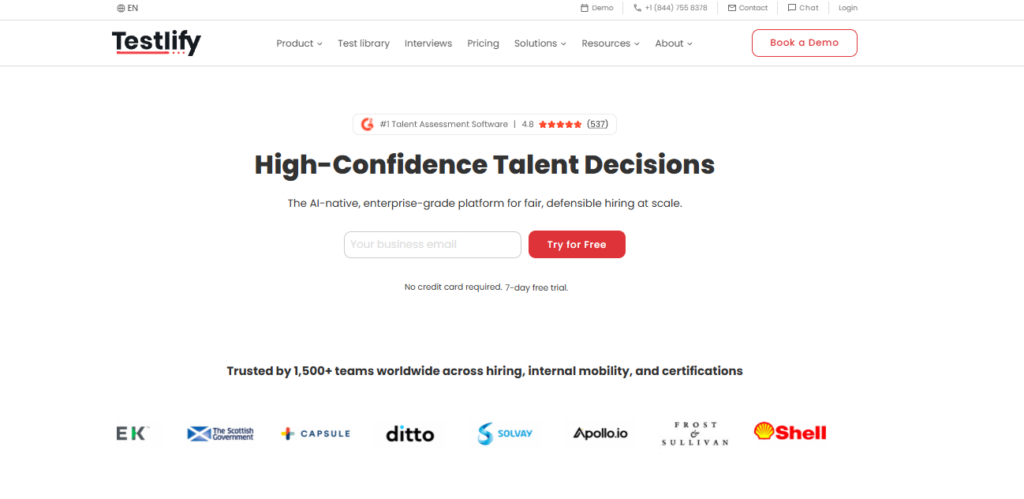
Testlify is a leading AI-native skills assessment and interviewing platform that features 3,500+ role-specific tests available in 16+s, enabling companies to hire confidently across campuses worldwide.
When it comes to large-scale campus hiring, Testlify is the clear leader. It is purpose-built for volume hiring without compromising on the depth of candidate evaluation, making it the go-to platform for HR teams managing high-stakes campus recruitment cycles.
Key features
- Test library featuring 3,500+ ready-to-use tests covering cognitive, technical, psychometric, situational judgement, coding, and role-specific tests
- Conversational AI interviews (chat, voice, video) that simulate real job scenarios
- 20+ anti-cheating and proctoring features, including dual webcam proctoring, AI assistance detection and more
- Supports 100+ ATS and HRMS integrations, including Greenhouse, Lever, and SAP SuccessFactors
- AI resume screener, benchmarking analytics, and white-labelling
Pros
- Built for scale with mobile-first candidate experience and no registration required, significantly improving completion rates
- Deep customization with 25+s and custom AI-generated questions
- Hands-on onboarding and responsive human customer support
- Transparent, flexible pricing with unlimited-use plans available
Cons
- Advanced customization options may have a slight learning curve for first-time users
G2 rating: 4.7 (550+ reviews)
Pricing: Starter plan starts at $198/monthnth (billed $1,663/year) for 100 credits and 3 users. Basic at $279/month, Business at $699/month, Premium and Enterprise tiers available on request. A fully unlimited plan is also available.
Learn more about how Testlify handles campus hiring at scale.
2. Talview
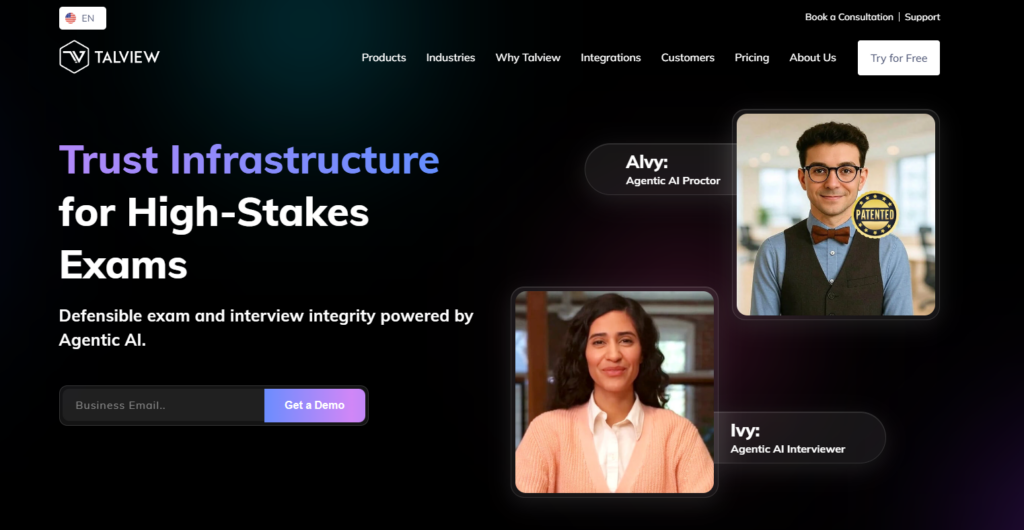
Talview is an AI-powered hiring and proctoring platform with strong video interviewing and assessment capabilities. It is commonly used by large enterprises for campus drives that require secure, high-volume assessments.
Key features
- AI-powered video interviews with behavioural analytics
- Remote proctoring with automated integrity flags
- Cognitive, technical, and domain-specific assessments
- ATS integrations and multilingual support
Pros
- Strong presence in enterprise-level campus programmes
- Good workflow automation for high-volume screening
Cons
- Smaller test library compared to dedicated assessment platforms
- Users report occasional technical glitches and slower support during peak hiring
G2 rating: 4.5/5
Pricing: Custom pricing only. Available on request via the sales team.
3. Vervoe
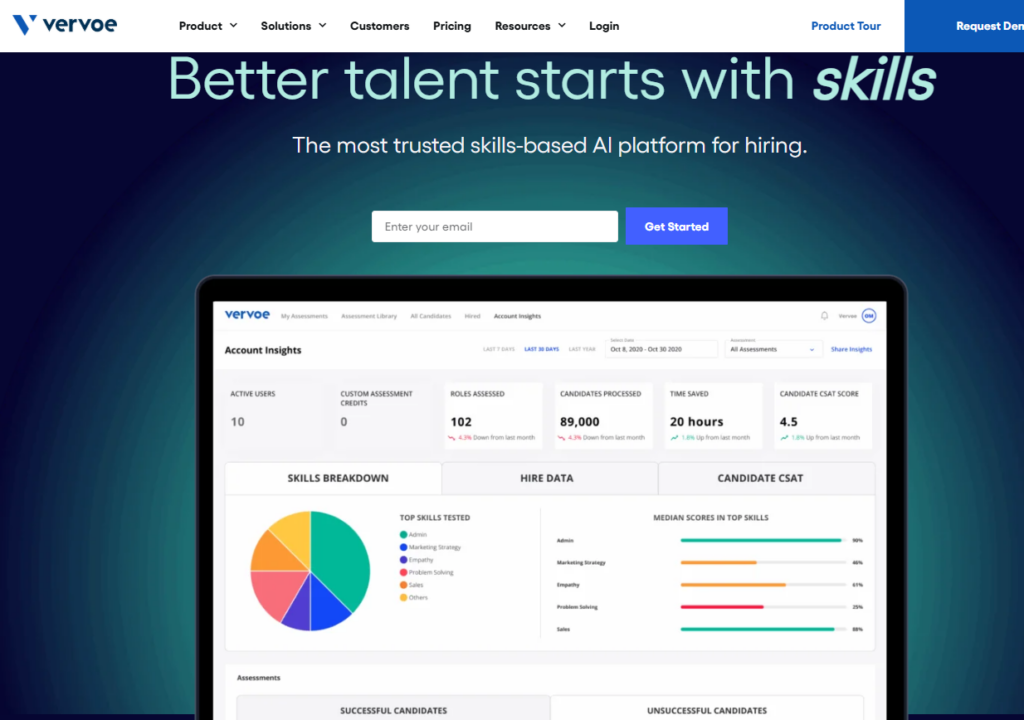
Vervoe is a skills-first hiring platform that uses job simulations and task-based assessments. Candidates complete real work samples, and AI ranks them based on actual performance rather than credentials.
Key features
- 300+ pre-built job simulation assessments
- Multi-format testing, including text, video, file upload, and spreadsheets
- AI-powered grading and candidate ranking
- Basic proctoring, including plagiarism detection
Pros
- Strong focus on real-world job performance over theoretical testing
- Easy-to-use interface with good candidate experience
Cons
- Limited psychometric assessment options
- Proctoring is less comprehensive than enterprise-grade platforms, which can be a risk for high-volume campus hiring
G2 rating: 4.6/5
Pricing: Pay-as-you-go model. Plans start around $300/month with pricing scaling by volume. Custom enterprise pricing on request.
4. Criteria Corp
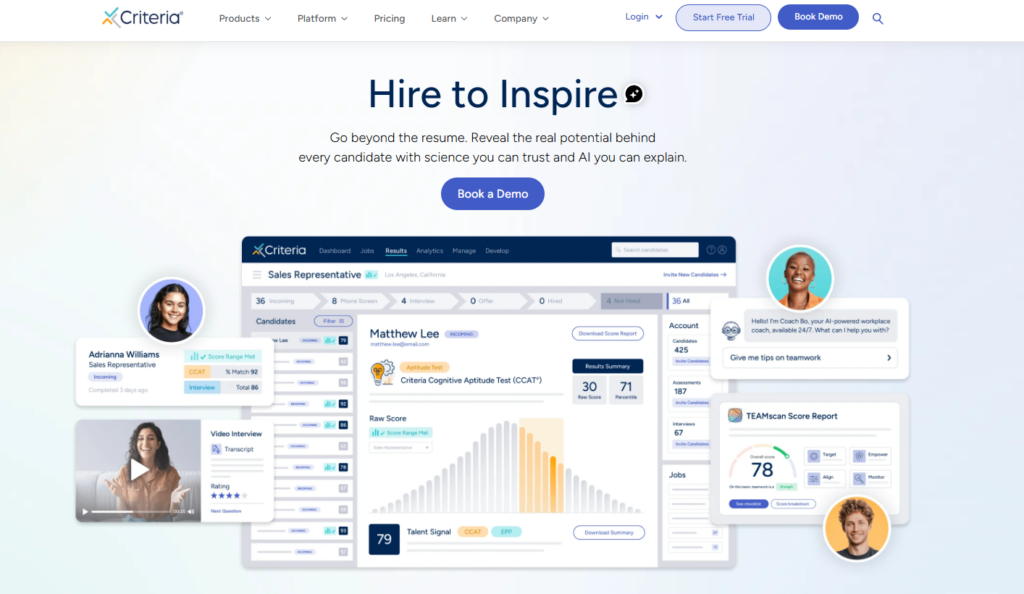
Criteria Corp is a pre-employment testing platform known for scientifically validated assessments. It is a popular choice for organizations that prioritize psychometric validity and evidence-based hiring decisions.
Key features
- Aptitude, personality, emotional intelligence, and risk tendency assessments
- Validated, peer-reviewed test library
- Structured reporting with role-fit scores
- ATS integrations with major platforms
Pros
- Strong scientific backing and validation studies
- Well-suited for standardized, structured testing programmes
Cons
- No conversational AI interview capability
- Limited customization and less flexible for high-volume or diverse campus roles
G2 rating: 4.6/5
Pricing: Starts around $100/month, with custom plans based on hiring volume. Pricing available on request.
5. Canditech
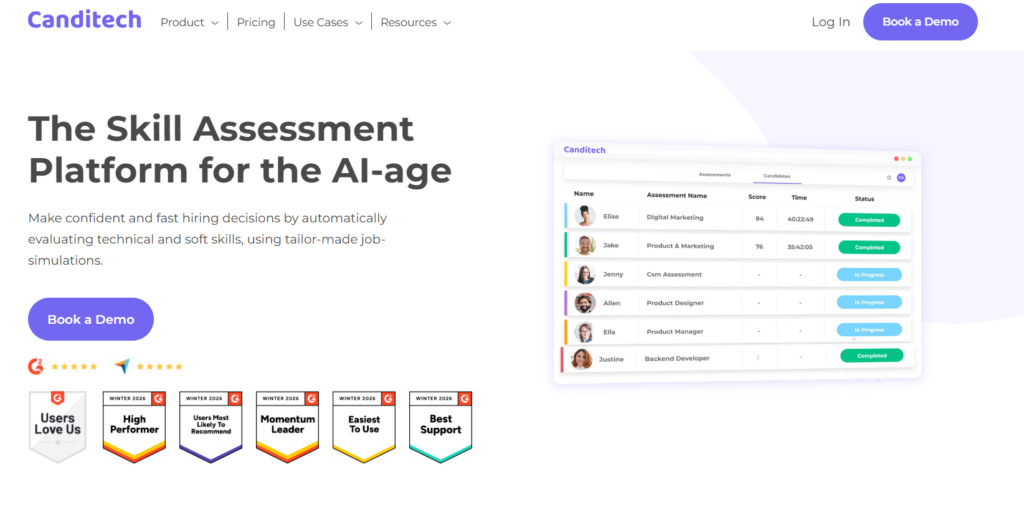
Canditech is a job-simulation focused assessment platform that evaluates technical and soft skills through real work scenarios. It has built strong traction among tech-forward hiring teams.
Key features
- 500+ ready-to-use tests plus expert-built custom assessments
- Multiple question types: coding, SQL, Excel, ChatGPT, open text, and video
- ChatGPT and copy-paste detection, tab-switch tracking
- Automated scoring and candidate ranking
Pros
- Highly customizable assessment flows
- Strong anti-cheating with AI-assistance detection
Cons
- Smaller test library for non-technical roles
- AI scoring requires training for niche use cases, which can slow initial rollout
G2 rating: 4.9/5
Pricing: Custom pricing based on assessment volume. Available on request from sales.
6. Xobin
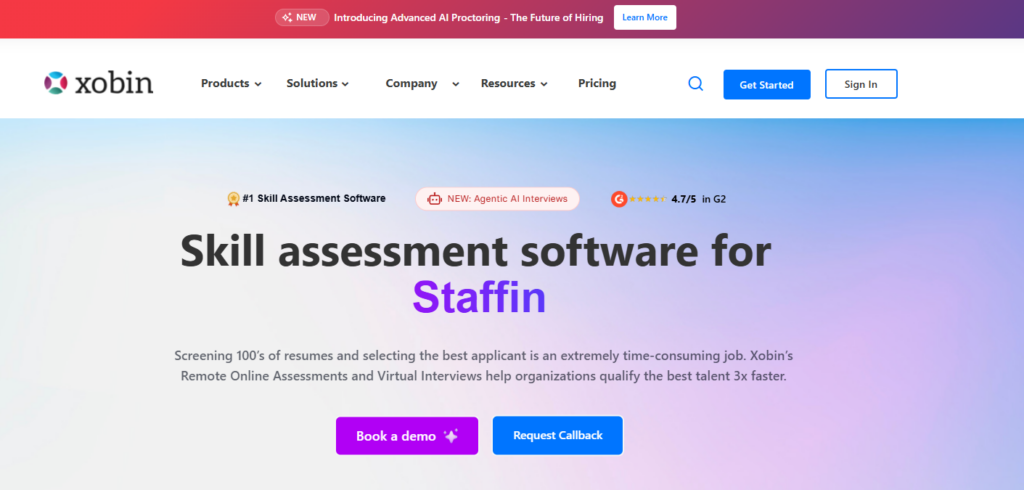
Xobin is a skills assessment and hiring automation platform covering aptitude, behavioural, technical, and job-specific tests. It serves mid-sized organizations with a decent volume of graduate hiring.
Key features
- Large library of aptitude, technical, and psychometric tests
- AI-based proctoring and video-based questions
- Custom test builder with white-label options
- ATS integrations and API access
Pros
- Strong coverage across functional and workplace competencies
- Good for campus and fresher-focused hiring programmes
Cons
- Reporting and analytics depth is moderate
- User experience feels less modern than newer platforms
G2 rating: 4.7/5
Pricing: Starts around $249/month. Quarterly, annual, and usage-based plans are available. Custom enterprise pricing on request.
7. Bryq
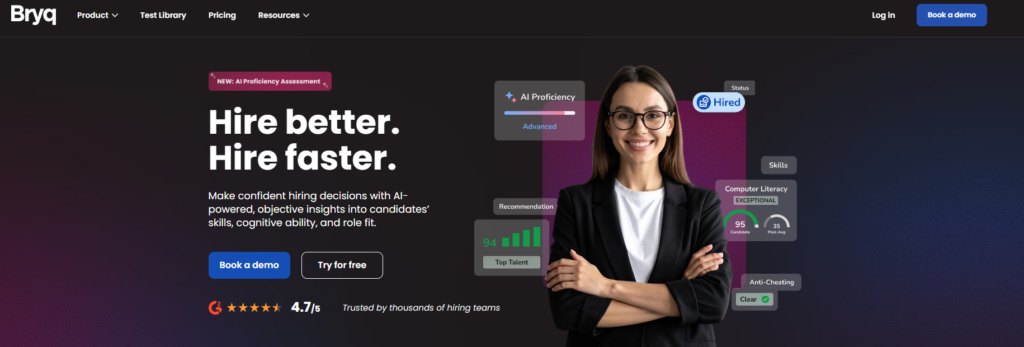
Bryq is a talent intelligence platform that combines cognitive ability and personality assessments to match candidates to roles. It is widely used by teams looking for bias-reduced, data-driven evaluation.
Key features
- Cognitive and personality assessments in a single short test
- Proprietary job-fit matching technology
- Anonymized evaluations to reduce unconscious bias
- ATS integrations and detailed candidate reports
Pros
- Quick 45-minute assessment improves completion rates
- Strong bias-mitigation positioning for diverse campus hiring
Cons
- Narrow test library, focused mainly on cognitive and personality
- Not ideal if you need a deep technical or coding tests
G2 rating: 4.7/5
Pricing: Tiered plans (Pro and Enterprise). 14-day free trial available. Custom pricing on request.
8. Wheebox
Wheebox is an established campus hiring assessment platform with strong adoption in India and parts of APAC. It is frequently used for large enterprise campus drives and graduate programmes.
Key features
- Cognitive, domain knowledge, and aptitude assessments
- Remote proctoring for exam-style campus drives
- Large-scale test delivery infrastructure
- Integrations with major HR systems
Pros
- Built for high-volume campus recruitment cycles
- Well-known brand in the Indian campus hiring ecosystem
Cons
- AI capabilities and UX feel dated compared to newer platforms
- Limited customization for modern, diverse assessment types
G2 rating: 4.2/5
Pricing: Custom pricing only. Available on request from sales.
How to choose the right tool for your campus hiring initiatives
The right platform depends on your hiring volume, role mix, and assessment depth:
- For high-volume, multi-role campus drives: Prioritize scale, proctoring, ATS integrations, and a broad test library.
- For psychometric-heavy evaluation: Look for validated cognitive and personality assessments backed by published research.
- For candidate experience and employer branding: Choose platforms with white-labelling, mobile-first design, and smooth test flows.
- For going beyond traditional assessments: Choose platforms that feature Conversational AI interviews and job simulations, offering a much richer view of each candidate.
Final thoughts
Campus hiring is not getting easier. Competition for top graduate talent is fierce, hiring windows are short, and the cost of a bad hire is higher than ever. The tools you use to assess candidates at scale will directly shape the quality of your talent pipeline.
Testlify gives you everything you need in one platform. Book a free demo and see how it transforms your campus hiring initiatives by helping you identify top talent in record time.
Frequently asked questions (FAQs)

Related resources
View all
HR & recruitment
Why a strategic recruitment plan is critical for business success

HR & recruitment
Different types of selection tests for HRM in large organizations

HR & recruitment
Free recruitment plan templates & examples

HR & recruitment
How to determine your recruitment KPIs in 2026
HR & recruitment
The ultimate guide to recruitment KPIs

HR & recruitment
Why traditional sources of recruitment are failing modern employers?
Get started.
Hire on proof, not resumes.
Run your first skills-based assessment free — no credit card required.