
Resume screening: What every recruiter should know in 2026
AI resume screening helps teams shortlist faster. This guide explains resume screening, criteria, limits of manual review, and tool checks.
Hiring teams aren’t short on applicants anymore. The struggle in 2026 is that most of them aren’t a good fit. LinkedIn found that 73% of HR professionals say less than half of the applications they receive meet all the criteria. That pressure makes resume screening one of the most important parts of the hiring process.
In this guide, we’ll break down what resume screening actually means in 2026, what you should be checking (beyond keyword matches), where manual screening and basic ATS filters fall short, and how AI resume screening can help you shortlist qualified candidates faster.
 ChatGPT
 Gemini
 Claude
 Grok
Grok Perplexity
TL;DR – Key takeaways
- Resume screening works best when job requirements are clear and consistent.
- Define must-haves vs nice-to-haves before reviewing job applications.
- Manual screening and basic ATS filters often miss qualified candidates at scale.
- AI resume screening helps shortlist faster, but still needs human oversight.
- Choose tools that explain matches, support overrides, and fit your workflow.
- Manual, ATS, and AI-assisted screening each solve a different problem — most teams get the best results from a mix of all three rather than picking one.

What is resume screening?
Resume screening is the first filter in the hiring process. It’s the quick review of job applications to decide who meets the basics and deserves a closer look, and who doesn’t. The point is to reduce a large pile into a workable shortlist based on the job requirements.
In real life, this step happens fast. One study from TheLadders found that the average initial resume screen was about 7.4 seconds. That doesn’t mean recruiters make final decisions in 7 seconds, but it does explain why unclear resumes and vague screening rules lead to messy shortlists.
So when we talk about “good resume screening,” we’re really talking about having clear checks that can be applied consistently, whether you’re doing manual screening, using an applicant tracking system, or adding AI later. Next, let’s get specific about what you should actually be looking for.
Resume screening criteria (what you’re actually checking)
Resume screening is easier when the criteria are clear before you open the first job application. Start with an up-to-date job description, and if it’s outdated, do a quick job analysis first so you’re not screening against the wrong target.
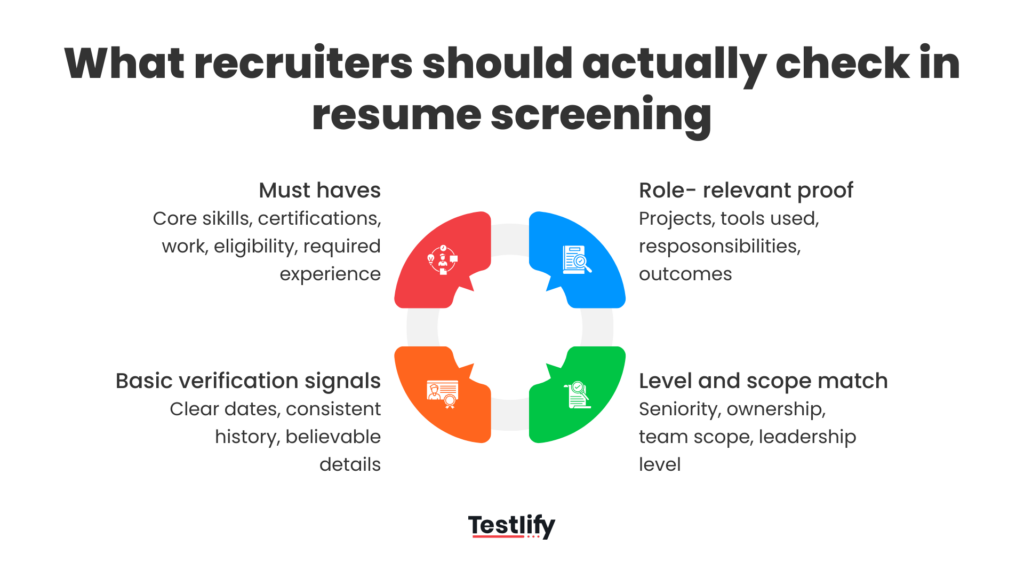
A clean way to screen is to use a short set of checks that map directly to the job requirements:
- Must-haves: The non-negotiables for this job (core skills, required certifications, minimum work experience, work authorization, location/shift constraints if they truly matter). If a candidate misses a must-have, they’re not a fit for this role, no matter how good the rest looks.
- Role-relevant proof: Evidence that they’ve done similar work, not just held a similar title. Look for skills and experiences shown through projects, responsibilities, tools used, and outcomes.
- Level and scope match: Whether their experience lines up with the seniority and ownership the job actually needs (for example, supporting vs leading, individual contributor vs managing). This is where many shortlists drift away from what hiring managers expect.
- Basic verification signals: Enough detail to trust the story: clear timelines, consistent work history, and information that can be validated later.
Once you define these checks, screening becomes consistent whether you’re doing manual screening, using an applicant tracking system, or adding AI-powered help later. When teams skip this step, traditional screening is exactly where things start to break, especially under volume-hiring, and that’s what we’ll cover next.
Where traditional resume screening breaks (limitations)
Traditional resume screening breaks when the input gets too big and the process stays the same. For many teams, the problem is handling the volume. Ashby’s recruiter productivity research shows applications per hire jumped sharply and stayed high. That’s a lot more noise to filter for the same outcome.
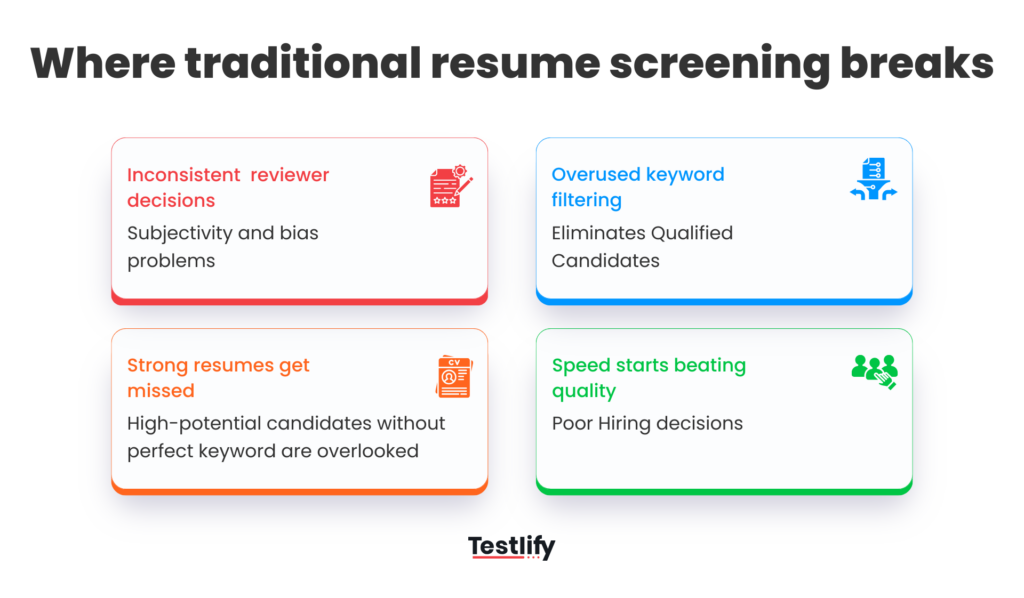
Once volume goes up, a few things start to happen:
- Screening becomes inconsistent: Two people can read the same job application and make different calls because “fit” isn’t defined the same way across the team, especially when hiring managers want different things.
- Keyword filtering gets overused: Basic rules in an applicant tracking system are fast, but they’re literal. If your job descriptions use one wording and a candidate describes the same skill differently, you can miss qualified candidates even when they match the job in real life.
- Strong resumes get treated like weak ones: People with non-standard titles, career pivots, or adjacent experience often look “off” in a quick screen, even when their skills and experiences are relevant.
- You optimize for speed, not quality: Under pressure, teams default to safer patterns (big brands, familiar titles, exact matches), which can narrow the pool and hurt quality of hire.
That’s why many teams moved from pure manual screening to rules-based filters, and now to AI resume screening. Next, let’s get clear on what “AI resume screening” actually means.
What is AI resume screening?
AI resume screening means using software to help review job applications. It reads resumes, pulls out key details like skills, work experience, and tools used, then compares them with the job requirements. Based on that match, it helps you sort, rank, or shortlist candidates for a recruiter to review.
This is not the same as basic ATS filtering. Traditional applicant tracking system rules often depend on fixed keywords or knockouts. AI-assisted screening is meant to look beyond exact wording, so you can still spot qualified candidates even if their resume uses different terms than the job description.
It’s become more common because hiring teams are dealing with heavier volume. Ashby’s recruiter productivity research found applications per hire rose about 182% compared to 2021, based on the most recent period they analyzed (Q4 2023–Q3 2024).
Next, let’s walk through how AI resume screening works, step by step.
Manual vs ATS vs AI-assisted screening: how the three methods compare
Before going deeper into the AI pipeline, it’s worth stepping back: resume screening today usually happens through one of three methods — manual review, ATS rule-based filtering, or AI-assisted screening — and each has a different strength. SHRM reports that 51% of organizations now use AI in recruiting, and 44% use it specifically to review or screen resumes, so it's rarely a choice of only one method anymore.
Manual resume screening: where human judgment still wins
Manual screening works best when a role needs judgment, context, or a closer reading of a person's background — senior positions, niche roles, leadership hiring, and candidates with non-traditional career paths. A human reviewer can spot transferable experience, strong career progression, unusual but relevant achievements, and problem-solving signals that don't show up in the same language as the job description. It breaks down once application volume rises: reviewing every application by hand takes time, slows the hiring process, and two reviewers can judge the same resume differently.
ATS screening: best for rule-based filtering
An ATS sorts and filters resumes automatically against set requirements — skills, experience, location, keywords, knockout questions. It's fast and consistent, but it follows patterns literally: a candidate with transferable skills, a career shift, or broader problem-solving experience can look weaker in the system than they actually are. ATS works best as a first filter, especially for structured, high-volume roles, but not as the only layer in a hiring decision.
AI-assisted screening: where context can help and where risk starts
AI-assisted screening tries to add context on top of automation — recognizing related skills, connecting similar job titles, and identifying relevant experience even when the wording is different. It can save time and make the first review more consistent. The risk is the same as anywhere else AI is used to rank people: it can make weak judgments if trained on poor data or narrow ideas of what a good candidate looks like.
Manual vs ATS vs AI-assisted: side-by-side
Screening method | What it does best | Where it struggles | Best use case |
|---|---|---|---|
Manual screening | Understands context, career shifts, transferable skills, and unusual experience | Slow, hard to scale, and less consistent when application volume is high | Senior roles, niche hiring, and candidates with non-traditional backgrounds |
ATS screening | Filters resumes quickly using set rules like keywords, location, work experience, or knockout requirements | Misses nuance and may screen out good people who don't match the exact terms in the job description | High-volume hiring and roles with clear must-have requirements |
AI-assisted screening | Helps connect related skills, surface likely matches, and review resumes with more context than strict keyword filters | Can make weak rankings, reflect old hiring patterns, or overvalue surface similarity if used without human review | Mid-to-high volume hiring where teams want speed with more context |
In practice the choice isn't about which method is universally best, it's about what the role needs. The most reliable approach is often a mix of all three: an ATS to handle basic filtering, AI to support the process with added context, and human review to make sure strong candidates aren't missed too early.
How does AI resume screening work?
Most AI resume screening follows the basic pipeline. It’s a series of steps that turns messy resumes into structured data, then compares that data to the job requirements.
- Resume parsing: The system takes resumes from your job listing or ATS and converts them into readable, structured fields like work experience, skills, education, and certifications. This is typically called resume parsing.
- Extracting and normalizing details: It cleans up variations so the data is usable. Example: different formats for dates, job titles, or skill names. This matters because two resumes can describe the same skill in different words.
- Understanding the job requirements: The tool uses your job description and any screening criteria you set (must-haves, preferred skills, experience level) as the target. If your criteria are vague, the output will be vague too.
- Matching and scoring: It compares each candidate’s skills and experiences against the role and produces a match score or ranking. Many systems also learn from your feedback over time (for example, which profiles you consistently move forward).
- Shortlisting with signals and flags: Instead of giving you a “yes/no,” good systems help you review faster by surfacing why someone looks relevant (key matches) and flagging gaps against must-have requirements.
- Human review & continuous monitoring: AI should support the screening process, not replace recruiter judgment. Teams still need to review edge cases, sanity-check shortlists, and monitor quality and fairness as inputs change. NIST’s AI Risk Management Framework is widely referenced for this idea of ongoing risk management and trustworthiness in AI systems
Next, we’ll look at what this changes day to day and why teams use AI-assisted screening in the first place, starting with the benefits.
Benefits of AI resume screening
The biggest benefit is speed without turning screening into pure keyword matching. AI-powered screening tools can read large batches of job applications, pull out skills and work experience, and compare them to job requirements in a more structured way than manual screening or simple ATS filters. That helps teams get to a clean shortlist faster, especially when the volume is high.
It also improves consistency. Instead of every recruiter interpreting the job description differently, AI can apply the same screening process to every resume, then surface why a candidate looks relevant (skills and experiences matched, gaps against must-haves, etc.). That makes it easier to align with hiring managers and reduces back-and-forth on shortlists.
Another practical win is better sorting and reporting. When resumes are converted into structured fields, teams can track where applicants drop off, which job listings attract the most qualified candidates, and whether screening criteria are too strict. That’s hard to do reliably with manual screening.
Know More: Benefits of AI resume screening & it’s drawbacks
Drawbacks and risks of AI resume screening
AI resume screening can fail in predictable ways when the inputs are messy. If the job requirements are unclear, if the job description is unrealistic, or if past hiring decisions were biased, the model can learn the wrong signals and scale them. That’s why most responsible guidance emphasizes ongoing risk management, monitoring, and human oversight, not “set it and forget it.”
The biggest risk area is fairness and discrimination. US regulators have warned that algorithmic tools used in hiring can disadvantage people with disabilities and create legal exposure if employers don’t provide reasonable accommodations or rely on tools that screen people out unfairly.
There’s also transparency and trust. If the tool can’t explain why it ranked someone higher or rejected them, recruiters and hiring managers either over-trust it (“the system said no”) or ignore it completely. And when candidates feel screened by a black box, it can hurt the candidate experience.
Finally, there’s growing legal and reputational risk. For example, Reuters has reported litigation alleging bias tied to AI-driven hiring software, which shows how closely these tools are being scrutinized.
Next, we’ll look at what to check in a resume screening tool so you get the speed benefits without inheriting these risks.
What to look for in a resume screening tool
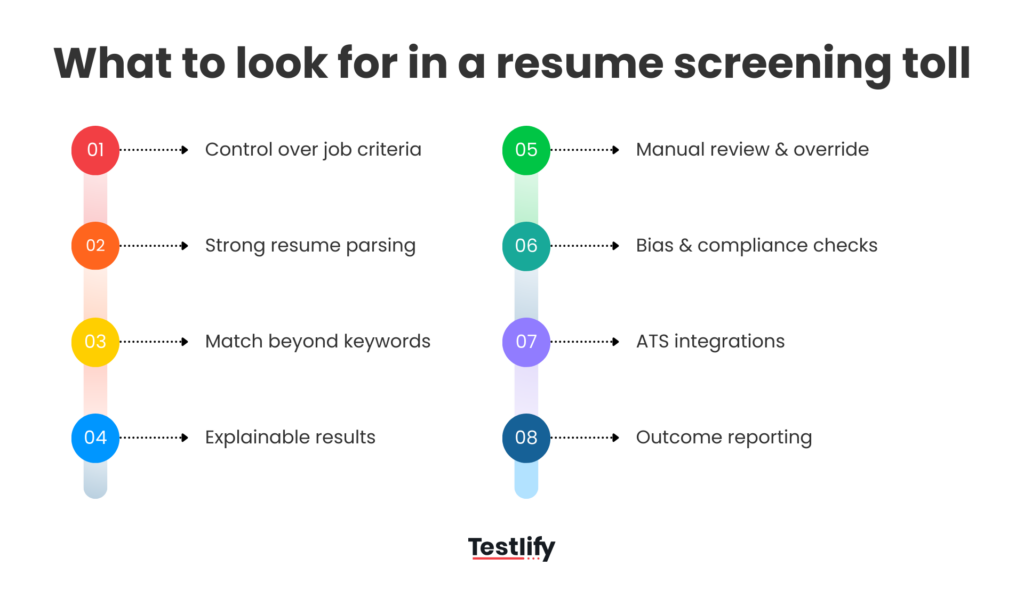
A resume screening tool should do two things at the same time: reduce manual screening time and keep your hiring process under your control. If it’s fast but you can’t explain or defend the shortlisting decisions, it’ll create more problems than it solves.
Here’s what’s worth checking before you commit:
1) Clear control over job requirements
You should be able to set must-haves vs nice-to-haves, weight criteria, and update them role by role. If the tool forces a one-size-fits-all model, your screening process will drift away from what hiring managers actually need.
2) Strong resume parsing that doesn’t break on formatting
If the system can’t reliably extract work experience, skills and experiences, and basic details from job applications, everything downstream is noisy. Most modern ATS tools include resume parsing and screening capabilities, so you’re evaluating quality here, not just whether it exists.
3) Match quality beyond keyword filters
Good tools help you match the job even when a candidate’s resume uses different wording than the job descriptions. Keyword-only screening is fast, but it’s also how qualified candidates get missed.
4) Explainable results (not just a score)
You should be able to answer: “Why did this person rank higher?” Look for clear reasons (matched skills, relevant work experience, gaps against job requirements) so recruiters and hiring managers can review quickly and confidently.
5) Human oversight and easy overrides
The tool should support decisions, not lock them in. You should be able to adjust criteria, override rankings, and document why. That “human-in-the-loop” approach is a core idea in responsible AI risk management.
6) Bias and compliance checks you can actually use
If the tool uses AI-powered ranking, ask what the vendor has done to test for adverse impact and how you can monitor it. The EEOC has been explicit that automated decision systems aren’t automatically “neutral,” and employers should evaluate how these tools behave in real hiring workflows.
7) ATS integrations
A tool can be accurate and still fail if it doesn’t fit your workflow. Check whether it works cleanly with your applicant tracking system, lets teams collaborate, and keeps candidate movement and notes in one place.
8) Reporting that ties back to outcomes
At minimum, you should be able to see: pass-through rates, time-to-shortlist, and where candidates drop off. The whole point is improving throughput without hurting the quality of hire.
Common mistakes and how to avoid them
Most screening problems don’t come from the tool. They come from unclear criteria, messy job descriptions, and teams treating screening like a one-time filter instead of a controlled screening process.
Keep the rules simple, review the shortlist quality regularly, and make sure hiring managers agree on what qualified candidates actually mean.
Common mistake | Why it hurts | How to avoid it |
|---|---|---|
Treating nice-to-haves like must-haves | You filter out good candidates and shrink the pool | Split job requirements into must-have vs nice-to-have, and stick to it |
Relying on keyword matches only | Misses candidates who describe the same skill differently | Screen for skills and experiences shown in work, not just words |
Using vague or overloaded job descriptions | The screening process becomes random | Rewrite the JD around outcomes, core skills, and level of role |
No alignment with hiring managers | Shortlists get rejected and the pipeline slows | Agree on 4–6 criteria and a few “deal-breakers” before screening |
Ignoring context (career pivots, titles, gaps) | You reject capable people for non-job-related reasons | Focus on “can they do the job?” and verify during later stages |
“Set and forget” automation | Bad criteria gets scaled across every job application | Review shortlist quality weekly, adjust criteria, document changes |
Not tracking what happens after shortlist | You can’t improve quality of hire | Track pass-through rate, time-to-shortlist, and hiring-manager satisfaction |
Read More: Resume screening techniques: Manual vs ATS vs AI-assisted
Conclusion
Resume screening in 2026 is less about reading every resume and more about running a clean screening process you can trust. When your job requirements are clear and your criteria are consistent, you shortlist qualified candidates faster and avoid back-and-forth with hiring managers.
AI resume screening can help handle volume and improve consistency, but it still needs human oversight and good inputs.
If you want to see what AI-assisted screening looks like in a real workflow, book a demo and we’ll show you how Testlify helps teams screen resumes faster without losing control of quality.
Frequently asked questions (FAQs)

Related resources
View all
Resume screening
Benefits of AI resume screening & it’s drawbacks
Resume screening
Resume screening techniques: Manual vs ATS vs AI-assisted

Workplace culture
Participative Leadership: Meaning, Types, Pros and Cons

Talent assessment
What Is Talent Benchmarking? A 2026 Guide for Hiring Teams

Technical assessments
Coding Interview: How to Run One That Tests Real Skill

Employment and labor laws
AI Hiring Laws in 2026: What Employers Need to Know
Get started.
Hire on proof, not resumes.
Run your first skills-based assessment free — no credit card required.