
Using Big Five to identify candidates: a practical guide
Map Big Five traits to the role, test them after the skills screen and turn every score into an interview question, not a pass or fail.

Using Big Five to identify candidates means measuring five broad personality traits, then comparing each candidate's profile with the two or three traits the role actually needs. Done well, the test adds evidence a resume cannot show: how someone is likely to work, cooperate and handle pressure. Done badly, it becomes a culture-fit filter that screens out good people.
TL;DR:
- Use the Big Five to add evidence about work style after a skills screen, never as a pass or fail gate on its own.
- Start from the job: pick the two or three traits the role needs before you look at any scores.
- Conscientiousness matters in almost every role. Extraversion, agreeableness and openness matter only when the job rewards them.
- Turn every high or low score into a structured interview question, so a person checks the result against real examples.
- Personality tests can be faked, so give them lower weight than skills and work samples.
- Keep it legal: measure work-related traits only, and audit any automated scoring for bias, as NYC Local Law 144 requires.
 ChatGPT
 Gemini
 Claude
 Grok
 Perplexity
What does using Big Five to identify candidates mean?
Using Big Five to identify candidates is the practice of adding a validated personality test to the hiring process and reading the results against the role. The test scores openness, conscientiousness, extraversion, agreeableness and emotional stability on a scale, so recruiters compare candidates on the same five measures instead of on impressions from a resume or a short call.
The model behind it, also called the Big Five personality traits or five-factor model, is the most widely used way to describe personality at work. Each trait is a range, not a type: nobody "is" an extravert or an introvert, they simply score higher or lower.

Why are resumes not enough to find the right candidate?
Resumes show what a candidate has done and where, but not how they work. Two people with the same title and the same years of experience can differ completely in reliability, teamwork and stress tolerance, and a resume is written to hide exactly those differences.
Hiring teams already feel the gap. LinkedIn's Future of Recruiting 2025 found that 93% of TA professionals believe accurately assessing a candidate's skills is crucial for improving quality of hire, and that companies running the most skills-based searches are 12% more likely to make a quality hire. At the same time, SHRM's 2025 Talent Trends survey found that 69% of organizations still struggle to fill roles, so a bad hire is expensive to replace.
A Big Five test does not replace skills evidence. Skills tests show whether someone can do the work. The Big Five shows how they are likely to do it, which helps you choose between candidates who all clear the skills bar.
What are the Big Five traits, and what do they show at work?
The Big Five traits are openness, conscientiousness, extraversion, agreeableness and neuroticism (scored as emotional stability in most hiring tests). Each trait describes a pattern of behavior at work, and both high and low scores can suit a role. The table shows what each end usually looks like on the job.
Trait | High score at work | Low score at work | Roles where it matters most |
|---|---|---|---|
Openness | Curious, likes new ideas, adapts to change | Prefers proven methods and routine | Product, design, research, strategy |
Conscientiousness | Organized, reliable, meets deadlines | Flexible but less structured | Almost every role, most of all finance, ops, compliance |
Extraversion | Energized by people, assertive, talkative | Reserved, prefers focused solo work | Sales, account management, recruiting |
Agreeableness | Cooperative, patient, avoids conflict | Direct, skeptical, comfortable with disagreement | Support, nursing, team roles (low can suit negotiation) |
Emotional stability | Calm under pressure, recovers fast | Feels stress more strongly | Contact centers, healthcare, incident response |
For how each trait relates to job performance, read our guide to the Big Five as a recruitment tool.
How does using Big Five to identify candidates work, step by step?
Using Big Five to identify candidates works in five steps: define the traits the role needs, choose a job-focused test, run it after the skills screen, compare scores with the role profile, and check every flag in a structured interview. The order matters, because picking traits after you see scores invites bias.
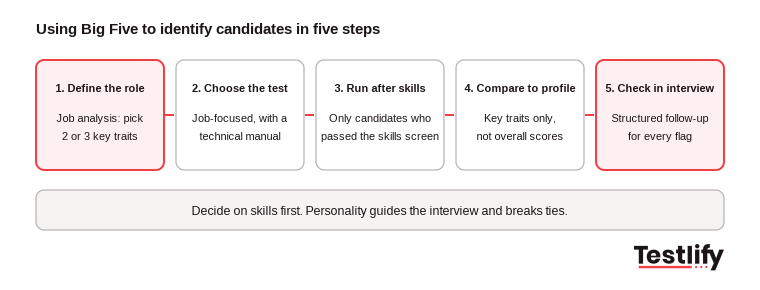
- Define the role profile: Run a short job analysis with the hiring manager and top performers. List the behaviors that separate good from great in the role, then map them to two or three traits. The O*NET Work Styles list helps here: it groups 21 work styles such as dependability, stress tolerance, cooperation and adaptability, which map neatly onto the five traits.
- Choose a job-focused test: Use an assessment built for hiring, with a technical manual and work-related questions. Free online quizzes are fine for self-discovery but are not built for selection decisions.
- Run it after the skills screen: Send the personality test to candidates who already passed a skills or role test, or bundle both in one assessment. Candidates take it once, and you avoid ruling people out on personality before you know they can do the job.
- Compare with the profile, not with each other: Look at the two or three traits you chose and ignore the rest. A candidate who fits the role profile on those traits is a stronger match than one with the "best" overall scores.
- Check every flag in the interview: Treat a low score on a key trait as a question to ask, not a reason to reject. A structured follow-up question gets real examples you can judge.
Pro tip: Write the role profile down and get the hiring manager to sign it off before the first candidate takes the test. A profile written after the scores arrive tends to describe the candidate the manager already liked.
Which Big Five traits matter for which roles?
The Big Five traits that matter depend on the work the role involves day to day. Conscientiousness helps in almost every job. Extraversion helps in roles built on talking to people, agreeableness in roles built on helping them, emotional stability in high-pressure roles, and openness in roles that keep changing.
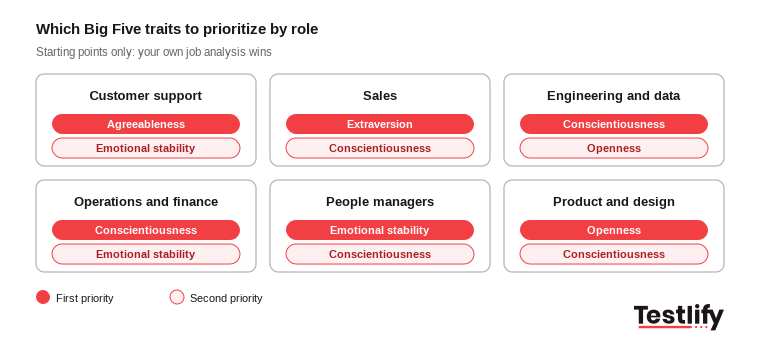
- Customer support and contact center agents: Agreeableness and emotional stability first. Agents handle upset customers for hours, so patience and calm under pressure matter more than charm.
- Sales and account managers: Extraversion and conscientiousness. Outgoing people open conversations, but organized ones follow up and close.
- Software engineers and analysts: Conscientiousness and openness. Careful work prevents bugs, and curiosity helps with new tools and problems. Low extraversion is not a weakness here.
- Operations and finance staff: Conscientiousness above all, with emotional stability for month-end and audit pressure.
- People managers: Emotional stability, conscientiousness and enough extraversion to lead meetings and give hard feedback.
- Product, marketing and design roles: Openness and conscientiousness, so new ideas also get shipped.
Treat these as starting points. Your own job analysis wins over any generic list, because the same title can mean very different work in two companies.
How do you turn Big Five scores into interview questions?
Big Five scores become interview questions when you take each key trait where a candidate scored low or unusually high and ask for a real past example. A structured interview with the same questions and scoring guide for every candidate keeps the follow-up fair.
Trait flag | What to check | Follow-up question |
|---|---|---|
Low conscientiousness | Can they meet deadlines without close supervision? | "Tell me about a deadline you nearly missed. What did you do?" |
Low extraversion (client-facing role) | Can they start and hold conversations with strangers? | "Walk me through the last time you had to win over a new contact." |
Very high agreeableness (negotiation role) | Can they hold a position under pushback? | "Describe a time you said no to a customer or colleague." |
Low emotional stability (high-pressure role) | How do they recover after a hard day? | "What do you do after a shift where everything went wrong?" |
Low openness (fast-changing role) | How do they handle a new tool or process? | "Tell me about a change at work you first disagreed with." |
Score each answer against the same rubric. If the example shows the behavior the role needs, the low score matters much less.
Where should a Big Five test sit in the hiring process?
A Big Five test should sit after the resume and skills screen and before the final interviews. At that point the candidate pool is smaller, everyone has shown they can do the work, and the personality results shape the interview plan instead of deciding who gets one.
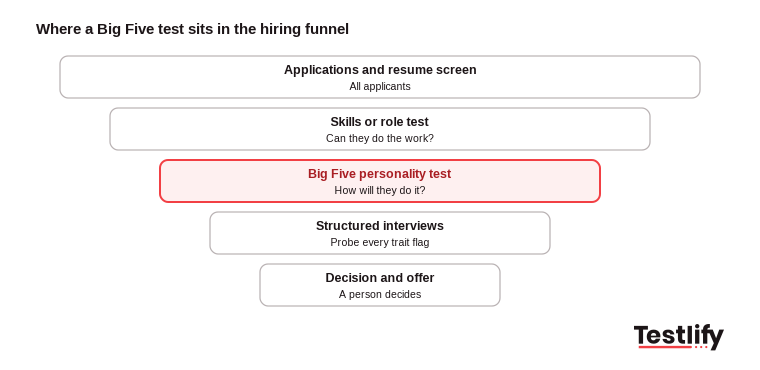
Give the result a modest weight. A common pattern is to let skills and work samples drive most of the decision and use personality as supporting evidence and a guide for the interview. Never set a hard cut-off score on a personality trait unless your job analysis shows the role truly cannot work without it.
Key takeaway: The Big Five works best as a tiebreaker and an interview guide. Skills decide whether someone can do the job; personality helps you decide how they will do it and what to ask next.
What are the limits and legal risks?
The limits of using the Big Five in hiring are faking, over-reliance and culture-fit bias, and the legal risks come from tests that look like medical exams or from automated scoring that nobody has audited. Each is manageable if you plan for it before the first candidate takes the test.
- Faking: Candidates can guess the "right" answers on a self-report test. Questions that force a choice between two positive statements, and follow-up interviews, both reduce the effect.
- Over-reliance: No single trait score predicts success in a job. Use the Big Five with skills tests, work samples and interviews, never alone.
- Culture-fit bias: "Fit" can become a polite word for "like us". Tie every trait you measure to the job, not to the team's current personality, and check pass rates across groups.
- Medical exam line: In the US, the EEOC's guidance on pre-employment medical exams says a psychological test counts as a medical exam if it gives evidence that would identify a mental disorder. Before a job offer, use tests that measure work-related traits only, not clinical screens for anxiety or depression.
- Candidate experience: Tell candidates what the test measures, how long it takes and how results are used. Short, clearly explained tests keep drop-off low.
How does Testlify support Big Five hiring?
Testlify includes a Big Five personality test in a library of 3,500+ tests, so teams can pair it with role-specific skills tests in a single assessment. The Big Five Personality test has 50 questions, takes about 15 minutes and reports each trait with two facets, such as diligence and efficiency for conscientiousness.
- One assessment, two kinds of evidence: Combine personality with skills, cognitive and situational judgment tests from the test library, and weight each part to match your role profile.
- Other personality models: SMART, DISC and the picture-based PicOCEAN test sit in the same personality and culture category, covered on the psychometric tests page.
- Reports reviewers can use: AI candidate insights give a per-skill breakdown, written strengths and gaps, and suggested follow-up questions for the interview.
- Fits your stack: Results sync to 100+ ATS and HRIS tools, including Workday, Greenhouse and Lever.
- Fairness checks: Testlify's matching model completed a third-party bias audit under NYC Local Law 144 on June 16, 2023. NYC bias audit
Ready to see personality next to skills?
Build an assessment that pairs the Big Five with the skills test for your next open role, and see both scores side by side for every candidate. Start a 7-day free trial of Testlify, no credit card required.
Frequently asked questions

Content Writer
Yashika Khandelwal is a Content Writer with 3+ years of experience creating research-backed content on hiring, talent assessment, and HR technology. She is a registered Organizational Psychologist and subject matter expert who combines behavioral science with practical recruitment insights to produce accurate, evidence-based content.
LinkedInRelated resources
View all
HR & recruitment
Campus Hiring Trends 2026: 7 Shifts Redefining Early Talent Hiring

HR & recruitment
Why Big Five personality test is the best for hybrid work?

HR & recruitment
Big Five Personality Traits and Job Performance: A 2026 Hiring Guide

HR & recruitment
How to Speed Up Recruitment with Hiring Assessments (2026 Guide)

HR & recruitment
Developer hiring strategies for tech startups

HR & recruitment
How to analyze and interpret programming test results?
Get started.
Hire on proof, not resumes.
Run your first skills-based assessment free — no credit card required.