
Different types of selection tests for HRM in large organizations
Discover the 10 best selection tests for HRM in large organizations to make smarter recruitment decisions at scale

A selection test is a structured, job-related assessment that measures what a candidate can actually do, before anyone makes an offer. The main types of selection tests are cognitive ability, aptitude, job knowledge, work sample, personality, situational judgement, integrity, language, digital literacy and physical ability tests. Each measures something different. Each fails differently too.
That last part is what most guides skip. A personality questionnaire will not tell you whether someone can write SQL, and a coding test will not tell you whether they will quit in four months. Picking the right test matters less than picking the right combination, and getting the order right.
 ChatGPT
 Gemini
 Claude
 Grok
Grok Perplexity
TL;DR
- Selection tests are job-related assessments used to predict performance before hiring. Twelve types are in common use, and they measure very different things.
- The research on which tests predict best changed in 2022. Structured interviews and job knowledge tests now score higher than cognitive ability tests, reversing decades of received wisdom.
- Most hiring processes need two to four tests, not one and not eight. More tests means more candidate drop-off for shrinking extra accuracy.
- Order matters as much as choice: cheap, fast, broadly applicable filters first, expensive role-specific ones last.
- Any test you use has to be job-related and defensible. The four-fifths rule is the number to know.

What are selection tests in HRM?
Selection tests in HRM are standardised assessments used during hiring to measure a candidate's skills, knowledge, reasoning or behaviour against the requirements of a specific role. They replace guesswork from a resume with evidence that can be compared across candidates, scored consistently and defended if challenged.
The word "standardised" is carrying weight there. A test only earns its place if every candidate meets the same questions, under the same conditions, scored the same way. An unstructured chat about someone's weekend is not a selection test, however revealing it feels.
The volume argument is simple. The U.S. Bureau of Labor Statistics counted 5.1 million hires in July 2026, and a matching 5.1 million separations. That churn is the reason structured testing exists: nobody can interview their way through it consistently, and inconsistency is where both bad hires and legal exposure come from.
Adoption is already wide. In a survey of 1,688 HR professionals, SHRM found that 56% of employers use pre-employment assessments to measure applicants' knowledge, skills and abilities, 78% said the quality of their hires improved as a result, and 23% said the diversity of their hires improved. That survey ran in 2022, so treat it as the established baseline rather than this year's number.
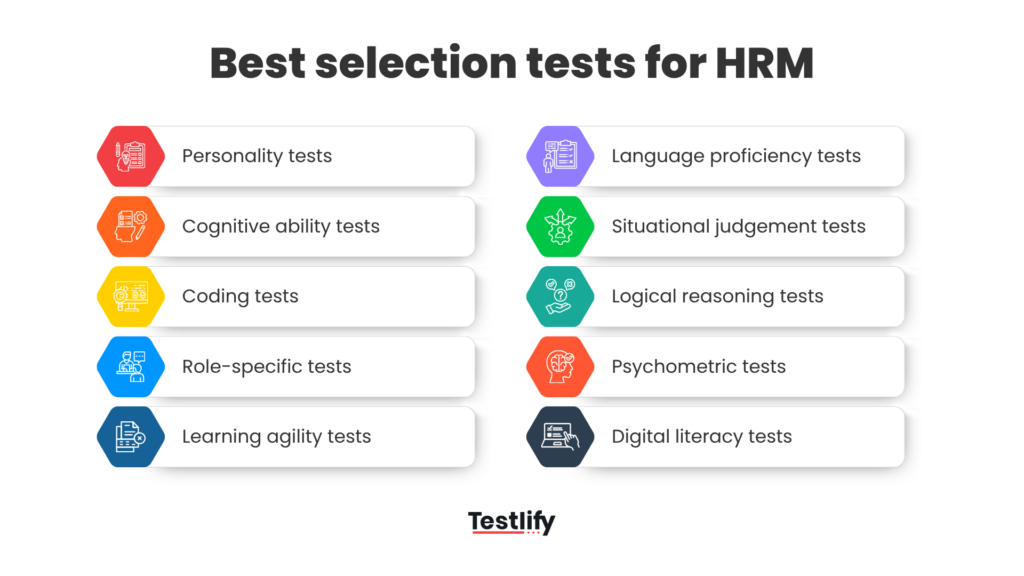
Types of selection tests in HRM: a quick map
Here is the whole field on one screen. Read the "watch out for" column first, because that is where hiring processes usually go wrong.
Test type | What it measures | Best for | Watch out for |
|---|---|---|---|
Cognitive ability | Reasoning, problem-solving, speed of learning | Early, high-volume screening across many roles | Adverse impact risk is highest here; always pair with job-related evidence |
Aptitude | Capacity to learn a specific skill not yet held | Trainees, apprentices, career changers | Predicts potential, not current output |
Job knowledge | What the candidate already knows about the work | Licensed, technical and regulated roles | Goes stale fast; review questions every cycle |
Work sample | Performance on a realistic slice of the actual job | Any role with a demonstrable output | Expensive to build and to mark; use it late |
Coding | Applied programming against real problems | Engineering, data, QA, DevOps | Puzzle questions measure puzzle skill, not the job |
Personality | Stable behavioural traits and working style | Team fit, customer-facing and leadership roles | Qualitative, no pass mark; never use it as a cut |
Situational judgement | Decision quality in realistic work scenarios | Graduate, retail, hospitality, service roles | Answers must be keyed to how your teams actually work |
Integrity | Propensity toward counterproductive behaviour | Cash handling, safety-critical, unsupervised work | Heavily regulated in some jurisdictions; take advice |
Language proficiency | Reading, writing, listening, speaking in a language | Global, support and multilingual teams | Test the level the job needs, not the highest available |
Digital literacy | Fluency with everyday software and tools | Ops, admin and any tool-heavy role | Easy to over-specify into an irrelevant tool list |
Physical ability | Strength, stamina or dexterity for the task | Field, warehouse, trades, emergency services | Tight legal constraints; must mirror real job demands |
Learning agility | Speed of adapting and applying new information | High-potential and fast-changing roles | Useful as a tie-breaker, weak as a primary filter |
What does each type of selection test measure?
The table is the map. This is the terrain.
Cognitive ability tests
These measure general reasoning: spotting patterns, working with numbers, drawing conclusions from information, absorbing something new quickly. They travel well across roles, which is why they sit early in most funnels, and they are cheap to run at volume.
They also carry the highest adverse-impact risk of anything on this list, which is why the legal section below is not optional reading. Use them as one signal among several, never as a standalone cut. Cognitive ability testing explained in depth covers the scoring detail.
Aptitude tests
An aptitude test asks whether someone can learn a skill they do not have yet. An achievement or job knowledge test asks what they know right now. That difference decides which one you reach for: hire a junior mechanic on aptitude, hire a shift supervisor on job knowledge.
Teams get this backwards more often than you would expect, usually by running a knowledge test on a trainee role and then wondering why the pipeline is empty.
Job knowledge and achievement tests
Knowledge tests check command of the facts, rules, and procedures a role runs on: tax treatment, safety protocol, drug interactions, and contract law. For licensed and regulated work, they are the most direct evidence available.
Their weakness is shelf life. A question bank written three years ago is testing an old version of the job, so review it every cycle, or it quietly becomes a trivia quiz. Library assessments built per job family, like these role-specific skill tests, save most of that maintenance.
Work sample tests
A work sample is a small, real piece of the job: edit this copy, debug this function, handle this customer complaint, and build this spreadsheet. Nothing else on the list is as convincing to a hiring manager, because the output is the evidence.
The catch is cost. Work samples take real effort to design and real time to mark, so they belong late in the process, on a short list of two or three candidates, not at the top of the funnel.
Coding tests
Coding tests show how a developer approaches a problem, structures a solution, and handles the edges. The failure mode is famous: an algorithm puzzle that nobody would ever write at work measures puzzle skill and screens out good engineers.
Tie the task to the stack and the work. On Testlify, that can be a single file or a multi-file project in an embedded VS Code editor, with up to 20 test cases (visible or hidden), per-test-case scoring, and SQLite database test cases. There is also a vibe coding format, where candidates direct AI tools toward a working solution instead of writing every line by hand, which is closer to how a lot of engineering now actually happens.
Personality tests
Personality questionnaires map stable traits: conscientiousness, openness, extraversion, agreeableness, and emotional stability. The Big Five (OCEAN) and DISC are the common frames. They predict how someone works, not whether they can do the work.
One rule, and it is the one most often broken: personality and culture tests are qualitative and carry no total score, so they cannot be used as a pass or fail gate. Use them to shape the interview and the onboarding, not to reject. Reading personality test results properly is worth the ten minutes.
Situational judgement tests
An SJT presents a realistic workplace scenario and asks what the candidate would do. Well-built, it is an efficient early filter for high-volume hiring where every applicant looks similar on paper: graduate schemes, retail, hospitality, and contact centers.
Badly built, it tests whether candidates can guess which answer the employer wants. The fix is keying the answers to how your teams genuinely operate, not to a generic ideal, which is why an SJT is worth customizing to your own scenarios rather than buying off the shelf.
Integrity tests
Integrity tests estimate the likelihood of counterproductive behavior: theft, rule-breaking, absenteeism, and unsafe shortcuts. They matter most for cash handling, safety-critical, and unsupervised roles.
They are also the most legally constrained type on this list, with rules that vary by country and by state. Take local advice before deploying one.
Language proficiency tests
These measures read, write, listen, and speak capabilities against a level, usually CEFR. For global support, sales and service teams do two useful things at once: they confirm the level a role actually needs, and they give strong candidates from non-native backgrounds a fair way to prove it instead of being judged on an accent in an interview.
Test to the level the job requires. A support role needing clear written B2 does not need a C1 gate, and setting one just shrinks the pool.
Digital literacy tests
Digital literacy covers the everyday tool fluency a role assumes: spreadsheets, documents, collaboration software, and internal systems. Testlify can assess this with live Google Docs, Sheets, and Slides tasks and Microsoft Word, Excel, and PowerPoint tasks, which is closer to the work than a multiple-choice question about a menu.
Physical ability tests
Used for field, warehouse, trades, and emergency services roles, these measure strength, stamina, or dexterity. They sit under the tightest legal constraints of anything here and must mirror genuine, documented job demands. Get occupational health and legal input before you build one.
Learning agility tests
Learning agility measures how fast someone picks up something unfamiliar and applies it somewhere new. It is a good tie-breaker between two otherwise even candidates and a good signal for high-potential programs. As a primary filter it is too blunt.
Which selection test predicts performance best?
Job knowledge tests are among the strongest predictors of job performance. they measure whether a candidate already has the knowledge needed to do the job, making them especially useful for technical, licensed and specialised roles.
But there is no single best selection test for every role. A coding test makes more sense for a developer, a work sample for a content writer, and an aptitude test for someone being hired into a role they can learn on the job. the best test is the one that measures the skills the role actually requires.
Pro tip: If you only change one thing after reading this, structure your interviews. The different interview formats vary a lot in how easily they take a rubric.
How do employee selection tests hold up legally?
Well, if they are job-related. Badly, if they are not. In the United States, employee selection tests fall under Title VII of the Civil Rights Act, the Americans with Disabilities Act and the Age Discrimination in Employment Act, and the U.S. Equal Employment Opportunity Commission's guidance on employment tests and selection procedures sets out how those laws apply to testing.
The number to know is the four-fifths rule, set out in the Uniform Guidelines on Employee Selection Procedures at 29 CFR 1607.4(D). A selection rate for any race, sex or ethnic group that is less than four-fifths (80%) of the rate for the highest-scoring group is generally treated by federal enforcement agencies as evidence of adverse impact.
That is a trigger for investigation, not a verdict. Once a disparity shows up, the employer has to show the procedure is job-related and consistent with business necessity, or swap it for a less discriminatory alternative that works. Failing to do either is where the exposure sits.
Three practical consequences:
- Track selection rates by group at every test stage. You cannot answer a four-fifths question you never measured.
- Keep the job analysis that justifies each test. "It seemed relevant" is not a defence.
- Be careful with anything that edges toward a medical or mental-health inquiry before an offer. The ADA restricts that sharply.
Testing is not the legal risk here. Unvalidated testing is. A documented, job-related assessment is easier to defend than an unstructured interview panel, because at least it leaves a record of what was asked and how it was scored.
Types of selection tests for recruitment at scale
Choosing tests is the easy half. Sequencing them is where hiring processes quietly break.
The principle: cheap, fast and broadly applicable first; expensive, slow and role-specific last. Every stage should cost more per candidate than the one before it, because fewer candidates reach it.
A funnel that works for most roles:
- Stage one, broad filter. A cognitive ability or logical reasoning test, 10 to 20 minutes, run on everyone who applies.
- Stage two, role validation. A job knowledge or role-specific test for the shortlist. This is where the revised validity research says to spend your effort.
- Stage three, behavioural context. A personality or situational judgement assessment, read alongside the others rather than scored as a gate.
- Stage four, the real thing. A work sample or structured interview with the final two or three candidates.
Two failure modes are worth naming. Running the work sample at stage one burns your team's time marking submissions from people who were never going to pass stage two. And stacking six tests into a single 90-minute assessment reliably loses the strongest candidates, who have other offers and less patience than you think.
This is where Testlify comes into play: combine several role-relevant signals, including assessments, interviews, simulations, references and reviewer feedback, so a decision rests on a pattern rather than one score. One signal is fragile. Several pointing the same way is confidence.
How many selection tests should you run?
Two to four, for almost every role. Below two, you are betting the hire on a single signal. Above four, candidate drop-off climbs faster than accuracy does, and you start losing the people you most wanted.
Adjust from there rather than starting over: add a work sample for senior or high-stakes roles, drop the behavioural read for short-tenure, high-volume hiring where speed matters more than fit. And keep total candidate time under 60 minutes. If the assessment takes longer than the interview it is screening for, the ratio is wrong.
Where Testlify fits in your stack
Testlify is a pre-hire assessment and interviewing platform: 3,500+ tests across 13 categories (cognitive ability, coding, role-specific, personality and culture, psychometric, situational judgement, language, software skills, simulation, gamified and more), 180,000+ validated questions and 25+ question types, plus AI video, audio and phone interviews with automatic transcripts and auto-scoring that a human can override.
On the integration question: most teams already run an applicant tracking system they trust, and Testlify plugs into it as the screening and interviewing layer while the ATS stays the system of record. There are 100+ ATS integrations, sold as an add-on on the self-serve tiers and included on Custom plans. Teams with no ATS at all get a simple built-in pipeline instead: post the job, collect applications, screen with evidence, move candidates through stages.
Two things worth knowing if fairness and defensibility are on your mind. AI scores and insights ship with an explicit disclaimer in the product that they are for guidance only and that humans make the final call, and both "display AI scores to the reviewer" and "include AI score in the final average" are toggles, so a team can run AI scoring as purely advisory. Candidates can request accommodations through a structured flow that routes to an administrator, and face-verification data is deleted after 30 days.
Ready to see it against your own roles? Book a demo and walk through a real funnel, or browse the assessment test library to see what exists for the roles you are hiring now. If you want the wider evidence base first, the skills-based hiring statistics roundup collects it in one place.
Frequently asked questions (FAQs)

Related resources
View all
HR & recruitment
Free recruitment plan templates & examples

HR & recruitment
How to determine your recruitment KPIs in 2026
HR & recruitment
The ultimate guide to recruitment KPIs

HR & recruitment
Why traditional sources of recruitment are failing modern employers?

HR & recruitment
Top 12 sources of recruitment for hiring top talent
HR & recruitment
Sources of recruitment checklist for high-growth companies
Get started.
Hire on proof, not resumes.
Run your first skills-based assessment free — no credit card required.