
10 top social media recruiting tools
Explore top social media recruiting tools, features, and strategies to attract passive talent, boost employer brand, and hire faster.

If you’ve been relying on job boards alone to find great candidates, you’re leaving a massive pool of talent untouched. Social media recruiting has gone from a “nice to have” to a core part of every modern HR strategy, and for good reason. The best candidates aren’t always the ones actively searching job boards. They’re scrolling LinkedIn, engaging on Instagram, and building communities on Facebook groups.
But here’s the challenge: managing social recruiting across multiple platforms, tracking applications, engaging with passive candidates, and keeping your employer brand consistent, all at the same time, is a lot. That’s exactly where social media recruiting tools come in.
This guide breaks down the top social media recruiting tools available today, what each one does best, and how to pick the right stack for your team’s needs.
 ChatGPT
 Gemini
 Claude
 Grok
Grok Perplexity
What are social media recruiting tools?
Social media recruiting tools are platforms and software solutions that help HR professionals and talent acquisition teams source, attract, engage, and hire candidates through social media channels. These tools go far beyond simply posting a job opening.
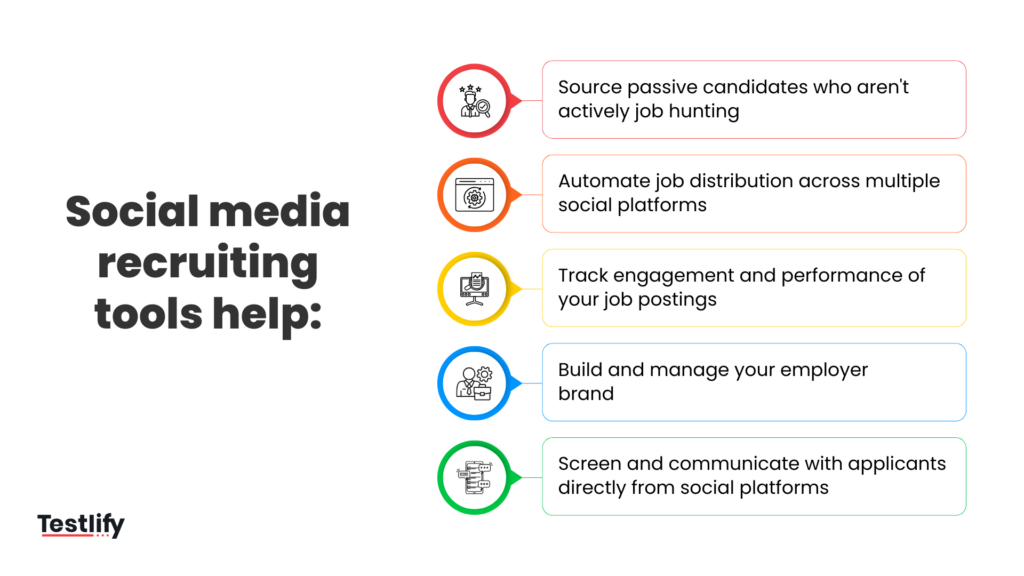
Think of them as your command center for social recruiting, helping you work smarter, not harder.

Why social media recruiting can’t be ignored?
Before diving into the tools, let’s be clear on why this matters from a business perspective.
According to SHRM, 84% of organizations are now using social media for recruitment, and that number keeps climbing. More importantly, companies that actively invest in their employer brand on social media report up to a 50% reduction in cost-per-hire and a significant decrease in time-to-fill.
The shift in candidate behavior is real. Job seekers today research a company’s culture, values, and people long before they apply. They’re reading your Glassdoor reviews, watching your Instagram stories, and checking your LinkedIn posts. If your social presence doesn’t tell a compelling story, you’re already losing candidates before the process even starts.
Now, let’s get into the tools.
Top social media recruiting tools you should know
1. LinkedIn Recruiter
Best for: Professional networking and direct outreach to passive candidates
If there’s one tool every HR professional should have in their kit, it’s LinkedIn Recruiter. With over 1 billion members globally, LinkedIn is the largest professional network in the world, and LinkedIn Recruiter is its dedicated hiring platform.
What makes it powerful
LinkedIn Recruiter gives you access to the full LinkedIn database, even people who haven’t applied for anything. You can:
- Use advanced boolean search filters (skills, location, industry, past companies)
- Send InMail messages directly to candidates outside your network
- Save and organize candidate lists with notes and status tracking
- Set up automated alerts when profiles matching your criteria appear
- Collaborate with your hiring team within a shared pipeline
LinkedIn Recruiter Lite vs. Full Recruiter
LinkedIn Recruiter Lite is the entry-level option, good for small teams doing moderate hiring. The full LinkedIn Recruiter is enterprise-grade with more InMail credits, deeper search capabilities, and ATS integrations.
Limitations
It’s expensive, especially for smaller HR teams. And because everyone uses it, candidate outreach fatigue is real. Your InMail needs to be genuinely personalized to cut through the noise.
Pricing: Starts around $170/month for Recruiter Lite; full Recruiter is custom-priced for enterprises.
2. Hootsuite Amplify
Best for: Employer brand building and employee advocacy
Hootsuite Amplify is built for teams that want to turn their own employees into a recruiting channel. It lets employees easily share pre-approved company content, including job openings, to their own social networks.
Why this matters for recruiting
Employee referrals and word-of-mouth are consistently the highest-quality hiring channels. When employees share job openings to their personal networks, those posts get significantly more engagement than posts from a company page. It feels authentic because it is authentic.
With Hootsuite Amplify, HR and marketing teams can:
- Create a library of pre-approved posts employees can share with one click
- Track which employees are sharing and how much reach those shares generate
- Measure the impact of employee advocacy on hiring outcomes
- Integrate with Hootsuite’s broader social media management platform
Best use case
This tool works especially well during high-volume hiring periods or when you’re trying to build awareness in a specific talent market. Get your engineering team sharing open tech roles to their developer networks, that’s where your next hire is hiding.
3. Sprout social for recruiting
Best for: Social media management + recruiting analytics in one place
Sprout Social isn’t a dedicated recruiting platform, but it’s become a go-to tool for HR teams that own their company’s social media presence alongside talent acquisition.
What it brings to recruiting
Sprout Social lets you manage all your social accounts (LinkedIn, Facebook, Instagram, X/Twitter) from one dashboard. For recruiting purposes, this means:
- Scheduling job posts across platforms at optimal times
- Monitoring brand mentions and candidate conversations
- Responding to DMs and comments from prospective candidates in one inbox
- Deep analytics on which job-related content is driving the most engagement and traffic
The Smart Inbox feature is particularly useful, it aggregates all messages and comments across platforms so no candidate inquiry falls through the cracks.
Limitation
Sprout Social doesn’t have built-in ATS functionality, so you’ll need to integrate it with your existing hiring system. But as a brand management and engagement layer for your recruiting funnel, it’s excellent.
Pricing: Starts at $249/month for the Standard plan; higher tiers for larger teams.
4. Jobvite
Best for: End-to-end social recruiting with ATS integration
Jobvite is one of the most comprehensive recruiting platforms that deeply integrates social media into the hiring workflow. It’s not just a social tool, it’s a full applicant tracking system with robust social recruiting features built in.
Core Features
- Social Recruiting Network: Distributes job postings to LinkedIn, Facebook, X/Twitter, and more with a single click
- Employee Referral Programs: Built-in tools to encourage and track employee social sharing
- Candidate Relationship Management (CRM): Tracks all touchpoints with candidates across social and email
- Career Site Builder: Creates branded, SEO-friendly career pages
- Analytics: Measures which social channels are driving the best candidates and hires
Why HR teams love it
Jobvite brings everything under one roof. You’re not switching between your ATS, a social scheduling tool, a referral platform, and email, it’s all connected. This makes reporting much cleaner, and you get a real picture of your cost-per-source.
According to a PeopleMatter survey, companies that use integrated recruiting platforms like Jobvite see a 30% faster time-to-hire compared to teams using disconnected tools. That’s a meaningful efficiency gain in a market where speed matters.
Pricing: Custom pricing; typically mid-market to enterprise.
5. CareerArc
Best for: Automated social job distribution at scale
If you’re a high-volume hiring team and manually posting jobs to social media platforms sounds like a nightmare, CareerArc was built for you.
How it works
CareerArc automates the distribution of your job postings across social media platforms, particularly LinkedIn, Facebook, and X/Twitter. It pulls directly from your ATS, creates platform-native posts with relevant hashtags and imagery, and schedules them at optimal times.
Key capabilities
- Auto-post new and backfill jobs to social channels based on rules you define
- Customize post templates by job category or location
- Include branded imagery and messaging without manual effort each time
- Track performance metrics: clicks, applications, and cost-per-applicant by channel
- Manage employer brand content alongside job postings
Best for
Large enterprises and retail/healthcare/logistics companies with hundreds of open roles at any given time. CareerArc removes the bottleneck of manual posting so your team can focus on engaging with applicants rather than scheduling content.
6. Greenhouse
Best for: Structured hiring with social sourcing integrations
Greenhouse is primarily an ATS (Applicant Tracking System), but it’s earned a spot on this list because of how well it integrates with social recruiting tools and LinkedIn specifically.
What Sets It Apart
Greenhouse is built around structured hiring, which means every stage of your process is deliberate, documented, and data-driven. From a social recruiting angle:
- Its LinkedIn integration lets recruiters import candidate profiles directly into Greenhouse pipelines
- The Sourcing Dashboard shows which channels (including social) are generating the highest-quality candidates
- Employee referral tracking is built in, with automated prompts for employees to share roles
- Strong API ecosystem means it connects with CareerArc, Hootsuite, and other social tools
Greenhouse is particularly popular with tech companies and scale-ups where data-driven hiring decisions are non-negotiable.
7. Workable
Best for: SMBs that want social sourcing without complexity
Not every HR team has an enterprise budget. Workable is the sweet spot for small-to-mid-sized businesses that want solid social recruiting features at an accessible price point.
Social Recruiting Features
- One-click job posting to LinkedIn, Indeed, Facebook, and 200+ job boards
- People Search: Workable’s AI-powered sourcing tool scans the web and social profiles to surface relevant passive candidates
- Collaborative hiring: Team members can comment on candidates, tag each other, and share social profiles for review
- Branded careers page with social sharing enabled
Why It Works for Smaller Teams
Workable is intuitive, most HR professionals can get up and running within a day. It doesn’t require a dedicated implementation team or a six-month onboarding process. For a lean HR team managing 20-50 hires a year, it delivers real value without the enterprise complexity.
Pricing: Starts at $189/month for the Starter plan.
8. Buffer
Best for: Simple, budget-friendly social job posting management
For teams that just need a clean, reliable tool to schedule and publish social content, including job postings, Buffer is hard to beat for simplicity and affordability.
What Buffer does
- Schedules posts across LinkedIn, Facebook, Instagram, and X/Twitter
- Shows analytics on post performance (reach, clicks, engagement)
- Allows team collaboration with role-based access
- Clean, visual content calendar for planning
Buffer doesn’t have recruiting-specific features like ATS integration or candidate tracking. But for an HR team that’s just getting started with social recruiting and wants to be consistent with posting without overpaying, it’s a smart starting point.
Pricing: Free plan available; paid plans start at $6/month per channel.
9. Phenom People (Phenom TXM)
Best for: AI-powered candidate experience and personalization
Phenom is a Talent Experience Management platform that uses AI to create hyper-personalized candidate journeys, from the first social touchpoint all the way through to hire.
What Makes Phenom Different
Most recruiting tools focus on the recruiter experience. Phenom flips that, it’s designed to make the candidate experience exceptional. Its social recruiting capabilities include:
- AI chatbot that engages with candidates on your career site and social channels 24/7
- Personalized job recommendations based on a candidate’s social and behavioral signals
- Employer brand content engine that dynamically surfaces relevant content to candidates based on their profile
- Deep analytics that map the entire candidate journey from social engagement to hire
For large enterprise HR teams focused on talent brand differentiation, Phenom is a high-ceiling investment.
10. Facebook Jobs / Meta for Business (Organic + Paid)
Best for: Reaching hourly workers, local talent, and non-traditional candidates
Don’t overlook Facebook. While LinkedIn dominates professional recruiting, Facebook Jobs and Meta’s advertising platform are unbeatable for reaching candidates in retail, hospitality, healthcare support, and logistics.
Two Ways to Use It
Organic (Free): Post jobs directly through Facebook Jobs. These appear in the Jobs marketplace and your company’s page. Candidates can apply directly through Facebook without leaving the platform.
Paid (Meta Ads): Run targeted job ads using Meta’s sophisticated audience targeting, by age, location, interests, behavior, and more. This is particularly powerful for reaching passive candidates who match your ideal profile but aren’t actively job searching.
A Harvard Business Review analysis found that companies using paid social ads alongside organic job posts fill roles 25% faster on average, particularly for roles with high application volume needs.
How to choose the right social recruiting tool?
With so many options, the choice can feel overwhelming. Here’s a simple framework to cut through it:
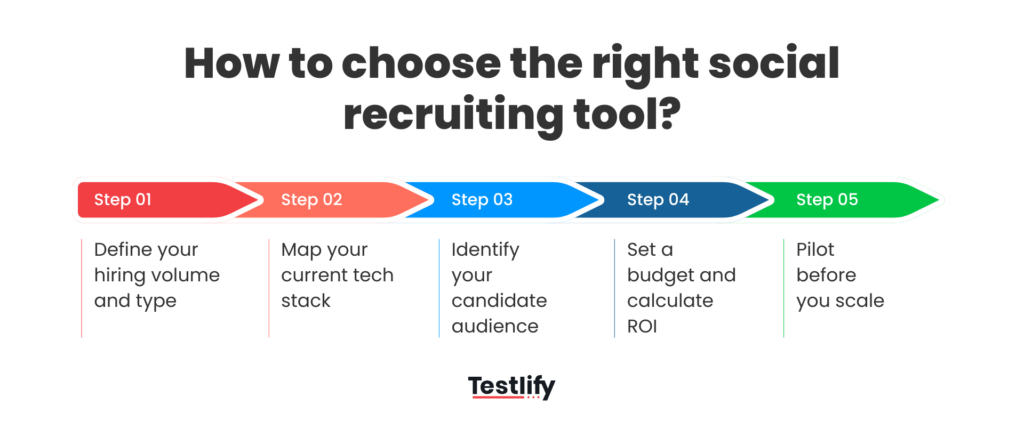
Step 1: Define your hiring volume and type
High-volume hiring (100+ roles/year) demands automation-first tools like CareerArc or Jobvite. Lower-volume, specialized hiring benefits more from deep sourcing tools like LinkedIn Recruiter or Phenom.
Step 2: Map your current tech stack
What ATS are you using? Pick tools that integrate cleanly with it. Greenhouse + LinkedIn Recruiter is a popular enterprise combo. Workable works well as an all-in-one for SMBs.
Step 3: Identify your candidate audience
Where does your target talent spend time? Engineers are on LinkedIn and GitHub. Hourly workers are on Facebook. Creative talent is on Instagram. Match your tools to your audience’s platforms.
Step 4: Set a budget and calculate ROI
Don’t just look at the tool’s price, look at cost-per-hire impact. If a $500/month tool reduces your cost-per-hire by $2,000 per role, the math is obvious. Track this rigorously from day one.
Step 5: Pilot before you scale
Most tools offer free trials or demos. Run a 30-60 day pilot with a small team before committing to an annual contract. Measure actual results, not feature lists.
Building a social recruiting strategy that works
Tools are only as good as the strategy behind them. Here are the principles that separate average social recruiting from genuinely high-performing talent acquisition:
Consistency beats virality: Posting regularly, even twice a week, builds brand recognition over time. Don’t chase viral moments. Build a reliable presence.
Employee stories outperform company announcements: A post from an employee sharing why they love their job will always out-engage a polished job posting from the company page. Make employee advocacy easy.
Respond fast: Candidates who message you on social expect a reply within hours, not days. Use tools that give you a unified inbox and set up quick-reply templates for common questions.
Measure what matters: Track source-of-hire religiously. Knowing that 30% of your best hires come from LinkedIn but only 5% from Facebook tells you exactly where to invest next quarter.
Final thoughts
Social media recruiting isn’t a trend, it’s the new default. The organizations winning the talent war are the ones showing up consistently, authentically, and strategically on social platforms. They’re not just posting jobs; they’re building communities, telling their story, and engaging with candidates long before a role opens up.
The tools in this list give you the infrastructure to do that at scale. Start with what fits your current hiring volume and budget, integrate it with your existing systems, and measure ruthlessly. The ROI is there, you just have to show up for it.
Frequently asked questions (FAQs)

Content Writer
Yashika Khandelwal is a Content Writer with 3+ years of experience creating research-backed content on hiring, talent assessment, and HR technology. She is a registered Organizational Psychologist and subject matter expert who combines behavioral science with practical recruitment insights to produce accurate, evidence-based content.
LinkedInRelated resources
View all
HR & recruitment
Social media recruiting: Benefits, steps and best practices

HR & recruitment
Top tools for large-scale campus hiring assessments

HR & recruitment
Why a strategic recruitment plan is critical for business success

HR & recruitment
Different types of selection tests for HRM in large organizations

HR & recruitment
Free recruitment plan templates & examples

HR & recruitment
How to determine your recruitment KPIs in 2026
Get started.
Hire on proof, not resumes.
Run your first skills-based assessment free — no credit card required.