
Top 10 targeted training strategies to bridge the skills gap
Targeted training addresses specific skill gaps in employees, creating customized solutions that align with individual learning needs.
Targeted training is a focused way to close a specific skill gap: you find the exact skill a role is missing, tie it to a business goal, then train only the people who need it, in the format that fits their work. It is the opposite of a one-size-fits-all course. And the timing matters. The World Economic Forum’s Future of Jobs 2025 finds that 59% of the global workforce will need reskilling or upskilling by 2030, yet 11 in every 100 workers are unlikely to get the training they need. Generic programs cannot close a gap that specific.
This guide covers what targeted training means, why it beats broad training, 10 strategies you can run this quarter, and how to prove the skills gap actually closed. Read on for the full playbook.
TL;DR
- Targeted training teaches one measured skill gap for one group, not the same course for everyone.
- Start from evidence: assess the gap first, so you train the right people on the right skill.
- Match the format to the work, on-the-job, video, instructor-led, eLearning, or group, not habit.
- Set one job metric per program and re-measure it 30 to 90 days later to prove ROI.
- Pair each program with targeted coaching so the new skill becomes a habit before it fades.
 ChatGPT
 Gemini
 Claude
 Grok
Grok Perplexity
What is targeted training? Meaning and definition
Targeted training combines formal and informal learning to fix a named skill gap for a specific role or team, instead of running the same content for the whole company. You identify the gap, connect it to a business outcome, then deliver focused learning to the people who actually need it. That focus is what makes it work.
Put simply, targeted training means you target training at one clear problem. When you target training on the exact gap a role has, you spend less, people ramp faster, and you can measure whether the skill moved. A broad catalog of courses feels productive, but it rarely changes the one number a manager cares about.
Done well, targeted training can cut the ramp time for a new hire, lift the skill of people already in the role, and show your team you are investing in their growth, not just filling seats in a workshop.

Why does targeted training matter now?
Because the gap is widening and broad training is not keeping up. McKinsey research shows that 87% of companies already have skill gaps or expect them within a few years (44% see gaps forming inside five years, 43% report them today), and hiring alone is not closing them, which is why 56% of firms now turn to reskilling their own people. The WEF adds that 39% of the core skills used in a job today will change by 2030.
The cost of ignoring the gap is not abstract. Gallup’s 2026 State of the Global Workplace found low engagement, often tied to employees stuck in roles that have outgrown their skills, cost the world economy an estimated 10 trillion dollars in lost productivity last year alone. Targeted training is cheaper than that, and far cheaper than a generic program nobody applies.
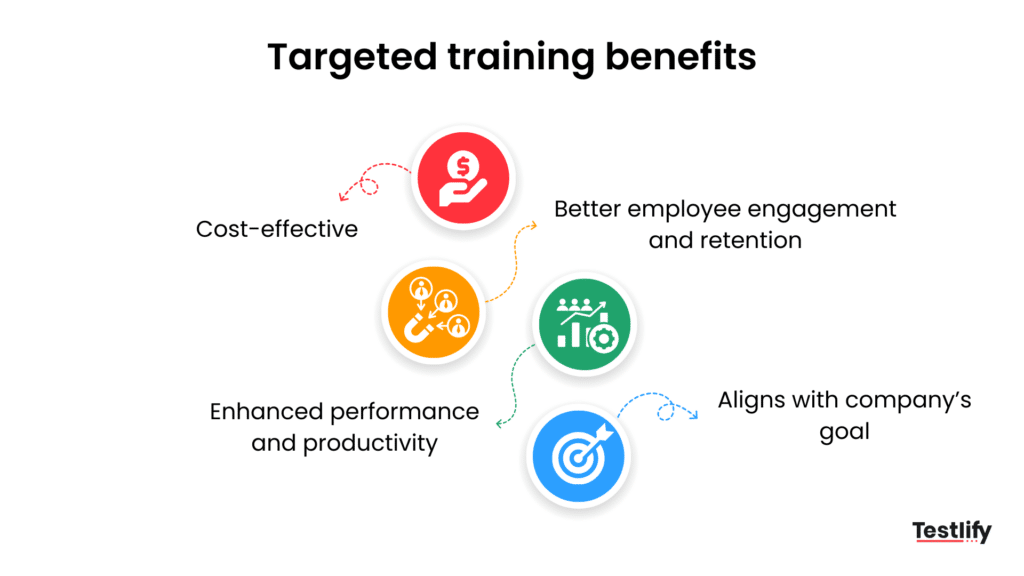
A focused program pays off in a few specific ways:
- Better engagement. People stay when they see their own skills growing, not when they sit through training built for someone else’s role.
- Lower cost. You pay to teach one gap to the people who have it, not to run a full catalog past everyone.
- Higher performance. Teaching the exact skill a role is missing moves the team metric, not just a completion rate.
- Alignment to goals. Each program maps to a business objective, so learning and strategy point the same way.
How does a training needs analysis fit into targeted training?
A training needs analysis is the diagnostic step that decides which gap you target: it compares the skills a role requires today against the skills your people actually have, using assessment data and performance records instead of a manager’s impression. Skip it, and targeted training becomes a guess with better branding.
Run it before you commit budget. SHRM’s 2025 Talent Trends research found that 28% of organizations now require new skills for roles they are filling, and 4 in 5 of those organizations struggle to find candidates who already have them. That gap moves faster than most training calendars, which is exactly why a fresh needs analysis, not last year’s course catalog, has to come first.
A working training needs analysis answers three questions before a single session gets built:
- Which roles changed. Pull the roles where the job itself shifted, new tools, new process, new customer expectation, in the last two quarters.
- Where the evidence sits. Score current skill level with a structured gap analysis instead of a self-review, so the result holds up when a budget gets questioned.
- What good looks like. Define the target proficiency in numbers, not adjectives, so the training plan has a finish line.
This is the same evidence the Testlify Competency-to-Evidence Matrix runs on: a training needs analysis supplies the gap, and the matrix turns that gap into the specific program to build next.
Top 10 targeted training strategies
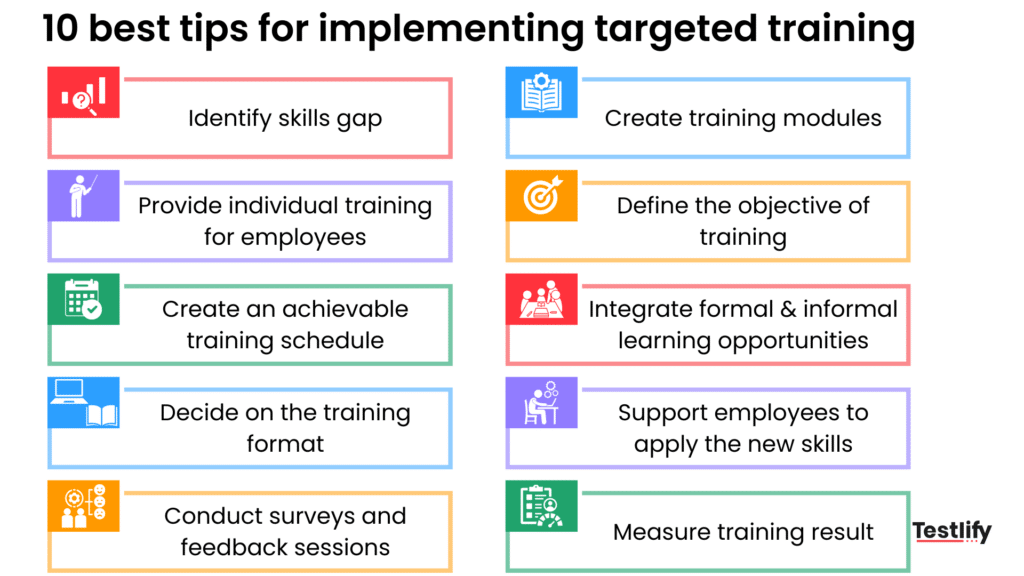
Here are 10 targeted training strategies you can run this quarter. Work them roughly in order, the first three do most of the heavy lifting.
1. Assess the skills gap before you train
Find the gap before you decide on any training. List the targeted skills each role needs, then measure where your people actually stand against that list, using self-assessments and skills assessment tests rather than a manager’s hunch.
This is where the Testlify Competency-to-Evidence Matrix comes in: map each role to the competencies that matter, connect every competency to measurable evidence from an assessment, then let that evidence tell you exactly which skill to train and for whom. A short skill gap analysis gives leaders the data to decide where training spend earns the most, and shows you their power skills in the process.
2. Tie every program to a business objective
Designing a course is easy; pointing it at a goal is the hard part. Start from what the business is trying to do. If the aim is faster customer resolution, look at current support interactions, spot the skill that is missing, and build training that fixes that skill with clear short and long-term targets. A program with no business goal behind it is just content.
3. Personalize for how people actually learn
Every employee brings different experience, context, and learning preferences. Factor in things like:
- prior knowledge and current skill level
- role and day-to-day workflow
- language and location
- time available around the real workload
- preferred format, hands-on, visual, or reading
Use mass training when the whole team needs the same thing at once, a new product launch or a process change. Otherwise, keep it individual. You can also pair sessions with targeted coaching so a manager or peer reinforces the skill one-on-one right after.
4. Write specific, measurable goals
Tell people what they should learn and, just as important, why it helps their own career. Then make the goal observable. Swap vague verbs like understand or learn for action words like calculate, demonstrate, or build. “After this course, you can design and present a campaign using digital tools” beats “you will learn about marketing.” Specific goals produce results you can actually check.
5. Build a realistic schedule
You cannot spot a gap on Monday and close it by Friday. Most skill gaps take a few months of steady effort to close, so set a sensible window. Tell people when they are expected to pick up the new skill, work around their current load, offer make-up dates, and leave buffer time between sessions so the learning sticks.
6. Blend formal and informal learning
Lean only on formal classroom or online sessions and you overload people, retention drops, and they struggle to apply it. Lean only on informal shadowing and feedback and knowledge gets inconsistent. Blend the two: teach the concept formally, then let people practice it on real work with a colleague nearby. That mix is what turns a session into a skill.
7. Match the format to the work
There is no single best format, only the best fit for the skill and the team. Use this quick comparison to choose:
Format | Best for | Watch out for |
|---|---|---|
On-the-job | Practical, role-specific skills learned by doing | Needs a skilled colleague with time to guide |
Video | Scalable, self-paced concepts and demos | Passive if there is no practice attached |
Instructor-led | Complex topics that need live questions | Harder to schedule; cost per session |
eLearning | Flexible, remote, and repeatable tracks | Completion does not equal capability |
Group workshop | Shared context and team problem-solving | Pace suits the middle, not the edges |
Formats also stack. A security team might get a targeted IT training track that pairs short videos with hands-on labs, while a sales team learns better in a live workshop. Where passive video falls short, interactive training videos can bridge the gap — they encourage active participation, helping employees stay engaged and apply what they learn more effectively, without requiring a live facilitator. Pick for the skill, not for habit.
8. Help people apply the new skill
A skill that is never used is a skill that is lost. Give people real chances to apply what they learned, and time to ask questions after each session. Make sure managers know what to expect, run regular check-ins, and treat a failed first attempt as practice, not a mark against them. When managers model the skill too, it sticks faster.
9. Collect feedback and iterate
Ask learners what worked. Use anonymous surveys, small focus groups, and one-on-one chats to learn whether the training landed and whether it is helping their growth. Make it safe to give honest, critical feedback, then act on it. Targeted training is not a one-time event; it is a loop you keep tightening.
10. Measure the result, not the attendance
Most training stops at “they showed up.” That tells you nothing. Decide up front how you will check whether the skill actually moved, and whether people are using it on the job. Measuring well shows the impact on performance, confirms the program matched its goal, and tells you what to change next time.
Pro tip: Run the same short skills assessment right before training and again 30 days after. The score delta is your cleanest proof the gap closed, and it is far more honest than a satisfaction survey.
How do you measure targeted training ROI?
Pick one job metric the training should move, record it before, then re-measure 30 to 90 days after. That is the core of it. A completion rate proves people finished; a moved metric proves the training worked.
A practical way to measure targeted training results:
- Pick the metric first. Resolved tickets, error rate, ramp time, or conversion, whatever the gap was hurting.
- Baseline it. Capture the number before the program starts, for the trained group only.
- Re-assess the skill. Use a before-and-after skills test so you see the skill gain, not just the work result.
- Compare at 30 to 90 days. Give the skill time to show up in real work, then read both numbers together.
You do not need to calculate ROI on every program. Match the depth of measurement to the stakes: a company-wide track earns a full readout, a five-person refresher does not.
How do you build a lasting targeted training program?
A lasting program runs on evidence, not guesswork. It starts with a measured gap, maps each gap to a business goal, trains the right people in the right format, and closes the loop by re-assessing the skill. Skip the measurement and you are back to generic training that feels busy and proves nothing.
That is where assessment data earns its place. When you build targeted training programs on real skills evidence, from the first gap analysis to the after-training re-test, every decision has a number behind it. Testlify’s library of 3,500+ tests lets you spot the gap, pick who to train, and prove the skill moved, all from the same place.
See the skills gap before you spend on training
Measure exactly where your team stands, then train only the gap that matters. Book a demo or start for free to run your first skills assessment.
Key takeaways
- Target the gap, not the calendar. Targeted training works because it teaches one measured skill gap to the specific people who have it, which is why it beats a broad course everyone sits through and few apply.
- Assess before you train. A skills assessment turns training from a guess into a decision, so you spend budget on the exact gap that is hurting a business metric instead of a topic that merely feels useful.
- Tie each program to a goal. When a program maps to a business objective like faster resolution or lower error rates, learning and strategy pull in the same direction and the result is easy to defend to leadership.
- Match format to the work. On-the-job, video, instructor-led, eLearning, and group each fit different skills and teams; choosing by fit rather than habit is what makes the training actually land.
- Prove it moved. Re-measure one job metric 30 to 90 days later and re-test the skill, because attendance and completion rates tell you nothing about whether the gap closed.
- Coach to keep it. Pair each program with targeted coaching so a manager or peer reinforces the new skill on real work before it fades, turning a one-time session into a lasting habit.
Frequently asked questions (FAQs)

Related resources
View all
Talent Acquisition
Diversity and inclusion in talent acquisition: Best practices for success

Talent Acquisition
Leveraging technology in talent acquisition: Trends and tools

Talent Acquisition
Building a winning talent acquisition strategy: A step-by-step guide

Talent Acquisition
The evolution of talent acquisition: From traditional to modern approaches

Talent Acquisition
How to scale talent acquisition without losing quality?

HR & recruitment
AI across all stages of the hiring process in 2026
Get started.
Hire on proof, not resumes.
Run your first skills-based assessment free — no credit card required.