
Why a strategic recruitment plan is critical for business success
A complete guide to building a strategic recruitment plan, including workforce planning, sourcing strategies, and key recruitment KPIs.

Most organizations still treat recruitment as a last-minute response to a vacancy. A role opens, a job post goes live, resumes pour in, and someone gets hired. Then the cycle repeats. While this reactive approach may keep the wheels turning, it rarely builds the kind of workforce that fuels long-term business success.
A strategic recruitment plan changes the game entirely. It transforms hiring from a reactive, transactional process into a proactive function aligned with business goals. Instead of constantly playing catch-up, organizations can anticipate talent needs, reduce hiring risks, and build high-performing teams that drive growth.
This article covers what a strategic recruitment plan is, how to build one from the ground up, and what metrics tell you whether it is actually working.
 ChatGPT
 Gemini
 Claude
 Grok
Grok Perplexity
What is a strategic recruitment plan?
A strategic recruitment plan is a long-term roadmap that aligns hiring activity with business goals. It helps recruiters answer important questions before the need to hire becomes urgent:
- What skills will our business need in the next 6, 12, and 24 months?
- Where are the gaps between our current workforce and those future requirements?
- Which sourcing channels reach the candidates we actually want?
- How do we assess candidates consistently and fairly at scale?
- What does a successful hire look like, and how do we measure it after they join?
A well-built strategic recruitment plan connects workforce planning, employer branding, candidate sourcing, screening processes, and post-hire measurement into a unified system. It turns hiring from a reactive response to business pressure into a competitive advantage.

Why a strategic recruitment plan is important for business success
A strategic recruitment plan ensures that every hiring decision directly supports long-term business goals rather than just filling immediate gaps. Here’s how a strategic recruitment plan actively fuels business growth
1. It aligns hiring with business strategy
When recruitment operates without a strategic plan, hiring happens in response to pressure rather than in anticipation of need. The result is roles filled in a hurry, often with candidates who are merely available rather than genuinely right for the job.
A strategic plan forces alignment between business leadership and HR from the start. When hiring managers and HR teams build the plan together, every recruitment decision is grounded in where the business is actually going, not just where it is today.
2. It dramatically reduces the cost of a bad hire
A bad hire is one of the most expensive things that can happen to an organization. SHRM estimates that replacing a mis-hire costs the equivalent of six to nine months of that employee’s salary. For senior or specialized roles, the figure climbs significantly higher.
Strategic recruitment reduces bad hire risk by:
- Defining success profiles clearly before sourcing begins
- Using structured, validated assessments to evaluate job-relevant competency rather than relying on interviews alone
- Applying consistent criteria across all candidates to reduce bias-driven decisions
- Ensuring role requirements are grounded in real business needs, not a vague sense of what is wanted
When you know exactly what you are looking for and have a structured way to evaluate it, you hire better people. It is that simple.
3. It protects productivity through smarter hiring
Every day a critical role sits vacant is a day of lost output, increased pressure on existing team members, and delayed delivery on business priorities. At $500 per day in lost productivity per unfilled role, the math adds up fast for organizations managing multiple open positions simultaneously.
A strategic plan reduces time-to-fill by:
- Building talent pipelines before roles open, so sourcing does not start from zero every time
- Automating early-stage screening with skills assessments and AI tools that filter applicants efficiently
- Streamlining interview processes with structured formats and clear decision criteria
- Enabling faster, more confident offers because the evaluation process is thorough from the start
Organizations using AI-enabled recruitment tools report 31% faster hiring times on average. That kind of efficiency is only possible when the underlying process is strategic, not improvised.
4. It strengthens the employer brand and candidate experience
Top candidates have options. In a competitive talent market, the quality of your hiring process is part of your employer brand, whether you intend it to be or not. A disorganized, inconsistent, or slow recruitment process signals something about how your organization operates.
A strategic recruitment plan builds a positive candidate experience by design. Every touchpoint, from the job posting to the final decision communication, reflects the organization’s professionalism and values. This matters more than many hiring teams realize.
Research consistently shows that 72% of recruiting leaders believe employer branding has a significant effect on recruitment outcomes. Organizations with a deliberate approach to candidate experience attract stronger applicants and convert offers at higher rates.
5. It builds a workforce that stays
High turnover is often a symptom of poor hiring rather than a poor retention strategy. When candidates are hired for a fit with a job description rather than for alignment with the role’s actual demands and the organization’s culture and growth trajectory, the mismatch eventually surfaces, and people leave.
A strategic recruitment plan addresses this by:
- Incorporating culture and values alignment into candidate evaluation
- Setting clear expectations about the role scope and progression from the first interaction
- Using behavioral and situational assessments that predict long-term performance, not just initial competence
- Building structured onboarding into the plan as an extension of the recruitment process
The goal is not just to fill the role. It is to make a hire that is still contributing and growing two or three years down the line.
6. It drives diversity, equity, and inclusion
McKinsey research has consistently shown that organizations in the top quartile for ethnic and gender diversity outperform their peers on profitability. But diversity does not happen by accident. It requires a deliberate strategy.
A strategic recruitment plan actively builds DEI into the process by:
- Diversifying sourcing channels beyond the traditional pipelines that tend to reproduce existing workforce demographics
- Using standardized assessments that evaluate candidates on job-relevant criteria rather than subjective impressions
- Auditing, screening, and interview processes regularly for potential bias
- Setting measurable diversity hiring goals that are tracked alongside other KPIs
When your recruitment process is built for fairness, you do not just become more inclusive. You access a broader, deeper pool of talent.
Key components of a strategic recruitment plan
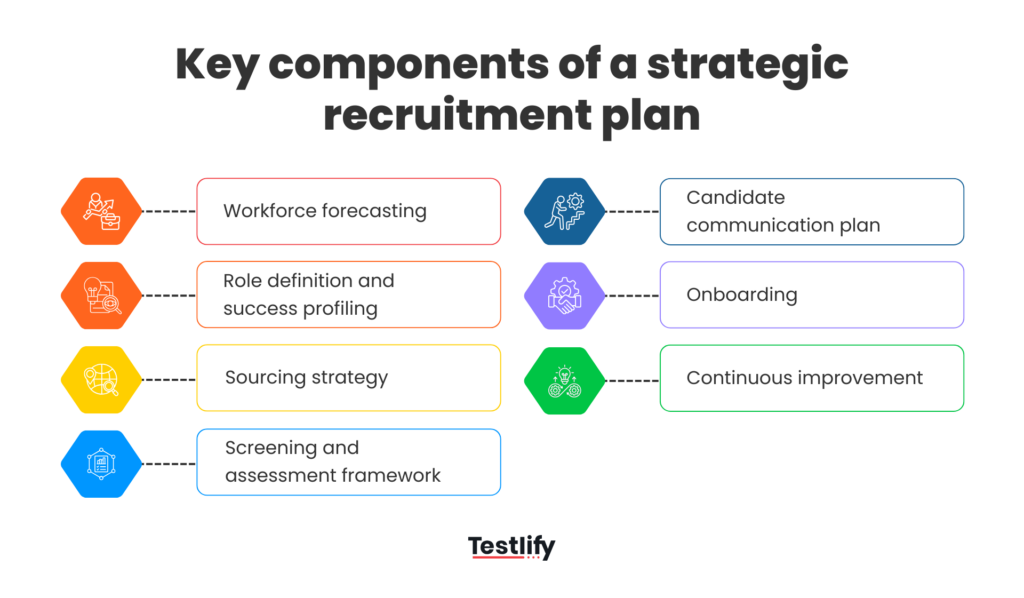
A strategic recruitment plan is only as strong as its individual components. Here is what every plan needs to include.
Workforce forecasting: Understand what your business will need before the need becomes urgent. Work with department heads to anticipate headcount requirements based on growth plans, attrition rates, and skills gap analysis. Proactive recruitment starts here.
Role definition and success profiling: Before writing a job description, define what success in the role actually looks like at 30, 90, and 180 days. What skills, behaviors, and outputs matter most? This becomes the foundation for every screening and evaluation decision.
Sourcing strategy: Identify which channels will reach the candidates you need. Job boards, employee referrals, talent communities, social media, university partnerships, and direct outreach all serve different purposes. A diversified sourcing strategy consistently outperforms single-channel dependence.
Screening and assessment framework: Define how candidates will be evaluated at each stage. Which assessments will be used? What criteria determine advancement? How will interviewers be trained and calibrated?
Candidate communication plan: Map out every candidate touchpoint from application acknowledgment to offer delivery.
Onboarding: Strategic recruitment does not end at the offer letter. A structured 30/60/90 day onboarding plan is part of the recruitment strategy, ensuring new hires reach productivity faster and feel supported from day one.
Continuous improvement: Define the KPIs you will track, establish a regular review cadence, and commit to refining the plan based on the data.
How to build a strategic recruitment plan
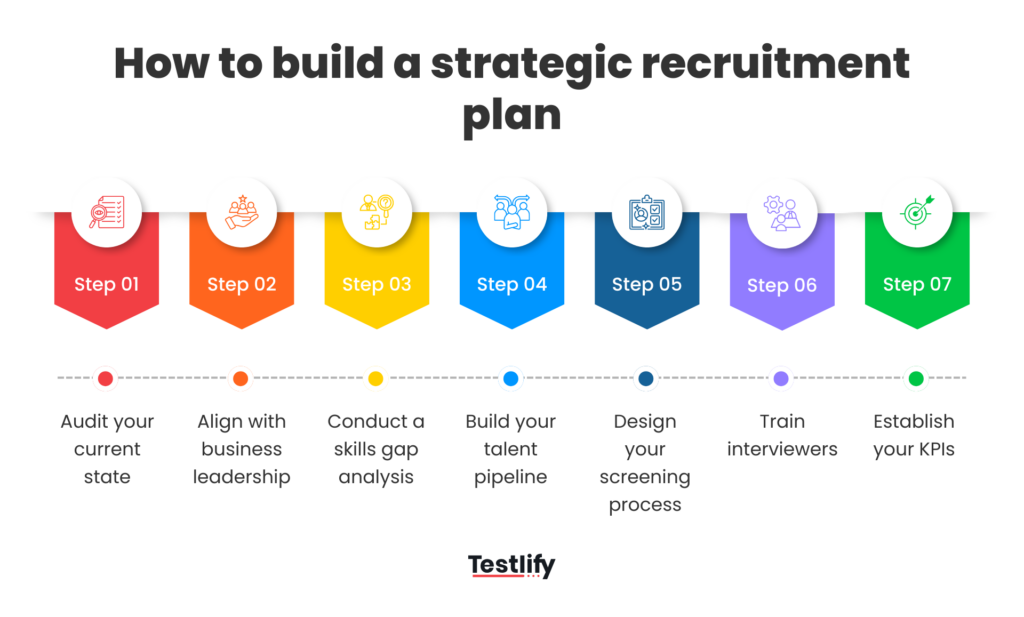
Building a strategic recruitment plan requires a structured, step-by-step approach that connects your current hiring reality with your future business goals. Here’s what recruiters need to do
Step 1: Audit your current state
Review your current hiring metrics: time-to-fill, cost-per-hire, quality-of-hire, offer acceptance rates, and first-year retention. Identify which roles are hardest to fill and why. Survey hiring managers on what is working and what is not. This baseline shapes everything that comes next.
Step 2: Align with business leadership
Meet with leadership to understand the organization’s growth plans for the next 12 to 24 months. Which markets are being entered? Which products are being built? Which functions will scale?
Map those plans to headcount implications and skills requirements. This is where recruitment becomes strategic rather than reactive.
Step 3: Conduct a skills gap analysis
Compare your current workforce capabilities to the skills your business strategy requires. Identify where internal development can fill skill gaps and where external hiring is necessary. A thorough skills gap analysis prevents both over-hiring and the kind of under-resourced scramble that costs organizations productivity every day.
Related resources: Skill gap analysis: A comprehensive guide
Step 4: Build your talent pipeline
For high-priority roles, do not wait for a vacancy to start sourcing. Build a proactive talent pipeline by engaging qualified candidates through networking, talent communities, and employer brand content before a role is even open. When the need arises, you are weeks ahead of where a reactive approach would leave you.
Step 5: Design your screening process
Define a consistent, structured screening process for each role family. Choose assessment tools that are valid, reliable, and job-relevant. Leverage recruitment technology to automate early-stage screening and surface the strongest candidates efficiently without creating bottlenecks.
Step 6: Train interviewers
Even the best screening process fails if interviews are inconsistent and unstructured. Train interviewers on the role’s success profile, the competencies being evaluated, and how to score responses against predefined criteria.
Step 7: Establish your KPIs
Decide which recruitment KPIs matter most for your organization and build a reporting structure around them. Review the data monthly or quarterly and use it to drive real improvements to the plan.
Key recruitment KPIs to track
A strategic recruitment plan without measurement is just a document. These are the metrics that tell you whether your plan is working.
- Time-to-fill: The number of days between a role opening and an accepted offer. The SHRM benchmark average is 44 days. Monitoring this by role type and department reveals where your process has bottlenecks.
- Cost-per-hire: Total recruitment spend divided by the number of hires made. The US average sits around $4,700, with significant variation by role level and industry. Reducing this without compromising quality is a core goal of strategic recruitment.
- Quality-of-hire: Arguably, the most important metric and the hardest to measure. Track new hire performance ratings, time-to-productivity, manager satisfaction scores, and first-year retention to build a composite picture of hiring quality.
- Offer acceptance rate: A low offer acceptance rate is a signal worth investigating. It may point to compensation misalignment, a weak candidate experience, or a recruiting process that takes too long and loses candidates to faster-moving competitors.
- Source effectiveness: Track which sourcing channels produce the candidates who are actually hired and who perform well after joining. This prevents the budget from being wasted on high-volume, low-quality channels.
- Diversity hiring metrics: Monitor the demographic composition of your applicant pool, your shortlists, and your final hires. If diversity drops off significantly between stages, that is a signal to investigate your screening and evaluation process.
- First-year retention rate: The proportion of new hires who remain with the organization after 12 months. A consistently low rate is often a recruitment problem masquerading as a retention problem.
Common mistakes that undermine strategic recruitment plans
Even well-intentioned plans fail when these mistakes creep in:
- Treating the plan as a static document: Some recruiters don’t treat a recruitment plan as a living strategy. Business conditions change, talent markets shift, and what worked last year may not work this year.
- Excluding hiring managers from the process: When hiring managers are not aligned on role requirements, candidate profiles, and process expectations, the plan breaks down at the interview stage.
- Over-indexing on speed at the expense of quality: Pressure to fill roles quickly is real, but hiring in a hurry produces bad hires, which are far more expensive than a longer vacancy.
- Ignoring the candidate experience: A poor recruitment experience becomes employer brand damage that makes future hiring harder. Every touchpoint in the plan should be designed with the candidate’s perspective in mind.
- Failing to close the loop on post-hire data: If you never connect hiring decisions to post-hire outcomes, you cannot improve your process. Build feedback loops between hiring managers and the recruitment team into the plan.
Final thoughts
Every organization that treats hiring as a reactive, ad-hoc process is leaving value on the table, and in most cases, it is paying a high financial cost for the privilege.
The shift from reactive to strategic is not overnight, but it starts with the same first step: deciding that hiring deserves the same planning rigor as every other function the business depends on.
Building your talent strategy with the right tools and the right assessment framework at its core is what separates organizations that simply fill roles from those that consistently build high-performing teams.
Ready to make your recruitment plan truly strategic?
Book a free demo with Testlify and explore how AI-powered skills assessments, conversational AI interviews, and intelligent resume screening can turn your hiring process into a genuine competitive advantage.
Frequently asked questions (FAQs)

Related resources
View all
HR & recruitment
Different types of selection tests for HRM in large organizations

HR & recruitment
Free recruitment plan templates & examples

HR & recruitment
How to determine your recruitment KPIs in 2026
HR & recruitment
The ultimate guide to recruitment KPIs

HR & recruitment
Why traditional sources of recruitment are failing modern employers?

HR & recruitment
Top 12 sources of recruitment for hiring top talent
Get started.
Hire on proof, not resumes.
Run your first skills-based assessment free — no credit card required.