
How to master effective candidate sourcing in 2026
Master candidate sourcing with targeted strategies, leveraging networks, and utilizing tools to find skilled candidates and meet organizational needs.

Candidate sourcing has evolved from a supporting recruitment activity into a strategic function that directly impacts hiring speed, quality, and business outcomes. In a market where skilled professionals are scarce and top candidates are rarely active job seekers, organizations that master effective candidate sourcing gain a lasting competitive advantage.
This in-depth article explores how to master effective candidate sourcing, covering the best practices you can follow to build predictable, high-quality talent pipelines at scale.
 ChatGPT
 Gemini
 Claude
 Grok
Grok Perplexity
What is candidate sourcing?
Candidate sourcing is the proactive identification, research, and engagement of potential candidates for current and future roles. Unlike recruitment, which manages candidates through interviews, offers, and onboarding, sourcing focuses on filling the top of the hiring funnel with qualified, relevant talent.
When done well, effective candidate sourcing ensures hiring teams are never dependent on inbound applications alone and are always prepared for upcoming talent needs.

Why effective candidate sourcing is important
Several shifts have made the art of effective of candidate sourcing more important than ever:
- Rise of passive talent: The best candidates are often employed and not actively seeking new opportunities.
- Skills-based hiring: Resumes alone no longer reflect real job readiness.
- Faster hiring expectations: Business leaders expect shorter time-to-fill without compromising quality.
- Candidate experience: Personalized, respectful outreach is now expected by Gen Z candidates.
Organizations that rely only on job postings risk slower hiring, lower-quality candidates, and increased costs.
Best candidate sourcing practices in 2026
Effective candidate sourcing is not about quick wins or filling roles reactively. It is a disciplined, repeatable practice that combines strategy, market understanding, relationship-building, and technology. Teams that master these candidate sourcing best practices can reduce hiring risk and build future-ready talent pipelines.
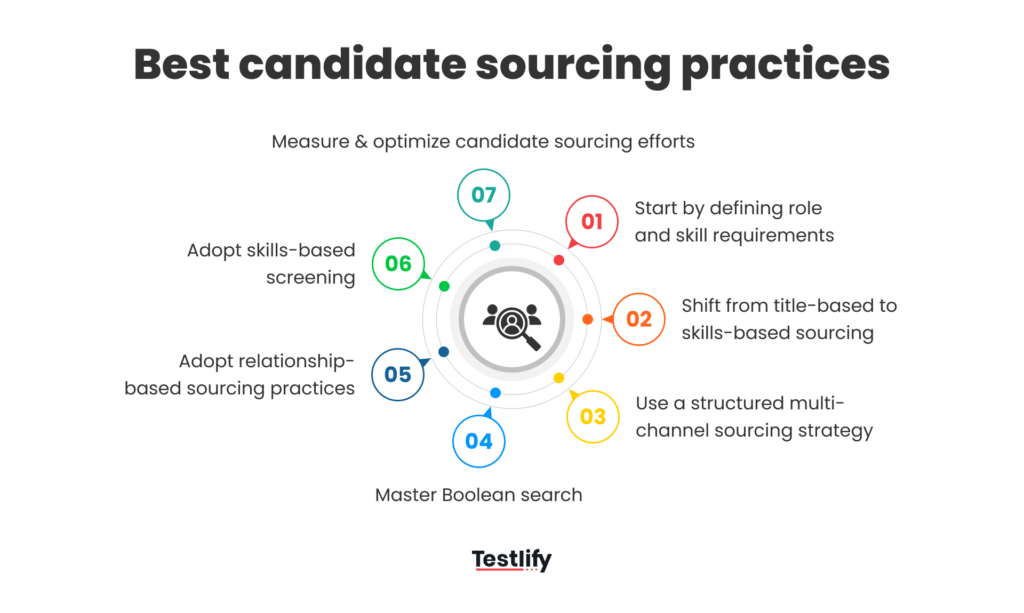
Below is a comprehensive breakdown of the most important candidate sourcing best practices, with clear explanations of why each matters and how to execute it effectively.
1. Start by defining role and skill requirements
Without a clear understanding of what success looks like in a role, sourcing efforts become scattered and inefficient. Instead of relying solely on job descriptions, recruiters should work closely with hiring managers to clarify:
- The core skills required to perform the role from day one
- The outcomes the role is expected to deliver in the first 6–12 months
- Skills that are trainable vs. non-negotiable
- Behavioral traits that align with team dynamics and work style
This depth of clarity allows recruiters to screen profiles accurately, write more compelling outreach, and avoid flooding the funnel with misaligned candidates.
2. Shift from title-based to skills-based sourcing
Job titles vary widely across companies, industries, and geographies. Two candidates with different titles may perform the same work, while identical titles can mask vastly different skill levels.
Best-in-class sourcing focuses on:
- Specific technical tools, technologies, and competencies
- Transferable skills that map to the role’s responsibilities
- Adjacent roles that develop similar capabilities
This approach significantly expands the talent pool while maintaining relevance, especially for emerging or hybrid roles where titles are inconsistent.
3. Use a structured multi-channel sourcing strategy
Relying on one effective candidate sourcing channel creates risk and limits reach. High-performing teams deliberately diversify sourcing channels based on role type, seniority, and market conditions.
The most effective candidate sourcing channels include:
- Professional networks like LinkedIn Recruiter for passive, experienced talent
- Employee referrals, which consistently deliver high-quality, culture-aligned candidates
- Talent communities such as GitHub, Behance, and Stack Overflow that showcase real work
- Internal databases of past applicants and silver-medalist candidates
- Niche platforms and forums for specialized or hard-to-fill roles
The best practice is not “use everything,” but intentionally select channels that align with the role and talent market.
4. Master Boolean search
Boolean search uses a combination of keywords and five simple operators to help you structure searches and surface highly relevant candidate profiles. When used correctly, it significantly improves search and dramatically reduces time spent filtering results.
At its core, Boolean search relies on just five syntax elements:
- AND: Narrows results by requiring multiple criteria
- OR: Broadens results by including variations
- NOT: Excludes unwanted terms
- ( ): Groups keywords and controls search logic
- “ ”: Quotation marks lock in exact phrases
By combining these elements with role-specific keywords, skills, and tools, recruiters can build highly targeted search strings. There’s no limit to how often you can use any operator, which means you can create precise searches. The best practices include:
- Combining skills, tools, certifications, and role keywords logically
- Using exclusion terms to reduce irrelevant results
- Iterating searches based on candidate quality and response rates
- Saving and refining proven search strings for reuse
5. Adopt relationship-based sourcing practices
High-performing sourcing teams understand that most candidates won’t convert immediately, and that’s perfectly fine. Instead of treating sourcing as a transactional activity tied to open roles, recruiters should adopt a talent relationship mindset.
Relationship-based sourcing ensures a warm pipeline is always available. This practice includes:
- Role-specific check-ins with silver medalist candidates when a relevant position opens
- Positioning the recruiter as a career partner, not a transaction facilitator
- Event invitations to webinars and virtual hiring events
- Engaging candidates through talent communities, newsletters, or events
- Company updates such as product launches, funding news, or team growth
- Talent community emails sharing insights, blogs, or industry trends
Over time, this approach reduces sourcing effort, improves trust, and shortens future hiring cycles.
6. Adopt skills-based screening
Sourcing brings candidates into the funnel, but evaluation determines success. Once candidates show interest, early skills validation prevents wasted interview time and poor hiring decisions. Other benefits of skills-based screening include
- Reduces unqualified candidates entering interviews
- Improves hiring manager confidence in shortlisted profiles
- Creates a fair, objective evaluation process
- Shortens overall time-to-hire
Platforms like Testlify enable recruiters to assess the role-specific skills of candidates using skills tests and conversational AI interviews.
7. Measure and optimize candidate sourcing efforts
Basic metrics like “number of sourced candidates” offer limited insight. Mature sourcing teams track metrics that reflect effectiveness, efficiency, and hiring impact.
Key sourcing metrics to monitor include:
- Source-to-interview ratio: Measures relevance of sourced profiles
- Response rate by channel: Identifies high-performing sourcing platforms
- Time to shortlist: Indicates sourcing speed and focus
- Quality of hire: Performance, retention, and time-to-productivity post-hire
By analyzing these metrics, recruiters can continuously refine sourcing channels, outreach messaging, and candidate profiles.
Final thoughts
Effective candidate sourcing helps you find the right talent—but hiring success depends on how well you evaluate them next. Once candidates enter your pipeline, resumes and conversations alone aren’t enough to validate real-world skills.
Testlify helps you bridge that gap with role-specific skills assessments and conversational AI interviews that objectively measure what candidates can actually do before you invest time in interviews.
If you’re serious about improving quality of hire, reducing screening time, and making data-backed decisions, book a demo with Testlify and see how skills-based evaluation can elevate your sourcing efforts into smarter, faster hiring.
For further reading, explore Web Master.
Frequently asked questions (FAQs)

Content Writer
Yashika Khandelwal is a Content Writer with 3+ years of experience creating research-backed content on hiring, talent assessment, and HR technology. She is a registered Organizational Psychologist and subject matter expert who combines behavioral science with practical recruitment insights to produce accurate, evidence-based content.
LinkedInRelated resources
View all
HR & recruitment
How to overcome HR challenges from sourcing to onboarding

HR & recruitment
How to create clear and engaging job postings

HR & recruitment
How to Bridge Communication Gaps During Interviews

HR & recruitment
Transparent Communication in Hiring: A 2026 Guide for Recruiters

HR & recruitment
How to build strong employer-candidate relations

HR & recruitment
How to use technology to support skills-based hiring
Get started.
Hire on proof, not resumes.
Run your first skills-based assessment free — no credit card required.