
Cost Per Hire
Cost per hire is total recruiting cost divided by hires. See SHRM/ANSI formula, 2026 $4,700 benchmark, hidden vacancy cost, and reduction playbook.
 ChatGPT
 Gemini
 Claude
 Grok
Grok Perplexity
Cost per hire (CPH) is the standardised talent acquisition metric measuring the total investment required to source, attract, assess, and onboard a new employee.
Cost Per Hire is the total investment to source, attract, assess, and onboard one new employee, calculated as (total internal + external recruiting costs) / total hires, with a 2026 SHRM benchmark of approximately $4,700 for non-executive roles.
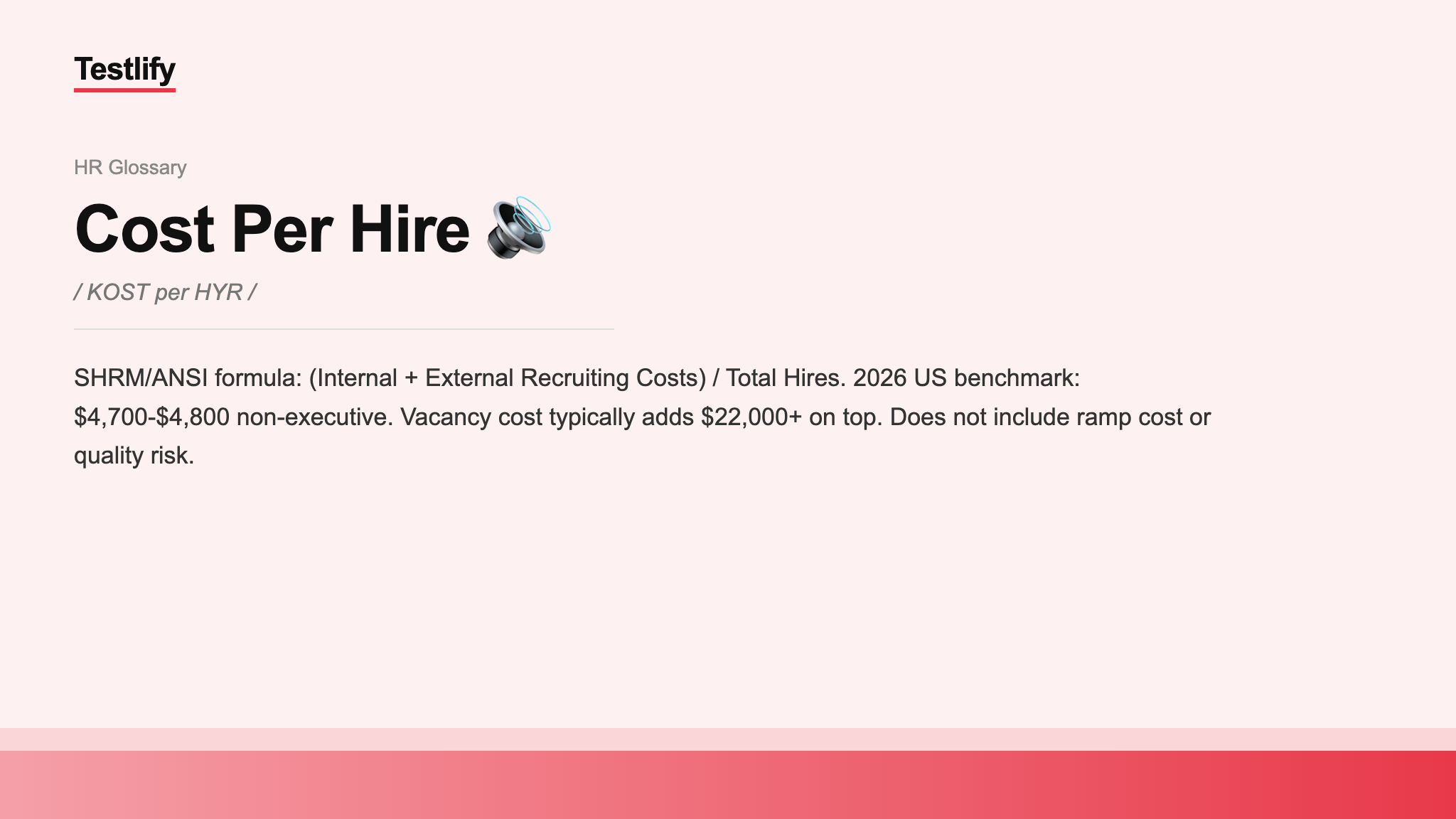
The SHRM/ANSI cost-per-hire formula
CPH = (Total Internal Recruiting Costs + Total External Recruiting Costs) / Total Number of Hires
Internal recruiting costs
- Recruiter salaries, benefits, and loaded overhead. Full cost of the internal TA function including base salary, benefits, taxes, and allocated overhead.
- Hiring manager interview time. Hours hiring managers and panel interviewers spend on the loop, valued at their loaded hourly rate. Often the single largest understated cost.
- HR administrative time. Coordinator scheduling, onboarding administration, system updates.
- Recruiting technology. ATS subscription, sourcing tools (LinkedIn Recruiter, SeekOut, Gem), assessment platforms, video interviewing tools.
- Internal referral bonuses. Bonuses paid to employees for successful referrals (typically $1,000-$5,000 per hire).
- Recruiting events and infrastructure. Job fairs, university recruiting, employer brand assets, careers website maintenance.
External recruiting costs
- Job board postings. LinkedIn, Indeed, Glassdoor, niche job boards, both per-posting and subscription costs.
- Recruitment advertising. CPM-based employer brand campaigns, CPC-based job ads, programmatic recruitment media.
- Agency / contingency / retained search fees. Typically 20-30% of first-year salary for contingency; 30-35% for retained executive search.
- Background checks and assessments. Background screening ($20-$100 per check), pre-employment assessments ($30-$200 per candidate).
- Sign-on bonuses. SHRM/ANSI includes when required to close the hire.
- Relocation costs. Significant for senior or geographic-move hires.
Worked example
A mid-sized company makes 15 hires in Q1 2026. Internal costs: recruiter salaries $20,000, HR admin time $4,000, ATS subscription $1,500, hiring manager time $3,000, referral bonuses $1,500 = $30,000. External costs: LinkedIn / Indeed ads $6,000, agency fees $15,000, background checks $1,200, assessments $1,800, recruiting events $1,000 = $25,000. Total: $55,000. CPH = $55,000 / 15 = $3,667.
2026 cost-per-hire benchmarks
The hidden cost: vacancy cost
The SHRM/ANSI standard does not include vacancy cost, the productivity loss while a role sits empty:
- Standard role vacancy cost. Typically $500 per day in lost output for an average professional role.
- Revenue-generating role vacancy cost. Sales roles can lose $7,000-$10,000 per month in lost deals.
- Median 2026 time-to-fill. 63.5 days per Employ’s 2026 report, down from 67.7 days in 2025.
- Vacancy cost example. At $500/day x 44 working days = $22,000 in vacancy cost before any recruiting expense.
- Senior sales vacancy. $2,500/day in lost pipeline x 45 days = $112,500 vacancy cost.
- Total loaded cost. True hiring cost combines SHRM/ANSI CPH + vacancy cost + ramp cost + quality risk.
Reducing cost per hire: 8-point playbook
1. Invest in employee referrals. Referrals consistently produce lower CPH and higher quality of hire than agency hires. Typical referral CPH is 30-60% of overall average.
- Build internal sourcing capability. In-house sourcers using LinkedIn Recruiter, SeekOut, and similar tools reduce agency dependence. Mature TA teams run 70%+ direct-sourced.
- Optimise candidate experience. Lower drop-off improves yield ratios; the same volume of applications produces more hires.
- Use AI tools for high-leverage activities. Resume screening, candidate matching, interview scheduling. Per industry research, AI recruiting tools cut average CPH by 30%+ in mature implementations.
- Reduce time-to-fill. Vacancy cost is often larger than CPH; reducing time-to-fill compounds savings.
- Track source-of-hire ROI rigorously. Quality-adjusted CPH per source is the right metric.
- Audit agency relationships. Are contingent fees justified by hire outcomes? Many agency hires could be made direct.
- Build talent pools. Pre-existing talent pipelines reduce future CPH dramatically.
Common cost-per-hire mistakes
- Undercounting by 30-50%. Per SHRM 2025 benchmarking, organisations using the full ANSI/SHRM methodology reported costs 34% higher than their previously self-reported figures.
- Ignoring vacancy cost. CPH benchmarks compare like-to-like, but the real cost often includes vacancy productivity loss exceeding the recruiting investment.
- Optimising CPH at the expense of quality. Cheapest hires often don’t perform; quality-adjusted CPH is the right metric.
- Including only successful searches. Under SHRM/ANSI, all recruiting costs in a period should be divided by all hires in that period.
- Treating CPH as a stand-alone KPI. Measure alongside time-to-fill, quality-of-hire, candidate experience, and source-of-hire effectiveness.
- Comparing across companies without controls. Industry, role mix, geography, and methodology all affect CPH; apples-to-apples comparisons require careful normalisation.
See also Cost-Benefit Analysis for the broader evaluation framework, Cost Per Impression for upstream recruiting metrics, Churn Rate as a downstream cost amplifier, and Backfill Position for vacancy cost context.
Frequently asked questions
Cost per hire (CPH) is the standardised talent acquisition metric measuring the total investment required to source, attract, assess, and onboard a new employee. The authoritative SHRM/ANSI formula is: CPH = (Total Internal Recruiting Costs + Total External Recruiting Costs) / Total Number of Hires. Per SHRM 2026 Talent Access Benchmarking Report, average US CPH is approximately $4,700-$4,800 for non-executive roles and $28,329-$35,879 for executive hires.
Cite this page
Copy a ready-made citation for this page in your preferred style.
- APA
Testlify. (2023). Cost Per Hire. https://testlify.com/hr-glossary/cost-per-hire-cph/
- MLA
"Cost Per Hire." Testlify, 11 January 2023, https://testlify.com/hr-glossary/cost-per-hire-cph/.
- Chicago
Testlify. "Cost Per Hire." Testlify. Last modified August 6, 2026. https://testlify.com/hr-glossary/cost-per-hire-cph/.
- HTML link
<a href="https://testlify.com/hr-glossary/cost-per-hire-cph/">Cost Per Hire</a>, Testlify (2023)
Related terms
Cost Per Impression
CPM measures ad cost per 1,000 impressions. See formula, CPM vs CPC vs CPA, recruitment marketing benchmarks, LinkedIn / Indeed rates, and viewability.
Cost to Company (CTC)
CTC is total annual employer spend per employee. See CTC vs gross vs net salary, India structure (Basic, HRA, EPF), and offer-letter navigation.
Cost-Benefit Analysis
Cost-benefit analysis weighs project costs against benefits. See NPV / BCR / IRR formulas, HR investment ROI examples, and step-by-step framework.
Cross-Functional Team
Cross-functional teams are groups of individuals from different functional areas that work together to achieve a common goal, bringing diverse perspectives, skills, and resources.
Cross-Training Employees
Cross-training is the process of training employees to perform multiple tasks and functions, improving organizational efficiency, employee engagement, adaptability and continuity.
Crowdsourcing
Obtaining services, ideas or content by soliciting contributions from a large group of people, often through online platforms.
Get started.
Hire on proof, not resumes.
Run your first skills-based assessment free — no credit card required.