
Top 8 candidate sourcing tools for recruiters in 2026
Discover the best candidate sourcing tools recruiters need in 2026 to find passive talent, improve hiring speed, and build high-quality pipelines.

Candidate sourcing in 2026 looks very different from what it used to be, even a few years ago. Recruiters are no longer limited to job boards and inbound applications.
Instead of relying on a single channel, modern sourcing involves discovering talent across multiple platforms, communities, and databases. AI-powered tools help surface potential candidates faster, but the focus has shifted from volume to relevance. Recruiters are expected to find people who not only match a job description but can also perform in real-world scenarios from day one.
This article covers the top candidate sourcing tools recruiters need in 2026 and explains where each tool fits into a modern hiring strategy.
 ChatGPT
 Gemini
 Claude
 Grok
Grok Perplexity
What is a candidate sourcing tool?
A candidate sourcing tool is a software solution that helps recruiters identify, discover, and engage potential candidates for current or future job openings. These tools allow hiring teams to proactively find talent rather than relying only on inbound applications.
By using candidate sourcing tools, recruiters can build and maintain talent pools over time, reduce time-to-hire, and ensure they have access to qualified candidates as soon as hiring needs arise.

How to choose the right candidate sourcing tool for your hiring goals
There is no single best candidate sourcing tool. The right choice depends on what you are hiring for, how often you hire, and the level of specialization required.
For high-volume or entry-level hiring, job boards and ATS resume databases are often the most efficient. They provide quick access to job-ready candidates and support faster turnaround times.
For technical, niche, or senior roles, sourcing tools that allow deeper skill-based searches are more effective. Platforms that surface real work, contributions, or community involvement help recruiters evaluate fit beyond resumes.
Early-stage teams may prioritize tools that are easy to use and cost-effective, while enterprise teams often need advanced analytics, integrations, and collaboration features to manage scale.
The key is alignment. A sourcing tool should support your hiring goals, not dictate them. Teams that clearly define what success looks like in a role are better equipped to choose tools that consistently deliver quality candidates.
Best candidate sourcing tools in 2026
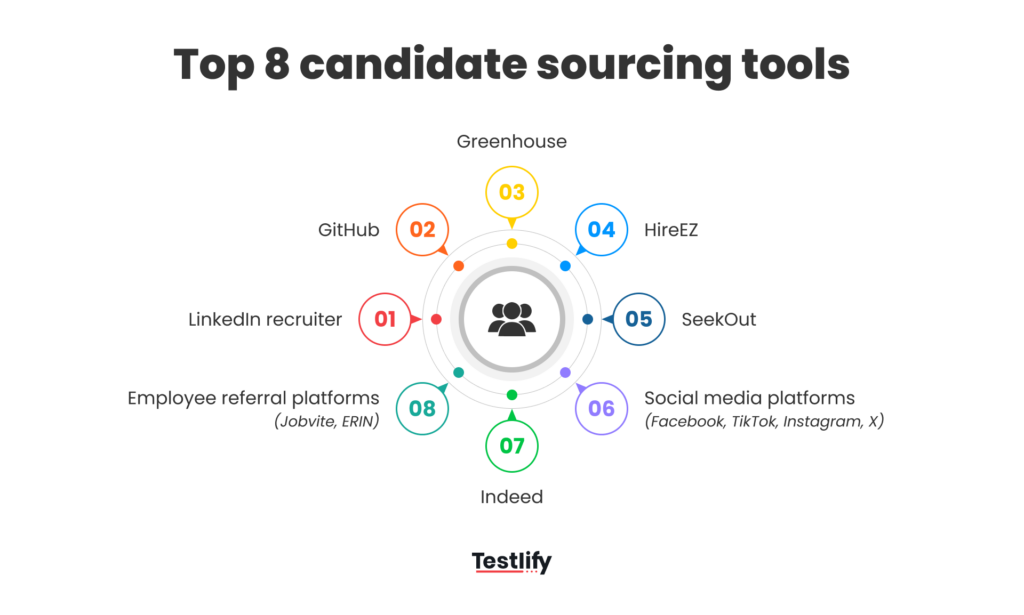
1. LinkedIn Recruiter
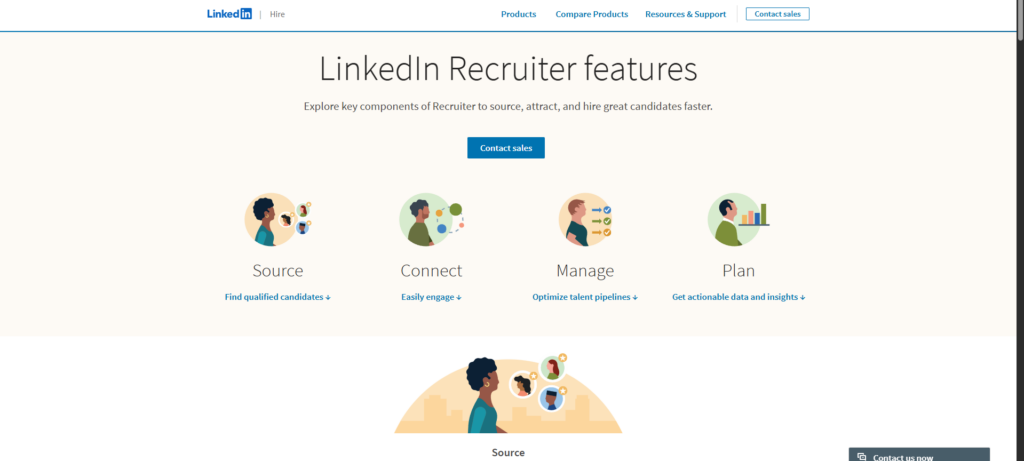
LinkedIn Recruiter remains the world’s most widely adopted sourcing tool. With the largest professional network at your fingertips, it gives recruiters instant access to millions of candidates across industries and experience levels.
What makes LinkedIn Recruiter effective for candidate sourcing
- Deep profile insights, including skills, endorsements, and work history
- AI-generated candidate recommendations
- Advanced search with powerful filters
- Ability to reach passive candidates directly through InMail
- Pipeline tracking and saved searches
Pros
- Unmatched professional database with the widest global reach
- Great for passive sourcing, especially niche leaders and specialists
- High data accuracy because profiles are frequently updated by candidates
Cons
- Expensive for smaller companies or early-stage teams
- Candidate fatigue, as many receive frequent recruiter messages
- High competition, especially for tech and leadership roles
- InMail limits may restrict outreach volume
2. GitHub
GitHub isn’t a traditional job board, but for technical recruiters, it’s a goldmine of talent. It’s a platform where developers collaborate on projects, share code, and showcase their programming skills. With over 100 million users worldwide, GitHub gives recruiters access to a vast pool of software engineers, data scientists, and other specialists who may not be active on LinkedIn.
GitHub stands out because it allows recruiters to evaluate technical ability through real work rather than resumes. Instead of relying on self-reported skills, recruiters can review repositories, contributions, and collaboration patterns to understand how candidates actually write and maintain code.
Why GitHub stands out for sourcing tech talent
- Search developers based on languages, frameworks, repositories, and contributions
- Understand real coding ability by reviewing their open-source work
- Access highly engaged communities that love solving complex problems
- Identify rising talent early before they become active job seekers
Pros
- Skill visibility based on real code, not self-reported claims
- Excellent for hard-to-find technical roles like DevOps, security, or ML
- Massive global community of experienced and early-career developers
- Many developers include email or portfolio links for easy outreach
Cons
- Only useful for technical roles
- Requires basic technical understanding to interpret code
- No built-in recruiter messaging system
- Profiles lack ta raditional resume structure
3. Greenhouse (ATS)
Greenhouse is a leading Applicant Tracking System that helps manage incoming applications and candidates through every stage of the hiring process, from resume screening to interviews to offer letters.
Recruiters and hiring managers can work together in one system, keeping notes and evaluations organised in real time. Greenhouse and similar ATS platforms dominate in tech and enterprise companies for good reason: they save time on administrative tasks, maintain compliance, and provide analytics to improve the recruitment pipeline.
Why Greenhouse is essential for candidate sourcing
- Fully customizable hiring pipelines
- Collaboration features for interviewers and recruiters
- Comprehensive candidate history and notes
- Reporting dashboards to improve hiring decisions
- Strong integration ecosystem with HR, sourcing, and assessment tools
Pros
- Highly structured, ensuring no candidate slips through the cracks
- Great for scaling hiring, especially in mid-market and enterprise
- Excellent collaboration tools
- Advanced filtering for rediscovering past applicants
Cons
- Steep learning curve for first-time users
- More expensive than lightweight ATS tools
- Setup and workflow building take time
4. HireEZ
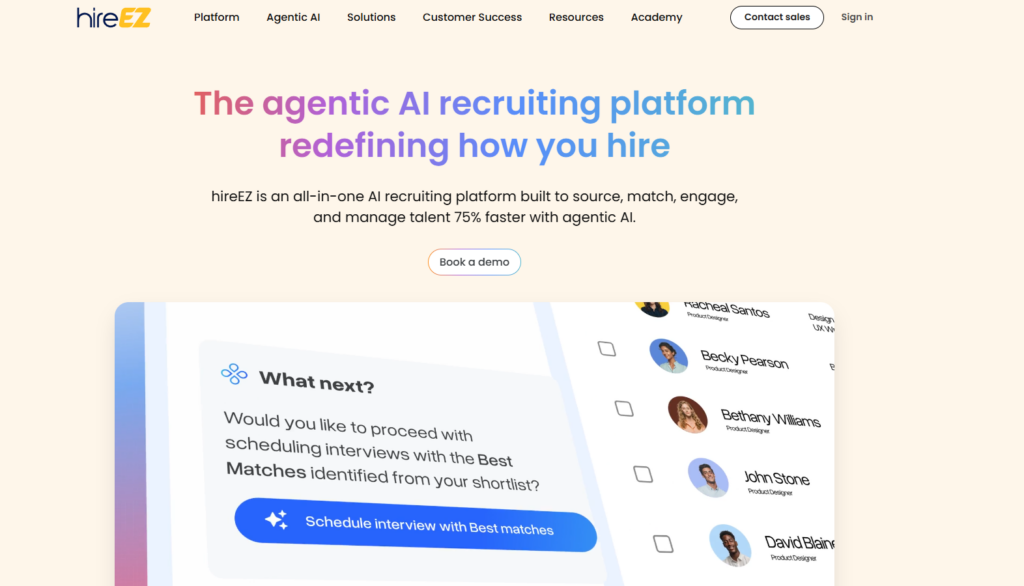
HireEZ is an AI-driven sourcing platform that takes candidate searching to the next level. It aggregates data from across the internet to build comprehensive candidate profiles, giving a 360° view of a person’s skills and experience.
Using HireEZ, recruiters can perform skill-based searches with remarkable precision such as finding engineers with a specific certification or marketers with certain software expertise.
Why HireEZ is a powerful candidate sourcing tool
- AI-based candidate matching
- Talent pool insights and market availability analysis
- Automated email sequencing for candidate outreach
- Integration with ATS and CRM systems
- Multi-channel sourcing from public profiles, forums, websites, and job boards
Pros
- Exceptional search depth, combining AI + Boolean precision
- Fast profile enrichment from multiple data sources
- Strong analytics for talent strategy planning
- Excellent for hard-to-fill or senior roles
Cons
- Advanced features require extensive training to use effectively
- Higher pricing, especially at enterprise scale
- Occasional duplicate profiles from different sources
5. SeekOut
SeekOut is another AI-powered sourcing platform renowned for its ability to find talent that other tools miss. It uses an AI talent search engine to identify candidates with very specific skills and experience across multiple sources beyond just LinkedIn.
SeekOut aggregates information from public profiles, technical forums, and other databases to create rich candidate profiles that provide deeper insight into each person.
What SeekOut offers for candidate sourcing
- AI-enhanced search and recommendations
- Diversity-focused filters (gender, underrepresented groups, etc.)
- Technical talent search with skill-level tagging
- Talent intelligence dashboards
- Multi-channel engagement capabilities
Pros
- Best-in-class diversity sourcing tools
- Very detailed profiles aggregated from multiple sources
- Great for technical and specialized hiring
- Highly effective ranking system for candidate engagement
Cons
- Premium pricing
- Dependent on the accuracy of external data sources
- Requires learning time to understand advanced filters
6. Social media platforms

Beyond LinkedIn, recruiters in 2026 are increasingly turning to mainstream social media platforms to source candidates creatively. This is because social platforms have become major sourcing channels due to the rise of communities, creator-led content, and real-time conversations.
Recruiters can use Twitter’s advanced search to find people discussing relevant keywords in their region, uncovering engaged professionals who might be open to new opportunities.
On Facebook, many companies leverage Facebook Groups or even Facebook’s search filters to find profiles with certain job titles or interests.
Instagram and TikTok are also emerging in recruiting, not for direct resume search, but for employer branding and attracting passive talent.
How recruiters use social media platforms for candidate sourcing
- Join industry Facebook groups
- Post opportunities on X using hashtags
- Find visual or creative talent on Instagram
- Build employer brand visibility on TikTok
- Participate in niche communities and comment threads
- Message candidates directly in DMs
Pros
- Great for passive sourcing
- Low-cost, high-reach brand visibility
- Strong for creative, retail, entry-level, or community-driven roles
- Helps recruiters tap into authentic conversations
Cons
- Time-consuming without a clear strategy
- Candidate information may be incomplete
- Limited advanced filtering tools
- Harder to track sourcing metrics
7. Indeed
Job boards remain a fundamental sourcing tool, and Indeed is one of the biggest players globally. In addition to posting jobs, recruiters use Indeed’s Resume Database to actively search millions of candidate resumes. In fact, Indeed’s database contains around 200 million resumes worldwide, spanning virtually every industry and profession.
What makes Indeed useful for candidate sourcing
- Millions of searchable resumes
- Filters for skills, titles, education, and location
- Quick outreach to active job seekers
- Strong visibility for job postings
- Resume alerts for new matches
Pros
- Ideal for high-volume roles
- Easy to find job-ready candidates
- Simple search experience
- Strong global footprint
Cons
- High competition for popular roles
- Resume quality varies widely
- Paid visibility can become expensive
8. Employee referral platforms (Jobvite, ERIN)
Employee referrals are often a recruiter’s secret weapon for finding great hires. In fact, 78% of recruiters say their best candidates come through referrals, and studies show referred employees perform up to 15% better than those hired through other channels.
Platforms like Jobvite and ERIN are designed to maximize these benefits by streamlining the referral process. They provide centralized referral portals where employees can easily submit referrals and track their status.
By implementing an employee referral platform, organizations can unlock their workforce’s networks at scale. This not only brings in more candidates, but often better-quality candidates who are pre-vetted by your own employees, leading to faster hires and improved retention.
How employee referral platforms help in candidate sourcing
- Centralize referral submissions
- Automate reminders, updates, and payouts
- Allow one-click sharing of openings
- Track referral performance and participation
Pros
- Higher quality-of-hire compared to most channels
- Faster time-to-fill since employees refer pre-vetted candidates
- Higher retention rates among referred hires
- Encourages ongoing employee involvement in hiring
Cons
- Limited to employee networks
- Over-reliance can impact diversity
- Requires internal communication campaigns to stay effective
Other best candidate sourcing tools in 2026
In addition to the eight core tools above, there are several other noteworthy candidate sourcing platforms that recruiters should know about in 2026:
- Glassdoor: Enhances employer brand and attracts informed candidates
- Lever: ATS + CRM hybrid for long-term candidate nurturing
- iCIMS: Enterprise ATS with high scalability
- Eightfold AI: AI-driven skills intelligence and future-potential matching
- LinkedIn Talent Insights: Real-time labor market and skills analytics
- Monster: Global job board and resume search platform
- Naukri: Leading sourcing platform for Indian and APAC markets
Common candidate sourcing mistakes to avoid
Even with the right tools in place, candidate sourcing can fall short if these common mistakes are not addressed:
- Relying on a single sourcing channel: Depending too heavily on one platform limits reach and increases competition for the same candidates. Effective sourcing in 2026 requires a multi-channel approach to access diverse and hard-to-find talent.
- Prioritizing speed over relevance: Mass outreach without proper role alignment often results in low response rates and candidate fatigue. Quality sourcing focuses on relevance and fit rather than sheer volume.
- Ignoring existing talent pools: Past applicants, silver medalists, and previous interviewees are frequently overlooked, even though they already have context about the organization and can convert faster than new candidates.
- Sourcing without clear skill validation criteria: Bringing candidates into the funnel without a defined plan to assess skills and job readiness increases hiring risk. Strong sourcing should always connect to structured evaluation.
- Using tools without a sourcing strategy:Even the best platforms fall short when recruiters lack clarity on role requirements, ideal candidate profiles, or long-term hiring goals.
Avoiding these mistakes helps recruiters build stronger pipelines, improve candidate engagement, and make more confident hiring decisions.
Final thoughts
The best candidate sourcing tools help recruiters work smarter and more strategically in 2026. They enable teams to:
- Reach and engage passive talent more effectively
- Analyze global labor market trends and talent availability
- Build diverse, high-quality talent pools at scale
- Automate repetitive sourcing and outreach tasks
- Personalize candidate communication without sacrificing speed
- Strengthen employer branding across sourcing channels
Once sourcing brings the right candidates into your funnel, the next challenge is validating real skills and job readiness. That’s where Testlify comes in. Testlify helps you assess candidates objectively using skills-based assessments and AI-powered interviews, so you can turn strong sourcing efforts into confident hiring decisions.
Book a demo with Testlify to see how skills assessments and AI interviews can help you hire better, faster, and with less bias.
For further reading, explore Testlify The Recruiter Who Never Sleeps.
Frequently asked questions (FAQs)
Related resources
View all
HR & recruitment
What are the best sourcing tools for recruiters

HR & recruitment
How to score video and audio interview responses

HR & recruitment
How to create video and audio interview questions

HR & recruitment
Challenges of using video and audio interviews

HR & recruitment
Benefits of using video and audio interviews

HR & recruitment
How to use audio and video interviews to assess candidates
Get started.
Hire on proof, not resumes.
Run your first skills-based assessment free — no credit card required.