
Cost of a bad hire: 2027 benchmarks and how to calculate it
What a hire who does not work out really costs, from hiring spend to lost output, with 2026 benchmarks and a formula to work out your own.

The cost of a bad hire is the total amount a business loses when a new employee does not work out: the money spent to hire and onboard them, the pay that bought weak output, the time managers and teammates spend covering gaps, and the cost of hiring again. A widely quoted rule of thumb puts it at about 30% of the person's first-year pay, and for most roles the real figure is higher.
TL;DR:
- The cost of a bad hire is usually 30% of first-year pay or more. A $60,000 role that fails at month six can cost $30,000 to $35,000 once hiring, lost output, manager time and rehiring are added up.
- SHRM's 2025 benchmarking puts the average cost per hire at $5,475 for nonexecutive roles and $35,879 for executive roles. A failed hire means paying that twice.
- Hidden costs are usually bigger than the invoice costs: lost output, manager time and team morale outweigh job ads and agency fees.
- Treat the "30% of salary" figure as a rule of thumb. It is quoted everywhere but is hard to trace to a current US Department of Labor publication.
- Work out your own number with one formula: hiring cost + onboarding + pay for missing output + extra manager and team time + cost to rehire.
- For volume hiring, a 10% early mis-hire rate across 200 nonexecutive hires repeats about $109,500 in hiring spend alone.
- The cheapest fix sits before the offer: skills tests, structured interviews and reference checks catch most skill gaps for a fraction of what a failed hire costs.
 ChatGPT
 Gemini
 Claude
 Grok
 Perplexity
What is the cost of a bad hire?
The cost of a bad hire is the full financial and operational loss from hiring someone who cannot do the job, does not stay, or harms the team, measured from the first job ad to the day the replacement is fully productive. The cost includes money you can see on invoices and losses you only see in output, deadlines and turnover.
A "bad hire" here means a hiring decision that has to be reversed or heavily corrected: the person leaves or is let go early, or stays but needs far more support than planned. Hiring teams call the same thing a mis-hire or a wrong hire.
Two numbers frame the answer. The first is what it costs to fill a role once, which HR teams track as cost per hire. The second is how much value the business loses while the role is filled by the wrong person. A failed hire means you pay the first number twice and absorb the second on top.

What is the average cost of a bad hire?
The average cost of a bad hire is usually quoted as at least 30% of the employee's first-year earnings, and replacement estimates for senior roles run to one or two times annual salary. Treat these as ranges, not exact figures: the most reliable recent data covers the cost to hire, not the cost of hiring wrong.
Benchmark | Figure | Source and year | How much to trust it |
|---|---|---|---|
Average cost per hire, nonexecutive | $5,475 | SHRM benchmarking, 2025 | High: survey of 2,371 SHRM members |
Average cost per hire, executive | $35,879 | SHRM benchmarking, 2025 | High: same survey |
Cost of a bad hire as share of salary | 30% of first-year earnings | Attributed to the US Department of Labor, undated | Low: widely repeated, hard to trace to a current DOL publication |
Full replacement cost, senior roles | 1 to 2 times annual salary | Industry estimates | Medium: depends heavily on the role |
SHRM's 2025 benchmarking release reports the cost per hire figures above, from a survey fielded between January and March 2025. Those numbers cover only the hiring process. When a hire fails, you spend them again and add every loss from the months in between.
The 30% figure is useful as a floor for a quick estimate. Older employer surveys that put a single dollar figure on a bad hire are now close to ten years old, so a number built from your own salaries and hiring costs will be more accurate for your budget than any national average.
Key takeaway: Quote the 30% rule in a meeting if you need a quick number, but build the business case on your own cost per hire and salary data.
Which costs add up when a hire does not work out?
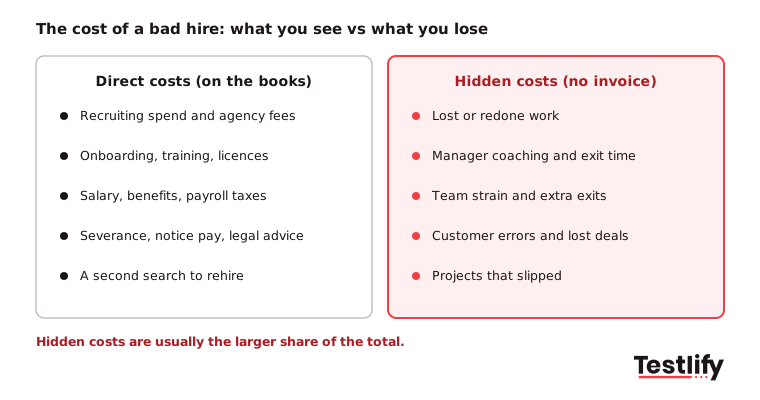
The costs of a failed hire fall into two groups: direct costs that appear in your books, such as recruiting, onboarding and severance, and hidden costs that never get an invoice, such as lost output, manager time, team morale and lost customers. Hidden costs are usually the larger share.
Direct costs
Direct costs are the immediate, measurable expenses an organization incurs when an employee leaves and needs to be replaced. These typically include:
- Recruiting spend: Job ads, agency or recruiter fees, background checks and assessment fees for the first search.
- Onboarding and training: Equipment, licences, training courses and the time of whoever runs onboarding.
- Pay and benefits: Salary, benefits and payroll taxes for the months the person was in the role.
- Exit costs: Severance, notice pay, legal advice and, in some cases, settlements.
- Rehiring: The full hiring process again, plus the vacancy while the seat is empty. HR teams often roll this into their turnover costs.
Hidden costs
Hidden costs are less obvious but can have a significant impact on team performance, productivity and business outcomes. They often include:
- Lost output: Work that was not done, done late or redone by others.
- Manager time: Extra coaching, reviews, performance plans and the exit process.
- Team strain: Colleagues covering gaps, which raises stress and can push good people to leave.
- Customer impact: Errors, slow service or lost deals in customer-facing roles.
- Opportunity cost: Projects that slipped while the team was short of a working hire.
Team strain is the cost leaders tend to underestimate. Gallup's 2026 State of the Global Workplace estimates that low engagement cost the world economy about $10 trillion in lost productivity, or 9% of global GDP. A poorly matched hire is one of the quickest ways to pull a working team's engagement down.
How do you calculate the cost of a bad hire?
The cost of a bad hire can be calculated by adding five numbers: what you spent to hire, what you spent to onboard, the pay that bought missing output, the extra time managers and teammates spent, and the cost of hiring a replacement. Add severance and lost revenue where they apply.
The formula: Cost of a bad hire = hiring cost + onboarding and training + (pay x share of output missing) + extra manager and team time + cost to rehire
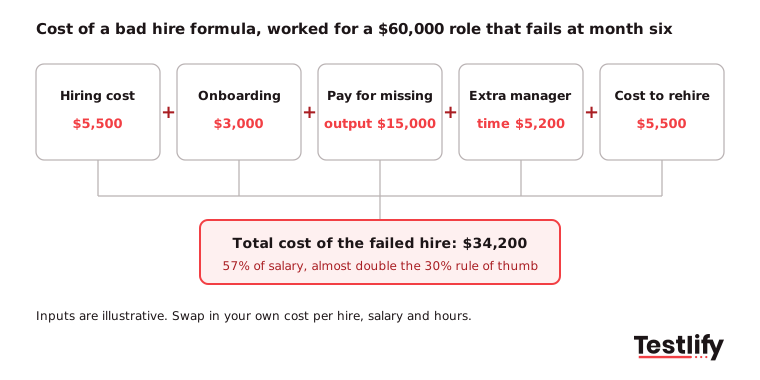
Here is a worked example for a customer support team lead on a $60,000 salary who leaves at month six. The inputs are illustrative; swap in your own.
Cost item | How it is worked out | Amount |
|---|---|---|
Hiring cost | About the SHRM 2025 nonexecutive average | $5,500 |
Onboarding and training | Training course, licences, trainer time | $3,000 |
Pay for missing output | 6 months of pay ($30,000) x 50% of expected output missing | $15,000 |
Extra manager time | 4 hours a week x 26 weeks x $50 an hour | $5,200 |
Cost to rehire | Second search at the same cost per hire | $5,500 |
Total | $34,200 |
The total is 57% of the annual salary, nearly double the 30% rule of thumb. The biggest single line is pay for missing output, not anything on an invoice.
Pro tip: Run the formula on one real hire from the last year that did not work out. A number from your own payroll is far more persuasive to finance than any industry average. The cost per hire calculator gives you the first input in a few minutes.
How does the cost change by role level and hiring volume?
The cost of a bad hire rises with seniority, because senior people cost more to find, take longer to replace and make decisions that affect more of the business. For high-volume roles the cost per hire is lower, but small mis-hire rates multiply across hundreds of hires.
Role level | What drives the cost | Typical time to spot the problem | Cost profile |
|---|---|---|---|
Entry level and hourly | Training time, early leavers, supervisor time | 2 to 6 weeks | Low per hire, high in total at volume |
Mid-level specialist | Lost output, rework, slower team delivery | 2 to 4 months | Usually above the 30% rule, as in the worked example |
Manager | Team turnover, morale, missed targets | 3 to 6 months | High: one failed manager can trigger several exits |
Executive | Strategy delays, team exits, search fees | 6 to 12 months | Highest: the hiring cost alone averages $35,879 (SHRM 2025) |
Volume hiring example: A contact center makes 200 nonexecutive hires a year. If 10% do not work out in the first six months, that is 20 rehires. At SHRM's 2025 nonexecutive average of $5,475 per hire, the repeat hiring spend alone is about $109,500, before training, lost output or supervisor time.
This is why mid-market and enterprise TA teams track early attrition and quality of hire next to cost per hire. The quality of hire calculator and the cost of employee turnover calculator help turn these patterns into numbers for each role family.
Why do hiring mistakes happen so often?
Hiring mistakes happen most often because teams decide on resumes and unstructured conversations instead of evidence of skill, and because pressure to fill roles fast pushes them to skip steps. A resume shows what a candidate says they can do; it does not show whether they can do the work. The common causes include:
- Time pressure: Open roles hurt, so teams shortcut the process. SHRM's 2026 recruiting benchmarking puts the median time to fill a nonexecutive role at 39 days, which is a long time for a short-staffed team to wait.
- Resume-only screening: AI-written resumes make more candidates look like a match on paper, so keyword screening lets more poor fits through.
- Unstructured interviews: Different interviewers ask different questions and score on gut feel, so the strongest talker wins.
- Vague role requirements: If nobody agreed what good looks like, nobody can test for it.
- Skipped checks: References, work samples and probation reviews are the first things dropped when hiring gets busy.
If you suspect a recent hire is already struggling, these early warning signs of a bad hire help you confirm it before the cost grows.
How can you lower the cost of a mis-hire before the offer?
The cost of a mis-hire is lowest when the mismatch is caught before the offer, so the strongest savings come from adding evidence at each hiring stage: a clear skill profile, a skills test, a structured interview, reference checks and a planned review in the first 90 days.
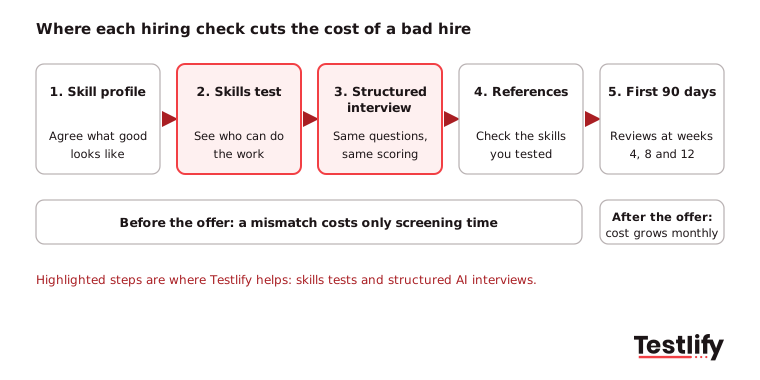
Organizations need a consistent process that evaluates candidates on relevant skills, verifies their experience and sets clear expectations from the beginning. Here are five ways to improve hiring decisions and reduce early employee turnover:
- Define the role in skills: Write down the four to six skills the role needs and what "good" looks like for each. Every later check tests against this list.
- Test skills before interviews: A short, role-specific skills test shows who can actually do the work before anyone spends interview time. Mix job skills with cognitive ability or situational judgment where the role needs it.
- Run structured interviews: Ask every candidate the same questions and score answers against the same criteria. A structured interview makes the decision comparable and easier to defend.
- Check references properly: Ask former managers about the specific skills you tested. These reference check best practices keep the calls focused.
- Plan the first 90 days: Set goals for weeks 4, 8 and 12 and review them. A well-run probation period catches a mismatch at month three instead of month nine.
Testlify brings steps 2 and 3 together on a single platform. Teams can choose from 3,500+ ready-made tests or create custom assessments based on specific job descriptions to evaluate candidates against role requirements.
They can also conduct structured AI interviews through video, voice or chat. Every candidate is evaluated against the same criteria, making it easier to compare performance and generate a ranked shortlist.
With 20+ advanced proctoring checks, Testlify helps maintain assessment integrity and prevent cheating. Its two-way integrations with 100+ ATS and HRIS platforms also ensure candidate scores and assessment results are synced directly with candidate records.
How do you make the business case to leadership?
The business case for better screening compares the cost of the mis-hires you avoid with the cost of the extra screening step. Leaders respond to that comparison because it turns a hiring process change into a number they can check.
Use three inputs:
- Your cost per failed hire: From the formula above, using one real example.
- Your current mis-hire rate: The share of hires who left or were let go in the first six to twelve months.
- The cost of the new step: Tool cost plus the team time to run it.
Then compare: (cost of mis-hires avoided minus cost of the new step) divided by cost of the new step. Using the worked example, avoiding just 5 of the contact center's 20 early mis-hires saves 5 x $34,200 = $171,000. Most screening steps cost a small fraction of that.
Present the result next to quality of hire and time to hire, so leadership sees that better screening is not a trade-off against speed. This guide on how to improve quality of hire covers the metrics to track after the change.
Ready to catch skill gaps before the offer?
Testlify helps hiring teams test real skills before the offer, so fewer hires fail and the cost of a bad hire stops showing up in your budget.
Browse the Testlify test library to find tests for your open roles, or book a demo to see skills tests and AI interviews on one of your roles. Plans are credit-based, you pay only when a candidate starts, and there is a 7-day free trial with no credit card.
Frequently asked questions (FAQs)

Human Resources Lead
Snehi Parmar leads People at Testlify, owning hiring, culture, performance, and retention for a 90-person team. She writes on practical HR strategy and building people processes that scale.
Related resources
View all
HR & recruitment
How to use technology to support performance management?

HR & recruitment
Case studies of successful performance management system

HR & recruitment
Implementing performance management system in the future of work

HR & recruitment
Implementing performance management system in remote teams

HR & recruitment
How to Implement a Performance Management System in a Startup

HR & recruitment
Implementing performance management system in small businesses
Get started.
Hire on proof, not resumes.
Run your first skills-based assessment free — no credit card required.