
10 challenges in campus recruitment and how to fix them
Campus drives fail at four points: attract, screen, select and keep. Here are the 10 common problems and a practical fix for each one.

The biggest challenges in campus recruitment are too many applicants for a small team, students with no work history to judge, bigger employer brands competing for the same graduates, and offers that fall through before day one. Each one has a practical fix, and most of those fixes start with screening every student on the same job-relevant skills test.
TL;DR:
- The 10 most common challenges in campus recruitment fall into four stages: attracting students, screening volume, selecting fairly and keeping the people you hire.
- Volume is the first bottleneck. A small campus team cannot read thousands of resumes, so a short online skills test for every applicant is the fastest way to a fair shortlist.
- GPA is losing ground as a filter. NACE found only 42% of employers screen graduates by GPA, down from 73% in 2019, while 70% now use skills-based hiring.
- Smaller employers win on campus with speed and specifics: a fast process, real project examples and a named contact beat a bigger brand with a slow one.
- Reneging and early attrition are hiring problems, not HR problems. Regular contact between offer and joining, plus a 90-day plan, protects the drive's results.
- Track six numbers after every drive (campus mix, applicants per campus, days to shortlist, interviews per hire, offer acceptance and first-year retention) and fix the weakest step first.
 ChatGPT
 Gemini
 Claude
 Grok
 Perplexity
What are the biggest challenges in campus recruitment?
The biggest challenges in campus recruitment are low brand awareness, competition from bigger employers, a narrow campus list, high applicant volume, a small recruiting team, AI-written answers, no work history to judge, bias in shortlisting, reneged offers and early attrition. The table maps each one to what you see and the first fix to try.
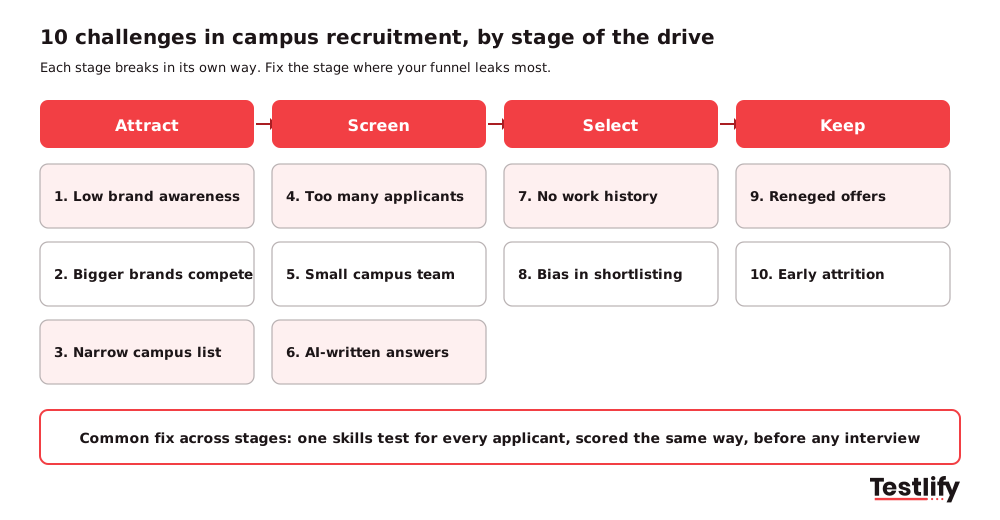
# | Challenge | What you see | First fix |
|---|---|---|---|
1 | Low brand awareness | Few applicants from target campuses | Show real projects and a named contact |
2 | Bigger brands compete | Top students accept other offers first | Move faster and make the offer specific |
3 | Narrow campus list | Same schools, same profiles every year | Add campuses and run open online tests |
4 | Too many applicants | Thousands of resumes, weeks to shortlist | One online skills test for every applicant |
5 | Small campus team | Recruiters stretched across drives | Auto-scored tests and bulk invites |
6 | AI-written answers | Polished resumes that all read alike | Proctored, timed tests and practical tasks |
7 | No work history to judge | Interviews based on GPA and confidence | Test the skills the role needs |
8 | Bias in shortlisting | Shortlists that mirror the panel | Same test and same rubric for everyone |
9 | Reneged offers | Accepted offers that never join | Fast offers and regular contact until day one |
10 | Early attrition | Campus hires leaving in year one | Hire for skill fit and run a 90-day plan |

Why are campus hiring challenges harder in 2026?
Campus hiring challenges are harder in 2026 because demand for graduates is rising again while the old signals for judging them are fading. NACE's Job Outlook 2026 spring update found employers plan to hire 5.6% more new graduates from the Class of 2026, with more than one-third planning to increase hiring.
More employers on campus means more competition for the same students. At the same time, applications are easier to write than ever, so resumes look alike and recruiters have less to go on. For TA teams in India, the pressure starts even earlier: placement seasons give the first employers on campus the first pick, so a slow shortlist can cost a whole batch. Read more on what is shifting in campus recruitment trends.
How do you screen thousands of applicants with a small campus team?
Screening thousands of applicants with a small team works only when the first cut is automated and the same for everyone. The most common student recruitment challenge for employers is not a lack of applicants. It is the gap between the number of applicants and the hours recruiters have to review them.
Manual resume reading breaks at campus scale for three reasons:
- Time: A recruiter who spends two minutes per resume needs more than 30 hours to read 1,000 applications from one campus.
- Consistency: The 50th resume of the day gets less attention than the first, so shortlists depend on reading order.
- Weak signal: Student resumes list the same courses, clubs and tools, so they rarely separate the strongest candidates.
The fix is a short online assessment sent to every applicant, scored automatically and ranked before any human review. Recruiters then spend their hours on the top 10 to 20% instead of the whole pool. Bulk invites through email, a public link or your ATS let one recruiter run several campuses at once.
How do you judge students who have no work history?
Judging students with no work history means testing what they can do instead of reading what they have done. Degrees and grades say little about whether a graduate can write clear code, handle a customer call or analyze a spreadsheet.
Employers are already moving this way. NACE's Job Outlook 2026 survey found 70% of employers use skills-based hiring for entry-level roles, up from 65% a year earlier, and only 42% still screen by GPA, down from 73% in 2019.
A practical campus assessment combines three parts:
- Aptitude: Numerical, verbal and logical reasoning, to see how fast a graduate learns.
- Role skills: A coding task, an Excel exercise, a writing sample or a sales scenario that mirrors the first month of the job.
- Soft skills: Communication and situational judgment, which campus hires most often lack. See how to add them in soft skills in campus hiring.
Keep the whole test under 45 minutes. Students take it on a phone between classes, and a long test loses your best applicants to employers with a shorter one.
How do you compete with bigger employer brands on campus?
Competing with bigger brands on campus is about being specific and fast, because a mid-sized employer rarely wins on name recognition alone. Students know the famous logos. They do not know what your first-year analyst actually works on.
What works for employers without a household name:
- Show the work: Bring a recent graduate to the talk and walk through a real project they shipped in year one.
- Name a contact: Give students one recruiter they can message, not a generic careers inbox.
- Publish the process: Tell students the steps, the test length and when they will hear back. A clear timeline is rare and students notice it.
- Move first: Send the assessment link on the day of the talk while interest is high.
Teams that need a full playbook for the drive itself can compare campus hiring solutions for attracting top graduates, and use ready-made job fair email templates to follow up the same day.
How do you keep campus hiring fair and diverse?
Keeping campus hiring fair starts with where you recruit and ends with how you shortlist. Many employers are narrowing their campus lists to save cost: according to a Wall Street Journal-reported employer survey summarized by Kelly Services, 26% of employers recruited only from a shortlist of schools in 2025, up from 17% in 2022, and diversity was a school-selection priority for 31% of employers, down from nearly 60%.
A short campus list saves travel, but it also caps your talent pool. Two fixes keep reach wide without raising cost:
- Open online drives: Run one assessment open to students from any campus, then visit only the campuses that send strong scorers.
- Blind first round: Score the test before anyone sees the student's college name, so shortlists reflect skill rather than school.
Use the same test, the same time limit and the same scoring rubric for every candidate. Consistency is the simplest defense when a hiring decision is questioned.
How do you stop AI-written answers and cheating in campus tests?
Stopping AI-written answers in campus hiring means moving the signal from documents students can polish to tasks they must complete themselves. Resumes and cover letters written with AI tools now look alike, so they separate candidates less than ever.
Three controls protect an online campus assessment:
- Proctoring: Webcam snapshots, tab-switch tracking, full-screen mode and copy-paste blocking flag suspicious sessions for review.
- Question randomization: Each student gets a different order and set of questions, which makes sharing answers in a group chat far less useful.
- Practical tasks: Timed coding, spreadsheet or writing tasks show how a student works, not only the final answer.
Flag, then review. A proctoring alert should send a session to a recruiter, not reject a student automatically. Testlify's anti-cheating and proctoring covers these checks in one place.
Why do students drop out or renege after an offer?
Students drop out or renege after an offer mostly because of slow processes, silence between offer and joining, and a better offer arriving first. Strong students often hold more than one offer: NACE's 2026 Student Survey found 43% of graduates had at least one job offer before graduation, and 55% of paid interns who applied for jobs received one.
Ways to keep accepted candidates committed:
- Shorten the gap: Aim to make an offer within a week of the final interview.
- Stay in touch: Send a short update every two to three weeks between offer and joining, with a named buddy and a first-week plan.
- Explain the role: Students who know their team, manager and first project are far less likely to accept a rival offer.
- Respect their time: Clear steps and quick feedback are part of the candidate experience that students share with their classmates.
How do you keep campus hires after they join?
Keeping campus hires after they join depends on hiring for real skill fit and giving them structure in the first 90 days. Many first-year exits trace back to a mismatch between what the graduate expected and what the job demanded.
Internships help close that gap. NACE's 2026 Internship and Co-op data shows employers plan to hire 3.9% more interns in 2025-26, and many use internships as a trial run before a full-time offer.
For full-time campus hires, three habits make the biggest difference:
- Use test results in onboarding: Share each hire's sub-skill scores with their manager so training starts where the gaps are.
- Set a 90-day plan: Clear goals, a buddy and one real project in the first quarter.
- Check in at 30, 60 and 90 days: Early conversations catch problems before they become resignations.
For a full process from first campus visit to onboarding, see this guide to hiring new grads at scale.
How do you know your campus hiring fixes are working?
Campus hiring fixes are working when the six numbers below improve from one drive to the next. Measure each step of the drive, not only the final hire count, so you know which challenge still holds you back.
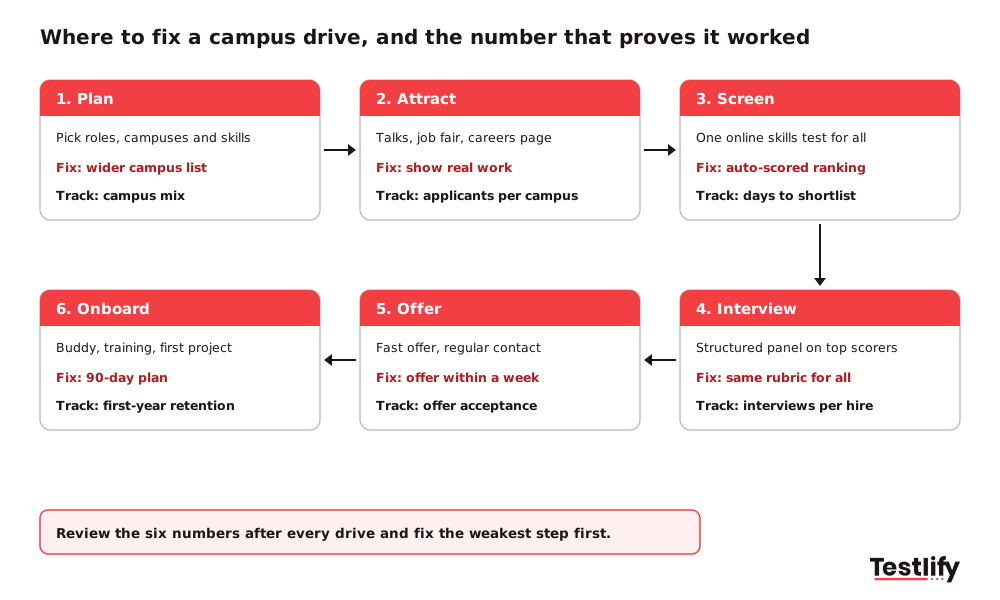
Step | Metric | What it tells you |
|---|---|---|
Plan | Campus mix | Whether your talent pool is too narrow |
Attract | Applicants per campus | Whether students know and want your brand |
Screen | Days from application to shortlist | Whether volume is still a bottleneck |
Interview | Interviews per hire | Whether the shortlist is accurate |
Offer | Offer acceptance rate | Whether speed and contact are working |
Onboard | First-year retention | Whether you hired for real skill fit |
Quality of hire is the number leadership asks about. LinkedIn's Future of Recruiting 2025 found 93% of talent acquisition professionals say accurately assessing skills is crucial to improving quality of hire, and companies with the most skills-based searches are 12% more likely to make a quality hire.
How does Testlify help with challenges in campus recruitment?
Testlify helps with challenges in campus recruitment by giving every student the same job-relevant test, scoring it automatically and ranking the pool before your team spends time on interviews. The campus hiring platform is built for high-volume graduate drives:
- Test library: 3,500+ validated tests, including aptitude, coding, communication and role-specific tests, plus an AI test builder that creates an assessment from a job description.
- Volume: Bulk invites by email, public link or your ATS, automatic scoring and a ranked shortlist, with unlimited assessments.
- Integrity: 20+ proctoring checks, AI assistance detection and question randomization.
- Reach: 25+ question types and tests in 15+ languages for campuses in different regions.
- Fit with your stack: Two-way sync with 100+ ATS and HRIS tools, including Workday, Greenhouse and SAP SuccessFactors, through integrations.
Results from a real drive: Gorin Systems hired 116 fresh graduates in 45 days with Testlify and cut phone interview time by 63%.
Ready to run your next campus drive?
Start with one role and one campus. Build the assessment from the Testlify test library, invite every applicant, and compare the ranked shortlist with your last drive. Testlify offers a 7-day free trial with no credit card. For a multi-campus program, book a demo and the team will help you set up the first drive.
Frequently asked questions
Related resources
View all
HR & recruitment
Campus hiring guide for new grads: how to hire at scale in 2026

HR & recruitment
Bad candidate experience: what it costs and how to fix it
HR & recruitment
How to enhance team productivity via cognitive reasoning

HR & recruitment
Building your HR tech stack for new-age recruiting

HR & recruitment
Difference between orientation and onboarding

HR & recruitment
The pros and cons of internal recruitment
Get started.
Hire on proof, not resumes.
Run your first skills-based assessment free — no credit card required.