
Reference Checks: Best Practices, Questions and Process
A practical guide to reference checks: when to run them, who to call, what to ask, what to avoid, and how to score the answers fairly.

Reference checks are short, structured conversations with people who have worked with a candidate, used near the end of hiring to confirm what the candidate told you and to fill gaps the interviews left open. Done well, they take about an hour per finalist and catch problems that are expensive to find after day one.
TL;DR / Key Takeaways
- Reference checks are short, structured calls with people who worked with a candidate, run to confirm claims and fill gaps.
- Fake identities and inflated resumes are more common in remote hiring.
- At the final stage, for one to three finalists, at the same point for every candidate.
- Three people who saw the work, including at least one former manager.
- Follow the seven-step process, from written consent to a scored decision.
- Confirm facts, ask for specific examples, and finish with the rehire question.
- Protected characteristics and anything unrelated to the job.
- Get written consent, follow FCRA rules for third-party checks, and store notes securely.
- Score every referee on the same 1 to 5 scale and compare the results with your assessment and interview evidence.
 ChatGPT
 Gemini
 Claude
 Grok
 Perplexity
What are reference checks?
Reference checks are conversations with a candidate's former managers, peers or clients to verify their work history and hear how they actually performed. A reference check usually confirms job titles, dates and responsibilities, then asks about results, working style and whether the person would rehire the candidate. The goal is evidence, not a character review.
The U.S. Office of Personnel Management describes reference checking as an evaluation of past job performance based on input from people who worked with the applicant, with three jobs: verify claims, predict success in the new role, and surface information other steps missed. For a one-line definition, see the reference check entry in our HR glossary.
Reference checks are often confused with two other final-stage checks:
Check | What it confirms | Who you contact | Usually needs |
|---|---|---|---|
Reference check | Performance, working style, rehire answer | Former managers, peers, clients | Candidate consent |
Employment verification | Employer name, job title, start and end dates | HR or a verification service | Candidate consent |
Background check | Criminal record, education, identity, licences | Screening company, public records | Written authorization under the FCRA in the U.S. |
Most teams run all three, but only the reference check tells you how someone worked. For the wider screening stage, read our guide to background checks.

Why do reference checks still matter?
Reference checks still matter because resumes, interviews and even video calls are easier to fake than they were three years ago. A reference who confirms the candidate's identity, title and results with specific examples is one of the few checks that comes from outside the candidate's own story.
The fraud numbers are the clearest reason. In a 2025 Checkr survey of 3,000 U.S. hiring managers, 31% said they had interviewed a candidate later found to be using a fake identity, 35% said someone other than the listed applicant had joined a virtual interview, and 60% had caught a candidate misrepresenting experience. Only 19% were extremely confident their process would catch a fraudulent applicant, and only 46% used reference verifications at all.
The trend is pointing the same way. Gartner, as reported by HR Dive, projects that by 2028 one in four candidate profiles worldwide could be fake, and 6% of the 3,000 candidates it surveyed admitted to interview fraud.
Recruiters also know the weakness: the candidate picks the referees, so most references are friendly. That is a reason to run reference checks better, not to drop them. Structured questions, the right mix of people and a verified referee turn a polite chat into evidence. A bad hire costs far more than an hour of calls; see our breakdown of the cost of a bad hire.
When should you run reference checks?
Reference checks belong at the final stage, after interviews and skills assessments, when you are choosing between one to three finalists. Many employers run them after a conditional offer, so the candidate's current job is not put at risk and the check confirms a decision rather than replacing one.
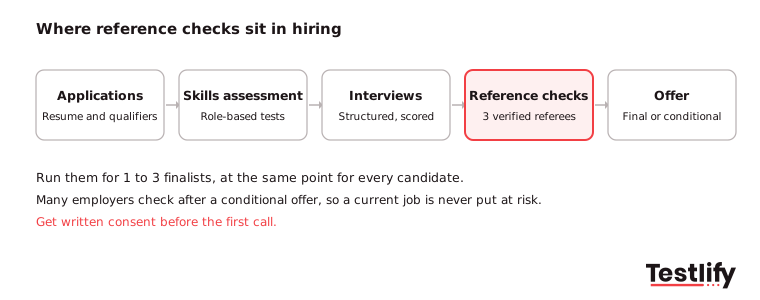
Whichever point you pick, keep it the same for every finalist in the same role. Checking one candidate before the offer and another after creates an uneven process that is hard to defend. Tell candidates early, in the job post or first interview, that references are part of the process, and ask for consent in writing before you call anyone.
Pro tip: Ask for references at the shortlist stage, not at the start. Collecting names from every applicant wastes their time and yours, and referees get tired of calls for roles the candidate never reaches.
Who should you ask for a reference?
Reference checks work best with three people who saw the candidate's work directly: at least one former manager, one peer, and for client-facing or leadership roles, a client or a direct report. OPM recommends at least three contacts per finalist, so a single glowing call does not decide the hire.
- Former managers: Best for performance, reliability and the rehire question. Aim for managers from two different jobs if you can.
- Peers: Best for collaboration, communication and how the candidate handles disagreement.
- Direct reports: Best for leadership roles, where how someone manages matters more than what their boss thought.
- Clients or customers: Best for sales, account management and support roles.
- Mentors or professors: Acceptable for graduates with little work history, but weaker evidence.
Friends and family are not references. Neither is a colleague who never saw the candidate's work.
Recruiters also talk about front-door and backdoor references. Front-door references are the names the candidate gives you. Backdoor references are people you find yourself, such as a mutual contact at a former employer. Backdoor calls can be useful, but only with the candidate's consent, and never with their current employer unless they agree. A surprise call to a current boss can cost someone their job.
How do you conduct a reference check?
A reference check works best as a structured, 20 minute phone or video call with the same core questions for every finalist. The seven steps below take about an hour per candidate across three referees and give you notes you can compare side by side.
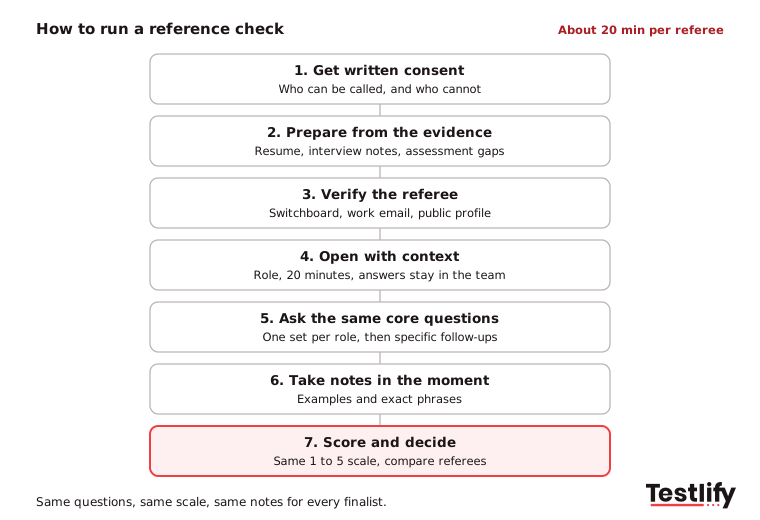
- Get written consent: Confirm the candidate agrees to each contact, and note any company they do not want called.
- Prepare from the evidence: Read the resume, interview notes and assessment results. List two or three gaps or claims you want confirmed.
- Verify the referee: Confirm the person is real and worked with the candidate: check the company switchboard, a work email domain or a public profile, not only the number the candidate gave.
- Open with context: Introduce yourself, name the role, say the call takes about 20 minutes and that answers stay within the hiring team.
- Ask the same core questions: Use one question set for every referee for the role, then follow up on specifics.
- Take notes in the moment: Write down examples and exact phrases, not impressions.
- Score and decide: Rate each competency on the same scale and compare referees before anyone discusses the candidate.
Structured reference calls follow the same logic as a structured interview: same questions, same scale, same notes, so the result depends on the candidate and not on who made the call.
What questions should you ask in a reference check?
Reference check questions should confirm facts first, then ask for specific examples of performance, working style and growth, and finish with whether the referee would hire the candidate again. Open questions that start with "tell me about a time" or "how did" get far more useful answers than yes or no questions.
Confirm the facts
- What was your working relationship with the candidate, and for how long?
- What were the candidate's job title and main responsibilities?
- What dates did the candidate work with you?
Performance and results
- What were the candidate's two or three biggest contributions?
- Can you describe a project that went badly and what the candidate did?
- How did the candidate's work compare with others in the same role?
Working style and collaboration
- How did the candidate handle disagreement with a colleague or manager?
- How much direction did the candidate need to do their best work?
- How did the candidate respond to feedback?
Growth and fit for the new role
- What should the candidate's next manager know to help them succeed?
- Where did the candidate need the most support?
- We are hiring for a role that involves [core task]. How do you think the candidate would do?
The rehire question
- Would you hire or work with the candidate again? Why or why not?
Tie at least two questions to gaps from earlier stages. If the skills assessment showed strong analysis but weak written communication, ask the referee about written work directly instead of repeating the interview.
What should you not ask a reference?
Reference checks should never ask about protected characteristics or anything unrelated to the job. That rules out age, race, religion, national origin, disability, health, pregnancy, family plans, marital status and similar topics, even when a referee volunteers them. Ask only what you would be comfortable defending in writing.
Ask about | Avoid asking about |
|---|---|
Job title, dates, responsibilities | Age, birth year or graduation year |
Results and specific examples | Health, sick days or medical leave |
Reliability and meeting deadlines | Pregnancy, children or family plans |
How the candidate handled feedback | Religion, nationality or ethnicity |
Rehire eligibility | Salary history, where local law bans it |
Skills needed for the new role | Off-duty life, politics or social media |
Pay questions need special care. In New York City, the salary history ban applies during any part of the hiring process, and many U.S. states have similar rules, so keep compensation out of reference calls unless counsel has cleared it for your locations.
What legal rules apply to reference checks?
Reference checks are legal almost everywhere, but they come with consent, discrimination, data and disclosure rules. The safe baseline is written consent from the candidate, job-related questions only, the same process for every finalist, and secure storage of notes. Local law adds detail, so confirm your process with counsel.
- Consent: Get the candidate's written agreement before you contact anyone, and record who you called.
- Third-party checks in the U.S.: If a screening company runs reference interviews for you, the Fair Credit Reporting Act guidance from the FTC applies: a stand-alone written notice, written authorization, and pre-adverse and adverse action notices if the report leads you to reject someone. Interview-based investigative reports need extra disclosure.
- Equal treatment: Discrimination law covers reference questions just as it covers interviews.
- What former employers can say: Many former employers confirm only dates and title because of defamation worries. Several U.S. states protect good-faith references through job reference immunity statutes, but policies still vary.
- Data protection: Under GDPR and similar laws, reference notes are personal data: collect only what you need, limit who sees it, and set a retention period.
This section is general information, not legal advice.
How do you spot red flags in a reference check?
Reference check red flags are patterns, not single moments: a referee who cannot be verified, facts that do not match the resume, vague or rehearsed answers, and hesitation on the rehire question. One lukewarm answer means little; the same concern from two independent referees deserves a follow-up with the candidate.
- The referee cannot be verified: A personal email, a mobile number with no company link, or a company that does not list the person. See how to identify and address fake employment references.
- Facts do not match: Different titles, dates or team sizes from what the candidate claimed.
- Vague or scripted answers: Praise with no examples, or identical phrasing across referees.
- Hesitation on rehire: A pause, a "it depends" or a change of subject.
- Policy-only responses: A former employer that confirms only dates is often following policy, not hiding something. Ask the candidate for another manager-level referee instead of assuming the worst.
Give the candidate a chance to explain a concern before you decide. A conflict with one manager can have a fair explanation that a second referee confirms.
How do you turn reference feedback into a hiring decision?
Reference feedback becomes useful when each referee's answers are scored against the same three to five competencies on a 1 to 5 scale, with a written example behind every score. The scores then sit next to assessment results and interview ratings, so references confirm or challenge the evidence instead of overriding it.
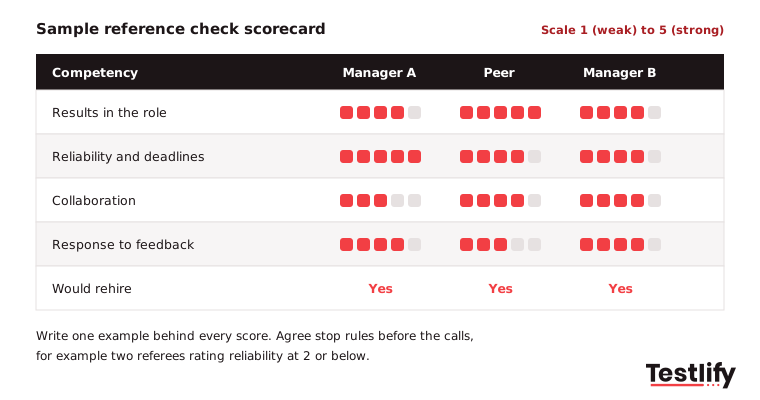
Use the same competencies you used in the interview scorecard, add the rehire answer, and agree in advance what counts as a stop: for example, two referees scoring reliability at 2 or below, or a fact that does not match the resume.
Reference checks are strongest when they confirm skills you already measured. Testlify gives hiring teams that earlier evidence: role-based skills assessments from a library of 3,500+ tests in the test library, structured AI interviews, and 20+ proctoring checks that help confirm the person who took the test is the person you are hiring. With scores in hand, the reference call can focus on the two or three gaps that remain.
Key takeaway: Treat reference checks as a structured, scored step at the end of hiring. Get consent, call three verified people who saw the work, ask the same job-related questions, avoid protected topics, and score answers next to your skills and interview evidence.
Frequently asked questions

Content Writer
Yashika Khandelwal is a Content Writer with 3+ years of experience creating research-backed content on hiring, talent assessment, and HR technology. She is a registered Organizational Psychologist and subject matter expert who combines behavioral science with practical recruitment insights to produce accurate, evidence-based content.
LinkedInRelated resources
View all
HR & recruitment
How to create a positive work culture

HR & recruitment
How to retain top employees

HR & recruitment
The importance of employee engagement

HR & recruitment
HR technology trends in 2026: a practical guide

HR & recruitment
How to manage workplace diversity: a practical guide

HR & recruitment
The ultimate guide to employee onboarding
Get started.
Hire on proof, not resumes.
Run your first skills-based assessment free — no credit card required.