
Employee Experience Tools: The 2026 Guide for HR Leaders
TL;DR Global employee engagement fell to 20% in 2025, the lowest since 2020, costing the world economy roughly $10 trillion in lost productivity (Gallup, 2025). Engaged teams are 23% more profitable and 51% less likely to see high turnover than disengaged ones (Gallup). Replacing one employee costs 50% to 200% of their annual salary, making…

TL;DR
- Global employee engagement fell to 20% in 2025, the lowest since 2020, costing the world economy roughly $10 trillion in lost productivity (Gallup, 2025).
- Engaged teams are 23% more profitable and 51% less likely to see high turnover than disengaged ones (Gallup).
- Replacing one employee costs 50% to 200% of their annual salary, making retention a financial goal, not just an HR metric.
- 52% of employees who quit voluntarily say their manager could have done something to prevent it (Gallup).
- Employee experience starts at the hiring assessment, not onboarding. The screening process shapes candidates’ first real impression of an organization.
- This guide covers 10 employee experience tools across five categories, pre-hire assessment, onboarding, feedback and performance, recognition, and culture measurement, mapped to the full employee lifecycle.
Most HR teams think employee experience begins on day one. It doesn’t. It begins the moment a candidate opens an assessment link, completes a skills test, or waits three weeks to hear back after a screening call. The tools used at the hiring stage say something about an organization before anyone writes their first line of code or sends their first client email.
That doesn’t diminish the importance of what happens after someone joins. Feedback, recognition, performance management, and culture tools all matter. But investing only in post-hire experience means starting the employee relationship behind. McKinsey’s State of Organizations 2023 found that companies in the top quartile for organizational health, which includes employee experience, outperform peers on total returns to shareholders by 2.2 times.
 ChatGPT
 Gemini
 Claude
 Grok
Grok Perplexity
What are employee experience tools?
Employee experience tools are software platforms that help organizations shape, measure, and improve how employees feel and perform across the full employment lifecycle. They span pre-hire assessment, onboarding, feedback and performance management, recognition, culture analytics, and digital experience management.
The stakes for getting this right are real. Gallup’s 2025 State of the Global Workplace report found that only 20% of employees globally are engaged at work, a drop from the 2023 peak of 23%. That gap costs roughly $10 trillion in lost productivity per year, or about 9% of global GDP.
The category has grown significantly, not just because HR budgets expanded, but because the return on investment is now measurable. Engaged teams are 23% more profitable and 14% more productive than their disengaged counterparts, according to Gallup’s research on engagement outcomes. Those aren’t soft outcomes. They show up in earnings.

What does poor employee experience cost?
The short version: more than most calculate. Gallup estimates that replacing one employee costs between 50% and 200% of their annual salary. For a team of 100 people earning $70,000 on average with a 20% annual turnover rate, that’s $700,000 to $2.8 million a year in replacement costs alone, before accounting for lost institutional knowledge, disruption to team productivity, and the time managers spend on interviews instead of their actual work.
There’s also a harder number to put on it: morale. One disengaged person tends to drag down the people around them. When 52% of voluntarily exiting employees say their manager or organization could have done something to keep them, most churn looks less like an inevitability and more like a management system failure.
Pro Tip: Managers account for up to 70% of the variance in team engagement, according to Gallup. If deciding where to invest in employee experience tools, start with tools that support the manager-employee feedback relationship, not company-wide perk programs that skip the day-to-day dynamic.
What are the 5 C’s of employee engagement?
The 5 C’s of employee engagement are Connection, Clarity, Contribution, Communication, and Credibility. These five factors consistently appear in engagement research as the primary drivers of whether employees feel motivated, valued, and committed to staying.
- Connection: Employees who feel connected to colleagues, managers, and company mission are significantly more likely to report high engagement. Recognition platforms and team feedback tools build this signal at scale.
- Clarity: Clear expectations, role definitions, and goal alignment reduce uncertainty and disengagement. Performance tools like Lattice and 15Five address this by making OKRs visible at every level of the organization.
- Contribution: Employees need to see how their work connects to outcomes that matter. Goal management platforms make individual contribution to team performance visible, which correlates directly with retention.
- Communication: Consistent two-way feedback loops between managers and employees reduce voluntary churn. SHRM research found that employees who receive regular feedback are 3.6 times more likely to report being motivated to perform above expectations.
- Credibility: Trust in leadership is non-negotiable. Culture survey tools like Culture Amp and Workday Peakon surface gaps between what leadership says and what employees experience, giving HR teams data to act on before credibility erodes.
Key Takeaway: Tools don’t create engagement. They create conditions for the 5 C’s to operate at scale. A recognition platform addresses Connection. A goal management tool addresses Clarity and Contribution. Culture surveys address Credibility. The right stack covers all five, not just one.
Which tools support ongoing feedback and performance?
Three platforms dominate this space for mid-to-large organizations: 15Five, Lattice, and Leapsome. All three replace the traditional annual review cycle with ongoing check-ins and real-time feedback, which is where most engagement research says the value actually is.
15Five
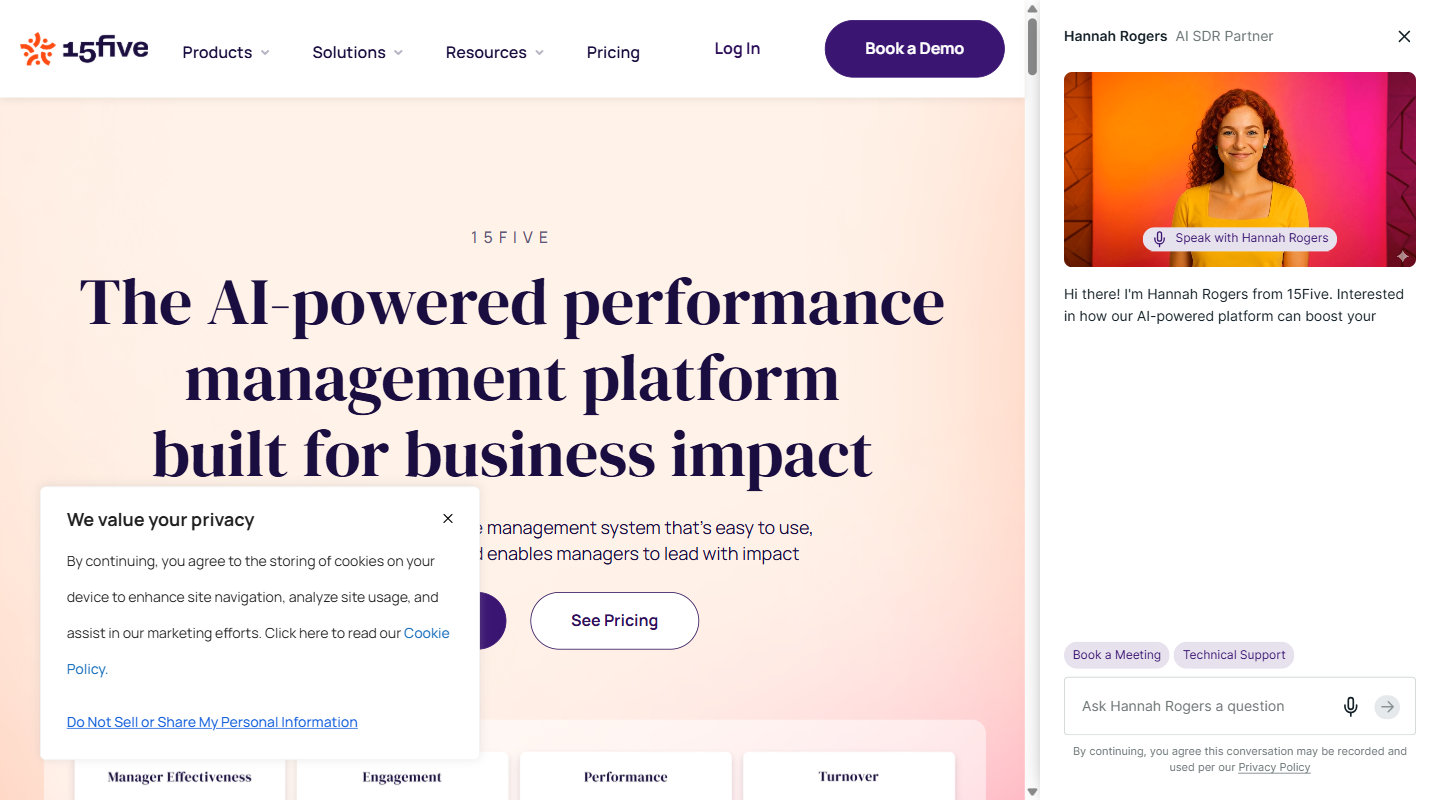
15Five is built around a weekly check-in that takes employees about 15 minutes to complete and managers about 5 minutes to review. That rhythm catches problems early. It gives employees a consistent channel to flag what’s working and what isn’t, and it gives managers a running record of progress rather than a once-yearly snapshot. For HR leaders scaling teams quickly, this kind of continuous signal is far more useful than a semi-annual performance conversation.
The honest caveat: the tool works when managers use it. If the organization’s culture treats one-on-ones as optional, the platform data goes stale quickly. 15Five amplifies habits that already exist, it doesn’t create new ones from scratch.
- Weekly check-in prompts for managers
- OKR-linked goal visibility dashboard
- Manager effectiveness scoring reports
- Engagement pulse survey templates
- 1-on-1 agenda and note builder
Pros: Fast manager adoption curve; strong mobile experience. Cons: Analytics depth limited on lower tiers. Pricing: Engage from $4/user/month; Perform from $8/user/month.
Lattice
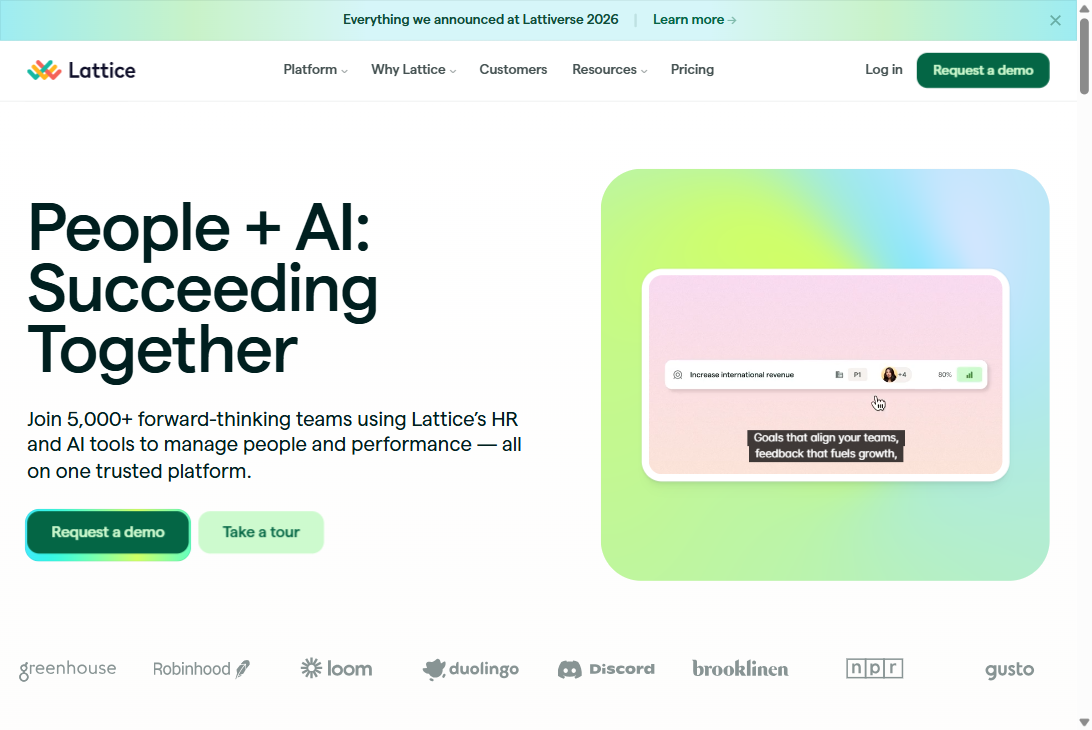
Lattice covers similar ground but leans more heavily into OKR-style goal tracking. Employees can see how their work connects to the team’s objectives, and managers get trend data across their team rather than one-off anecdotes. The analytics layer is useful for identifying high performers and spotting early signs of disengagement before someone starts quietly looking elsewhere.
Lattice also includes a compensation module in higher tiers, which connects performance data directly to pay decisions. For HR teams where performance review cycles drive compensation reviews, that integration reduces the manual work of correlating two separate systems.
- 360-degree peer review builder
- OKR and goal alignment tracking
- Engagement survey and sentiment analysis
- Career development and growth tools
- Compensation management and benchmarking
Pros: Strong data analytics; connects performance to compensation. Cons: Setup time is significant for smaller HR teams. Pricing: From $11/person/month for Performance + OKRs.
Leapsome
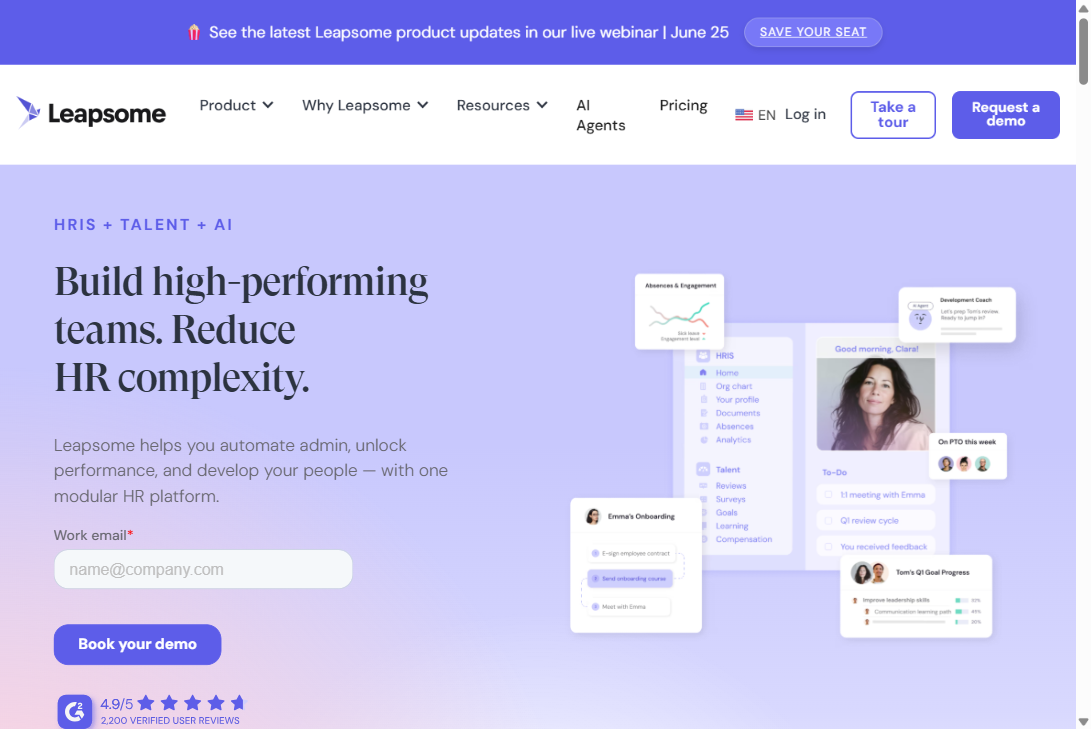
Leapsome combines performance management, OKRs, engagement surveys, and learning and development into a single platform. Where 15Five is optimized for the manager-employee feedback loop and Lattice for data-driven HR analytics, Leapsome is positioned for organizations that want to connect performance outcomes to learning pathways in the same interface.
For companies where employee development is a stated retention strategy, the combined performance-plus-learning approach means managers can recommend specific learning paths based on review outcomes without switching tools. That reduces the gap between identifying a skill need and addressing it.
- Performance review and 360 feedback
- OKR and goal cascading tools
- Integrated learning path recommendations
- Engagement and pulse survey analytics
- Compensation and calibration modules
Pros: All-in-one performance and L&D; strong for growth-focused cultures. Cons: Feature breadth creates onboarding complexity. Pricing: From $8/user/month.
Key Takeaway: Before buying a feedback or performance management platform, ask whether managers currently hold consistent one-on-ones with their reports. If the answer is rarely, the tool won’t fix that. Address the management behavior first, then choose the platform that fits the cadence the organization can actually sustain.
How do recognition programs shape employee experience?
Recognition is one of the most effective inputs to engagement, and one of the cheapest levers when implemented well. The catch is that generic recognition (“great work this quarter”) has almost no measurable effect. Specific, behavior-linked recognition (“you caught that billing error that saved the company $40,000”) does.
Kudos
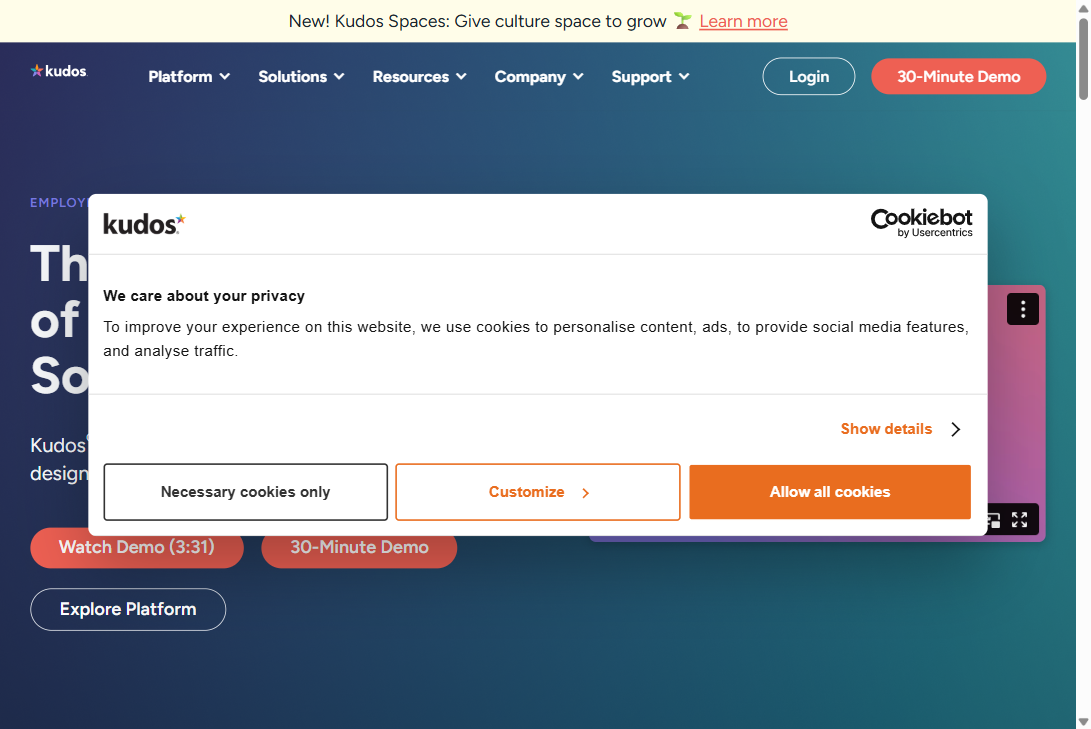
Kudos is a peer-to-peer recognition platform where employees acknowledge colleagues publicly and connect recognition to company values. The dual effect is useful: recognized employees feel valued, and the public nature of the recognition models the behaviors the organization is trying to reinforce. For distributed or remote teams, this kind of visible appreciation matters more than in a tight-knit in-person environment where informal praise happens naturally.
- Values-linked peer recognition feed
- Public social recognition wall
- Points-based rewards and redemption
- Manager and executive recognition tools
- Engagement analytics by team and department
Pros: High employee adoption; strong for remote and hybrid teams. Cons: Participation can concentrate in smaller groups over time without active management. Pricing: Quote-based; typically $3-5/user/month.
Vantage Circle
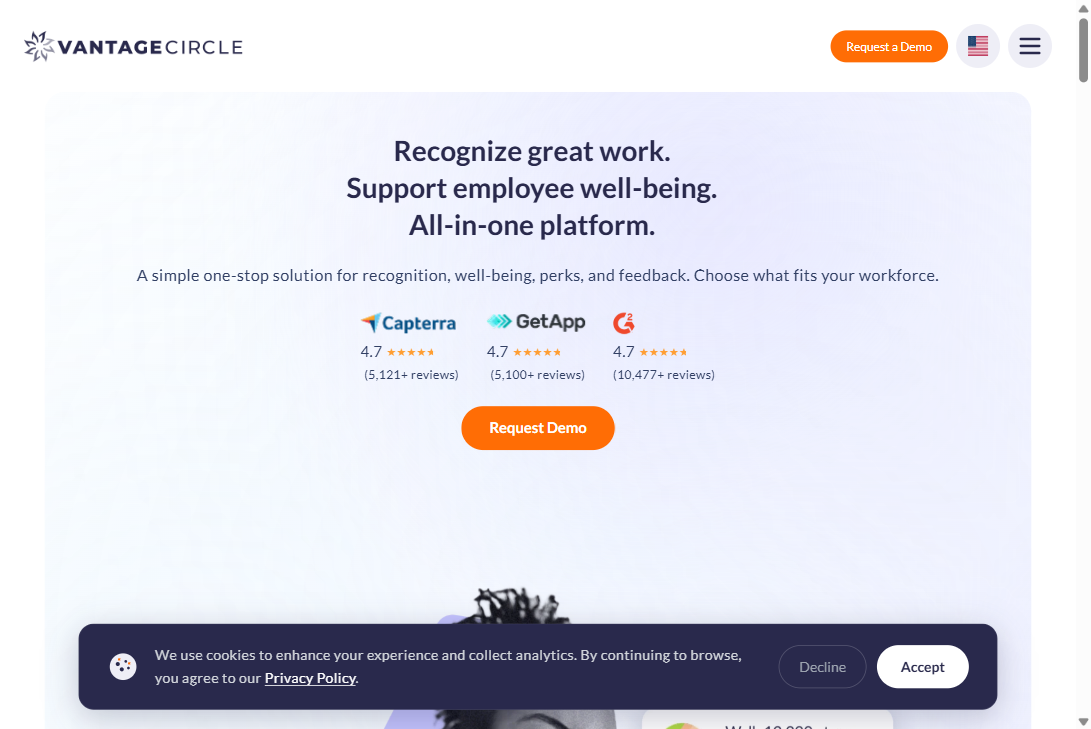
Vantage Circle adds a perks and rewards layer to recognition, including employee discounts, wellness programs, and service award management. The theory is that visible investment in employee wellbeing builds a sense of belonging that salary increases alone can’t replicate. That holds up in practice for companies where compensation is competitive but culture signals are thin.
Recognition programs have a shelf life. They lose meaning when they become routine or when participation drops to a small group of enthusiastic advocates. The most effective implementations tie recognition to specific cultural values and require specificity in nominations, so the system stays meaningful rather than becoming another checkbox.
- Employee discount marketplace integration
- Wellness reimbursement and tracking
- Service award and milestone automation
- Peer-to-peer recognition with points
- Engagement survey and feedback tools
Pros: Combines recognition and perks in one platform; global reward catalog. Cons: Survey module is less capable than dedicated culture tools. Pricing: Quote-based; starts around $2/user/month.
How do you measure workplace culture at scale?
Culture is the hardest thing to move and the easiest to lose. It’s also notoriously difficult to measure because it lives in how people talk about their manager on the commute home, not in the answers they give on a quarterly survey. Two platforms take meaningfully different approaches to this problem.
Culture Amp
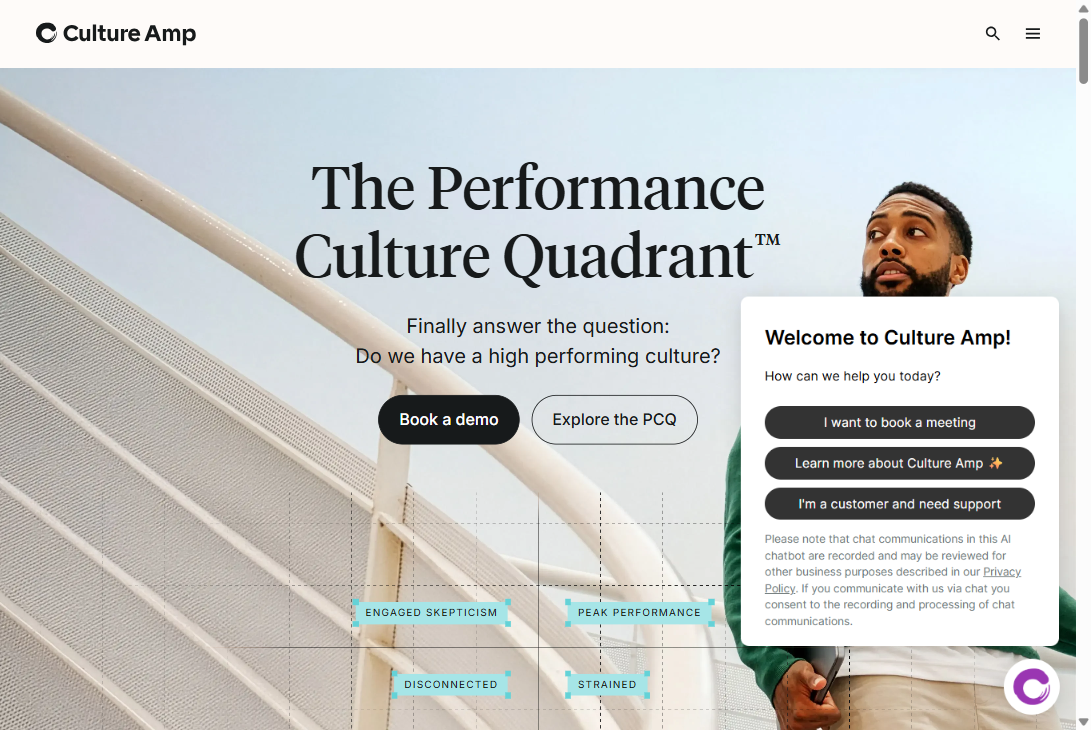
Culture Amp approaches culture measurement with employee surveys, sentiment analysis, and benchmarking data drawn from a large customer base. For people leaders at organizations with more than a few hundred employees, the scale problem is real: talking directly to everyone isn’t possible. Culture Amp gives aggregated signals broken down by team, tenure, and function. That turns “culture feels off in the engineering org” from a vague worry into a data point that can be addressed.
Survey fatigue is real and worth naming directly. If employees have seen multiple survey rounds with no visible follow-through, response rates drop and the data becomes less useful. Culture Amp works best in organizations where leadership has a track record of acting on what they hear, not just collecting it.
- Engagement survey benchmarking by industry
- Sentiment analysis across open-text responses
- Performance review and goal management
- DEI analytics and reporting dashboard
- Manager effectiveness and feedback tools
Pros: Industry benchmark data; actionable insights for mid-to-large teams. Cons: Requires HR investment to interpret and act on results. Pricing: Quote-based; typically $5-8/user/month at enterprise scale.
Workday Peakon Employee Voice
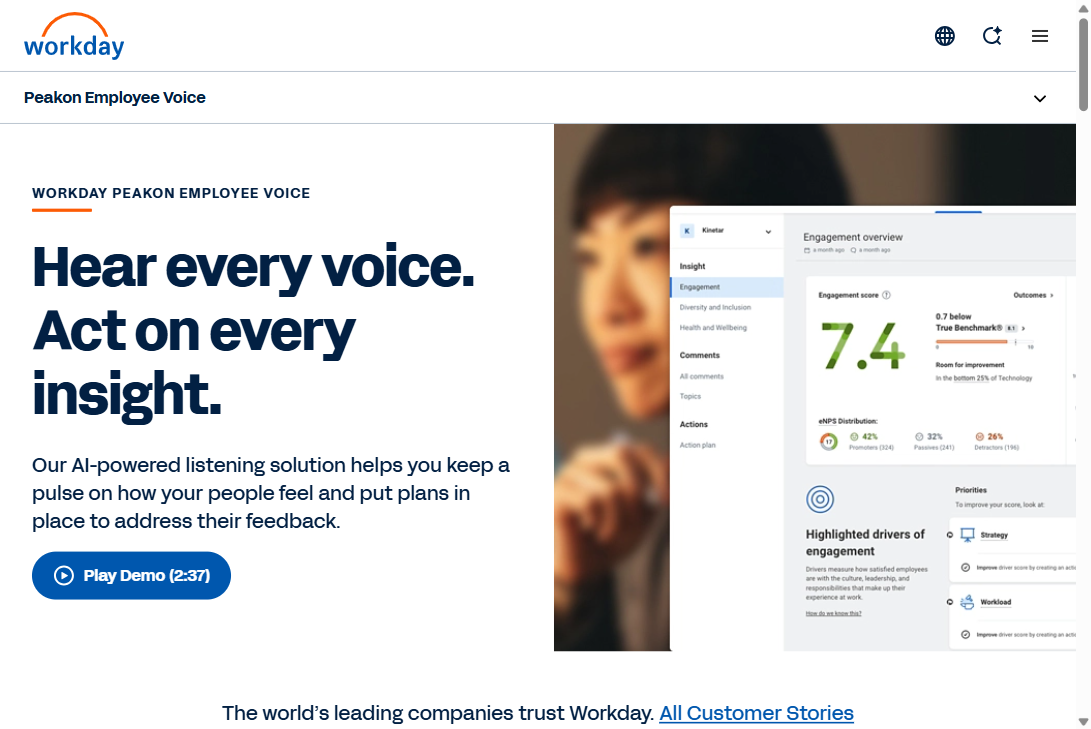
Workday Peakon takes a continuous listening approach rather than periodic survey cycles. Employees receive short pulse questions on a rolling basis, generating a real-time engagement signal rather than a quarterly snapshot. The platform’s predictive analytics layer flags teams and individuals showing early attrition signals, giving HR leaders time to intervene before someone submits their resignation.
For enterprises already running Workday for HRIS and payroll, the Peakon integration means engagement data sits in the same system as compensation and headcount data. That connection makes it possible to correlate pay equity gaps or internal mobility patterns with engagement scores, which is a significantly more nuanced picture than survey data alone provides.
- Continuous pulse survey delivery system
- Predictive attrition risk scoring
- Manager dashboard with team insights
- Confidential employee comment analysis
- Native Workday HRIS integration
Pros: Real-time signal versus quarterly snapshots; strong enterprise integrations. Cons: Most value is realized within the Workday ecosystem. Pricing: Enterprise only; quote-based.
Pro Tip: After each survey cycle, identify one or two specific pain points and make one visible change in response to each. The “you said, we did” pattern builds more trust in the feedback system than any platform feature. Without it, survey response rates decline with each round.
Which digital employee experience tools support distributed teams?
For organizations with remote or hybrid workforces, the digital layer of employee experience, meaning the tools people use to collaborate, access information, and manage their own records, directly shapes how connected and productive they feel day-to-day. Two platforms are purpose-built for this layer.
Microsoft Viva
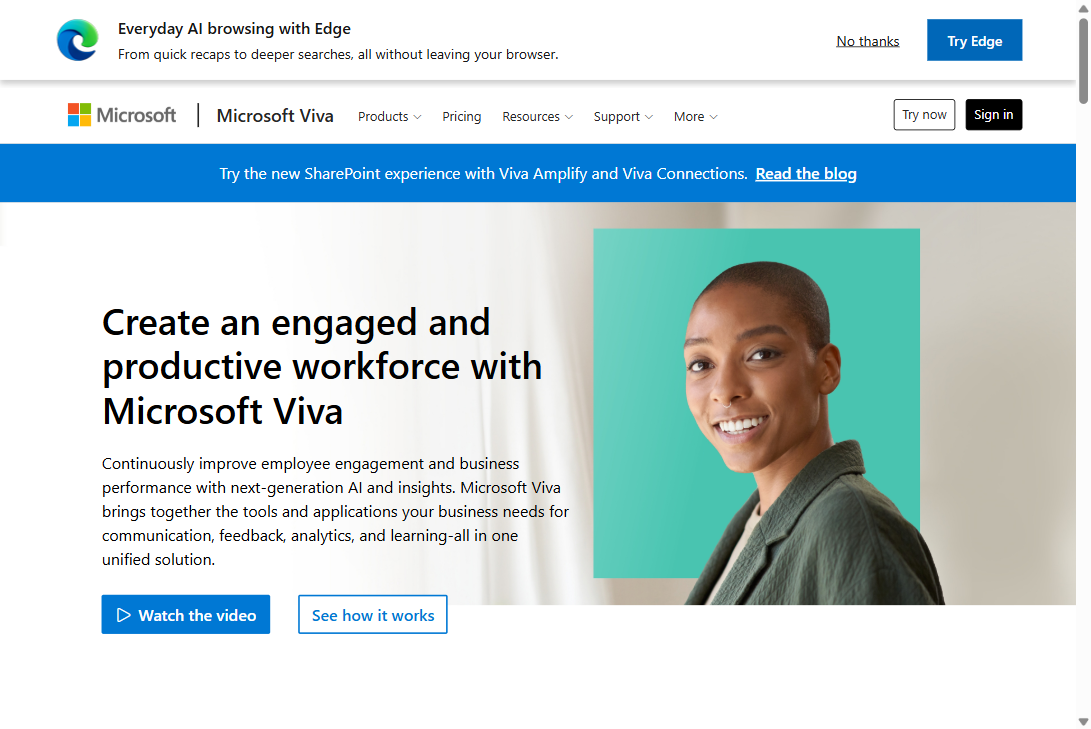
Microsoft Viva is an employee experience platform built into Microsoft 365 and Microsoft Teams. It covers four areas: Viva Insights for personal and team wellbeing and productivity data, Viva Engage for company-wide community and communication, Viva Learning for integrated L&D, and Viva Goals for OKR management. For organizations already invested in the Microsoft ecosystem, Viva reduces the need for separate point solutions across each of these categories.
The practical advantage is visibility without surveillance. Managers can see aggregated meeting load, after-hours collaboration patterns, and focus time data through Viva Insights, which helps identify whether a team is burning out before individuals start flagging it in one-on-ones.
- Wellbeing and focus time analytics
- Company community and communications hub
- Integrated learning and skill recommendations
- OKR and team goal management
- Native Microsoft 365 and Teams integration
Pros: No additional login friction; deep Microsoft 365 integration. Cons: Full value only realized within the Microsoft ecosystem. Pricing: Core modules included with M365; full suite from $12/user/month.
BambooHR
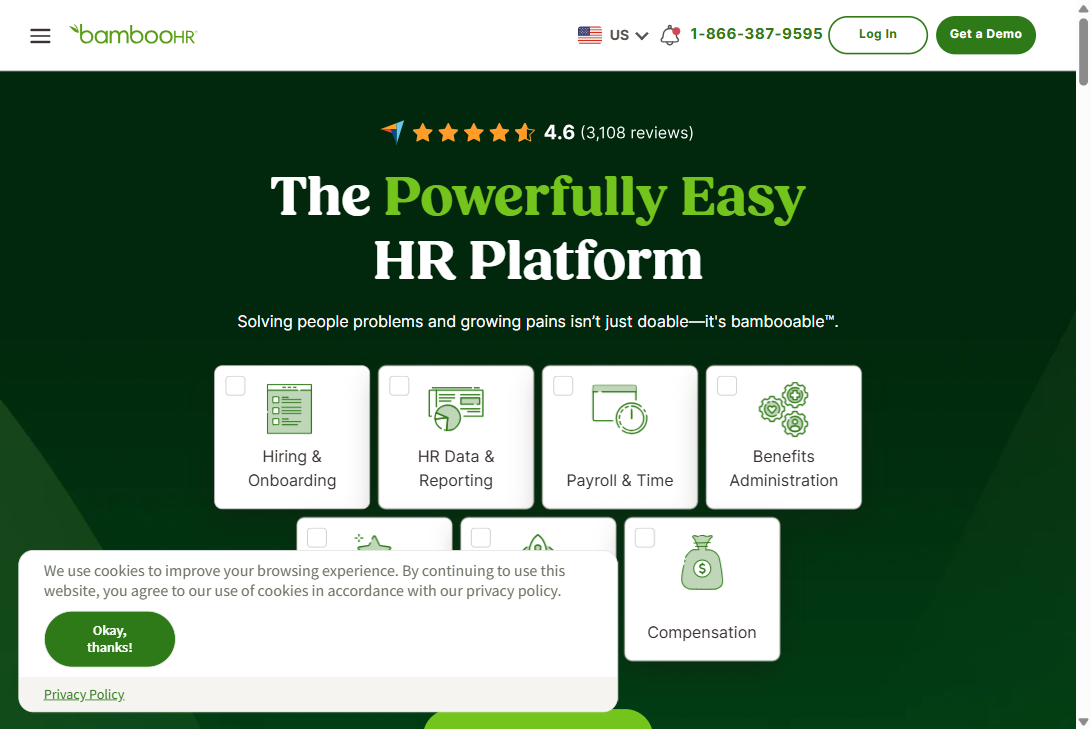
BambooHR is an HRIS platform that handles the onboarding and employee self-service layer of experience: electronic offer letters, structured onboarding workflows, time tracking, basic performance management, and an employee self-service portal. For HR teams at companies between 50 and 1,000 employees, the value is in consolidating what would otherwise be four or five separate tools into one.
SHRM research found that 69% of employees are more likely to stay for at least three years following a positive onboarding experience. BambooHR’s structured onboarding workflows address this directly by ensuring new hires complete the same set of activities regardless of which manager handles them, which removes the inconsistency that makes early-tenure experience so variable across teams.
- Structured onboarding workflow automation
- Electronic offer letter and e-signature
- Employee self-service portal and records
- Time tracking and PTO management
- Basic performance review module
Pros: Easy setup for mid-size HR teams; strong onboarding workflows. Cons: Performance module is basic compared to dedicated platforms. Pricing: Essentials from approximately $6/user/month.
Does employee experience start during the hiring process?
Yes, and this is the part most employee experience strategies miss entirely. The first real interaction most candidates have with an organization is not onboarding: it’s the moment they open a screening assessment or complete a skills test. What that experience communicates matters before any offer is signed.
A poorly designed screening process tells candidates that their time is valued less than the organization’s convenience. A structured, role-relevant skills assessment says the opposite: evaluation is based on what people can actually do, not how polished their CV looks or how well they perform in an unstructured interview.
Testlify
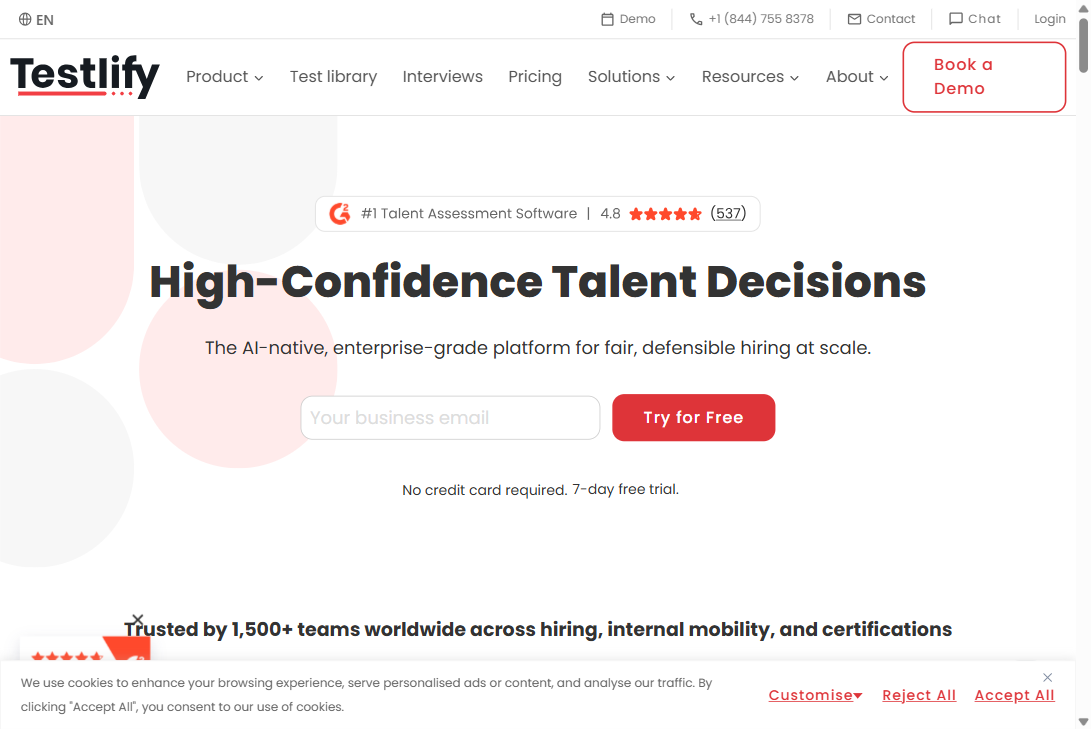
This is the core of Testlify’s Hire-for-Fit Framework: skills-based screening at the top of the hiring funnel does two things simultaneously. It creates a better candidate experience because evaluation is merit-based and structured, and it improves hire quality because people selected for demonstrated skills are better fits for the role, which translates to higher early engagement and lower time-to-productivity.
A 500-person SaaS company hiring 20 engineers per quarter could use role-specific coding assessments before the first screening call. That approach typically cuts a six-week screening loop to roughly ten days because the shortlist is already skill-validated. Candidates who advance feel the process was fair. Candidates who don’t still leave with a structured, respectful experience. Both groups remember how they were treated, which matters for employer brand at scale.
Testlify’s candidate screening platform covers more than 3,000 tests across 4,500 job roles, including technical, cognitive, personality, and role-based assessments. With 100+ ATS integrations, assessments fit into existing hiring workflows without requiring a platform switch. The result: a 94% candidate satisfaction rate and a 55% average reduction in time-to-hire across Testlify customers.
- 3,500+ role-specific assessment library
- Anti-cheat and proctoring controls
- 100+ ATS and HRIS integrations
- Candidate experience rating and feedback
- Structured shortlist with score reporting
Pros: 94% candidate satisfaction; 55% reduction in time-to-hire. Cons: Best results require role-specific test selection upfront. Pricing: Free trial available; Growth, Business, and Enterprise tiers.
Key Takeaway: An ATS, job descriptions, and pre-hire assessments are all part of employee experience. A candidate who goes through a structured, skills-first screening process carries a better impression into their first day. That shortens the time it takes new hires to become fully productive because role fit and culture fit were confirmed before the offer.
Which employee experience tools suit your use case?
No single platform covers the full employee lifecycle well. The right stack depends on which phase of the lifecycle is creating the most friction and which integrations matter most for the existing tech environment. This table maps all 10 tools in this guide by category, best-fit use case, and pricing tier.
Tool | Category | Best for | Pricing tier |
|---|---|---|---|
Testlify | Pre-hire assessment | Skills-based hiring, fast shortlisting | Free trial; Growth/Business/Enterprise |
BambooHR | HRIS + onboarding | SMBs needing structured onboarding | From ~$6/user/month |
15Five | Feedback + performance | Manager-employee check-in cadence | From $4/user/month |
Lattice | Performance + OKRs | Data-driven HR at 50-5,000 employees | From $11/person/month |
Leapsome | Performance + L&D | Connecting reviews to learning paths | From $8/user/month |
Kudos | Recognition | Remote/hybrid peer recognition | ~$3-5/user/month |
Vantage Circle | Recognition + perks | Global reward catalog and wellness | From ~$2/user/month |
Culture Amp | Culture analytics | Mid-to-large teams needing benchmarks | ~$5-8/user/month |
Workday Peakon | Continuous listening | Enterprises wanting real-time signals | Enterprise; quote-based |
Microsoft Viva | Digital EX platform | Microsoft 365 organizations | From $12/user/month |
How do you pick the right employee experience tools?
Most HR tech stacks have gaps, not because teams haven’t tried, but because buying decisions get made one tool at a time without a clear view of which lifecycle phase is most underserved.
A useful frame: map tool selection against the four phases of employee experience. Most organizations invest heavily in in-role and retention tools (feedback, recognition, culture surveys) and almost nothing in the pre-hire phase. That imbalance creates a gap between who’s being hired and who’s actually needed.
Phase | What it covers | Tools in this guide | What to look for |
|---|---|---|---|
Pre-hire | Skills assessment, candidate screening, first impressions | Testlify | Role-specific tests, anti-cheat, ATS integrations, fast time-to-shortlist |
Onboarding | Role readiness, cultural orientation, early engagement | BambooHR | Structured 30-60-90 day check-ins, manager guidance workflows |
In-role | Feedback, goals, recognition, day-to-day engagement | 15Five, Lattice, Leapsome, Kudos, Microsoft Viva | Weekly check-in cadence, manager adoption rate, goal visibility |
Retention | Culture measurement, benefits, wellbeing programs | Culture Amp, Workday Peakon, Vantage Circle | Survey response rates, actionable reporting, segmentation by team and tenure |
Four questions to guide tool selection:
- Which lifecycle phase has the most friction right now? Start there, not with whatever platform was seen at a conference.
- Does the management culture support the tool’s workflow? A weekly check-in platform fails if managers treat one-on-ones as optional.
- What does the integration picture look like? Tools that don’t connect to the ATS or HRIS create data silos that make people analytics harder.
- Are outcomes being measured, not just activity? A low survey response rate is data. A shortlist that takes six weeks to build is data. Track what the tool actually changes, not just whether people are using it.
Start with the phase that’s costing the most. If retention is the problem, check whether hire quality is contributing before investing in another recognition platform. If screening quality is the issue, a better feedback tool won’t fix it. Look at the pre-employment testing approach first, then build out from there.
Frequently asked questions about employee experience tools

Content Writer
Yashika Khandelwal is a Content Writer with 3+ years of experience creating research-backed content on hiring, talent assessment, and HR technology. She is a registered Organizational Psychologist and subject matter expert who combines behavioral science with practical recruitment insights to produce accurate, evidence-based content.
LinkedInRelated resources
View all
HR & recruitment
How to create an inclusive employee experience in 2026?

HR & recruitment
Employee experience trends for 2026 and beyond

HR & recruitment
How to measure and improve employee experience in 2026?
HR & recruitment
How to create a positive employee experience?

HR & recruitment
What is employee experience and why is it important?

HR & recruitment
A Practical Guide to Hiring an Executive Resume Writer
Get started.
Hire on proof, not resumes.
Run your first skills-based assessment free — no credit card required.