
The benefits of using talent assessment in the hiring process
Talent assessments improve hiring by identifying top candidates, reducing biases, and aligning skills with organizational needs.

According to SHRM, 69% of organisations reported difficulty recruiting for any full-time role. With remote work, global talent pools, digital-first organizations, and evolving skill demands, the traditional hiring methods, resumes, intuition, and unstructured interviews are no longer enough to consistently make great hiring decisions.
Organizations now need ways to truly understand whether a candidate has the right skills, problem-solving capabilities, behaviors, and values to thrive in a role and within a specific work environment. That’s exactly where talent assessments come in.
Talent assessments are tools and methods used to evaluate a candidate’s abilities, personality, aptitudes, and job fit in a structured, objective way. They help recruiters and hiring managers make better, faster, and more confident decisions.
In this article, we’ll explore:
- What talent assessments are
- The different types of assessments
- The key benefits of using assessments in hiring
- How they improve quality of hire, minimize bias, support candidate experience, and boost retention
- Practical best practices for implementing assessments effectively
Let’s dive in.
 ChatGPT
 Gemini
 Claude
 Grok
Grok Perplexity
What are talent assessments?
Talent assessments help hiring teams evaluate whether a candidate can do the job and is the right fit for the role and workplace.
While resumes show work history and interviews reveal communication style, assessments give data-backed insights into:
- Skills
- Problem-solving
- Technical competency
- Personality traits
- Cultural alignment
- Ability to learn, adapt, and collaborate
They are used at different stages of the hiring process, from initial screening to final evaluations, depending on role complexity and hiring volume.

Types of talent assessments
Talent assessments come in various forms. The most widely used categories include:
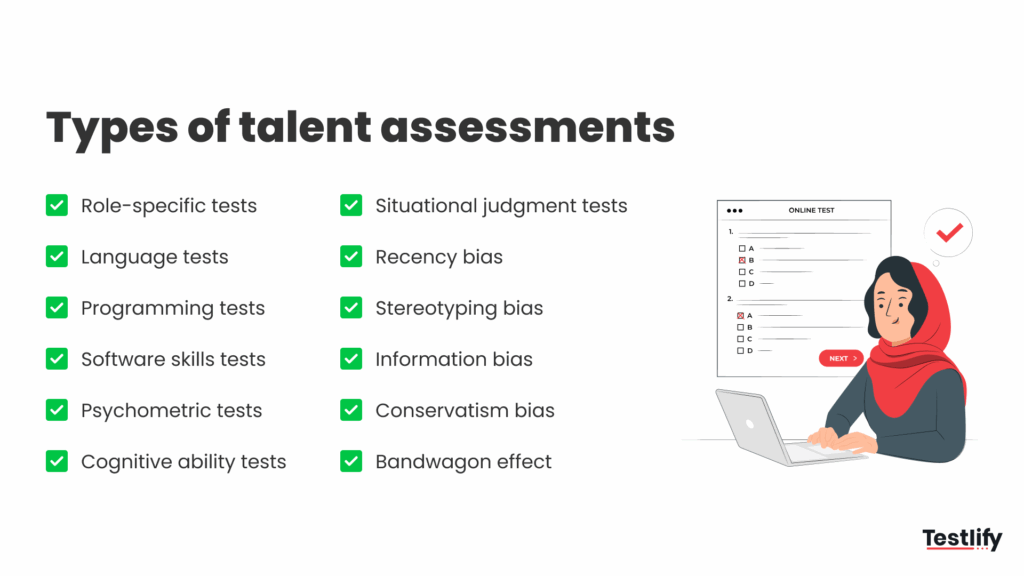
1. Skills and job-specific assessments
These measure role-specific skills, for example:
- Coding tests for developers
- Writing samples for content roles
- Sales call simulations for sales professionals
These tests show whether the candidate can actually perform the job, beyond what is written on a resume.
2. Cognitive and aptitude tests
These measure:
- Critical thinking
- Logical reasoning
- Problem-solving skills
- Ability to learn quickly
Cognitive ability is one of the strongest predictors of long-term job performance.
3. Behavioral and personality assessments
These examine:
- Work style
- Interpersonal tendencies
- Motivations
- Openness to feedback
- Team compatibility
This helps determine culture fit and role fit, which directly impacts retention.
4. Situational Judgment Tests (SJTs)
With Situaltion Judgment tests candidates are presented with realistic scenarios and asked how they would respond. These tests show decision-making ability, ethics, and job understanding.
Why talent assessments matter?
The hiring environment has become more:
- Competitive
- Fast-moving
- Skills-based
- Digital-first
Organizations need to hire better, faster, and more efficiently, without compromising quality. Talent assessments help bridge the gap between what a candidate says and what a candidate can actually do.
Benefits of using talent assessments in the hiring process
By adding structure and objective evaluation to the hiring process, talent assessments improve the quality of hire, reduce bias, and create a fairer and more efficient recruitment experience.
Improved quality of hire
Across talent acquisition leadership, 75% of HR/TA leaders identifed improving “quality of hire” as their top priority metric. One of the biggest benefits of talent assessments is their ability to significantly improve hiring outcomes.
Instead of relying on resumes (which often exaggerate) or interviews (which may be subjective), assessments provide objective data on:
- Skill proficiency
- Job readiness
- Work behavior
- Learning ability
This helps hiring teams select the best-suited candidate, not just the most confident or best-presenting one.
According to multiple HR studies, organizations that use assessments consistently report:
- Better performance from new hires
- Lower turnover within the first 6–12 months
- Higher overall employee satisfaction
More objective and bias-free hiring decisions
Traditional hiring methods can unintentionally introduce bias, based on appearance, background, familiarity, education, or assumptions.
Talent assessments help reduce bias by:
- Standardizing evaluation criteria
- Ensuring every candidate is assessed the same way
- Relying on data instead of intuition
This leads to fairer hiring outcomes and promotes workplace diversity, something all modern organizations value.
Faster and more efficient hiring
Hiring cycles are costly. Lengthy screening processes slow down the pipeline and risk losing top candidates to competitors.
Assessments can quickly filter unqualified candidates early, allowing recruiters to focus on strong applicants. Many tools automate:
- Screening
- Scoring
- Shortlisting
This leads to:
- Faster decision-making
- Less recruiter workload
- Shorter time-to-hire
For high-volume hiring (like retail, support, or seasonal roles), assessments are especially impactful.
Better culture and role fit = higher retention
Employees don’t leave companies, they leave roles that don’t fit them.
Behavioral and personality assessments help evaluate:
- Work style compatibility
- Values alignment
- Team communication patterns
- Motivation drivers
When candidates are aligned with the role and workplace environment, they are:
- More engaged
- More productive
- Less likely to leave
This improves long-term retention, saving organizations the cost of re-hiring and onboarding replacements.
Enhances the candidate experience
A well-designed assessment process can actually improve the candidate’s experience.
How?
Candidates appreciate:
- Clear expectations
- A fair evaluation process
- Opportunities to demonstrate their real skills
- Transparency in how decisions are made
Some modern assessments even feel engaging, using gamification, real job simulations, and interactive tasks.
This strengthens employer brand, especially among younger talent pools who value fairness and clarity.
Supports data-driven talent strategy
Assessments produce rich talent analytics, including:
- Skill gaps in the candidate market
- Behavioral trends
- Hiring success predictors
- Performance correlations
- Managerial fit patterns
Over time, this helps organizations refine:
- Job descriptions
- Hiring scorecards
- Training programs
- Workforce planning
- Leadership development
Data drives strategy, and assessments supply that data.
How to implement talent assessments effectively?
To get the most value out of assessments, HR teams should:
Define success for the role
List the:
- Skills
- Competencies
- Personality traits
- Behaviors needed to perform well
Choose the right type of assessment
Not every role needs every test. Select assessments that align with job needs.
Integrate assessments seamlessly
Assessment workflows should be:
- Mobile-friendly
- ATS-integrated
- Easy to complete
- Clearly explained to candidates
Communicate with candidates
Explain:
- Why the assessment matters
- What it measures
- How it supports fairness
Use assessments as one data point, not the only one
Combine assessment results with:
- Interviews
- Background checks
- Reference checks
- Work history
This creates a holistic evaluation.
Conclusion
Talent assessments are no longer a “nice to have”, they’re becoming a core part of modern hiring.
They help organizations:
- Hire better-quality talent
- Make fair, data-backed decisions
- Reduce time-to-hire
- Improve cultural fit
- Strengthen retention
- Support long-term workforce planning
When implemented thoughtfully, assessments enhance efficiency, fairness, and overall hiring effectiveness, benefiting both organizations and candidates.
As work continues to evolve, talent assessments are proving to be one of the most reliable ways to ensure hiring decisions lead to long-term success, for individuals, teams, and organizations as a whole.
For further reading, explore Job Specialization.
Frequently asked questions (FAQs)

Content Writer
Yashika Khandelwal is a Content Writer with 3+ years of experience creating research-backed content on hiring, talent assessment, and HR technology. She is a registered Organizational Psychologist and subject matter expert who combines behavioral science with practical recruitment insights to produce accurate, evidence-based content.
LinkedInRelated resources
View all
Talent assessment
25 best talent assessment tools for hiring in 2026

Talent assessment
Soft skills interview question bank (100+ behavioral indicators)

Talent assessment
Top qualities every talent leader should have in 2026

Talent assessment
What Is a Job Simulation? Types, Benefits & How to Create One (2026 Guide)

Talent assessment
How to build a hiring process with talent assessment tools

Talent assessment
Best Talent Assessment Software in 2026: How to Evaluate and Choose
Get started.
Hire on proof, not resumes.
Run your first skills-based assessment free — no credit card required.