
Entry level aptitude test vs experienced hire tests: how to customize both
How to build an entry level aptitude test, what to change for experienced hires, and how to set length, difficulty and cut-offs for each.

An entry level aptitude test measures how quickly a candidate with little or no work history can learn, reason and solve problems, so you can hire on potential instead of a thin CV. Experienced hires need a different test: one that checks proven skill, judgment and the ability to lead. This guide shows what to put in each version and how to customize one role's assessment for both levels.
TL;DR:
- An entry level aptitude test should measure learning potential: numerical, verbal and logical reasoning, attention to detail and learning agility, plus one short role task.
- Experienced hires should spend most of their test time on job skills, work simulations and judgment, with only a short reasoning check.
- Keep the entry level test to about 20 to 30 minutes and use it as the first screen. Give experienced candidates a 45 to 60 minute assessment after a first conversation.
- Set entry level cut-offs from the scores of your current good performers, and review pass rates by group after every hiring cycle.
- NACE found that 70% of US employers now use skills-based hiring for entry-level hires, up from 65% a year earlier, while GPA screening fell to 42%.
- Never reuse the same test for both levels: change the weighting, difficulty, length and stage, and keep the role's core skills the same.
 ChatGPT
 Gemini
 Claude
 Grok
 Perplexity
What is an entry level aptitude test?
An entry level aptitude test is a short, timed assessment that shows how well a candidate can learn new tasks, work with numbers and text, and solve unfamiliar problems. Hiring teams use it to screen graduates, freshers and career changers who have little work history, so the shortlist is based on ability instead of school name or CV polish.
Employers are moving this way fast. According to NACE's Job Outlook 2026 survey, 70% of employers use skills-based hiring for entry-level hires, up from 65% the year before. Only 42% still screen on GPA, down from 73% in 2019. The same release reports that nearly half of 2025 graduating seniors were asked to complete an assessment during the application or interview.
Ready-made options such as the Testlify graduate aptitude test or a general aptitude test are good starting points. The value comes from customizing them for the role and level.

What should an entry level aptitude test measure?
An entry level aptitude test should measure the abilities a new hire needs to learn the job in the first 90 days. For most graduate, trainee and junior roles, five areas cover it:
- Numerical reasoning: Percentages, ratios, tables and charts. Weight it higher for finance, operations and analyst roles.
- Verbal reasoning: Reading a short passage, following instructions and spotting what a text does and does not say. Weight it higher for support, sales and admin roles.
- Logical or abstract reasoning: Patterns and rules in unfamiliar problems. Useful for technical, IT and engineering trainees.
- Attention to detail: Finding errors in data, text or forms. Essential for data entry, claims, compliance and QA roles.
- Learning agility: How quickly a candidate picks up a new rule or process and applies it. A learning agility test adds this directly.
Add one short role task on top, such as a customer email for a support associate or a simple spreadsheet for an operations trainee. A role task tells you more about day-one readiness than another reasoning section. Leave out anything the new hire will be trained on in the first month, such as your internal tools or product knowledge.
Before you pick the mix, our guide to the types of aptitude tests explains what each format covers.
How is an aptitude test for experienced candidates different?
An aptitude test for experienced candidates shifts the weight from potential to proof. Someone with five or more years in the role has already shown they can learn; what you need to know is whether they can do the work at your level, make sound decisions and lead others.
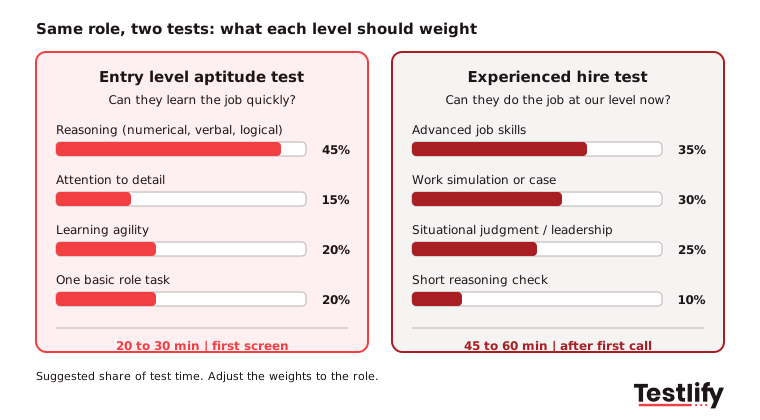
For experienced hires, build the assessment around:
- Job skills at advanced level: Role-specific tests set to advanced difficulty, such as financial modelling, SQL or a programming language.
- Work simulations: A realistic task from the job, such as reviewing a flawed project plan, triaging a queue of escalations or fixing a broken piece of code.
- Judgment: A situational judgment test with scenarios at the level they will work, for example, handling an underperforming direct report.
- Leadership, for people managers: A leadership potential test or open-ended questions on decisions they have made.
- A short reasoning check: 10 to 15 minutes of reasoning is still useful when the role involves learning new systems, but it should not decide the outcome on its own.
Experienced candidates also have less patience for long, generic tests. Explain why each section is there, and keep everything clearly linked to the job. Our lateral hiring guide covers the rest of the experienced-hire process.
What does a side-by-side blueprint look like?
A side-by-side blueprint keeps the role's core skills the same and changes everything around them. Here is how one role's assessment should differ by level.
Aspect | Entry level aptitude test | Experienced hire test |
|---|---|---|
Main question it answers | Can this person learn the job quickly? | Can this person do the job at our level now? |
Typical candidates | Graduates, freshers, career changers, 0 to 2 years | 3+ years in a similar role, lateral hires, managers |
Core sections | Numerical, verbal, logical reasoning, attention to detail, learning agility | Advanced job skills, work simulation, situational judgment, leadership |
Role task | One short, basic task | One realistic, complex task or case |
Question types | Multiple choice, short answer, one practical task | Practical tasks, coding, file upload, open-ended, video answers |
Difficulty | Beginner to intermediate | Intermediate to advanced |
Length | 20 to 30 minutes | 45 to 60 minutes |
Stage in the process | First screen, before any interview | After a first call, before final interviews |
How you use the score | Cut-off to build a shortlist from high volume | One input in a panel decision, discussed in interview |
Cut-off source | Scores of current good performers in the role | Role benchmarks plus interviewer review |
The same core skill can appear at both levels with different depth. A support associate might answer multiple-choice questions on a refund policy, while a support team lead reviews three real escalations and writes how they would coach the agent.
How do you customize an entry level aptitude test step by step?
Customizing an entry level aptitude test takes six steps, and the same steps produce the experienced version of the same role. Most employers already build at least part of their assessments in-house: a NACE Job Outlook 2025 survey found that close to 40% of employers using skills-based hiring for entry-level roles create their own assessment tools, and about a quarter use external ones.
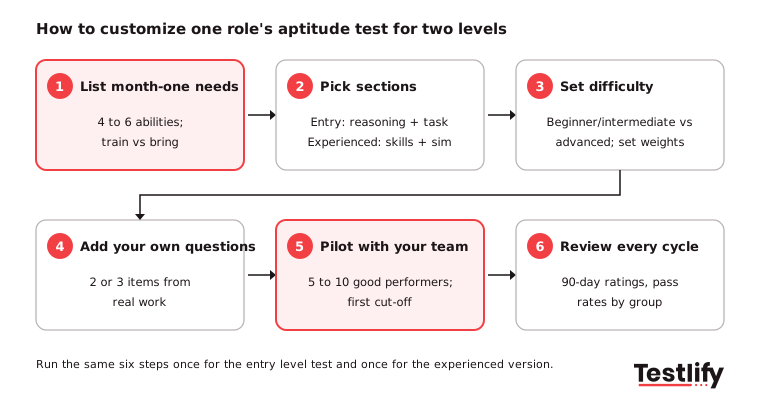
1. List what the role needs in month one: Ask the hiring manager which 4 to 6 abilities a new hire uses every week. Split them into abilities you will train and abilities the person must bring.
2. Pick sections to match: For the entry-level version, choose 3 or 4 reasoning sections and one role task. For the experienced version, choose 2 or 3 advanced skills tests, one simulation and one judgment section.
3. Set difficulty and weighting: Use beginner or intermediate questions for entry-level and give the reasoning sections most of the weight. Use advanced questions for experienced hires and give the job skills and simulation most of the weight.
4. Add your own questions: Add 2 or 3 questions written from real work: a real customer email, a real data table, a real policy paragraph. These raise face value for candidates and make the test harder to game with generic practice.
5. Pilot with current employees: Ask 5 to 10 people already doing the job well to take the test. Their scores show you whether the test is too easy or too hard, and give you a starting cut-off.
6. Review after every hiring cycle: Compare test scores with 90-day manager ratings, check completion rates and pass rates by group, and adjust sections or cut-offs.
Pro tip: Freshers often prepare on public practice sites, so candidates who have drilled fresherslive aptitude style question banks may score well on generic items. Role-based questions written from your own work separate real ability from practice.
How long and how hard should each test be?
An entry level aptitude test should take 20 to 30 minutes, with 25 to 40 questions at beginner to intermediate difficulty. Graduates often apply to dozens of roles at once, and every extra 10 minutes adds drop-off before you have spoken to anyone. Campus and volume programs that need a longer view should split testing into two short stages instead of one long sitting; our campus hiring guide shows how to stage it.
An experienced hire assessment can run 45 to 60 minutes, because the candidate is already invested after a first conversation and the tasks are richer. Fewer, harder questions work better than many easy ones at this level: one 20-minute simulation tells you more than 20 more multiple-choice items.
Difficulty should match the role, not the candidate's ego. A senior analyst still needs advanced numerical questions, but a team lead in a contact center needs judgment and coaching scenarios more than harder math.
How should you score results and set cut-offs at each level?
Scoring differs by level because the score does a different job. For entry level hiring, the score is a filter that turns hundreds of applicants into a shortlist. For experienced hiring, the score is one piece of evidence that the panel discusses.
For an entry-level aptitude test:
- Start from your own people: Set the first cut-off near the lower scores of your current good performers from the pilot, not at an arbitrary 70%.
- Weight by role: Give the sections that matter most for the job a higher weight in the total score, for example numerical reasoning for a finance trainee.
- Use a range, not a hard line: Candidates just below the cut-off can be reviewed by a person, especially when volume is low.
For experienced hires:
- Score the simulation with a rubric: Define what a strong, acceptable and weak answer looks like before anyone takes the test.
- Bring results into the interview: Ask candidates to walk through their simulation answer in a structured interview. The discussion shows how they think.
- Compare against role benchmarks: Look at where the candidate sits against others who took the same assessment for the same role.
For more on where reasoning scores add value, see our guide to cognitive ability tests in recruitment.
Key takeaway: For entry level hiring, the score decides who moves forward. For experienced hiring, the score decides what you ask in the interview.
How do you keep aptitude testing fair and legal?
Aptitude testing stays fair and legal when every section is linked to the job, results are checked for adverse impact, and candidates who need accommodations get them. The EEOC's guidance on employment tests says a test that screens out a protected group more often must be job-related and consistent with business necessity, and employers must provide reasonable accommodations under the ADA.
In practice:
- Write down why each section exists: Link every section to a task in the job description.
- Check pass rates by group after each cycle: If one group passes at a much lower rate, review the section driving the gap and look for an equally useful alternative.
- Offer accommodations up front: Tell candidates how to request extra time or a different format before the test starts.
- Watch for age bias in experienced hiring: Long, speed-heavy reasoning tests can disadvantage older candidates without telling you more about job performance. Weight job skills and simulations instead.
- Protect unproctored screens: Entry-level tests are often taken at home, so use anti-cheating checks to keep the shortlist honest.
How does Testlify support both levels?
Testlify lets you build both versions of a role's assessment on one platform, from one job description.
- Ready-made tests at each level: The library has 3,500+ tests, including cognitive ability, situational judgment, role-specific and software skills tests, with beginner, intermediate and advanced levels.
- AI test builder: Paste a job description and Testlify generates a role-specific assessment in under a minute, which you can then adjust for entry-level or experienced candidates.
- Custom questions: 25+ question types, including practical tasks, coding, file upload, video answers and Excel or Google Sheets tasks, so you can add real work from the role.
- AI interviews for experienced hires: Video AI, Voice AI and Chat AI interviews ask structured follow-up questions and score every answer, with a person reviewing the result.
- Fair, protected screening: 20+ anti-cheating and proctoring checks, including AI assistance detection, plus tests in 15+ languages. The Matching Model completed a third-party NYC Local Law 144 bias audit in June 2023.
- Scoring and workflow: Weighted scoring, benchmarking, score thresholds that auto-shortlist candidates, and two-way sync with 100+ ATS and HRIS tools.
Ready to build your entry-level aptitude test?
Start with a ready-made aptitude test, add one task from your own work, pilot it with five people already in the role, and set your first cut-off from their scores. Then build the experienced version of the same role with advanced skills tests and a simulation. Browse the Testlify test library or try Testlify free for 7 days, no credit card needed.
Frequently asked questions (FAQs)

People and Talent Partner
Arushi Shah runs day-to-day talent acquisition and candidate experience at Testlify. She writes on interviewing, structured hiring, and giving candidates a fair, fast process.
LinkedInRelated resources
View all
Skill assessment
Industry-Specific Skills Assessment: A Practical Guide

Skill assessment
The future of skills assessment: 8 trends for 2027 and beyond
Skill assessment
How to conduct a remote technical interview that hires the right engineers

Skill assessment
What to do when a top candidate fails a skills assessment

Skill assessment
Choosing a programming skills assessment: How and why?

Skill assessment
Why cognitive reasoning matters for a future-proof workforce
Get started.
Hire on proof, not resumes.
Run your first skills-based assessment free — no credit card required.