
12 recruitment skills to look for and how to test them
The 12 recruitment skills to look for in 2026, what good looks like at each level, and how to test each skill before you hire a recruiter.

Recruitment skills are the hard and soft skills a recruiter uses to find, assess and hire the right people: sourcing, screening, interviewing, data and compliance on one side, communication, relationship building and negotiation on the other. For a TA leader, they are also the checklist for hiring and developing the recruiting team itself.
TL;DR:
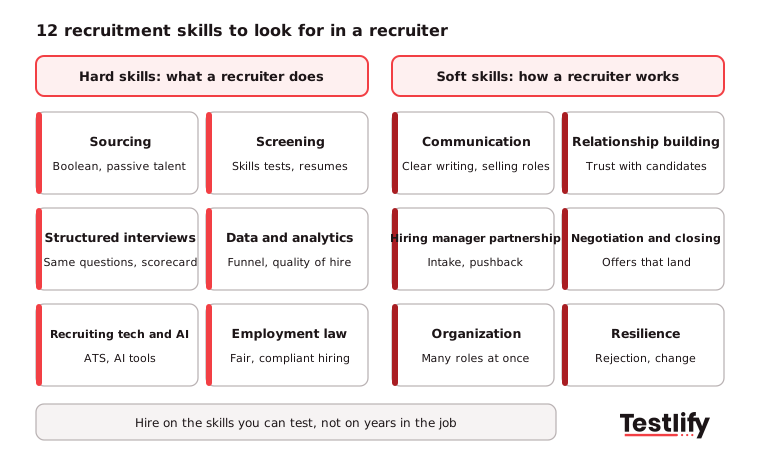
- The 12 recruitment skills to look for are sourcing, screening, structured interviewing, data, recruiting tech and AI, employment law, communication, relationship building, hiring manager partnership, negotiation, organization and resilience.
- Relationship building is the skill employers ask for most right now: LinkedIn found employers were 54 times more likely to list "relationship development" as a required recruiter skill.
- AI literacy is now a core skill, not a bonus. 37% of organizations are integrating or experimenting with generative AI in hiring, up from 27% a year earlier.
- Expectations rise with level: coordinators need organization and communication, recruiters need sourcing and screening, senior recruiters need data, negotiation and the confidence to push back on hiring managers.
- Test recruitment skills the way you test any hire: a scorecard, a short skills test, a work sample such as a Boolean string or outreach message, then a structured interview.
- The fastest way to improve is practice on real work: review funnel data every month, sit in on intake meetings and get feedback on outreach messages.
 ChatGPT
 Gemini
 Claude
 Grok
 Perplexity
What are recruitment skills?
Recruitment skills are the abilities a recruiter needs to run hiring from first search to signed offer. Hard skills cover what a recruiter does, such as sourcing, screening and reading hiring data. Soft skills cover how a recruiter works with people, such as communication, persuasion and staying calm when a search stalls.
The US Bureau of Labor Statistics groups recruiters with HR specialists, who find, screen and interview applicants, and may test them, contact references and extend offers. BLS lists communication, decision-making, attention to detail and interpersonal skills as the important qualities for the job, which counted 939,700 jobs in 2025 with 6% growth projected to 2035.
The same core list holds for in-house recruiters, agency recruiters and HR generalists who recruit part time. What changes is the weight: an agency recruiter leans harder on sales, an in-house recruiter on hiring manager partnership, and HR recruiter skills in a small team include admin and onboarding too.

Which recruitment skills matter most in 2026?
The recruitment skills that matter most in 2026 are relationship building, structured screening and AI literacy, on top of the classic sourcing and communication basics. LinkedIn's Future of Recruiting 2025 survey of 1,271 recruiting professionals points the same way: human skills grew in demand while AI took over more admin.
Skill | What good looks like | Type |
|---|---|---|
Sourcing | Finds qualified passive candidates, not only applicants | Hard |
Screening and assessment | Shortlists on tested skills, not keywords | Hard |
Structured interviewing | Same questions and scorecard for every candidate | Hard |
Data and recruitment analytics | Reads funnel data and fixes the weak stage | Hard |
Recruiting tech and AI literacy | Uses the ATS and AI tools well, checks AI output | Hard |
Employment law and fair hiring | Writes compliant ads, runs fair, documented processes | Hard |
Communication and writing | Clear job ads, outreach and feedback | Soft |
Relationship building | Candidates and managers trust them and come back | Soft |
Hiring manager partnership | Runs a sharp intake and pushes back with data | Soft |
Negotiation and closing | Closes offers without surprises at the last step | Soft |
Organization | Runs 15 or more open roles without dropping candidates | Soft |
Resilience and adaptability | Keeps going through rejection, freezes and new tools | Soft |
Key takeaway: A recruiter who is strong on the six hard skills fills roles. A recruiter who is also strong on the six soft skills fills them with people who stay.
What hard recruiting skills does a recruiter need?
The hard recruiting skills a recruiter needs are sourcing, screening, structured interviewing, data, recruiting technology and employment law. Each one can be taught, practiced and tested, which makes them the easiest place to start when you hire or train a recruiter.
1. Sourcing
Strong sourcers find people who are not looking. They build Boolean search strings, search LinkedIn, GitHub and niche communities, and keep a warm pipeline for roles that open every quarter. A good sign in an interview: the candidate can explain where the best people for your role spend time online and how they would reach them.
2. Screening and assessment
Screening is where most hiring time goes, and where most bias gets in. Recruiters who screen well shortlist on evidence: a short skills test, a clear rubric for resumes and a quick phone screen with the same questions for everyone. Weak screeners match keywords and job titles and miss strong people with a different background.
3. Structured interviewing
Structured interviewing means every candidate for a role gets the same questions, scored against the same criteria. Recruiters do not need to run every round, but they should design the plan, brief interviewers and run a debrief that sticks to evidence. The Testlify guide to structured interviews shows how to set one up.
4. Data and recruitment analytics
Data skills turn "we need more candidates" into "our onsite-to-offer rate dropped from 40% to 25% for engineering". Recruiters should track time to fill, pass-through rates by stage, source quality and offer acceptance, and use recruitment analytics to show hiring managers where the funnel leaks.
5. Recruiting technology and AI literacy
Every recruiter now works inside an ATS, a CRM, a scheduling tool and, more and more, AI tools that write outreach, screen resumes and run first interviews. AI literacy means knowing what each tool does well, where it gets things wrong and when a person has to review the output. Among TA pros already using generative AI, LinkedIn reports time savings of about 20% of the work week.
6. Employment law and fair hiring
Recruiters are the first line of compliance. They need to know what a job ad cannot say, which interview questions are off limits and how to keep records. The EEOC warns that ads showing a preference based on a protected trait, word-of-mouth hiring that keeps a workforce the same and tests that unfairly screen out protected groups can all be illegal. Employers that use automated hiring tools for New York City roles also need a yearly bias audit under Local Law 144.
What soft skills make a recruiter effective?
Soft skills make a recruiter effective because recruiting is a people job with a sales cycle on both sides. Communication, relationship building, hiring manager partnership, negotiation, organization and resilience decide whether a good shortlist turns into an accepted offer.
7. Communication and writing
Recruiters write all day: job ads, outreach messages, interview briefs, rejection emails. Good writers keep it short, specific and honest about the role, and they sell the job without overselling it. Writing also carries your employer branding, so a careless outreach message costs more than one candidate.
8. Relationship building
LinkedIn's 2025 data shows employers were 54 times more likely to list relationship development as a required skill for recruiters. Strong relationship builders stay in touch with silver-medal candidates, give real feedback and remember what each person wants next. Much of this rests on emotional intelligence: reading how a candidate feels about a move before they say it.
9. Hiring manager partnership
The best recruiters act as advisors, not order takers. They run a tight intake meeting, agree on the must-have skills, set expectations on salary and timing with market data, and push back when a brief asks for a unicorn. Business knowledge helps here: a recruiter who understands the team's goals writes better briefs and asks better questions.
10. Negotiation and closing
Closing starts at the first call. Recruiters who close well learn early what a candidate needs on pay, flexibility and growth, test for counter-offers and keep the hiring manager informed, so the offer holds no surprises. A weak closer loses finalists in the last week.
11. Organization and context switching
A corporate recruiter often carries 15 to 30 open roles, each with its own stage, manager and deadline. Organized recruiters time-block sourcing, keep the ATS current and never leave a candidate waiting without an update, which is the core of a good candidate experience.
12. Resilience and adaptability
Most outreach gets no reply, and many finalists say no. Hiring freezes, new tools and new laws arrive with little notice. Resilient recruiters treat a rejection as data, change the approach and keep going, and they learn new tools quickly instead of waiting for training.
Pro tip: When you hire a recruiter, ask about the search that went worst and what they changed. The answer shows resilience, data skills and honesty in one go.
Which recruitment skills matter at each level?
Recruitment skills matter at every level, but the weight shifts as a recruiter grows. Coordinators are judged on organization and communication, recruiters on sourcing and screening, and senior recruiters and TA partners on data, negotiation and how well they advise the business. Use the table below to set key skills for recruiter roles at each level.
Skill area | Recruiting coordinator | Recruiter | Senior recruiter or TA partner |
|---|---|---|---|
Sourcing | Posts jobs, manages inbound | Builds Boolean searches, reaches passive talent | Builds talent pools for critical roles |
Screening | Runs assessments and scheduling | Shortlists on skills tests and rubrics | Designs the assessment plan per role family |
Interviewing | Prepares interview kits | Runs phone screens, briefs interviewers | Trains interviewers, runs debriefs |
Data | Keeps ATS data clean | Tracks own funnel and time to fill | Reports quality of hire to leadership |
Hiring managers | Handles logistics | Runs intake, sets expectations | Advises on org design and market pay |
Negotiation | None | Extends offers within bands | Closes senior and competing offers |
Compliance | Follows process | Writes compliant ads, documents decisions | Owns fair hiring policy and AI audits |
How do you test recruitment skills before you hire a recruiter?
Recruitment skills are tested best with a mix of a short skills test, a work sample and a structured interview, scored against a scorecard you write first. LinkedIn found 93% of TA professionals say accurately assessing a candidate's skills is crucial for quality of hire, and recruiters are no exception.
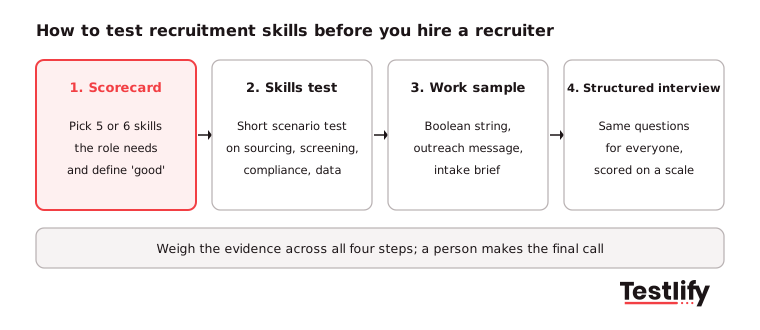
To make an informed hiring decision, use a structured evaluation process that assesses each candidate's skills, practical abilities and suitability for the role. Follow these steps:
- Write the scorecard: Pick the five or six skills from the list above that matter most for the role and level, and write what a strong, average and weak answer looks like for each.
- Run a short skills test: A scenario-based test checks sourcing, screening, compliance and data judgment in 30 minutes, before anyone spends time on interviews.
- Ask for a work sample: Give a real brief and ask for a Boolean string, a three-line outreach message and a list of intake questions. Score it on the scorecard.
- Hold a structured interview: Ask every finalist the same behavioral questions and score each answer. A person weighs all the evidence and makes the call.
Skill | Best way to test | What a strong answer shows |
|---|---|---|
Sourcing | Boolean string for a live brief | Smart synonyms, exclusions, more than one channel |
Screening | Rank six sample resumes against a rubric | Picks on evidence, explains each cut |
Communication | Write an outreach message | Short, personal, a clear reason to reply |
Hiring manager partnership | Role-play an intake with an unrealistic brief | Asks why, uses data, agrees on must-haves |
Data | Read a funnel report | Finds the weak stage and suggests a fix |
Negotiation | Role-play a counter-offer | Learns what matters, protects the offer band |
Compliance | Spot the problems in a sample job ad | Flags biased wording and illegal questions |
Common mistake: Hiring a recruiter on their placement count alone. Numbers depend on the market and the roles they had, so test the skills behind the numbers too.
How can recruiters improve their recruiting skills?
Recruiters improve their recruiting skills fastest through practice on live work with regular feedback, not through courses alone. Pick one or two skills a quarter, measure them and review progress with a manager.
- Run a skills check first: Take a recruiting skills test or score yourself against the 12 skills above and choose the two weakest.
- Review your funnel every month: Look at pass-through rates by stage and source, and find one change to test next month.
- Get feedback on outreach: Share five messages with a peer each week, and track reply rates before and after edits.
- Sit in on strong intakes: Shadow a senior recruiter's intake meeting and debrief, then run the next one yourself with them watching.
- Build AI skills on purpose: Learn the AI features in your ATS and sourcing tools, and check their output against your own judgment. LinkedIn reports the number of TA pros using LinkedIn Learning for AI skills grew 2.3 times in a year.
- Learn the rules where you hire: Read the official guidance for your main hiring locations, such as the EEOC in the US, and keep a short checklist of what job ads and interviews must avoid.
The O*NET profile for HR specialists, which includes corporate recruiters, lists speaking, active listening, reading comprehension, critical thinking and writing as the top skills, a useful reminder that the basics still decide most outcomes.
How can Testlify help you assess recruitment skills?
Testlify helps TA teams assess recruitment skills with ready-made, role-specific tests, so you shortlist recruiters on what they can do. The Recruiter test covers sourcing, screening, compliance, employer branding, negotiation, stakeholder management and data-driven recruiting in 30 scenario-based questions.
For narrower needs, add the Talent acquisition skills test or the Technical recruiter test. Testlify's library holds 3,500+ tests, runs structured AI interviews and includes 20+ proctoring checks, and it connects with 100+ ATS and HRIS tools. Browse the test library or start a 7-day free trial, no credit card needed.
Frequently asked questions (FAQs)

Human Resources Lead
Snehi Parmar leads People at Testlify, owning hiring, culture, performance, and retention for a 90-person team. She writes on practical HR strategy and building people processes that scale.
Related resources
View all
HR & recruitment
What is the purpose of capturing screenshots while testing?

HR & recruitment
AutoCAD assessment test: how to screen CAD candidates in 2026

HR & recruitment
Customized talent assessments: how to build and score them

HR & recruitment
Application assessment checklist: 30 checks for fair, fast hiring

HR & recruitment
How to incorporate AWS test into your recruitment strategy

HR & recruitment
How to simplify candidate screening with AWS test
Get started.
Hire on proof, not resumes.
Run your first skills-based assessment free — no credit card required.