
Small business background check: how to run a rigorous one on a lean budget
Which checks each role needs, what screening costs, the FCRA steps to follow and what a lean HR team can safely verify on its own.

A small business background check is a pre-hire review of a candidate's identity, records and claims, scaled to what the role needs and what a lean team can afford. You get written consent, buy only the reports the role calls for from a screening provider, verify references and credentials yourself, and follow the same steps for every finalist.
TL;DR:
- A small business background check does not need a big budget: check identity, references and credentials for every hire, and buy paid reports only for finalists in trust or high-risk roles.
- Most single checks from screening providers cost about $20 to $85 and come back in 1 to 3 business days.
- When you buy a report, the FCRA requires a standalone disclosure, written consent and a pre-adverse action notice before you reject anyone on what it shows.
- Discrepancies are common: HireRight's 2025 benchmark found more than three in four businesses caught at least one in the past year, and one in six had a confirmed case of identity fraud.
- A short written screening policy is the cheapest compliance control you can have: same checks per role, after a conditional offer, reviewed the same way.
- Background checks confirm history, not ability. Test skills first so you only pay to screen the people you plan to hire.
 ChatGPT
 Gemini
 Claude
 Grok
 Perplexity
What is a small business background check?
A small business background check is the set of pre-employment checks a company with a lean HR team runs to confirm a candidate is who they say they are, has the history they claim, and has no record that matters for the role. It covers the same ground as larger programs, but the scope is set per role, not per company.
The term "small business" here is about resources, not headcount. A 400-person company with one recruiter and no screening budget faces the same trade-offs as a 30-person startup. For a definition of the wider practice, see our glossary entry on background checks.
A typical check can include:
- Identity verification: confirms the name, date of birth and Social Security number match one real person.
- Criminal record search: county, state or federal court records, usually for the last seven years.
- Employment verification: dates and job titles at previous employers.
- Education and license checks: degrees, certifications and professional licenses the role depends on.
- References: what former managers say about the candidate's work.
- Role add-ons: driving records, drug tests or credit checks, only where the job and the law support them.

Which checks does each role really need?
Each role needs only the checks that match its risk. A rigorous background check is one that is thorough for the risks a role carries, not one that runs every report on every candidate. Grouping roles into three tiers keeps costs predictable and makes every decision easy to defend.
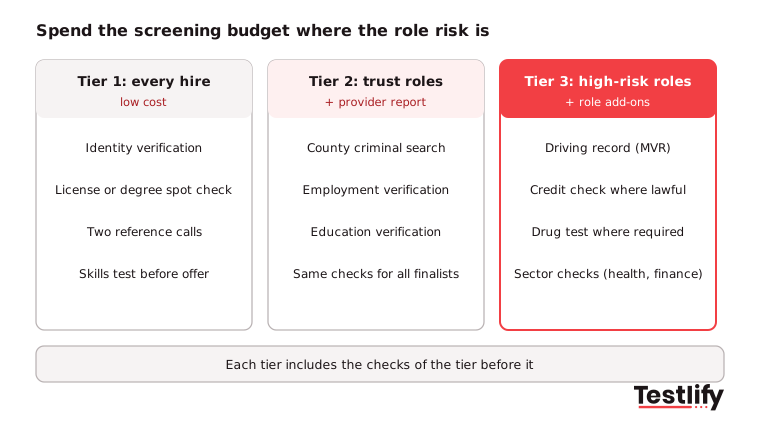
Identity deserves a place in every tier now. HireRight's 2025 Global Benchmark Report, as covered by Help Net Security, found that one in six businesses had a confirmed case of identity fraud during hiring, while only three in five companies run identity checks at all. Remote hiring makes this the gap lean teams most often leave open.
Pro tip: Write the tier for each role into the job requisition before you post it. Deciding the checks after you meet a candidate is how inconsistent screening, and discrimination claims, start.
How do you run a small business background check step by step?
Running a small business background check takes six steps: write a policy, make a conditional offer, disclose and get consent, run the role's checks, review the results fairly, and follow adverse action steps if the report changes your decision. Steps 3 and 6 are legal requirements whenever you use a screening provider.
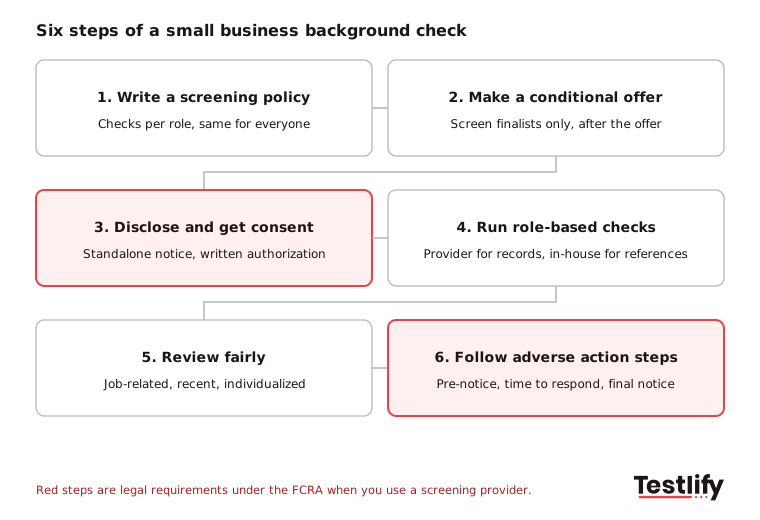
- Write a screening policy: One page that lists the checks for each role tier, when they run and who reviews results. Apply it to every candidate for the role.
- Make a conditional offer first: Screen finalists only, after a conditional offer. It cuts cost, and in places with fair chance laws, such as California, it is required before you ask about conviction history.
- Disclose and get consent: Give a standalone written notice that you will get a background report, and collect written authorization. The FTC's guide for employers says the notice cannot sit inside the job application.
- Run the role's checks: Order the paid reports from an FCRA-compliant provider and handle references and credential calls in-house.
- Review results fairly: Judge each finding against the job: what it was, how long ago, and whether it matters for this role.
- Follow adverse action steps: Before you withdraw an offer because of the report, send a pre-adverse action notice with a copy of the report and a summary of rights, give the candidate time to respond, then send the final notice.
When the check is done, store the report separately from the personnel file and destroy it securely when you no longer need it.
How much does screening cost and how long does it take?
Screening costs most employers about $20 to $85 per check, based on the published prices of providers that serve background checks for small business, with bundled packages starting near $30. Most reports come back within 1 to 3 business days; education and employment verifications take longer when schools or past employers are slow to reply.
Check | Typical turnaround | Cost driver |
|---|---|---|
Identity / SSN trace | Minutes to 1 day | Usually bundled |
County criminal search | 1 to 3 business days | Number of counties searched |
Employment verification | 2 to 5 business days | Number of past employers |
Education verification | 2 to 5 business days | Schools outside the US |
Driving record | Same day to 2 days | State fees |
Drug test | 1 to 3 business days | Panel size, lab |
Put that cost next to the cost of a hire. The 2025 SHRM Benchmarking Survey puts the average cost-per-hire at $5,475 for nonexecutive roles and $35,879 for executive roles. A $60 check on a finalist is a small share of that; a wrong hire is not.
Ways to keep the bill down:
- Screen finalists only: one paid report per hire instead of one per shortlisted candidate.
- Pick pay-per-check plans: most providers that serve small employers have no setup fees or minimums.
- Order by tier: do not buy a credit check for a role that never touches money.
- Compare providers on compliance tools: built-in consent forms and adverse action workflows save legal hours. Our guide to background check software for HR teams compares the main options.
What can a lean HR team verify in-house?
A lean HR team can verify references, employment dates, degrees and professional licenses in-house at no cost beyond time. These checks need a phone, an email template and a consistent script. Criminal, credit and driving records are better bought from a provider, because the searches and the legal steps are hard to do well alone.
- References: Call two former managers and ask the same five questions for every candidate. See our best practices for reference checks.
- Employment dates and titles: Call the HR line listed on the company's website, not the number the candidate gives you.
- Degrees: Many universities confirm degrees by email or an online request form.
- Professional licenses: State licensing boards publish free public lookups for nurses, accountants, engineers and other licensed roles.
- Resume claims: Compare dates, titles and tools across the resume, LinkedIn profile and interview answers. Our resume verification process lists what to check first.
Be careful with free people-search websites and social media. Free sites often mix up people with similar names, and a social media review can show you protected details such as religion, age or health. SHRM reported in 2024 that only 9% of employers used third-party social media screens, so skipping it puts you in the majority.
Which laws apply even to small employers?
Federal background check law applies to employers of every size. The Fair Credit Reporting Act governs any report you buy from a screening provider, equal employment law governs how you use results, and many states and cities add fair chance rules on when you can ask about criminal history.
- FCRA: standalone disclosure, written authorization, certification to the provider, pre-adverse action notice with the report and a summary of rights, then a final adverse action notice.
- Equal treatment: The EEOC and FTC joint guide asks employers to apply the same standards to everyone and to keep records, generally for one year.
- Fair chance laws: California's Fair Chance Act applies to employers with five or more employees and bars asking about conviction history before a job offer. Other states and cities have similar ban-the-box rules, so check where each role is based.
- Secure disposal: Shred paper reports and make electronic files unreadable once you no longer need them.
If you only call references or verify a degree yourself, the FCRA disclosure rules for purchased reports do not apply, but equal treatment rules and some state laws still do. When in doubt, ask employment counsel before you build the policy, not after a dispute.
How do you keep checks fair and consistent?
Fair checks follow the same rules for every candidate in a role, judge each finding against the job, and give the candidate a chance to explain. Consistency is what makes a lean process defensible, and it costs nothing except discipline.
- Same checks, same order: Every finalist for a role gets the checks in the policy, no extras for people who "feel off".
- Individualized assessment: Look at the nature of an offense, the time since it happened and its link to the job before you decide.
- Let candidates explain: Discrepancies are often honest errors in dates or titles. Ask before you assume.
- Separate the reviewer: Where you can, have someone who did not interview the candidate review the report.
- Plan for later checks: SHRM's 2024 coverage of HireRight's survey found about 57% of North American employers ran no post-hire screening, which matters for roles that gain access to money or data after hiring.
Key takeaway: A rigorous background check is a consistent one. Decide the checks per role in advance, apply them only after a conditional offer, and review every result against the job, not against a gut feeling.
Where do skills tests fit next to screening?
Skills tests check whether a candidate can do the job; background checks confirm their history. Running a skills test first is the simplest way to stretch a small screening budget, because you only pay for reports on the few candidates who have already shown they can do the work.
Testlify helps lean hiring teams put that order into practice:
- Skills first: 3,500+ validated tests across technical and non-technical roles, so the shortlist is built on proof, not resume claims. Browse the test library.
- Identity and integrity: 20+ proctoring checks are included, and photo ID verification with Face Match is available per attempt, which closes part of the identity gap before you buy a background report. See anti-cheating and proctoring.
- Fits your stack: 100+ ATS and HRIS integrations send scores back to the system your team already uses.
- Pay as you assess: credit-based pricing, where you pay only when a candidate starts an assessment.
Skills tests do not replace background screening for trust and high-risk roles. They decide who is worth screening. For the cost of skipping checks altogether, read the risks of skipping pre-hiring background checks.
Ready to screen for skills before you pay for reports?
Build a role-based skills assessment from your job description and send background checks only to the finalists who pass. Start a 7-day free trial of Testlify, no credit card required, or book a demo to see it with your own roles.
Frequently asked questions

Wordpress Developer
Yash Patel is a Wordpress and SEO Specialist at Testlify with 3+ years of experience in technical SEO, on-page optimization, and content strategy. He works on improving Testlify's organic presence and produces content focused on hiring, talent assessment, and HR technology.
LinkedInRelated resources
View all
HR & recruitment
Cultural awareness in hiring: how to assess it fairly

HR & recruitment
Early career talent assessments: how to spot who will grow
HR & recruitment
What is SharePoint and benefits of LMS with SharePoint integration

HR & recruitment
Should HRs consider using peer interviews in pre-hiring assessments?

HR & recruitment
How do pre-hiring assessments impact time-to-hire metrics?

HR & recruitment
What are the potential legal risks of pre-hiring assessments?
Get started.
Hire on proof, not resumes.
Run your first skills-based assessment free — no credit card required.