
Campus Hiring for Talent Pipeline Development
Leverage campus hiring to build a strong talent pipeline with strategic recruitment, skill assessments, and long-term engagement while fostering educational partnerships.

Campus hiring is how you build a talent pipeline before you need one. You recruit students and recent graduates early, screen them, and keep the strong ones warm so a role gets filled from a bench you already trust, not a search you start from zero. The pull is timing: while most employers wait for a senior candidate to appear on the open market, a campus program has been growing that candidate for two or three years.
The shortage makes the case on its own. Nearly three in four employers say they cannot find the skilled talent they need, per ManpowerGroup’s 2025 Talent Shortage survey. This guide walks through campus hiring for talent pipeline: why an early-talent pipeline pays off, the six steps that build one, how to screen hundreds of applicants fairly, and the metrics that tell you it is working. Every number here traces to a named, recent source.
 ChatGPT
 Gemini
 Claude
 Grok
Grok Perplexity
TL;DR
- Campus hiring is a pipeline strategy, not a once-a-year career-fair trip. Treated as an ongoing program, it fills roles from a warm bench of pre-screened early talent.
- The payoff is retention and readiness, not a cheaper hire. Campus cost-per-hire runs above the all-hires average, but more than 8 in 10 graduate hires stay past a year.
- Internships are the highest-signal channel: 63.1% of 2024-25 interns converted to full-time roles, a five-year high.
- Screen for skills before interviews. Structured assessments rank a large applicant pool objectively and give every school an equal shot.
- Measure convert-and-retain, not raw applications: offer-acceptance, intern conversion, quality of hire, and one-year retention.

What is campus hiring for talent pipeline development?
Campus hiring is recruiting students and recent graduates directly from colleges and universities. Used for pipeline development, it is a proactive strategy: you build relationships, run internships, and screen early talent so a pool of qualified future hires is ready before a role opens, not scrambled for after it does.
The difference is timing. Reactive hiring starts when a seat is empty, so you compete for whoever is on the open market that week. A campus pipeline starts two or three years earlier. You meet promising students as sophomores and juniors, keep them warm through internships and events, and convert the strongest ones when they graduate. For a deeper walkthrough of the front end, see our guide to hiring new grads at scale.
Why does campus hiring matter for your pipeline?
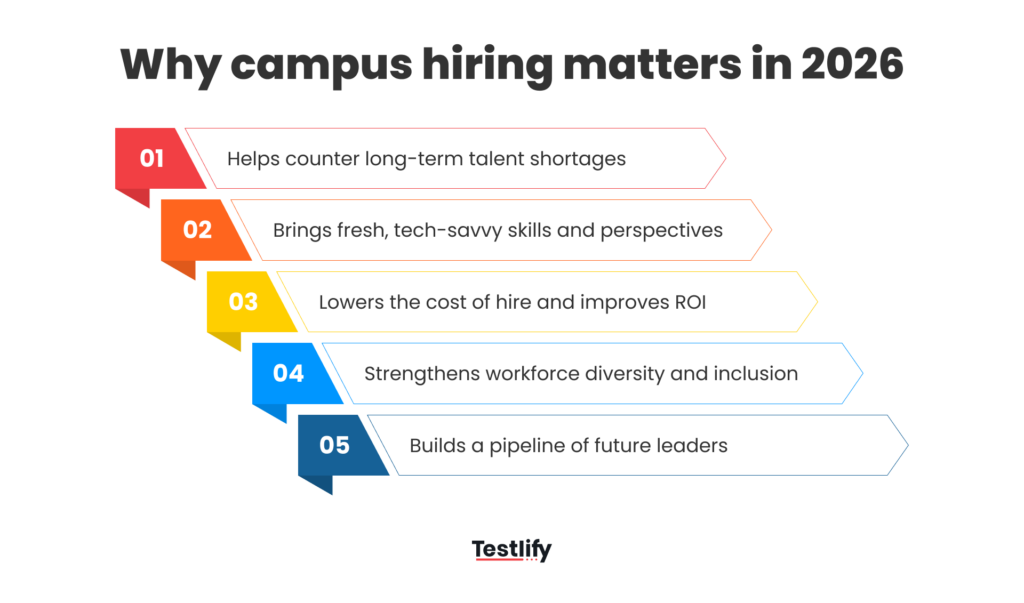
Campus hiring matters because it fixes a supply problem at the root. When most employers cannot find experienced talent, waiting for the perfect senior candidate is slow and costly. A campus pipeline gives you a renewable source of trainable people you shape to your own standards, on a schedule you control. Five reasons make the case.
1. It counters chronic talent shortages
The skills gap is not a blip. It ranks as the number one barrier to business transformation, named by 63% of employers. Recruiting from campus is one of the few levers that grow the missing talent instead of competing for it, filling entry and mid-level roles with people you have already assessed. Over a few cycles, a steady intake of graduates closes the very gap that makes senior hiring so hard, at a price you can plan around instead of a premium you pay under pressure.
2. It brings fresh, adaptable skills
Employers expect 39% of workers’ core skills to change by 2030 (World Economic Forum, 2025). Graduates arrive trained on current tools and current thinking, and they tend to pick up new ones quickly because learning is still their default mode. That adaptability is worth more than it looks on a resume, especially in functions where the toolset shifts every couple of years.
3. It builds retention, not just a lower price tag
Here is the myth worth correcting: campus hiring is not the cheapest way to hire. NACE benchmarks put campus cost-per-hire near $6,275, about a third above the all-hires average. The real return is loyalty. More than 8 in 10 college graduates hired in 2023 were still with their employer a year later, per NACE recruiting benchmarks. People who start their careers with you tend to stay and grow, which is where the savings actually show up.
4. It widens diversity and your candidate pool
Campuses are one of the most diverse talent markets you will ever recruit in. By partnering with a mix of universities, including community colleges and schools you have never sourced from, you reach candidates who would never surface through referrals or a resume database. A wider early-career pool feeds a more diverse pipeline for years, not just one hiring season.
5. It develops your future leaders
Many of tomorrow’s managers are today’s interns. When you hire and grow people internally, they carry your context, your customers, and your standards with them as they move up. That continuity is hard to hire for laterally. A campus pipeline is also a leadership pipeline, as long as you pair it with real development once people are in the door.
How do you build a campus hiring pipeline?
Building a campus pipeline is a repeatable program, not a single career-fair appearance. You run internships, show up consistently, partner with faculty, screen for real skills, move fast, and develop people once they join. The six steps below turn scattered campus activity into a pipeline that fills roles on schedule.
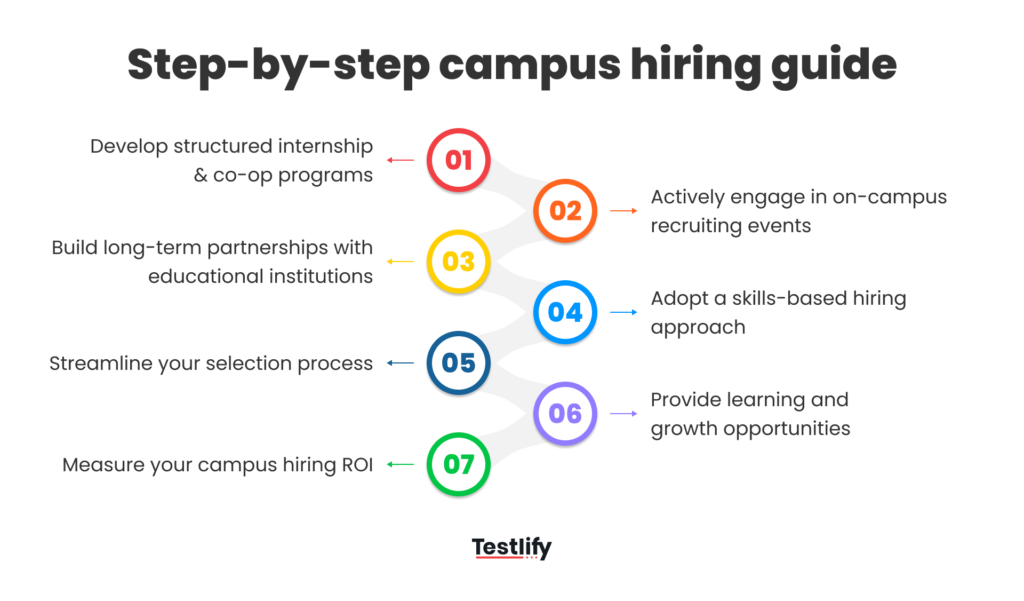
Step 1: Start with internships and co-ops
Internships are the closest thing to a guaranteed pipeline you can build. They let both sides test the fit over months instead of a 45-minute interview, and the conversion numbers back it up: 63.1% of the 2024-25 intern class received and accepted full-time offers, a five-year high, per NACE internship data. Treat interns as pre-hired talent, give them real work, and convert your best ones on the spot. The role of internships in talent acquisition goes deeper into program design.
Step 2: Show up on campus consistently
Appearing at one career fair a year is not a presence; it is a cameo. Students remember the employers who show up for guest lectures, hackathons, club sponsorships, and mentoring sessions across the year. Consistency builds an employer brand on campus, so the strongest candidates already know you before they apply. If your name is unfamiliar, work on your employer brand first, then scale the campus calendar.
Step 3: Partner with universities and faculty
Career centers, department heads, and faculty are the gatekeepers to the best students, and they refer employers they trust. Offer something real in return: guest lectures, capstone projects, curriculum feedback, scholarships. These relationships give you early access to talent and a say in the skills students graduate with, which pays back directly when you hire them.
Step 4: Screen for skills, not GPA alone
A high GPA from a name-brand school is a weak predictor of on-the-job performance, and it quietly filters out capable candidates from less-known programs. Test for the skills the role actually needs instead. Skills-based screening also lets you compare candidates who took very different paths, which matters more when you also want to assess soft skills that a transcript never captures.
Step 5: Make your selection process fast and clear
Top graduates get multiple offers, and a slow, silent process loses them. Compress your funnel: a skills assessment right after application, then one structured interview loop, then a decision within days. Tell every candidate where they stand and when they will hear back. Speed and clear communication are, on their own, a competitive advantage against employers who leave students waiting.
Step 6: Offer learning and growth from day one
Early-career talent stays where it grows. A clear first-year plan, a mentor, and a visible path to the next role turn a new grad into a long-tenured employee, which is the whole point of the pipeline. Skip this and you refill the same entry roles every year. Build it and you compound the retention advantage campus hiring already gives you.
How do you screen campus talent at scale?
You screen campus talent at scale by testing for the skills the job needs before anyone reads a resume or books an interview. A single career fair can generate hundreds of applications. Structured, skills-based assessments rank that pool objectively, so recruiters spend interview time only on candidates who can already do the work.
This is where the Testlify Multi-Signal Talent Evaluation Model earns its keep. Rather than leaning on one resume, one GPA, or a single career-fair chat, it combines several role-relevant signals: a skills assessment, a cognitive or aptitude test, a communication sample, a structured interview, and references. For campus hiring, where candidates have little work history, multiple signals matter more, not less. They let you compare a marketing grad and a computer-science grad on evidence of what each can actually do, and they keep the final call with your hiring team rather than an algorithm.
How do you measure campus hiring success?
Measure campus hiring across the whole pipeline, not just applications. The metrics that matter are offer-acceptance rate, intern-to-full-time conversion, quality of hire, time-to-fill from your pipeline, and one-year retention. Convert-and-retain beats raw volume. Benchmark each number against national data so you know whether your program is ahead of or behind the market.
Metric | What it tells you | Recent national benchmark (NACE) |
|---|---|---|
Intern-to-full-time conversion rate | Measures how effectively your internship program converts interns into full-time employees. A higher rate indicates stronger talent identification and successful early-career hiring. | 63.1% for the 2024–25 class — the highest conversion rate recorded in the past five years. |
Offer acceptance rate | Shows how attractive your internship and employer brand are by measuring the percentage of interns who accept full-time offers. | 88.3% of interns accepted full-time offers for the 2024–25 recruiting cycle. |
One-year retention of graduate hires | Indicates whether campus hires remain with the organization after their first year, reflecting hiring quality, onboarding, and employee experience. | More than 80% of graduates hired in 2023 were still employed one year later. |
Cost per campus hire | Measures the total investment required to recruit and hire a graduate, including sourcing, events, assessments, interviews, and onboarding. | Approximately $6,275 per campus hire—around one-third higher than the average cost per hire across all roles. |
Read these numbers together, not in isolation. A high offer-acceptance rate with weak one-year retention means you are selling the job well but the reality does not match, so fix onboarding and growth. Strong conversion with a thin applicant pool means you should widen your campus footprint. The goal is a pipeline that converts and retains, and the metrics tell you which lever to pull. If early-cycle numbers stall, our take on common campus hiring challenges covers the usual culprits.
Key takeaways
- Campus hiring is a pipeline, not an event. Run as an ongoing program of internships, campus presence, and a nurtured candidate database, it fills roles from a warm bench, which cuts time-to-fill the moment a req opens.
- The payoff is retention, not a cheaper hire. Campus cost-per-hire sits above the all-hires average, but with more than 8 in 10 grad hires staying past a year, the return shows up in tenure and internal growth, not the invoice.
- Internships are your highest-signal channel. A 63.1% intern-to-hire conversion in 2024-25 means a strong internship program is the most reliable pipeline you can build, so fund it before anything else.
- Screen for skills before interviews. Applicant volume is the campus bottleneck; structured assessments rank a large pool objectively and give every school an equal shot, which protects both speed and fairness.
- Fresh skills are a feature, not a gap. With 39% of core skills set to change by 2030, early-career hires trained on current tools adapt faster than the market assumes, so weigh trajectory alongside experience.
- Measure convert-and-retain, not applications. Offer-acceptance, conversion, quality of hire, and one-year retention tell you whether the pipeline works; raw application counts flatter the program without proving it.
Frequently asked questions

Director of Marketing
Akash Patange is the Director of Marketing at Testlify, where he works closely with HR leaders and recruiters to help organizations improve hiring outcomes. He writes about talent assessment, recruitment technology, and data-driven hiring practices.
LinkedInRelated resources
View all
HR & recruitment
How to adapt recruitment processes for a virtual environment

HR & recruitment
The role of HR tools in remote work environment

HR & recruitment
The secret to creating the best job pre-screening test

HR & recruitment
A recruiter’s ultimate guide to diversity hiring in 2026

HR & recruitment
How to screen and assess blue-collar skills and experience

HR & recruitment
Best practices for blue-collar screening and interviewing
Get started.
Hire on proof, not resumes.
Run your first skills-based assessment free — no credit card required.