
10 strategic human resource planning mistakes and how to fix them
Ten mistakes that quietly break a strategic HR plan, from counting heads instead of skills to never reviewing it, and how to fix each one.
Strategic human resource planning is the process of working out which people and skills a business will need over the next one to five years, comparing that with the workforce it has today, and deciding how to close the gap through hiring, development, internal moves or partners. Most plans do not fail because the idea is wrong. They fail because of a handful of avoidable mistakes in how the plan is built, owned and used.
TL;DR:
- Most strategic HR plans stall because they look too short a distance ahead, rest on weak skills data and have no owner outside HR.
- The 10 common mistakes include planning for headcount instead of skills, looking only one year ahead, betting on a single forecast and defaulting to external hiring.
- Others are screening on resumes, leaving managers out, ignoring change and AI, and never measuring the plan.
- Each mistake comes with a warning sign to spot and a practical fix.
- A six-step cycle, reviewed every quarter, keeps the plan current.
- Five or six metrics show whether the plan is working.
- Skills assessments give the plan reliable data and tie hiring to the skills the business needs.
 ChatGPT
 Gemini
 Claude
 Grok
 Perplexity
What is strategic human resource planning?
Strategic human resource planning is the link between business strategy and people decisions. Strategic human resource planning answers four questions: what the business is trying to achieve, which skills and roles that will take, what the current workforce can already do, and how to fill the difference in time.
Strategic human resource planning differs from day-to-day HR planning in its horizon and its unit of measure. Operational planning fills this quarter's open roles. Strategic planning looks three to five years out and plans in skills and capabilities, not only in job titles. For a full definition, read our guide on what strategic human resource planning is.

Why do strategic human resource plans fail?
Strategic human resource plans usually fail for three reasons: they look too short a distance ahead, they rest on weak skills data, and nobody outside HR owns them. Recent surveys show how common these gaps are.
- Short horizons: According to McKinsey's HR Monitor 2025, as reported by UNLEASH, 73% of HR teams do short-term operational workforce planning, but only 9% do truly strategic planning with a three to five year view.
- Missing skills data: The same research found that only three in ten organizations doing workforce planning and skills documentation actually use that skills data in strategic planning, while HR leaders say 32% of employees lack the skills they need in their current roles.
- No clear picture of future needs: In a 2026 survey of 5,936 HR decision makers by SD Worx, 51% of employers called workforce planning an important priority, yet 39% did not have a clear picture of the skills their organization will need in the next two to three years.
Hiring pressure makes every gap more expensive. The SHRM 2025 Talent Trends report found that 69% of organizations still struggle to fill roles.
What are the most common strategic human resource planning mistakes?
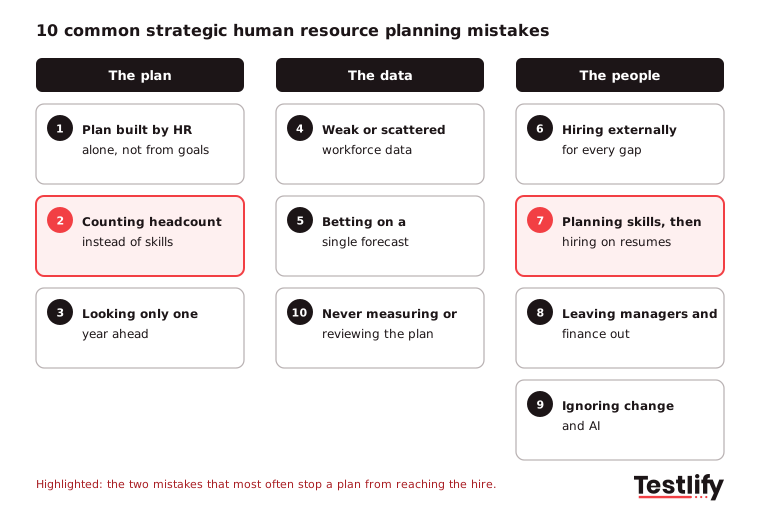
The most common strategic human resource planning mistakes are planning for headcount instead of skills, keeping the plan inside HR, looking only one year ahead, trusting weak data, betting on a single forecast, defaulting to external hiring, screening on resumes, leaving managers out, ignoring change, and never reviewing results.
1. Treating the plan as an HR document, not a business plan
A plan written by HR alone tends to describe HR programs rather than business outcomes. When the company decides to enter a new market or launch a product, the people plan does not change because nobody connected the two.
- Warning sign: the plan's goals are HR activities ("run two leadership programs") rather than business results ("staff the new region with 40 trained sales reps by Q3").
- Fix: start every planning cycle from the business plan. For each strategic goal, write down the roles, skills and timing it needs, and get the business owner of that goal to sign off.
2. Planning for headcount instead of skills
Counting seats is the most common shortcut. A headcount plan says "add six engineers"; a skills plan says "add cloud security and data engineering skills, and move two developers into those areas." Job titles hide what people can actually do, so a headcount plan often hires for skills the company already has and misses the ones it lacks.
- Warning sign: the plan has rows for roles and numbers but no list of critical skills.
- Fix: build a short skills inventory for your critical roles and plan against it. A skills gap analysis is the fastest way to start.
3. Looking only one year ahead
Annual budgets pull planning into a 12-month window. That works for replacing leavers but not for skills that take two or three years to build, such as senior engineering, specialist clinical or leadership roles.
- Warning sign: every action in the plan finishes inside the current financial year.
- Fix: keep the budget annual but add a rolling three-year view for critical roles. Revisit the outer years each quarter instead of rewriting them once a year.
4. Building the plan on weak or scattered data
Workforce data often lives in three or four systems: the HRIS, the ATS, payroll and spreadsheets owned by managers. Skills data, where it exists, is often self-reported and out of date.
- Warning sign: different teams quote different headcount or attrition numbers in the same meeting.
- Fix: agree on one source for each core number (headcount, attrition, time to fill, internal moves). Replace self-reported skills with measured ones where it matters, for example through role-based assessments.
5. Betting everything on a single forecast
A single forecast assumes one future. Demand shifts, AI changes how roles are done, and a key client can leave. A plan built on one number breaks the first time reality moves.
- Warning sign: the plan has no "what if" section.
- Fix: model two or three simple scenarios (for example base, faster growth and slower growth, or roles with and without AI support) and agree in advance which actions each scenario triggers.
6. Defaulting to external hiring for every gap
Many plans treat every gap as a new hire. External hiring is slower and costlier than people think, and it ignores employees who could move into the role. The SD Worx survey found that 66% of employees feel their organization does not make it easy to explore internal jobs.
- Warning sign: the plan has a hiring budget but no budget for training, internal moves or contractors.
- Fix: for each gap, choose between build (train), buy (hire), borrow (contractors or partners) and redeploy (internal mobility). SHRM found that over a third of organizations already train existing employees for hard-to-fill roles. Our guide to internal mobility vs external hiring covers the trade-offs.
7. Planning for skills, then hiring on resumes
This is the gap we have seen most often: the plan lists the skills the business needs, but recruiting still filters candidates by job title, degree and years of experience. The planned skills never make it into the hiring decision.
Skills-based screening widens the pool considerably. The LinkedIn Economic Graph Skills-Based Hiring report (March 2025) found that hiring on skills instead of past job titles expands talent pools by a median of 6.1 times globally and 15.9 times in the US.
- Warning sign: job descriptions still list "5+ years in a similar role" as the main requirement.
- Fix: turn the skills in your plan into the screening criteria, and test them early with a skills-based hiring approach.
8. Leaving managers, finance and IT out of the room
HR cannot see every team's workload, and finance controls the budget that pays for the plan. Randstad lists lack of cross-functional collaboration and leadership buy-in among the most common planning mistakes.
- Warning sign: managers see the plan for the first time when it is final.
- Fix: set up a small planning group with HR, a senior business sponsor, finance, two or three line managers and someone from HR systems. Give each member a named responsibility.
9. Ignoring change management and the effect of AI
New roles, new tools and new team structures change how people work. Employees who hear about a plan only through rumors tend to resist it, and AI is now changing tasks inside most knowledge roles faster than job descriptions are updated.
- Warning sign: the plan describes structures and numbers but says nothing about communication, training or which tasks AI will take on.
- Fix: add a change section to the plan: who is affected, what changes for them, how they will be trained, and when managers will talk to their teams. Review which tasks in each critical role are likely to shift to AI tools and plan the reskilling.
10. Setting the plan and never measuring it
Many plans are written, approved and filed. Without agreed measures and a review rhythm, nobody notices when the plan stops matching reality.
- Warning sign: nobody can say whether last year's plan worked.
- Fix: pick five or six metrics, review them every quarter, and update the plan when the numbers move. Our guide on how to measure the success of strategic human resource planning goes deeper.
Key takeaway: most of these mistakes come from the same root. The plan is built in isolation from the business, from real skills data, or from the hiring process that has to deliver it.
How can you spot these mistakes in your own plan?
Use the table below as a quick audit. If you recognize three or more warning signs, start with the fixes for those mistakes before adding new initiatives.
Mistake | Warning sign | First fix |
|---|---|---|
HR-only plan | Goals are HR activities, not business results | Map each business goal to roles, skills and timing |
Headcount, not skills | No list of critical skills | Run a skills gap analysis for critical roles |
One-year horizon | Every action ends this financial year | Add a rolling three-year view |
Weak data | Teams quote different numbers | Agree one source per core metric |
Single forecast | No "what if" section | Model two or three scenarios |
Hire-only mindset | No budget for training or internal moves | Choose build, buy, borrow or redeploy per gap |
Resume screening | Job ads ask mainly for years and titles | Screen on the skills in the plan |
No cross-functional input | Managers see the plan only when final | Form a planning group with named owners |
No change plan | Nothing on communication or AI | Add a change and reskilling section |
No measurement | Nobody knows if last year's plan worked | Review five or six metrics quarterly |
Across the teams we work with, the quickest wins usually come from mistakes 2 and 7: once the plan names the skills, and hiring tests for those skills, the rest of the plan has real data to work from.
How do you build a strategic human resource plan that avoids these mistakes?
A strategic human resource plan that avoids these mistakes follows a simple six-step cycle and repeats it every quarter rather than once a year. The detailed steps are covered in our guide to the steps in strategic human resource planning.
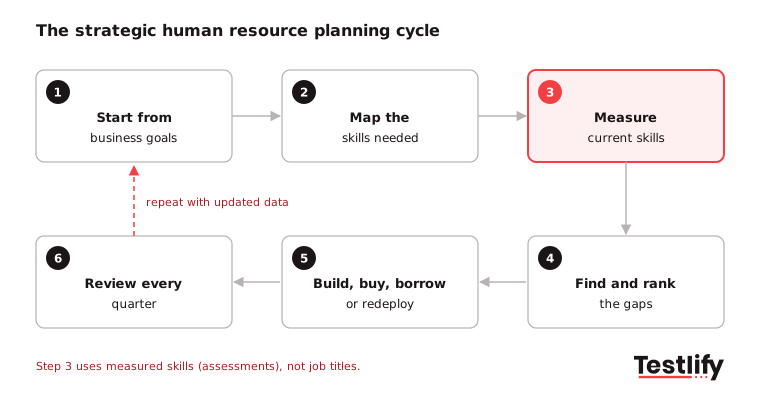
- Start from business goals: List the three to five goals for the next one to three years and the people each one depends on.
- Map the skills needed: For every critical role, write the five to eight skills that matter most and the level required.
- Measure current skills: Use assessments, performance data and manager input to see what the current workforce can do, not just what job titles say.
- Find and rank the gaps: Compare needed and current skills, then rank gaps by business impact and time to close. Do not try to fix every gap at once.
- Choose how to close each gap: Decide between build, buy, borrow and redeploy, with an owner, budget and date for each action.
- Review and adjust every quarter: Track the metrics below, check the scenarios, and update the plan when the business changes.
Pro tip: keep the plan itself short. A two-page summary with a gap table and owners gets read and updated; a 40-page document gets filed. You can find a template approach in how to create a strategic human resource plan.
Which metrics show a strategic human resource plan is working?
A strategic human resource plan is working when critical roles are filled on time with people who have the planned skills, and when the business can point to fewer surprises. Five or six metrics are enough to show that.
Metric | What it tells you | Review |
|---|---|---|
Critical role fill rate | Share of planned critical roles filled on time | Quarterly |
Time to fill for critical roles | Whether hiring can keep pace with the plan | Monthly |
Skills gap closure | Share of priority skill gaps closed against target | Quarterly |
Internal fill rate | Share of roles filled by internal moves | Quarterly |
Quality of hire | Performance and retention of new hires after 6 to 12 months | Twice a year |
Regretted attrition in critical roles | Whether you are losing the skills you planned to keep | Quarterly |
Tie each metric to an owner in the planning group. A metric nobody owns rarely leads to a change in the plan.
How does skills assessment support strategic human resource planning?
Skills assessment supports strategic human resource planning by replacing guesses about skills with measured results, both for current employees and for candidates. Measured skills make the gap analysis reliable and make sure the skills in the plan are the skills you hire for.
Testlify is a skills assessment and AI interviewing platform that helps HR and talent teams do this at scale:
- Measure skills against the plan: Choose from 3,500+ tests in the Testlify test library, covering role-specific, coding, cognitive ability, situational judgment, language and personality tests, or build a custom assessment from a job description.
- Hire on skills, not resumes: Score every candidate on the same criteria, with 20+ proctoring checks to protect results. The AI resume screener adds explainable match scores before the assessment stage.
- Keep data in one place: Results sync with 100+ ATS and HRIS tools through Testlify integrations, so skills data feeds the same systems you plan from.
- Assess at scale: Candidates can take assessments in 15+ languages, which helps when the plan spans regions.
If you want to see how measured skills data changes your next planning cycle, start a 7-day free trial, no credit card needed. For a broader view, also read our list of common mistakes to avoid in workforce planning.
Frequently asked questions

Content Writer
Yashika Khandelwal is a Content Writer with 3+ years of experience creating research-backed content on hiring, talent assessment, and HR technology. She is a registered Organizational Psychologist and subject matter expert who combines behavioral science with practical recruitment insights to produce accurate, evidence-based content.
LinkedInRelated resources
View all
HR & recruitment
How to measure the success of strategic human resource planning?

HR & recruitment
How to create a strategic human resource plan in 8 steps

HR & recruitment
What are the different steps in strategic human resource planning?

HR & recruitment
The importance of strategic human resource planning

HR & recruitment
What is strategic human resource planning?

HR & recruitment
How to use technology to support new hire orientations?
Get started.
Hire on proof, not resumes.
Run your first skills-based assessment free — no credit card required.