
How to measure the success of organizational development?
Measure organizational development success by evaluating employee performance, engagement levels, and alignment with strategic objectives.

By Priya Sharma, HR Content Specialist at Testlify
 ChatGPT
 Gemini
 Claude
 Grok
Grok Perplexity
Key Takeaways
- Only 23% of employees globally are engaged at work, making OD measurement critical to reversing this trend (Gallup, 2024).
- Change initiatives with excellent change management succeed 88% of the time vs. 13% with weak change management (Gartner, 2025).
- Leadership development delivers an average ROI of $7 for every $1 invested when tied to measurable outcomes.
- The five core pillars of OD success measurement: goal-setting, KPI selection, data collection, stakeholder engagement, and continuous benchmarking.
- Measurement is not a one-time audit — it is a continuous feedback loop that turns strategy into sustainable performance.
Organizational Development (OD) is one of the most strategic ways a company can improve its overall effectiveness, align its people with its mission, and build a culture that supports long-term growth. But after implementing OD initiatives — whether that is leadership development, culture transformation, team restructuring, or process redesign — one crucial question remains: how do you know if it is actually working?
Measuring the success of organizational development means evaluating how people, processes, and culture evolve in response to deliberate, strategic change. Organizations that consistently track OD metrics report measurably better outcomes: companies with high employee engagement experience 21% lower turnover in high-turnover industries and 51% lower turnover in low-turnover industries (Gallup, 2024). Without a measurement framework, even well-designed OD programs become invisible investments with no way to demonstrate value or course-correct.
This guide walks through every dimension of how to measure the success of organizational development — from defining goals to selecting KPIs, collecting data, benchmarking, and creating a continuous improvement cycle that sustains results.

Why Should You Measure OD Success?
The purpose of measuring organizational development success is not only to track performance — it is to ensure that every developmental effort aligns with the organization’s broader business strategy. Without measurement, OD becomes a well-intentioned but unverifiable expense. With measurement, it becomes a strategic lever that connects human behavior directly to business results.
The stakes are real. Low employee engagement cost the global economy $8.9 trillion in 2024, equivalent to 9% of global GDP (Gallup, 2024). In the United States alone, only 31% of employees were engaged in 2024 — the lowest figure since 2014. These are not abstract numbers: declining engagement drains productivity, increases turnover, and erodes the organizational capability that OD programs are specifically designed to build.
When done correctly, OD measurement helps leaders answer the questions that matter most:
- Are our initiatives driving the cultural and behavioral changes we envisioned?
- Are employees more engaged, capable, and aligned with our mission?
- Are leaders demonstrating stronger decision-making and collaboration skills?
- Are OD investments producing a measurable return relative to turnover, productivity, and culture outcomes?
The business case is compelling: leadership development alone delivers an average ROI of $7 for every $1 invested when organizations measure outcomes systematically and tie programs to business metrics. Measurement is what makes that ROI visible — and repeatable.
Read: Case studies of successful organizational development programs
How Do You Measure OD Intervention Effectiveness?
Measuring OD intervention effectiveness requires a structured five-step approach: define goals, select metrics, collect data, involve stakeholders, and benchmark continuously. The process is iterative — each cycle of measurement feeds the next round of improvement. Before measuring anything, you need to choose the right OD interventions aligned with your strategic goals.
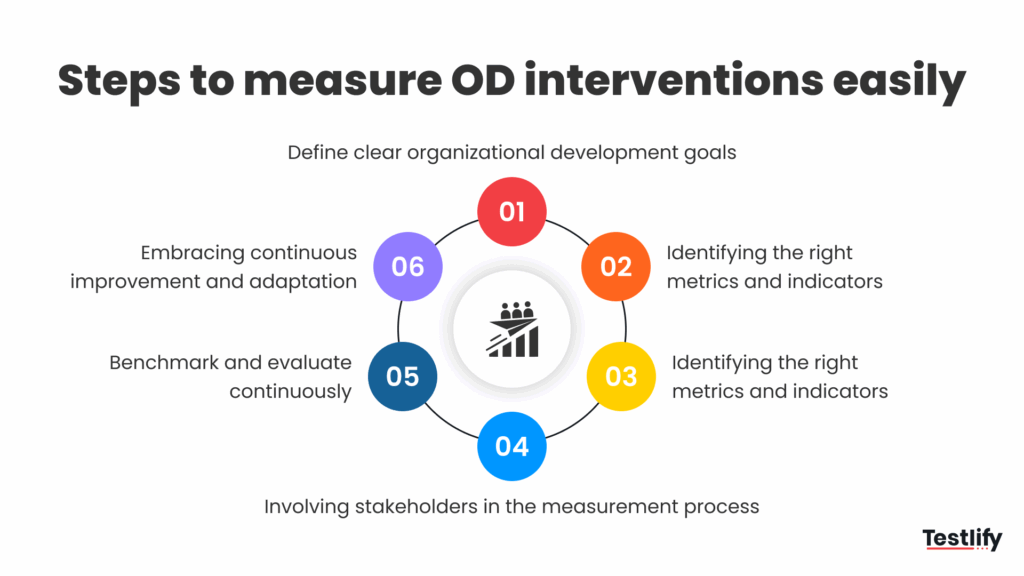
Step 1: Define Clear Organizational Development Goals
The first step in measuring OD success is defining specific, measurable, and time-bound goals that align with the organization’s overall talent and business strategy. Without clear goals, measurement becomes subjective and inconsistent — and organizations lose the ability to distinguish between progress and noise.
Effective OD goals share three characteristics: they are linked to a business outcome (not just an activity), they are measurable with existing or accessible data, and they have a defined timeframe for review. Common strategic OD goals include:
- Enhance employee engagement: Engaged employees are more productive and significantly less likely to leave. Gallup data shows engaged teams are 23% more profitable.
- Improve leadership effectiveness: Strong leaders retain talent and create high-performing teams. Trust in managers dropped from 46% in 2022 to just 29% in 2024 — a measurable signal that leadership development is urgently needed.
- Reduce turnover: Lower attrition decreases hiring costs. Replacing an employee can cost 50%–200% of their annual salary; executive-level turnover can cost up to 300%.
- Strengthen company culture: A positive workplace culture improves recruitment outcomes, team cohesion, and innovation capacity.
- Increase diversity and inclusion: A diverse workforce improves decision-making quality and broadens the talent pool for future growth.
Recruiters and HR leaders should map each OD goal to specific recruitment metrics — time-to-fill, quality-of-hire, and early attrition rates — to demonstrate the tangible downstream benefits of OD investments.
Step 2: Identify the Right Metrics and KPIs
Once goals are established, the next step is selecting Key Performance Indicators (KPIs) that will show whether those goals are being achieved. Effective OD measurement goes beyond surface-level statistics and focuses on indicators that reveal genuine cultural and behavioral shifts — not just activity completion.
A useful way to organize OD KPIs is to separate leading indicators (measures that predict future outcomes, such as engagement pulse scores) from lagging indicators (outcomes that confirm past performance, such as annual turnover rates). Using both together creates a more complete picture of organizational health.
Core OD metrics to track include:
- Employee engagement scores from annual surveys, pulse checks, or platforms like Glint and Culture Amp
- Leadership effectiveness ratings from 360-degree feedback programs and upward feedback surveys
- Turnover and retention rates, particularly for high performers and critical roles
- Culture assessments, measuring values alignment, psychological safety, and belonging
- Internal mobility data, reflecting how often employees advance or transfer within the organization
- Change adoption rates, measuring how effectively employees are embracing new processes, tools, or behaviors
Change adoption data matters more than most organizations realize: only 32% of change initiatives achieve healthy adoption by employees (Gartner, 2025). Tracking this metric across OD interventions can reveal whether structural or communication gaps are undermining otherwise well-designed programs.
Step 3: Collect and Analyze Data Effectively
Measurement in OD is only as strong as the data behind it. A robust data collection strategy combines quantitative and qualitative methods to capture both measurable outcomes and human experiences — because numbers alone rarely tell the full story.
Quantitative data — survey scores, performance statistics, turnover rates, productivity metrics — provide tangible indicators of progress. Qualitative insights — gathered through interviews, focus groups, and structured observation — provide the “why” behind the numbers. Organizations that rely exclusively on one or the other will systematically misread their OD results.
For example, if engagement scores improve in certain departments but decline in others, discussions with employees can identify root causes: leadership style differences, workload imbalances, communication breakdowns, or unclear role expectations. This deeper interpretation converts data into actionable strategy.
The analysis phase should also explore relationships between metrics — how leadership training correlates with team-level engagement, or how cross-functional collaboration impacts innovation output. When done well, this relational analysis allows organizations to allocate OD investment with far greater precision. According to McKinsey, organizations where employees are genuinely invested in change see a 30% higher likelihood of success (McKinsey, 2024).
Step 4: Involve Stakeholders in the Measurement Process
Organizational development succeeds only when everyone involved has a meaningful voice in its evaluation. Measurement should not be confined to HR or OD departments — it must engage stakeholders at every level of the organization to ensure results reflect reality, not just leadership perceptions.
Each stakeholder group brings a distinct and necessary perspective:
- Employees provide ground-level feedback on how initiatives influence their day-to-day experience, motivation, and trust in the organization.
- Managers assess the practicality and team-level impact of OD programs. Notably, 74% of managers in a 2024 Gartner survey said they lack the skills to lead change — making their participation in measurement both urgent and revealing.
- Executives evaluate alignment between OD outcomes and strategic business goals, including revenue, talent pipeline, and competitive positioning.
- External consultants can offer objective benchmarking, industry comparison data, and unbiased analysis that internal teams may struggle to provide.
Also Read: How to measure the success of sourcing candidates in 2026
This inclusive approach creates shared accountability and builds organizational trust. When employees see their feedback driving real changes, engagement in future OD initiatives increases — creating a positive feedback loop that compounds over time. Research confirms that open-source change management strategies (those that invite broad participation) improve change success rates from 34% to 58% (Gartner, 2024).
Step 5: Benchmark and Evaluate Continuously
Measurement gains real meaning only when placed in context. Benchmarking — comparing your OD outcomes against external standards, industry peers, or your own historical data — transforms raw metrics into actionable intelligence and prevents the common trap of measuring progress in a vacuum.
Consider a concrete example: if your employee engagement score is 68% while the industry average for comparable organizations is 76%, that gap of 8 percentage points becomes a targeted improvement objective, not a vague aspiration. Benchmarks make priorities visible and defensible to leadership.
However, benchmarking should be applied with judgment. Every organization has unique cultural dynamics, workforce demographics, and market pressures. The goal is not imitation but adaptation — understanding why high-performing organizations succeed in specific OD domains and tailoring those insights to fit your own context. SHRM research consistently shows that organizations that adapt best-practice frameworks to their specific culture outperform those that transplant them wholesale.
For further context on industry benchmarks and HR best practices, the SHRM Research and Insights hub provides regularly updated data on engagement, retention, and organizational performance.
What Are the Key Frameworks for Measuring OD Success?
Several proven frameworks help organizations structure their OD measurement approach. The right framework depends on the type of OD intervention, the available data infrastructure, and the organization’s measurement maturity. The most widely used models include:
- Kirkpatrick Model: Evaluates training and development programs across four levels — Reaction, Learning, Behavior, and Results. It is the industry standard for assessing how behavioral changes translate into business outcomes.
- Balanced Scorecard: Connects OD metrics to four organizational perspectives — financial, customer, internal processes, and learning and growth. Particularly useful for aligning OD with enterprise strategy.
- OKRs (Objectives and Key Results): A goal-setting framework that ties OD objectives to measurable key results with defined quarterly timelines. OKRs create visible accountability across teams and leadership levels.
- 360-Degree Feedback Systems: Multi-source feedback tools that measure leadership effectiveness, team dynamics, and individual behavioral change — core indicators of OD success at the individual and team levels.
No single framework fits all organizations. The most effective approach typically combines elements from multiple models, aligned with the specific goals of each OD initiative. Organizations using Testlify’s test library can also integrate skills and behavioral assessments directly into OD measurement workflows, adding objective pre- and post-intervention data to support program evaluation.
How Does Organizational Culture Affect OD Measurement?
Organizational culture is not a soft backdrop to OD — it is the medium through which all OD programs succeed or fail. Culture shapes whether employees trust the measurement process, whether managers act on feedback, and whether leadership commits to the follow-through required for sustained change.
One of the most consistent findings in OD research is that measurement itself can be culturally disruptive. When employees are asked to evaluate leadership effectiveness or report on culture health, the act of measurement signals organizational values. If feedback is collected and then ignored, trust erodes rapidly — and future measurement efforts become contaminated by cynicism. When feedback drives visible action, however, the measurement process itself becomes an OD intervention, demonstrating that the organization values transparency and continuous improvement.
A psychologically safe culture — one where employees feel comfortable sharing honest feedback without fear of reprisal — is a prerequisite for accurate OD measurement. Organizations scoring high on psychological safety consistently produce more accurate survey data, making their OD measurement more reliable and their improvement cycles faster. This is a competitive advantage that compounds: better data leads to better interventions, which leads to better culture, which leads to better data.
For organizations building or refining their talent assessment capabilities, Testlify’s pricing page outlines options for integrating objective assessments into culture and OD measurement programs.
What Role Does Continuous Improvement Play in OD Measurement?
Organizational development is not a finite project — it is a living system that requires ongoing attention, recalibration, and reinvestment. Measuring OD success should therefore be a cyclical process: evaluate, learn, refine, and repeat. Organizations that treat OD measurement as an annual audit rather than a continuous feedback loop consistently underperform compared to those that embed measurement into their operational rhythm.
The business environment reinforces this imperative. Market dynamics shift, technologies advance, and employee expectations evolve. According to Gartner, 73% of HR leaders reported in 2024 that employees are experiencing change fatigue — a direct consequence of organizations that launch new initiatives without measuring, learning from, and improving on previous ones. Change fatigue signals that the volume of change has exceeded the organization’s capacity to absorb it without a measurement and recovery mechanism in place.
Insights from data, stakeholder feedback, and benchmarks should feed into quarterly or semi-annual action planning cycles. Whether that means redesigning leadership programs, updating communication strategies, or restructuring team workflows, every data-driven improvement reinforces the organization’s capacity to adapt. This culture of constant reflection ensures that OD remains a long-term driver of resilience and competitive advantage — not a one-time initiative with a finite end date.
To explore how leading organizations approach talent development and OD measurement, Testlify’s blog covers the latest research and frameworks from across the HR and organizational development landscape.
Key Takeaway
Measuring the success of organizational development is fundamentally about connecting intent to impact. It is not enough to implement change — organizations must understand whether that change is creating real, measurable value at the employee, team, and business level.
A well-designed OD measurement strategy transforms organizational development from theory into traceable, improvable progress. By setting clear goals, tracking meaningful KPIs, collecting both quantitative and qualitative data, involving stakeholders at every level, and benchmarking against relevant standards, organizations gain the clarity needed to evolve with precision and confidence.
The true measure of OD success is sustained improvement: a workplace where employees are engaged, leaders are empowered and accountable, and the organization adapts confidently to the future. When measurement becomes an integral part of the development culture — not an afterthought — OD stops being an initiative and becomes an organizational capability that compounds over time.
Ready to strengthen your talent measurement infrastructure? Book a demo with Testlify to see how objective assessments integrate with your OD measurement framework.
Frequently Asked Questions

Wordpress Developer
Yash Patel is a Wordpress and SEO Specialist at Testlify with 3+ years of experience in technical SEO, on-page optimization, and content strategy. He works on improving Testlify's organic presence and produces content focused on hiring, talent assessment, and HR technology.
LinkedInRelated resources
View all
HR & recruitment
How to implement organizational development successfully?

HR & recruitment
How to implement a workforce plan?

HR & recruitment
How to develop a workforce plan?

HR & recruitment
How to identify your workforce needs?

HR & recruitment
Organizational development for remote teams

HR & recruitment
Organizational development for startups
Get started.
Hire on proof, not resumes.
Run your first skills-based assessment free — no credit card required.