
Tips to evaluate analytical skills in candidates (2026)
How to evaluate analytical skills in hiring: skills tests, work tasks, interview questions, a 1 to 5 scoring rubric and red flags to watch.

The most useful tips to evaluate analytical skills come down to one rule: watch candidates analyze instead of taking their word for it. Analytical skills are the ability to break a problem down, read the evidence, test assumptions and reach a conclusion you can explain. Resumes and "I am very analytical" claims say little about them, so hiring teams need a short test, a job-like task and structured interview questions, all scored the same way for every candidate.
TL;DR:
- Evaluate analytical skills by testing them: a short timed skills test, a job-like task and structured interview questions beat resume keywords and gut feel.
- Analytical thinking is the top core skill employers want, with seven out of 10 companies calling it essential in the World Economic Forum's Future of Jobs Report 2025.
- Put the skills test right after the resume screen, so only candidates who can actually reason with data reach the interview.
- Judge the reasoning, not only the answer: score how candidates break the problem down, use evidence, test assumptions, conclude and explain.
- Use one 1 to 5 rubric for every candidate and agree the pass mark before anyone sees results.
- Red flags are canned answers, jumping to conclusions, treating guesses as facts and not being able to explain the steps.
- Keep remote tests honest and fair: job-related questions, the same conditions for all, accommodations on request and proctoring on take-home work.
 ChatGPT
 Gemini
 Claude
 Grok
 Perplexity
What are analytical skills?
Analytical skills are the abilities people use to collect information, find what matters in it and turn it into a sound decision. In hiring, they usually break into five parts that you can observe and score: critical thinking, data interpretation, research, problem-solving, and explaining findings so others can act on them.
- Critical thinking: Weighing arguments, spotting weak logic and making a judgment based on evidence rather than first impressions.
- Data interpretation: Reading charts, tables and numbers, doing quick calculations such as percentages and ratios, and drawing the right conclusion.
- Research: Knowing where to look, which sources to trust and when there is enough information to decide.
- Problem-solving: Splitting a complex problem into parts, finding the root cause and choosing between options.
- Communication of findings: Explaining a conclusion in plain words to people who did not do the analysis.
Employers screen hard for these skills. In NACE's Job Outlook 2025 survey, nearly 90% of employers said they look for evidence of problem-solving on new graduates' resumes, and more than two-thirds look for analytical and quantitative skills (NACE's Job Outlook 2025 findings).

Why should hiring teams evaluate analytical skills?
Hiring teams should evaluate analytical skills because weak analysis is expensive and hard to spot after hiring. A poor analytical hire needs closer supervision, and mistakes in a report, forecast or budget often surface weeks later, when they are costly to fix. Testing before the offer catches the gap while it is cheap.
Demand is broad. The World Economic Forum's Future of Jobs Report 2025 names analytical thinking the top core skill for employers, with seven out of 10 companies considering it essential. The survey covers more than 1,000 employers that together employ over 14 million workers.
Analytical skills matter most in roles such as data analysts, financial analysts, business strategists, research professionals, operations managers and product managers. People in these roles gather complex information, spot patterns and make data-driven decisions that shape growth, efficiency and risk. Strong analysts also anticipate trends and see opportunities for improvement that others miss.
What are the best tips to evaluate analytical skills?
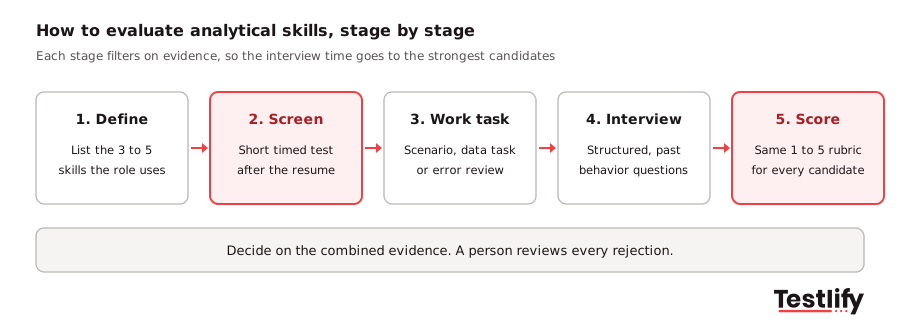
The best tips to evaluate analytical skills combine several methods, each placed at the stage where it gives the most evidence for the least time. Define the skills first, screen with a short test, then use a job-like task and structured questions for the shortlist, and score everything on one rubric.
Method | What it shows | Best stage | Candidate time |
|---|---|---|---|
Skills test (numerical, logical, data) | Reasoning speed and accuracy on the same questions for all | Right after resume screen | 10 to 30 minutes |
Problem-solving scenario | How candidates structure a messy, job-like problem | Shortlist | 20 to 45 minutes |
Critical thinking exercise | Whether candidates spot weak arguments and bias | Screen or shortlist | 10 to 20 minutes |
Data analysis assignment | Cleaning, analysis, charts and a recommendation | Final shortlist | 1 to 2 hours |
Planted-error review | Attention to detail and rigor | Screen or shortlist | 10 to 15 minutes |
Structured behavioral interview | Past analytical work, in the candidate's words | Interview | 30 to 45 minutes |
1. Define the analytical skills the role needs
Start with the job, not the test. List the three to five analytical tasks the person will do in the first six months, for example "reconcile weekly sales data" or "decide which supplier to keep". Each task points to a skill to test. A financial analyst needs numerical reasoning and attention to detail. A support team lead needs root-cause problem-solving and clear explanations. Questions that match the real work tell you whether candidates can solve the problems they will actually face.
2. Screen early with a short skills test
Place a short, timed skills test right after the resume screen. An analytical ability test or a numerical reasoning test gives every applicant the same questions, so you compare people on evidence before anyone spends interview time. Good quantitative and reasoning questions cover:
- Data interpretation: Reading charts, graphs and tables and drawing an accurate conclusion.
- Calculations: Percentages, ratios and basic statistics applied to work situations.
- Logical problems: Finding the steps and the method needed to reach a correct answer.
- Time pressure: A sensible time limit shows who can prioritize and stay accurate under pressure.
- Detail: Spotting calculation errors or inconsistent figures.
Match the difficulty to the level. Entry-level roles need basic reasoning; senior analyst roles need harder, multi-step data questions.
3. Use realistic problem-solving scenarios
Give candidates a real or simulated problem from the role and watch how they work through it. A good scenario has a clear problem statement and all the information needed, plus a few details that do not matter. Then look for four things:
- Structure: Do they break the problem into smaller parts and set an order of attack?
- Questions: Do they ask for the information they are missing?
- Patterns: Do they notice trends or links in the facts given?
- Solutions: Is the recommendation practical and backed by the evidence, and can they explain it?
Realistic scenarios also improve the candidate experience. People get a preview of the actual job, which tells them you have thought about the role.
4. Add a critical thinking exercise
Critical thinking exercises show whether candidates can evaluate an argument instead of accepting it. Give a short memo, claim or business case and ask what is wrong with it, what evidence is missing and what they would conclude. Strong candidates name logical gaps, question how reliable the evidence is, consider other explanations and still propose a clear answer. A critical thinking test covers this at scale, and our guide on evaluating critical thinking skills goes deeper.
5. Set a data analysis assignment for the shortlist
For analyst roles, a data assignment is the closest thing to the job. Share a small dataset similar to the data the role uses and ask for a short written answer to a business question. Evaluate how candidates:
- Explore the data: Clean it, handle missing values and check what the columns really mean.
- Analyze it: Use descriptive statistics, comparisons or a simple regression where it fits.
- Visualize it: Build one or two clear charts that support the point.
- Recommend: Turn the findings into a decision with its risks.
Keep it to one or two hours and use it only for the final few candidates. Long unpaid take-home work drives good candidates away.
6. Run a planted-error review
Hand candidates a one-page report or spreadsheet with five deliberate errors: a wrong total, a mislabeled chart, a percentage that does not add up, a conclusion the data does not support and an outdated figure. Give 10 minutes and count what they find and how they explain each error. The task is quick to set, easy to score and shows rigor better than any interview question.
Pro tip: Plant one error that only shows up when someone checks the source data. Candidates who catch it verify numbers instead of trusting them, which is the habit you want in an analyst.
7. Ask structured behavioral interview questions
Behavioral questions ask candidates to describe real situations where they used analytical skills: a complex problem they solved, data they analyzed to make a decision or a process they improved. Ask every candidate the same questions in the same order, as in a structured interview, and probe with follow-ups such as "What data did you use?" and "How did you check your conclusion?" Listen for how they handled pressure, worked with others and explained complex points simply.
8. Score every candidate with the same rubric
Decide before the first interview what good looks like. Score each analytical behavior from 1 to 5 using written anchors, and have each interviewer score alone before the debrief. A shared interview scorecard keeps scores comparable and makes the final decision easy to explain.
9. Combine methods and refine them over time
No single method is enough. A test shows reasoning on fixed questions, a task shows how someone works, and an interview shows how they think out loud. Combine them for a complete picture. After each hiring round, compare test and task scores with how new hires actually perform, then drop questions that do not separate strong from weak candidates.
Key takeaway: A short test filters, a job-like task confirms and a structured interview explains. Use all three, score them on one rubric, and each stage does the job it is best at.
Which interview questions reveal analytical skills?
Interview questions reveal analytical skills when they ask for a specific past situation or a realistic choice and then probe the reasoning. Generic questions such as "Are you analytical?" invite canned answers. The questions below each target one skill, with the signal a strong answer gives.
Question | Skill it tests | A strong answer shows |
|---|---|---|
Tell me about a time you solved a problem with incomplete information. | Problem-solving | What they knew, what they assumed, how they filled the gaps |
Walk me through how you would troubleshoot a sudden drop in weekly sales. | Structuring | A step-by-step plan that rules causes in or out |
Which metrics do you track in your current role, and why those? | Data interpretation | Clear link between each metric and a decision |
How do you make sure your numbers are accurate? | Rigor | Specific checks, such as source reconciliation and peer review |
You must choose between three tools for your team. How do you decide? | Decision-making | Criteria set first, options weighed openly, trade-offs named |
Describe a time your analysis changed a decision. | Impact | The finding, the decision before and after, the result |
Tell me about a time you found conflicting data. What did you do? | Critical thinking | How they found the cause and which source they trusted |
How did you explain a complex finding to someone non-technical? | Communication | Plain words, one key message, a visual or example |
How do you score analytical skills fairly?
Analytical skills are scored fairly when every candidate is rated on the same behaviors, with written anchors for each score, by reviewers who rate alone before they compare. Score the reasoning, not only the final answer: a candidate who reaches a slightly wrong number through a sound method often outperforms one who guessed right.
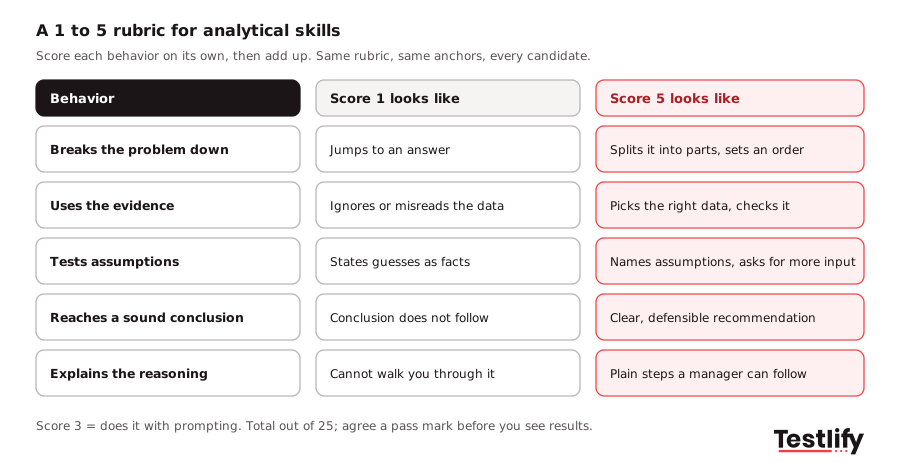
Use five behaviors and a 1 to 5 scale:
- Breaks the problem down: 1 jumps straight to an answer; 5 splits the problem into parts and sets an order.
- Uses the evidence: 1 ignores or misreads the data; 5 picks the right data and checks it.
- Tests assumptions: 1 states guesses as facts; 5 names assumptions and asks for more input.
- Reaches a sound conclusion: 1 draws a conclusion that does not follow; 5 gives a clear, defensible recommendation.
- Explains the reasoning: 1 cannot walk you through it; 5 explains the steps so a manager can follow them.
A 3 means the candidate gets there with prompting. Add the scores for a total out of 25, agree the pass mark before results come in, and weight the behaviors that matter most for the role. On a skills test, give more points to harder multi-step questions than to quick ones.
What red flags show weak analytical skills?
Red flags for weak analytical skills are answers that claim the skill without showing it. The most common are canned answers, jumping to conclusions, unchecked assumptions, big-picture talk with no root cause, and not being able to explain the steps behind a conclusion.
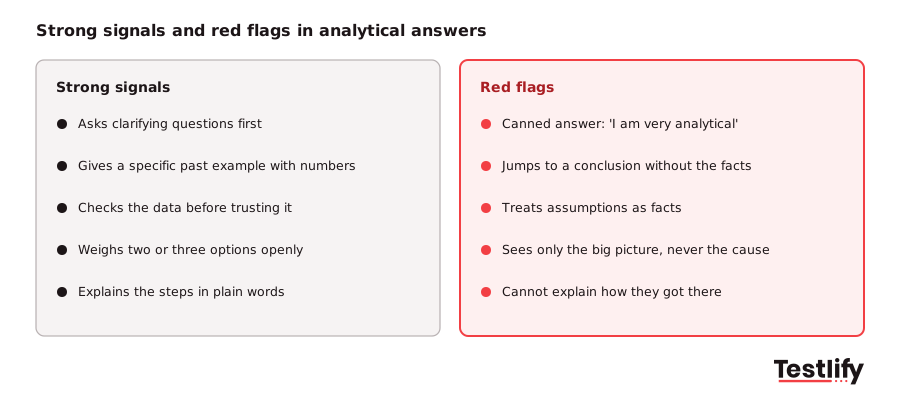
- Canned answers: "I am very analytical and detail-oriented" with no real example behind it.
- Jumping to conclusions: Answering before asking a single clarifying question.
- Unchecked assumptions: Treating guesses as facts and never verifying a number.
- No root cause: Describing the big picture but never what actually caused the problem.
- Weak explanation: Reaching a sound answer but being unable to explain how, which makes their work hard to trust or hand over.
- Weak justification: Choosing an option without saying why the others were worse.
Which analytical skills matter most for each role?
The analytical skills that matter most depend on the decisions the role makes. Data roles lean on interpretation and statistics, finance roles on numerical accuracy, operations roles on root-cause problem-solving and customer-facing roles on quick judgment. Weight your test and rubric to match.
Role | Skills to weight | Best methods |
|---|---|---|
Data analyst | Data interpretation, statistics, visualization | Data interpretation test, data assignment |
Financial analyst | Numerical reasoning, attention to detail, forecasting | Numerical test, planted-error review |
Operations manager | Root-cause problem-solving, process improvement | Scenario, behavioral questions |
Product manager | Decision-making, research, trade-offs | Scenario, critical thinking exercise |
Customer support or BPO lead | Quick judgment, problem-solving, clear explanations | Situational judgment questions, scenario |
Entry-level and graduate roles | Basic reasoning, learning speed | Short reasoning test, simple scenario |
For roles where problem-solving is the main skill, see our tips to evaluate problem-solving skills.
How do you keep analytical assessments fair and accurate?
Analytical assessments stay fair and accurate when every question links to the job, every candidate gets the same conditions, and results are checked for bias. The EEOC's guidance on employment tests says employers stay responsible for the tests they use, even when a vendor supplies them.
- Keep it job-related: Every question should trace back to a task from tip 1. Puzzle questions with no link to the job are harder to defend and tell you little.
- Mix formats: Combine multiple choice, short written answers and practical tasks, so no single format favors one group.
- Give clear instructions: Explain the time limit, the format and what you score before the test starts.
- Offer accommodations: Extra time, a screen reader or an audio version on request, as the EEOC expects under the ADA.
- Check for bias: Compare pass rates across groups after each round and replace questions that screen out one group without a job reason.
- Protect remote tests: Take-home tasks are easy to outsource or hand to AI. Use anti-cheating and proctoring checks for screening tests and ask candidates to walk through their task live.
- Update often: Refresh questions as the role changes and retire ones that leaked.
How does Testlify help you evaluate analytical skills?
Testlify helps hiring teams evaluate analytical skills with ready-made tests, job-like tasks and automated scoring in one platform. The test library holds 3,500+ tests, including cognitive ability, numerical reasoning, logical reasoning, critical thinking, data interpretation and situational judgment tests at beginner, intermediate and advanced levels.
- Build a role-specific test fast: The AI test builder turns a job description into a custom assessment in under a minute, and you can mix in your own questions.
- Add job-like tasks: 25+ question types include practical tasks, file uploads, spreadsheet uploads and open-ended answers, so a data task or planted-error review sits in the same assessment.
- Score the same way for everyone: Automated scoring, weighted scores and per-skill breakdowns rank candidates on evidence, with benchmarking against other candidates.
- Keep it honest: 20+ proctoring checks, including tab tracking, copy and paste tracking and AI assistance detection.
- Fit your stack: Results sync to 100+ ATS and HRIS tools.
Want to see it on one real role? Start a 7-day free trial with no credit card, or book a demo to see how an analytical assessment would work for your next hire.
Frequently asked questions

Wordpress Developer
Yash Patel is a Wordpress and SEO Specialist at Testlify with 3+ years of experience in technical SEO, on-page optimization, and content strategy. He works on improving Testlify's organic presence and produces content focused on hiring, talent assessment, and HR technology.
LinkedInRelated resources
View all
HR & recruitment
How to Evaluate Content Writing Skills When Hiring

HR & recruitment
How to Evaluate Project Coordination Skills When Hiring

HR & recruitment
How to evaluate negotiation skills in candidates: methods, questions and a scorecard

HR & recruitment
How to evaluate web development skills in candidates

HR & recruitment
5 tips to evaluate social media marketing skills

HR & recruitment
How to evaluate critical thinking skills in candidates
Get started.
Hire on proof, not resumes.
Run your first skills-based assessment free — no credit card required.