
Maintaining fairness designing cheating resistant online tests: a guide for hiring teams
How hiring teams design online tests that are hard to cheat on and still fair: question design, clear rules, risk-based checks and review.
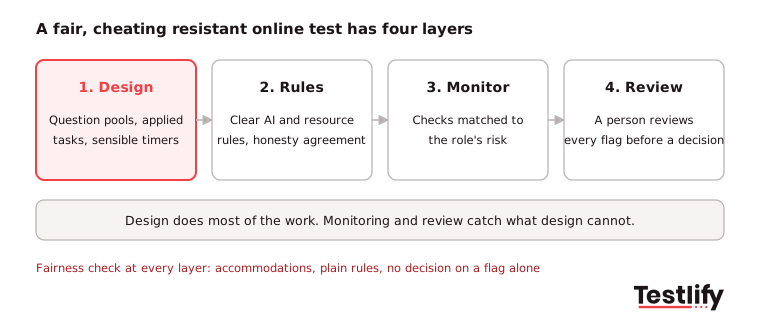
Maintaining fairness designing cheating resistant online tests means building pre-employment tests that are hard to game and still fair to every honest candidate. Good design does most of the work: question pools, applied tasks and clear rules come first. Monitoring is matched to the risk of the role, and a person reviews every flag before anyone is rejected.
TL;DR:
- A fair, cheating resistant online test rests on four layers: question design, clear rules, monitoring matched to role risk, and human review of every flag.
- AI makes cheating easy. A Gartner survey of 3,290 job candidates found 39% used AI in applications, and 29% of those used it to draft assessment answers.
- Design beats surveillance: large randomized question pools, applied tasks, sensible timers and a short retest for finalists make outside help far less useful.
- Match monitoring to the role's risk and access, not seniority. Full proctoring on every role raises drop-off and adds little.
- No anti-cheating flag is proof. Review the recording and logs, then advance, retest or disqualify, and record why.
- Fairness rules still apply: offer accommodations, tell candidates what is monitored, and keep a person in charge of decisions.
 ChatGPT
 Gemini
 Claude
 Grok
 Perplexity
What does maintaining fairness designing cheating resistant online tests involve?
Maintaining fairness designing cheating resistant online tests involves two goals that pull against each other: stopping candidates who cheat and protecting candidates who do not. Every control you add, from a webcam check to a strict timer, has a fairness cost, so each one has to earn its place.
The pressure to get this right is high. SHRM's 2026 Talent Trends research found that nearly 70% of HR professionals still face challenges recruiting for full-time roles. When a test result decides who moves forward, a score inflated by outside help pushes a better candidate out of the process.
A fair test is also one that measures the job. Questions tied to real tasks are harder to look up, and they give every candidate the same chance to show the skill the role needs. For a broader view of the topic, see the guide to online test integrity.

How do candidates cheat on online tests in 2026?
Candidates cheat on online tests in four main ways: looking up answers, getting AI tools to answer, having someone else take the test, and using leaked questions. The older methods never went away. What changed is that AI now sits behind many of them and produces polished answers in seconds.
- Searching and outside material: Googling answers, notes in another window and reference documents on the desk.
- Copying and pasting: pasting answers from a prepared document or from another site.
- AI assistance: typing or reading questions into an AI chatbot, often on a phone or second device outside the camera frame, then retyping the answer to avoid copy-paste checks.
- Proxy test-takers: a more skilled person takes the test, or takes over the session after the real candidate logs in. Deepfake video can make this harder to spot.
- Screen sharing and helpers: a helper watches the screen remotely and dictates answers.
- Leaked questions: fixed question sets get shared on forums and in group chats.
The numbers show why this matters. According to SHRM's report on fraudulent candidates, a Gartner survey of 3,290 job candidates found 39% used AI in their applications, and 29% of those used it to draft assessment answers. The same report notes that 6% of candidates in a separate survey admitted to interview fraud, and that by 2028 one in four candidates globally could be fake.
Vendor data points the same way. CodeSignal reported in February 2026 that cheating and fraud attempts on its proctored assessments rose from 16% in 2024 to 35% in 2025, and from 15% to 40% for entry-level roles. Its unproctored tests showed score jumps more than four times larger than proctored ones. Treat vendor figures as signals rather than market averages, but the direction is clear. More on spotting fake identities is in how to prevent impostors in video interviews.
How do you design questions that resist cheating?
Question design resists cheating by making outside help slow, risky or useless: draw from large randomized pools, test applied skills instead of facts, set timers that fit the task, and confirm finalists with a short follow-up. A well-designed test needs less monitoring, which keeps it fairer for honest candidates.
- Use large question pools: Draw each candidate's questions from a bank much bigger than the test. Fewer people see any one question, so leaks matter less.
- Randomize questions and answer options: No two candidates see the same order, which breaks shared answer keys and over-the-shoulder copying.
- Test applied skills, not recall: Scenario questions, coding tasks, spreadsheet tasks and short written answers about a real work problem are harder to look up than definitions.
- Set timers that fit the task: Per-question timers limit time for searching. Set them from how long honest candidates take, not as a trap, or you measure speed instead of skill.
- Limit backtracking where it makes sense: Locking answered questions stops candidates from looking up a block of questions at the end.
- Retire exposed questions: Watch for questions whose pass rate suddenly jumps and replace them.
- Verify finalists: A short follow-up test or a live discussion of the candidate's own answers shows whether the first score holds up.
Pro tip: Ask candidates to explain one of their answers in the interview. A candidate who wrote the answer can walk through it easily. One who pasted it from an AI tool usually cannot.
Design also covers language. A test written in plain English, or offered in the candidate's language, stops non-native speakers from being marked down on reading speed rather than skill. See how to ensure language fairness in assessments.
Which anti-cheating controls should you use?
Anti-cheating controls fall into four groups: identity checks, environment controls, behavior monitoring and session rules. Each one catches some cheating methods and misses others, so no single control is enough. The table shows what each control catches and where it falls short, so you can combine them.
Threat | Control that catches it | What it misses |
|---|---|---|
Tab switching, new windows | Full-screen mode, tab and mouse-out tracking | A phone or second device |
Copying from documents | Copy-paste blocking and tracking | Answers retyped by hand |
Someone else taking the test | Webcam snapshots, face detection, photo ID with face match | A helper outside the camera frame |
AI chatbot answers | AI assistance detection, response timing, follow-up questions | Not conclusive on its own |
Helper watching the screen | Screen recording, mandatory screen share | Answers dictated through an earpiece |
Talking to a helper in the room | Talking detection, live video proctoring | Silent help |
Testing from an unexpected place | IP and location restriction | VPNs and shared networks cause false alarms |
Shared or leaked questions | Question randomization from a large pool | Organized groups with the whole bank |
The weak spot in any single control is that candidates learn what triggers it. Once people know the browser is locked, they move to a phone. Layering controls raises the effort of cheating without claiming to make it impossible. For a full list of features, see Testlify's anti-cheating and proctoring checks.
How do you match monitoring to role risk?
Monitoring should match the risk of the role: light, always-on checks for every test, active monitoring where the result decides the hire, and identity verification with live proctoring for regulated or high-access roles. Base the tier on what the person will be able to do or access, not on seniority.
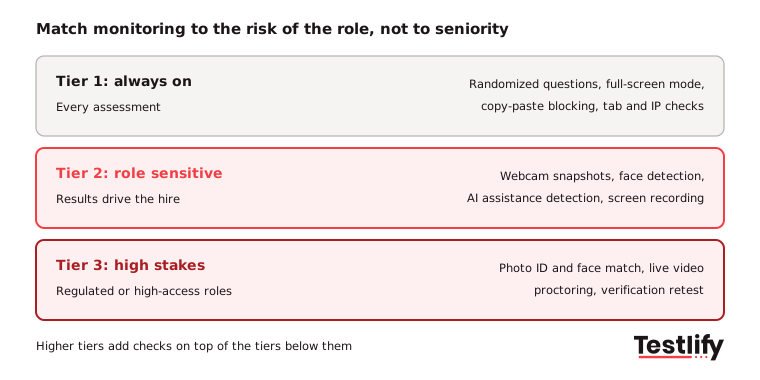
- Tier 1, always on: Randomized questions, full-screen mode, copy-paste blocking, tab tracking and IP checks. These add no friction for honest candidates and catch most casual cheating.
- Tier 2, role sensitive: Webcam snapshots, face detection, AI assistance detection and screen recording, for roles where the test score drives the shortlist.
- Tier 3, high stakes: Photo ID with face match, live video proctoring and a verification retest, for regulated roles, roles with access to money, customer data or production systems.
A junior developer with access to production code needs the same tier as a senior engineer. Teams that tie monitoring to job title end up under-protecting junior roles with high access.
Over-monitoring has a cost. Several assessment providers warn that heavy proctoring raises drop-off, and the strongest candidates, who have other offers, tend to leave first. Watch completion rates by role after you change settings: a sharp fall usually means the checks are heavier than the role needs.
How do you keep cheating controls fair to honest candidates?
Cheating controls stay fair when candidates know the rules, people who need accommodations get them, data collection is limited to what integrity needs, and a person makes every final decision. Fairness also means the test itself measures the job, so honest candidates are judged on skills they will actually use.
- Tell candidates what is monitored: State in the invite which checks run, what AI and resources are allowed, and how flags are handled. Clear rules deter cheating and reduce anxiety, which several providers see as a driver of cheating.
- Ask for an honesty agreement: A short agreement before the test, like the Testlify candidate honesty agreement, sets expectations in plain words.
- Offer accommodations: Extra time, screen readers or a different format may be needed. The EEOC guidance on employment tests says employers must provide reasonable accommodations in how tests are given and that tests should be job-related. A timer or webcam rule should never screen out a disabled candidate.
- Collect only what you need: Keep recordings for a set period and delete them after. Privacy rules in the EU, UK and several US states apply to webcam and screen data.
- Check for bias: Review pass rates by group after adding a control. A face detection check that fails more often in poor lighting can hit some candidates harder than others.
For the legal side of monitoring, see AI proctoring compliance.
What should you do when a test session is flagged?
A flagged test session should go to a person for review before any decision. The reviewer checks the recording and activity logs, decides whether the flags form a pattern or are a one-off or a technical issue, and then advances the candidate, invites a short retest, or disqualifies with a written reason.
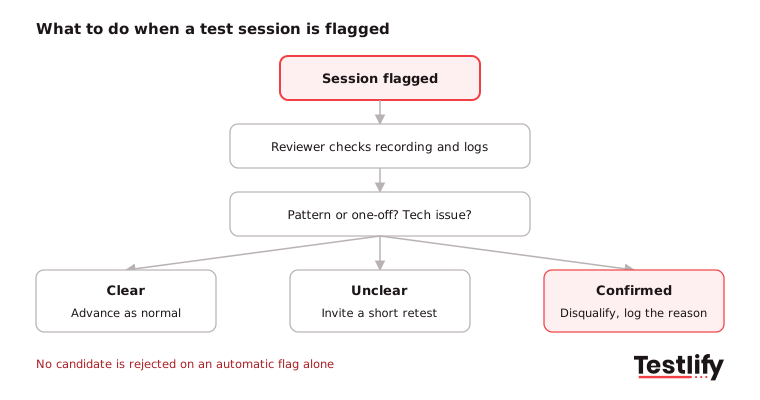
- Review the evidence: Look at the recording, screenshots and question-level logs, not just the flag count.
- Look for patterns: One tab switch is weak evidence. Repeated exits across most questions, plus very fast answers on hard questions, is stronger.
- Rule out technical causes: A slow connection, a notification or a second monitor left on can all trigger flags.
- Decide and record: Advance, retest or disqualify, and note the reason so decisions stay consistent across candidates.
- Talk to the candidate when unsure: A short conversation or retest often settles it.
Human review also matters for compliance. Under the EU AI Act, AI used to recruit, filter applications or evaluate candidates is classed as high-risk, which brings duties on human oversight and record-keeping. More on reading the data is in how to detect cheating in exams using analytics.
Key takeaway: The gap in most test integrity setups is not missing technology. It is a missing review step for the cases technology cannot settle, and that step is where false alarms and real cheating get separated.
How does Testlify help keep online tests fair and secure?
Testlify helps keep online tests fair and secure by combining question design, 20+ proctoring checks and review tools in one platform, so hiring teams can match checks to each role. Proctoring is included in plans, with identity verification and live video proctoring available per use for high-stakes roles.
- Question design: 3,500+ validated tests, question randomization, 25+ question types including coding, spreadsheet and video answers, and custom tests built by subject experts.
- Identity checks: webcam snapshots, face detection, photo ID verification with face match, and speech authenticity detection for voice and video AI interviews.
- Environment controls: full-screen enforcement, multi-monitor restriction, live environment check, mandatory screen share, IP and location restriction, and private invites.
- Behavior monitoring: copy-paste tracking and blocking, tab and mouse-out tracking, talking detection, AI assistance detection, Focus Guard anti-cheat mode, session recording and question-level activity logs.
- Fair process: honesty agreements, custom violation tolerance, tests in 15+ languages, and a third-party bias audit of Testlify's matching model under NYC Local Law 144, completed June 16, 2023. See the NYC bias audit.
Violation tolerance lets you decide how many flags a session can have before it ends, so a single accidental tab switch does not cost a candidate the test.
Ready to run fair, cheating resistant online tests?
Browse the Testlify test library to find role-based tests, or start a 7-day free trial with no credit card. For enterprise hiring, book a demo to see how proctoring settings and flag review work for your roles.
FAQs: what do hiring teams ask about cheating resistant online tests?

Content Writer
Yashika Khandelwal is a Content Writer with 3+ years of experience creating research-backed content on hiring, talent assessment, and HR technology. She is a registered Organizational Psychologist and subject matter expert who combines behavioral science with practical recruitment insights to produce accurate, evidence-based content.
LinkedInRelated resources
View all
Talent assessment
Ensuring integrity in online tests with Anti-cheating measures
Talent assessment
How to choose employment assessment tools: 2026 guide
Talent assessment
Talent assessment case studies: How top companies hire better
Talent assessment
How to assess candidates for your talent pool
Talent assessment
Talent pool vs talent pipeline: the difference and how to build both

Talent assessment
How to use talent assessment to improve employee performance
Get started.
Hire on proof, not resumes.
Run your first skills-based assessment free — no credit card required.