
The role of the organizational development consultant
Organizational development consultants drive change by analyzing processes, improving strategies, and aligning workforce efforts with business goals.

Organizational development (OD) consultants help companies improve processes, enhance employee engagement, and adapt to changing markets. They focus on both systems and people, ensuring that organizational changes stick and deliver measurable results.
For example, poor communication can cost large businesses tens of millions of dollars a year in lost productivity. OD consultants streamline workflows, improve collaboration, and build stronger organizational culture to prevent such losses.
This blog covers everything you need to know about OD consultants: what they do, why they matter, and how organizations benefit from their expertise.
 ChatGPT
 Gemini
 Claude
 Grok
Grok Perplexity
What is an organizational development consultant?
Organizational development consultants focus on people, processes, and overall organizational effectiveness.
OD consultants apply psychology principles to human resources (HR), management, sales, marketing, and administrative problems. OD specialists or consultants include policy planning, employee testing, training, and development, etc.
Such consultants might also work with management to organize the work setting to improve employee productivity.
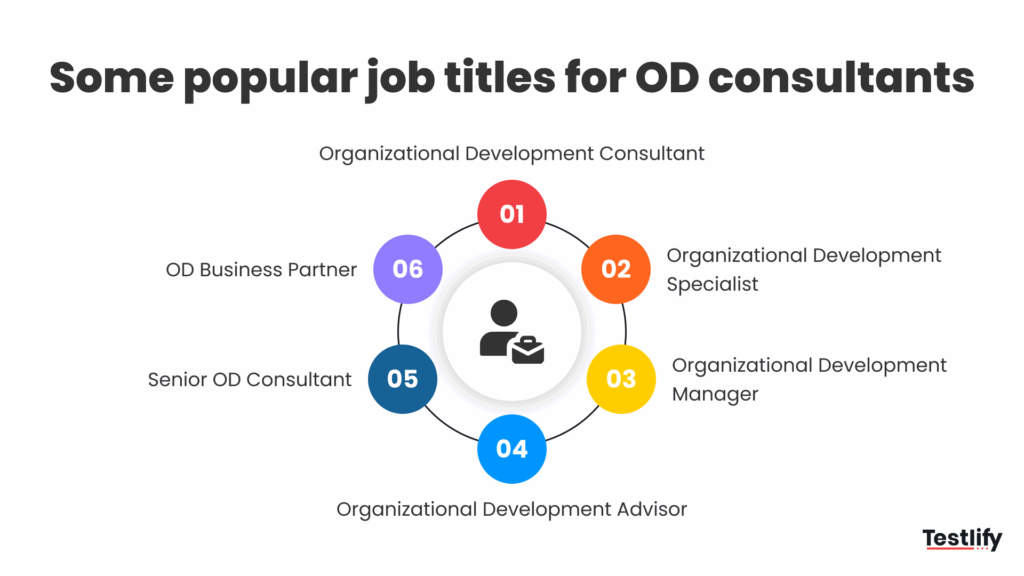
The main goal of organizational development consultants is to build a healthier, high-performing, and more agile organization. To create an organization that adapts to change according to both business and employee needs.

What do organizational development consultants do?
Organizational development consultants act as trusted advisors and change agents, working closely with leadership and teams to improve the effectiveness of the company as a whole.
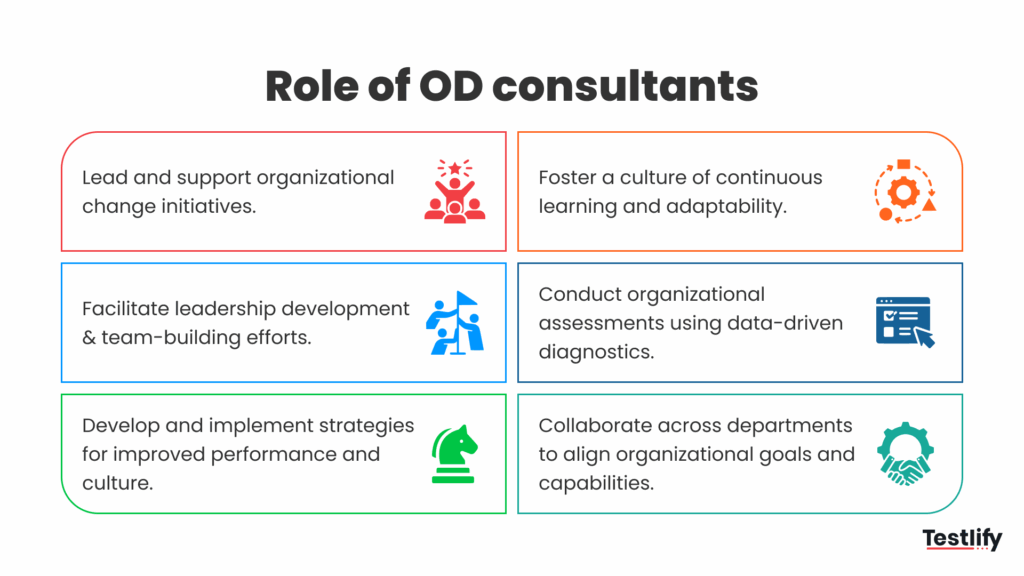
Assess organizational health and needs
OD consultants start by thoroughly assessing the organization’s current state.
This involves evaluating the structure, processes, culture, communication patterns, and employee engagement through tools such as surveys, interviews, focus groups, and data analysis.
The goal is to identify strengths, weaknesses, and areas that need improvement or realignment to meet strategic goals.
Design and implement change strategies
Based on their assessments, OD consultants develop customized strategies and interventions aimed at improving organizational effectiveness.
These can include redesigning organizational structures, streamlining workflows, improving leadership capabilities, fostering collaboration, and enhancing communication channels.
They help organizations adapt to change smoothly, whether it’s a restructuring, digital transformation, merger, or a shift in culture.
Manage change in organizations
A key role of OD consultants is managing change.
OD specialists design and deliver change management plans that include communication strategies, training programs, and employee engagement activities to minimize resistance and promote buy-in from all levels of the organization.
They coach leaders and teams during transitions and ensure the changes are sustainable.
Develop leadership and teams
OD consultants facilitate leadership development programs to build managerial skills, strategic thinking, and adaptability.
They also work on team effectiveness by clarifying roles, improving communication, resolving conflicts, and boosting collaboration to support organizational goals.
Support continuous learning and improvement
They help organizations build a culture that values continuous learning, innovation, and knowledge sharing. This can involve setting up learning and development programs, coaching, and creating systems that enable employees to grow and contribute more effectively.
Provide expert advice and collaborate
OD consultants collaborate with HR, executives, and other stakeholders to align people, processes, and systems with the organization’s objectives.
They offer insights based on organizational behavior expertise and industry best practices while remaining flexible to the organization’s unique context.
Assist in training and development
OD consultants design and implement training programs customized for each organizatoin’s needs. These training programs might include leadership development, change management, communication skills, conflict resolutions, etc.
The consultants improve employees’ skills and knowledge, thereby improving the organization’s overall effectiveness.
Unsure why your company needs an OD consultant? Explore the key benefits of organizational development.
Emerging trends in organizational development
Organizational development consultants help companies tackle their biggest challenges. They figure out what changes are needed and how to make them happen. Some of the top future emerging trends in OD include:
Diversity and inclusion (DI)
Diversity and inclusion are key emerging trends, where organizational development consultants help companies create equitable and inclusive workspaces by assessing culture, identifying any potential biases, and designing tailored DEI strategies.
OD specialists implement initiatives like training, diverse hiring practices, and employee resource groups to foster belonging and respect.
OD consultants also support leadership accountability and use data-driven approaches to track progress, ensuring D&I efforts are integrated into the organization’s overall strategy for sustainable growth and innovation.
This focus helps organizations not only meet social responsibility goals but also enhances engagement, creativity, and business performance by leveraging diverse perspectives.
Contingent workforce
More employers are also turning to contract or gig-based work models. OD consultants analyze workforce data to help organizations effectively train, develop, and manage contingent workers, ensuring consistency and performance across all employee types.
Employee engagement
OD consultants use engagement surveys to understand how employees feel about their work, managers, and organizations. They use these insights to build programs that strengthen engagement, retention, and performance. Research from Gallup shows that high engagement leads to better results, even during economic downturns.
Curious about your team’s engagement levels? Try our Employee Engagement Skill Test
Organizational agility and change readiness
As markets shift faster than ever, OD is increasingly focused on building adaptive organizations. Consultants are helping teams develop change readiness, resilience, and rapid decision-making structures, moving away from rigid hierarchies toward more fluid, team-based models.
Also read: Common mistakes to avoid in organizational development
Organizational development consultant job description
Understanding the role of an OD Consultant is key to recognizing how they drive organizational growth and transformation. Below is a breakdown of the position.
About the role
An OD Consultant partners with organizational leaders and stakeholders to assess current organizational needs, design tailored strategies, and implement initiatives that enhance performance and employee engagement.
They act as change agents facilitating smooth transitions through structured change management processes. Key responsibilities
- Conduct thorough assessments to measure the success of OD by evaluating organization’s structure, culture, workflows, and employee engagement using surveys, interviews, and data analysis.
- Develop and implement strategic organizational development plans aimed at improving efficiency, collaboration, and performance.
- Lead change management initiatives by creating communication plans, engaging stakeholders, managing resistance, and supporting adoption of new processes or structures.
- Design and facilitate leadership development programs, workshops, and team-building interventions to strengthen managerial capabilities and team effectiveness.
- Collaborate closely with HR and other departments to align talent management, succession planning, and employee development with organizational objectives.
- Provide coaching and support to leaders and teams to drive high-performance outcomes and foster a continuous learning culture.
- Monitor and evaluate the effectiveness of interventions and recommend ongoing improvements.
- Stay updated on industry trends and apply best practices in organizational development and change management.
Required skills and qualifications
- Strong analytical skills to assess organizational data and identify improvement areas.
- Excellent communication, facilitation, and stakeholder management abilities.
- Expertise in change management methodologies and organizational behavior.
- Experience in designing and delivering leadership development and training programs.
- Project management skills to handle multiple initiatives efficiently.
- Ability to build collaborative relationships and influence at all organizational levels.
- Professional certifications in organizational development, change management, or related fields are an advantage.
Create custom, inclusive, AI-generated job descriptions instantly using our free tool.
Over to you
Organizational development consultants play a pivotal role in helping companies adapt, evolve, and thrive amid constant change. By aligning people, strategy, and culture, they build organizations that are not only efficient but resilient, inclusive, and ready for the future of work.
For further reading, explore It Consultant, Leasing Consultant, Travel Agent & Senior Business Intelligence Consultant.
Frequently asked questions (FAQs)
Related resources
View all
HR & recruitment
What is organizational development? A complete overview

HR & recruitment
Top 8 case studies of successful succession planning

HR & recruitment
Importance of self-confidence skills for assertive employee

HR & recruitment
Importance of Assessing Ethics for Ethical Decision-Making

HR & recruitment
How to measure the success of your talent management strategy

HR & recruitment
The importance of talent management in today’s economy
Get started.
Hire on proof, not resumes.
Run your first skills-based assessment free — no credit card required.