
40 diversity and inclusion specialist interview questions to ask job applicants
Interview questions for D&I specialist candidates, grouped by skill, with sample answers, a scoring guide, a work sample and red flags.

A candidate who says they care about inclusion is easy to find. A candidate who can prove a program changed promotion, pay or exit numbers is much harder.
Most interviews for this role test values and miss the skills that matter. The legal rules also changed in 2025, so a warm answer with no evidence or legal awareness is a real risk.
The best diversity and inclusion specialist interview questions test five skills: program design, data, legal knowledge, influence and case handling. Below are 40 questions, sample answers, a scorecard, a work sample and red flags, so every interviewer judges candidates the same way.
TL;DR:
- Ask diversity and inclusion specialist candidates about strategy, data, legal knowledge, influence and case handling, not just their values. Those five skills decide whether the role changes anything.
- The law moved in 2025. Executive Order 14173 revoked Executive Order 11246 for federal contractors, and the EEOC says DEI programs, training and ERGs that limit access by race or sex can break Title VII. Ask every candidate how that changed their work.
- Strong answers name a metric (promotion rates, pay gaps, inclusion survey scores), a method and a result. Weak answers stop at "we ran a training and people loved it".
- Expect skeptics: Pew Research found 21% of US workers called a focus on DEI a bad thing in late 2024, up from 16% in 2023. A good specialist can talk to them without losing the room.
- Give finalists a 90-minute take-home data brief and score it with a rubric. It shows analysis, judgment and writing in one exercise.
- Never ask candidates about their own identity or for a personal diversity statement. Ask what they have done and how they would handle a situation.
 ChatGPT
 Gemini
 Claude
 Grok
 Perplexity
What does a diversity and inclusion specialist do?
A diversity and inclusion specialist finds where people are treated unequally at work, designs programs and process changes to fix it, and measures whether those changes worked. The role covers hiring, promotion, pay, training, employee groups and complaint handling, and works with HR, legal and business leaders who own the outcomes.
The US Bureau of Labor Statistics does not track D&I specialists as a separate job. It counts them under human resources specialists: 939,700 jobs in 2025, a median pay of $75,940 in May 2025 and 6% projected growth from 2025 to 2035.
Senior D&I roles in large companies often pay more because they carry strategy and reporting work.
Since 2025, many US employers have renamed the role (inclusion, belonging, culture or people programs specialist) and moved the focus from identity-based programs to fair processes that are open to everyone. The interview should test whether a candidate can work that way.
If your team needs a refresher on the terms, the glossary entries for diversity and inclusion and unconscious bias are a good start.

What are the best diversity and inclusion specialist interview questions?
The best diversity and inclusion specialist interview questions ask for a real example with a metric and a result. If you only have time for ten, use these:
- Walk me through a D&I program you built, from the problem to the result.
- How do you decide which inclusion problem to work on first?
- Which metrics would you report to our leadership team every quarter?
- How did the 2025 changes to US law change your work?
- Tell me about a time you won over a skeptical senior leader.
- How do you handle an employee complaint about exclusion or bias?
- How do you check a hiring process for bias without using quotas?
- Tell me about a program that did not work. What did you change?
- How do you keep employee resource groups open and useful to everyone?
- What would your first 90 days in this role look like?
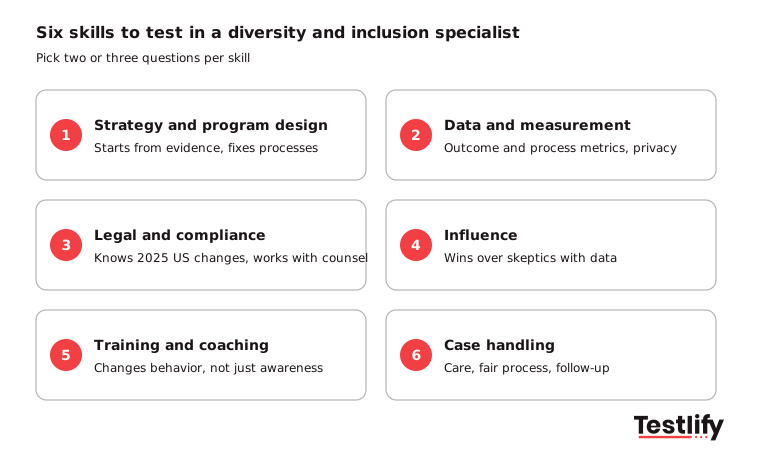
The rest of this list goes deeper on each skill. Pick two or three questions per skill so a single interview stays under an hour.
What general and motivation questions should you ask?
General questions open the interview and show the range of a candidate's experience: company sizes, regions, budgets and how much of the work they owned themselves.
- What drew you to inclusion work, and what keeps you in it?
- What size of organization have you supported, and in which countries?
- Which parts of a D&I program have you owned end to end, and which did you support?
- How do you explain the business case for inclusion to a CFO in two minutes?
- Where do you get your information on law, research and practice, and how do you check it?
- What would you want to learn from our people data in your first month?
What questions test D&I strategy and program design?
Strategy questions separate specialists who run events from specialists who fix systems. Listen for how the candidate gathers evidence before they build anything, and whether the fix is a process change or only awareness training.
- How do you run a D&I assessment for an organization that has no strategy yet?
- How do you turn survey and HR data into three priorities for the year?
- How do you build inclusion into hiring, onboarding, promotion and exits, not just training?
- How do you design a training program that changes behavior, not only awareness? (Our guide on how to conduct effective diversity training covers the basics.)
- How do you set up an employee resource group so that membership is open to all and it has a business goal?
- How do you adapt a global program for regions with different laws and cultures?
- How do you decide when a program has done its job and should end?
What questions test data, metrics and people analytics?
Data questions show whether a candidate can prove impact. A specialist who cannot read a promotion-rate table or a pay analysis will struggle to keep leadership support for long.
- Which five metrics would you track for this organization, and why those five?
- How do you measure inclusion, not just representation?
- Walk me through how you would review pay for unexplained gaps. (See the glossary entry on pay equity.)
- How do you check whether a hiring stage screens out one group more than others?
- How do you handle small numbers, where a single person could be identified in the data?
- Which HRIS, survey or analytics tools have you used, and what did you build with them?
What questions test legal and compliance knowledge?
Legal questions matter more than ever in this role. On January 21, 2025, Executive Order 14173 revoked Executive Order 11246, and the US Department of Labor's OFCCP stopped enforcing affirmative action duties under it, while Section 503 and VEVRAA obligations for disability and veterans stayed in place.
A D&I specialist does not need to be a lawyer, but they must know when to call one.
- What changed for US employers in 2025, and how did you adjust your programs?
- Which parts of a D&I program carry the most legal risk, and how do you reduce it?
- How do you work with legal counsel and HR before launching a new program?
- How do you keep a program compliant across the US, UK and EU at the same time?
- What do you know about bias audits for AI hiring tools, such as New York City's Local Law 144?
- How do you document decisions so a program can stand up to a complaint or audit?
For question 24, a candidate should know that NYC Local Law 144 requires a bias audit before employers use automated tools to screen candidates. Testlify's own NYC bias audit is one public example of what an audit report looks like.
What behavioral interview questions should you ask?
Behavioral questions ask for past examples. Ask the candidate to answer with the situation, the action they took and the result, and push for numbers and for what they would do differently.
- Tell me about a time you used data to change a leader's mind.
- Describe a program that did not deliver the result you expected. What did you learn?
- Tell me about a time you handled a sensitive complaint. How did you balance care for the person with a fair process?
- Describe a time you changed a hiring or promotion process to make it fairer.
- Tell me about a time you had to deliver a program with almost no budget.
- Describe a time you disagreed with a senior leader about a D&I decision.
- Tell me about a time you coached a manager to lead a more inclusive team.
- Describe a time you had to pause or redesign a program because of a legal or policy change.
If the role is more junior and focused on events, scheduling and reporting, our list of diversity and inclusion coordinator interview questions is a better fit.
What situational questions show how a candidate handles hard moments?
Situational questions ask what the candidate would do in a scenario from your own business. These questions matter because employee views have split: Pew Research Center found that 52% of US workers said focusing on DEI at work is mainly a good thing in October 2024, down from 56% in 2023, and 19% said their company pays too much attention to it.
- A manager says the new structured interview process slows hiring. What do you do?
- An employee tells you a colleague keeps making jokes about their accent. What are your first three steps?
- Leadership asks you to cut the D&I budget by half. What do you keep, and why?
- An employee says a mentoring program is unfair because they were not allowed to join. How do you respond?
- Survey results show one team scores far lower on inclusion than the rest. What do you do next?
- A senior leader makes a remark in a meeting that upsets part of the room. How do you handle it that day and after?
- Your CEO asks for a single number that shows whether D&I is working. What do you give them?
Question 37 is worth extra time. Under current EEOC guidance, a program limited to certain groups can be unlawful, so a strong candidate will talk about opening eligibility, not defending a closed program.
What do strong answers to diversity and inclusion specialist interview questions sound like?
Strong answers to diversity and inclusion specialist interview questions name a problem, the evidence behind it, a specific action and a measured result. The sample answers below show what a strong response sounds like for five key questions.
Use the "look for" notes to score answers, not to expect the exact words.
1. Walk me through a D&I program you built, from the problem to the result.
Look for: a clear sequence (evidence, design, launch, measurement), a business problem, and a result in numbers.
Sample answer: "Exit data showed our engineers left at twice the rate in their second year if they had not been promoted. I compared promotion timing across teams and found that three teams had no written promotion criteria.
"With HR and the engineering leads, we wrote criteria, trained managers to use them and added a calibration meeting. Second-year exits in those teams fell by about a third over the next year, and the criteria became the company standard."
2. Which metrics would you report to our leadership team every quarter?
Look for: a mix of outcome and process metrics, an inclusion measure beyond headcount, and care with small numbers and privacy.
Sample answer: "I would report five: hiring pass-through rates by stage, promotion rates, regretted exits, unexplained pay gaps after a yearly review, and two inclusion survey items such as 'I can speak up without fear'. I show trends, not single quarters, and I group small teams so no one can be identified.
"Each metric comes with one action, so the report leads to decisions."
3. How did the 2025 changes to US law change your work?
Look for: accurate knowledge, a calm tone and practical changes, such as reviewing eligibility rules, renaming programs and working with legal counsel.
Sample answer: "After Executive Order 14173 and the EEOC guidance, we reviewed every program with our lawyers. We opened our mentoring and ERG programs to all employees, removed demographic targets from manager goals and moved the focus to fair processes: structured interviews, written promotion criteria and pay reviews.
"Participation went up, because more people felt the programs were for them."
4. How do you handle an employee complaint about exclusion or bias?
Look for: care for the person, a clear process with HR, confidentiality limits stated up front, and follow-up.
Sample answer: "I listen first and tell the person what I can and cannot keep confidential. I write down what happened, check what they want, and bring in HR if it could be a policy breach.
"I agree a timeline for next steps and check back with them, even after the case closes. I also look for patterns, because one complaint is often a sign of a team problem."
5. Tell me about a program that did not work. What did you change?
Look for: honesty, a specific cause and a change in how they work. Be careful with candidates who cannot name a single failure.
Sample answer: "We ran a one-day unconscious bias workshop for all managers. Feedback was positive, but six months later hiring and promotion data had not moved.
"I replaced the workshop with short sessions tied to real decisions: a briefing before each promotion round and a scoring guide for interviews. The process changes moved the numbers, and the workshop did not."
How do you score a diversity and inclusion specialist interview?
A diversity and inclusion specialist interview is scored best with a short scorecard: six skills, a weight for each and a 1 to 5 scale with an example of a 1, 3 and 5 answer. Every interviewer scores alone before the debrief, so the loudest opinion does not decide the hire.
Our guide to the interview scorecard shows how to build one.
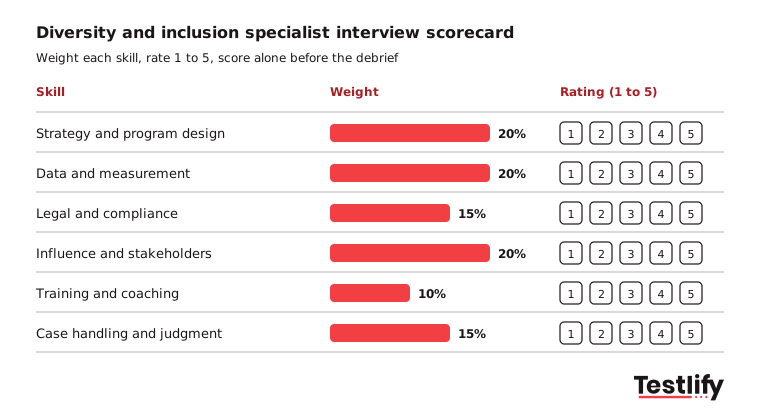
Adjust the weights to the role. A specialist who mostly runs programs needs more weight on design and training. A specialist who reports to the board needs more weight on data and legal knowledge.
Pro tip: Write the score and one piece of evidence for each skill straight after the interview. Across the hiring teams we work with, scores written the next day drift toward an overall impression and lose the detail that separates two good candidates.
What work sample should you give a diversity and inclusion specialist candidate?
A work sample for a diversity and inclusion specialist candidate is a short take-home data brief: a small, anonymized data set and a one-page question from leadership. The exercise shows how the candidate reads data, picks priorities and writes for executives, which no interview question can show as well.
- Brief: send a fictional table of hiring, promotion and exit numbers for four teams, plus two survey results, and the question "Where should we focus next year, and how will we know it worked?"
- Analyze: give the candidate 90 minutes. Tell them they may use any tool and must say which numbers are too small to trust.
- Recommend: ask for one page with no more than three priorities, the metric for each and one legal or privacy risk to check.
- Present: in the final round, the candidate talks through the brief for ten minutes and the panel asks two challenge questions.
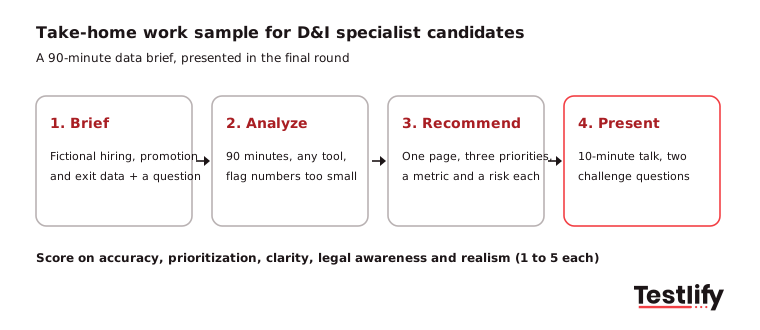
Score the brief on accuracy, prioritization, clarity, legal awareness and realism, each from 1 to 5. Pay the candidate for the time if your policy allows it, and use fictional data only.
What are the red flags in a D&I specialist interview?
The biggest red flags in a D&I specialist interview are answers with no evidence, no results and no awareness of legal risk. Watch for these patterns:
- Activity instead of impact: "We ran 40 events" with no change in hiring, promotion, pay or exits.
- Only training: every problem is solved with a workshop, never with a process change.
- No legal awareness: the candidate has not heard of the 2025 changes or would launch programs without legal review.
- Closed programs: the candidate defends programs limited to certain groups instead of making them open to all.
- No failures: a specialist with years of experience who cannot name a program that failed is either not reflecting or not being honest.
- Blames skeptics: resistance is always the other side's fault, never the design or the message.
Key takeaway: A strong diversity and inclusion specialist talks about fair processes, numbers and the law. A weak one talks about events and good intentions.
Which questions should you avoid in a D&I specialist interview?
Questions to avoid in a D&I specialist interview are any that ask about the candidate's own race, religion, sexual orientation, disability, age or other protected characteristics, or that ask for a personal diversity statement. Those questions do not test skill and can expose the employer to a discrimination claim.
The EEOC states that Title VII protects all workers and applicants, and that interview selection, hiring, training and access to employee groups are all covered. The University of Washington's HR guidance on diversity interview questions makes the same practical point: assess skills and knowledge for building an inclusive workplace, not personal identity, and agree on what a quality answer looks like before you screen anyone.
Swap identity questions for skill questions:
Avoid | Ask instead |
|---|---|
"What is your own background?" | "How have you built trust with people whose experience differs from yours?" |
"Why does diversity matter to you personally?" | "Walk me through a program you built and the result it had." |
"Please send a diversity statement." | "Send a one-page plan for our first quarter based on this brief." |
How do skills tests help you hire a diversity and inclusion specialist?
Skills tests help you hire a diversity and inclusion specialist by checking knowledge, judgment and communication before you spend panel time on live interviews. A short test stage means the people who reach the work sample already understand inclusion basics and can handle workplace situations well.
A typical test stage for this role combines three or four of these:
- The diversity and inclusion foundations test for core concepts and practice.
- The cross-cultural communication test for working across cultures and regions.
- The conflict resolution test for handling complaints and tense meetings.
- The data analysis test for reading people data and spotting gaps.
- Situational judgment questions built around scenarios like questions 34 to 40.
Testlify's library has 3,500+ tests and 25+ question types, including video, audio and file upload, so you can add a two-minute video answer or ask finalists to upload their data brief. Results come back scored with a per-skill breakdown and sync to 100+ ATS and HRIS tools such as Workday, Greenhouse and SAP SuccessFactors.
Every candidate gets the same test and the same scoring, and you can see how Testlify supports diversity hiring across the rest of the process.
We have seen hiring teams use the test stage to cut a long list of applicants to a shortlist of five or six, then spend live interview time only on the questions and the work sample above.
Ready to hire your next diversity and inclusion specialist?
Build a test stage for your D&I specialist role from the Testlify test library, add a short video question and the take-home brief, and share a ranked shortlist with your hiring manager. Start a 7-day free trial with no credit card, or book a demo to see it set up for an HR role.
Frequently asked questions (FAQs)
Human Resources Lead
Snehi Parmar leads People at Testlify, owning hiring, culture, performance, and retention for a 90-person team. She writes on practical HR strategy and building people processes that scale.
Related resources
View all
HR & recruitment
40 interview questions for copywriters and what to listen for

HR & recruitment
50 Market Research Analyst interview questions to ask job applicants

HR & recruitment
40 growth marketer interview questions to ask in 2026

HR & recruitment
45 research analyst interview questions to ask job applicants

HR & recruitment
50 Inside Sales Representative interview questions to ask job applicants

HR & recruitment
50 Business Consultant interview questions to ask job applicants
Get started.
Hire on proof, not resumes.
Run your first skills-based assessment free — no credit card required.