
How to build a finance team: roles, hiring order and structure
A practical plan for building a finance team: the functions to cover, who to hire first, team size by stage and how to test candidates.

Knowing how to build a finance team comes down to three decisions: what finance must own, which roles cover that work at your current size, and how you check that each hire can actually do the job. Get the order wrong and you either pay for strategy before the books are clean, or you run the business on numbers nobody trusts. This guide is written for HR, talent acquisition and finance leaders who are hiring for the function, not just the people who will run it.
TL;DR / Key Takeaways
- To build a finance team, define what finance must own, cover the five core functions, hire a controller or finance lead first, then add accounting depth and FP&A as volume grows.
- The first dedicated finance hire is usually a controller or player-coach finance lead, not a full-time CFO.
- Most startups make their first full-time finance hire at around 30 to 50 employees. A 51 to 250 person company averages about 5 finance staff, and a 251 to 500 person company about 11.
- Hire to business triggers, such as a first audit, a funding round, a new entity or an IPO, not to the calendar.
- Outsource tax, audit support and payroll early. Keep cash, reporting and forecasting in-house.
- Test every finance hire on the real work: accounting, Excel modeling and budgeting tests, a case task and a structured interview.
- Financial manager roles in the US are projected to grow 10% from 2025 to 2035, so plan for competition on senior hires.
 ChatGPT
 Gemini
 Claude
 Grok
 Perplexity
What does a finance team do?
A finance team manages the money side of a company: it records every transaction, reports results, plans and forecasts, manages cash and keeps the company compliant with tax and audit rules. In a small company one person covers all of it. In a large one, each job becomes its own team.
Most finance teams cover five core functions:
- Accounting and reporting: The general ledger, month-end close, financial statements and internal controls.
- FP&A (financial planning and analysis): Budgets, forecasts, variance analysis and the numbers behind big decisions.
- Accounts payable and receivable: Paying suppliers on time and collecting cash from customers.
- Treasury: Cash management, bank relationships, funding and financial risk.
- Tax and compliance: Tax filings, audits and regulatory reporting.
Accounting looks back and makes sure the numbers are right. FP&A looks forward and uses those numbers to guide decisions. Both usually report to a CFO or head of finance, and the split between them shapes almost every hiring choice that follows.

How to build a finance team, step by step
Building a finance team works best when you start from what the business needs finance to own and only then choose roles, people and tools. The seven steps below work for a first finance hire at a growing company and for a rebuild at a larger one.
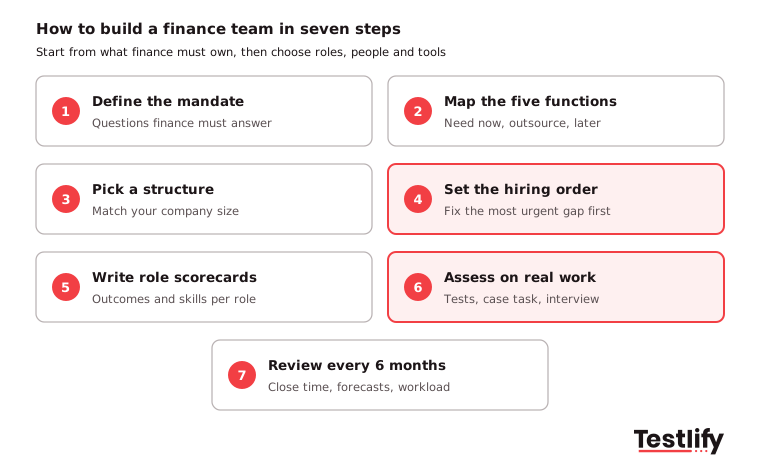
- Define the mandate: List the questions leadership needs finance to answer. How much cash do we have and how long will it last? Which products or regions make money? Are we ready for an audit or a funding round?
- Map the five functions: Mark which functions you need today, which you can outsource and which can wait.
- Pick a structure for your stage: A 40-person startup and a 600-person company need very different teams. Use the size bands further down as a starting point.
- Set the hiring order: Decide which role fixes your most urgent gap first. In most cases that is accurate books and a reliable close.
- Write role scorecards: For each role, list the outcomes expected in the first 6 to 12 months and the skills needed to deliver them. Use the scorecard to write the job description and the interview plan.
- Assess on the real work: Use skills tests, a short case task and a structured interview so every candidate is judged on the same evidence.
- Review every six months: Check close time, forecast accuracy and workload. Add people when volume or complexity grows, and automate repetitive work before you add headcount.
Pro tip: Before you open a new finance role, ask whether the workload is real or caused by manual work a tool could absorb. A finance leader who adds people to fix broken processes ends up with a bigger team doing the same low-value work.
Which finance roles do you need?
The finance roles you need depend on size, but the core set is the same at most companies: a finance leader, a controller, accountants, financial analysts, AP and AR specialists, and later treasury and tax specialists. The table shows what each role owns and when it usually appears.
Role | What the role owns | When it usually appears |
|---|---|---|
Bookkeeper or staff accountant | Daily transactions, reconciliations, basic reports | First hire or outsourced at the start |
Controller | Month-end close, financial statements, internal controls, audit | First audit, investor reporting, rising complexity |
FP&A analyst or manager | Budgets, forecasts, variance analysis, board packs | After a funding round or when leaders need forecasts |
AP and AR specialists | Supplier payments, invoicing, collections | Hundreds of invoices a month |
Finance business partner | Supporting sales, product or operations leaders with numbers | Mid-market, when teams need their own finance contact |
Treasury manager | Cash, banking, funding, currency and liquidity risk | Multiple entities, debt or international cash |
Tax manager | Tax planning and filings | Multiple countries or complex tax positions |
CFO or VP Finance | Strategy, capital, investors, the board, leading the function | Growth stage, pre-IPO or M&A |
Senior finance hires are expensive and in demand. The US Bureau of Labor Statistics puts the median pay for financial managers, a group that includes controllers and treasurers, at $166,570 in May 2025, and projects employment to grow 10% from 2025 to 2035, with about 65,600 openings a year. Budget for that before you write the job ad.
For ready-made role outlines, start from the controller job description template, the CFO job description template and the finance business partner template.
Who should you hire first for your finance team?
The first dedicated finance hire is usually a controller or a player-coach finance lead who can own the close and the cash forecast, not a full-time CFO. Accurate books come first, because every forecast, board pack and funding conversation depends on them.
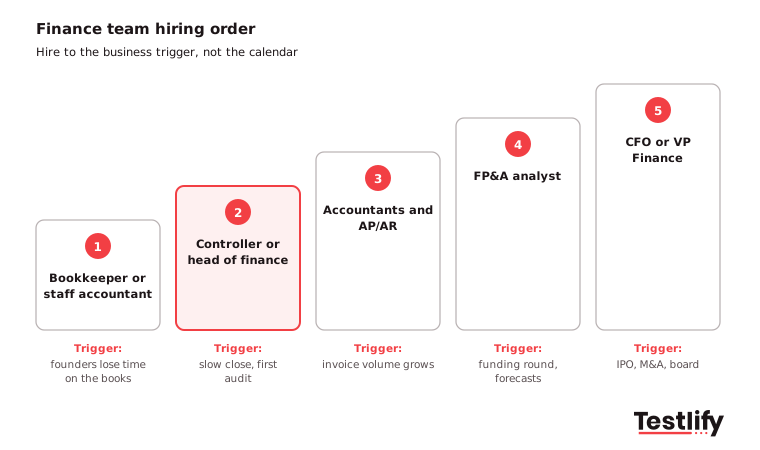
A practical hiring order looks like this:
- Outsourced bookkeeping or a staff accountant: Covers daily transactions while the founders or an operations lead own the numbers.
- Controller or head of finance: Hire when the close takes too long, an audit is coming or investors want regular reporting.
- Staff accountants and AP/AR specialists: Add them as transaction volume grows, so the controller can focus on controls and reporting.
- FP&A analyst: Hire when leaders need forecasts, scenario plans and budget-versus-actual reviews they can act on.
- CFO or VP Finance: Hire when finance needs a strategic leader for fundraising, an IPO, M&A or the board.
Timing varies. An analysis by the FP&A platform Aleph of 218 Y Combinator B2B companies found that most make their first full-time finance hire at around 30 to 50 employees. In Bessemer Venture Partners' CFO community, 37% said $10 million to $25 million in annual recurring revenue is the right point to bring on a CFO.
Key takeaway: Hire to the trigger, not the calendar. A first audit calls for a controller, a funding round for FP&A capacity, new legal entities for someone with consolidation experience, and an IPO or acquisition for a full-time CFO.
How should finance team structure change as the company grows?
Finance team structure should match the company's current size and complexity, not the org chart of a much larger company. Small teams rely on generalists and outside help. Larger teams split accounting from FP&A and add specialists.
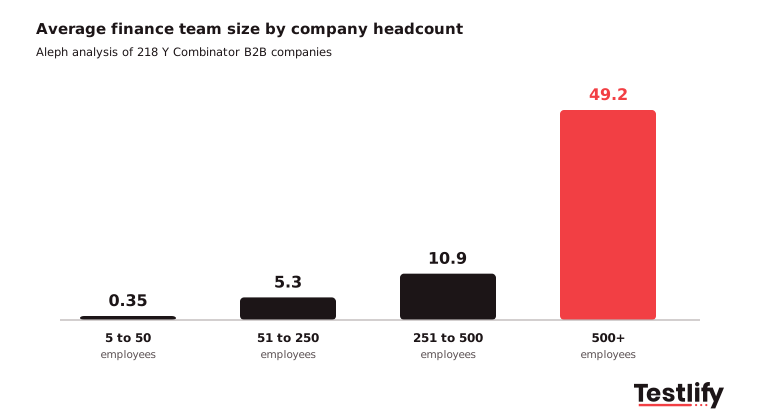
Company size | Typical finance team | Structure |
|---|---|---|
Under 50 employees | 0 to 1 in-house, plus outside help | Founder-led or one generalist; bookkeeping, tax and audit outsourced |
51 to 250 employees | About 5 people | Finance lead, controller, accountants, first FP&A role |
251 to 500 employees | About 11 people | CFO, accounting leader, layered FP&A, first tax or treasury specialist |
500+ employees | About 50 people | VPs for FP&A, accounting and treasury; dedicated tax, audit and business partners |
Team sizes are averages from Aleph's study of 218 companies. Your number will depend on transaction volume, entities, countries and how much of the work is automated.
As the team grows, keep spans of control manageable. The Access Group suggests a rule of thumb of one manager for every seven team members, give or take two. Decide early whether finance will be centralized under the CFO or embedded in business units through finance business partners. Centralized teams are easier to control. Embedded teams sit closer to the decisions.
Should you hire in-house, outsource or go fractional?
Most growing companies use a mix: they outsource specialist or occasional work, hire in-house for anything that needs daily knowledge of the business, and bring in a fractional CFO for strategic work before a full-time CFO is justified.
Option | Best for | Watch out for |
|---|---|---|
Outsourced firm | Bookkeeping, payroll, tax filings, audit support | Less control, slower answers, shared attention |
Fractional CFO | Fundraising, board reporting, planning, a cash crunch | Limited hours, not there for daily decisions |
In-house hire | Close, reporting, forecasting, cash, business partnering | Fixed cost, longer time to hire |
Interim hire | Covering a gap during a search or a system change | Knowledge leaves when the contract ends |
Keep cash management, management reporting and forecasting in-house as soon as you can. Those jobs depend on knowing the business, and they are the ones leaders lean on every week.
What skills should you look for in finance hires?
Finance hires need two sets of skills: technical skills for the role, such as accounting standards, financial modeling, budgeting and tax, and working skills, such as clear communication, attention to detail, judgment and comfort with data and finance software.
- Technical accuracy: Accounting principles (US GAAP or IFRS), reconciliations and month-end close for accounting roles. Modeling, forecasting and variance analysis for FP&A.
- Excel and systems: Advanced Excel is still the daily tool. ERP, planning software and BI dashboards matter more as the team grows.
- Data and AI literacy: Finance teams now work with automation and AI tools. Gartner's 2025 AI in finance survey of 183 finance leaders found that 59% use AI in the finance function, and named data literacy and technical skills among the biggest barriers. See the Gartner 2025 finance AI survey.
- Communication: Turning numbers into a short, clear story for people outside finance.
- Attention to detail: One wrong entry can flow into every report built on top of it.
- Judgment and integrity: Finance staff handle sensitive data and make calls on risk, so ethics and sound judgment are part of the job.
Certifications such as CPA, CMA or CFA show commitment, but they do not prove someone can run your close or build your forecast. Treat them as a signal, then test the work.
How do you assess finance candidates before you hire?
Finance candidates are best assessed on the work they will actually do: a role-specific skills test, a short case task and a structured interview scored against the same criteria for everyone. Resumes and certifications show where someone has been, not how well they reconcile an account or build a forecast.
Role | Skills to test | Testlify tests to start from |
|---|---|---|
Staff accountant | Accounting principles, reconciliations, Excel | |
AP and AR specialist | Invoice processing, collections, accuracy | |
FP&A analyst | Modeling, forecasting, budgeting | |
Controller | Close, controls, reporting, team leadership | |
Treasury manager | Cash management, liquidity, risk | |
CFO | Strategy, capital, leadership |
A simple assessment plan for each finance role:
- Screen on skills: Send a short role-specific test before the first interview, so you only spend interview time on people who can do the core work.
- Add a case task: Give a small, realistic exercise, such as a reconciliation with errors to find or a three-month forecast from sample data. Keep it under an hour.
- Run a structured interview: Ask every candidate the same questions and score them against a rubric. The guide to structured interviews explains how to set one up, and for senior and strategic finance roles you can draw on these corporate finance interview questions.
- Check working skills: Score communication and judgment in the interview and the case write-up, not on gut feel.
For deeper guidance on specific skills, see how to evaluate financial analysis skills and how to assess accounting skills.
How do you keep a finance team strong after you build it?
A finance team stays strong when people know what they own, can see a path to grow, and spend their time on analysis rather than manual data entry. Building the team is the first step. Keeping it is where most of the value comes from.
- Write down ownership: Agree who owns each input, report and forecast, so accounting and FP&A work from one set of numbers.
- Automate before you add headcount: Move invoice processing, reconciliations and expense coding into software where you can.
- Invest in development: Fund certifications, training on new systems and time with business teams. People who can see a path upward are more likely to stay.
- Promote from within: A strong senior accountant can grow into a controller, and an analyst into an FP&A manager, if you plan for it.
- Review the structure twice a year: Look at close time, forecast accuracy and workload, and adjust before problems show up in the numbers.
Hiring will stay competitive for core roles too. The BLS outlook for accountants and auditors projects about 115,300 openings a year over the decade to 2035, so a team that develops and keeps its people saves months of hiring later.
Where does Testlify fit when you build a finance team?
Testlify helps hiring teams check finance candidates on real skills before the interview stage. The test library has 3,500+ tests, including accounting, Excel, financial modeling, budgeting, tax and role tests for controllers, treasury managers and CFOs, which you can combine into one assessment for each role.
- Role-based assessments: Combine finance tests with custom questions from 25+ question types, including Excel simulations and file uploads for case tasks.
- AI interviews: Run structured first-round interviews by video, voice or chat, with the same questions and scoring for every candidate.
- Fair and secure testing: 20+ proctoring checks help keep results honest for remote candidates.
- Fits your stack: 100+ ATS and HRIS integrations, including Workday, Greenhouse and Lever, and tests in 15+ languages for teams hiring across countries.
Teams in banking, insurance and fintech can also see how Testlify supports the financial services industry.
Build your finance team on proven skills
Browse the finance tests in the Testlify test library, or start a 7-day free trial with no credit card and send your first finance assessment today.
Frequently asked questions (FAQs)

Content Writer
Yashika Khandelwal is a Content Writer with 3+ years of experience creating research-backed content on hiring, talent assessment, and HR technology. She is a registered Organizational Psychologist and subject matter expert who combines behavioral science with practical recruitment insights to produce accurate, evidence-based content.
LinkedInRelated resources
View all
Hiring Guide
How to screen candidates for AI developer

Hiring Guide
How to screen and hire an AR developer: Skills, tests and interview questions

Hiring Guide
How to screen candidates for JavaScript developer

Hiring Guide
How to Screen Candidates for Ruby on Rails Developers

Hiring Guide
How to Screen Candidates for PHP Developers

Hiring Guide
How to Screen Candidates for .NET Developer
Get started.
Hire on proof, not resumes.
Run your first skills-based assessment free — no credit card required.