
45 risk management interview questions to ask in 2026
Risk management interview questions by skill and level, with sample answers, a scorecard, a risk register work sample and red flags.

The best risk management interview questions ask a candidate to walk through a real risk they found: how they rated its likelihood and impact, which response they chose, who owned it and what changed afterwards. This list gives you 45 risk management interview questions grouped by skill and level, from risk management analyst to head of risk, plus sample answers, a scorecard and a short risk register work sample, so every interviewer judges candidates on the same evidence.
TL;DR / Key takeaways
- Strong risk management interview questions ask for one real risk from start to finish: how it was found, how it was rated, the response chosen, the owner and the result.
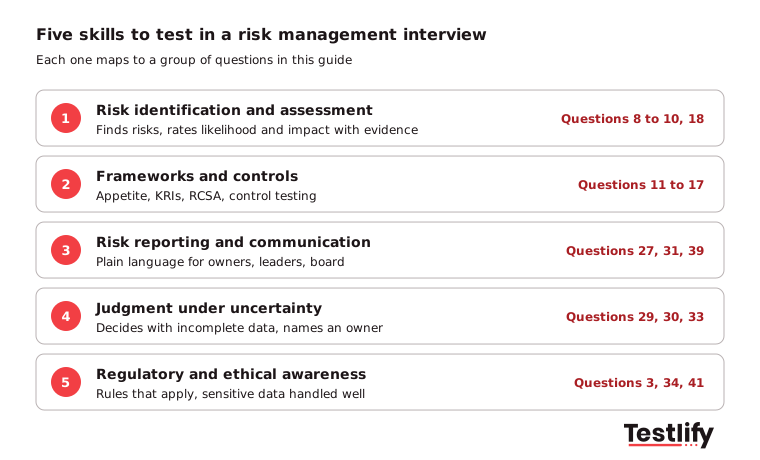
- Test five skills: risk identification and assessment, frameworks and controls, risk reporting and communication, judgment under uncertainty, and regulatory and ethical awareness.
- Good answers name a method (a likelihood and impact matrix, key risk indicators, a risk register), a specific risk and a number that moved. Weak answers stop at "I monitor risks closely".
- Risk roles pay well and stay in demand: BLS counts risk managers among financial managers, with a median pay of $166,570 in May 2025 and 10% projected growth from 2025 to 2035.
- Ask every candidate about third-party and cyber risk. These are now part of almost every risk role, not only specialist ones.
- Use a 45-minute risk register work sample and a weighted scorecard, and run a skills test before the first interview to shorten the list.
 ChatGPT
 Gemini
 Claude
 Grok
 Perplexity
What does a risk management professional do?
A risk management professional finds, rates and reduces the risks that could stop an organization from reaching its goals, such as a supplier failure, a data breach, a compliance breach or a large financial loss. The work covers risk assessments, risk registers, controls, key risk indicators, incident reviews and reports to senior leaders and the board.
The title changes with the level. A risk management analyst or specialist gathers data, runs assessments and keeps the risk register current. A risk manager owns the risk process for a business unit or risk type and challenges the people who own each risk. A head of risk, chief risk officer or ERM lead sets the risk appetite, reports to the board and builds risk awareness across the organization. For a short definition of the discipline, see the Testlify HR glossary entry on risk management.
Demand is steady. The US Bureau of Labor Statistics lists risk managers as a type of financial manager, a group that held about 879,700 jobs in 2025 with a median pay of $166,570, 10% projected growth from 2025 to 2035 and about 65,600 openings a year. Strong candidates often have more than one offer, so a clear, fast interview process matters.
Level | Typical titles | What to test most |
|---|---|---|
Entry and analyst | Risk management analyst, risk specialist, risk coordinator | Assessment method, data accuracy, risk register discipline |
Manager | Risk manager, operational risk manager, third-party risk manager | Frameworks, controls, challenge of risk owners, reporting |
Senior | Head of risk, ERM lead, chief risk officer | Risk appetite, board reporting, risk culture, strategy |

What are the best risk management interview questions?
The best risk management interview questions ask for a real example with a method and a result. If you only have time for ten, use these:
- Walk me through the last significant risk you identified, from the first warning sign to the final outcome.
- How do you rate a risk's likelihood and impact, and what do you do when people disagree with your rating?
- Which risk framework have you worked with, and where did you adapt it?
- How do you decide whether to avoid, reduce, transfer or accept a risk?
- Which key risk indicators have you set up, and which one warned you early?
- Tell me about a time a risk owner pushed back on your assessment. What did you do?
- How do you assess the risk of a new vendor or third party?
- How would you explain a complex risk to a board in five minutes?
- Describe a risk you missed. What did you change afterwards?
- How do you make a call when the data is incomplete and the deadline is today?
The rest of this list goes deeper on each skill. Pick two or three questions per skill so the interview stays under an hour.
What general and experience questions should you ask a risk management candidate?
General and experience questions open the interview and show the scale and type of risk a candidate has handled: operational, financial, compliance, technology or strategic risk, in a regulated or unregulated business.
- Which types of risk have you worked on, and in which industries?
- What is the largest risk program you owned, in budget, business units or number of risks tracked?
- Have you worked in the first line (the business), the second line (risk and compliance) or the third line (internal audit), and how did that shape your approach?
- Which risk tools and systems have you used day to day, such as a GRC platform, Excel models or BI dashboards?
- Which certifications or training shaped how you work, such as FRM, PRM, CRISC or an ISO 31000 course?
- What part of risk management do you enjoy most, and which part do you find hardest?
- What would you want to learn in your first 30 days here before you change anything?
What questions test the risk management process and frameworks?
Risk management process questions test whether a candidate can run a repeatable cycle: identify, assess, respond, monitor and report. Strong candidates can name the frameworks they have used, such as ISO 31000 or COSO Enterprise Risk Management, and explain how they applied them rather than reciting the steps.
- Walk me through how you would run a risk assessment for a business unit you have never worked with.
- How do you rate likelihood and impact, and when do you prefer a qualitative scale over a numeric one?
- What is the difference between inherent risk and residual risk, and how do you show both in a register?
- How do you define risk appetite and risk tolerance, and how have you used them to make a decision?
- What makes a good key risk indicator? Give an example you set up and the threshold you chose.
- How do you run a risk and control self-assessment (RCSA) so that business owners take it seriously?
- How do you test whether a control actually works, not just whether it exists on paper?
- How do you decide whether to avoid, reduce, transfer or accept a risk? Give a case for each.
- How do you keep a risk register current, and how often do you review the top risks?
- How do you handle correlated risks, where one event triggers several others at once?
Listen for the order a candidate works in. Good answers start with the business objective, not the risk list, and end with an owner and a date.
What questions test operational, third-party and cyber risk?
Operational, third-party and cyber risk questions check whether a candidate can handle the risks that now appear in almost every risk role. Even a financial risk hire will be asked to review a vendor or a data incident, so test at least two of these areas.
- How do you map the critical processes of a business and find where a single failure could stop them?
- Tell me about a business continuity or disaster recovery plan you built or tested. What did the test reveal?
- How do you assess a new vendor before signing, and what would make you recommend against them?
- How do you monitor third-party risk after the contract is signed?
- What would you do if a critical supplier failed tomorrow?
- How do you work with the security team on technology and cyber risk? Which framework do you use to structure it?
- How would you rate the risk of a ransomware attack on our main customer system?
- How do you assess the risk of a new AI tool the business wants to use?
- Tell me about an incident you helped investigate. How did you find the root cause?
- How do you report operational losses and near misses so the business learns from them?
For cyber questions, a strong candidate often mentions the NIST Cybersecurity Framework, whose 2.0 version came out in February 2024 and added a govern function. Knowing a framework matters less than explaining how risk and security teams split ownership.
Which behavioral risk management interview questions work best?
Behavioral risk management interview questions work best when they ask for one specific past situation and the candidate's own actions. Ask candidates to use the STAR format (situation, task, action, result) and push hardest on the action and the result. A structured interview with the same questions for every candidate makes the answers easy to compare.
- Tell me about a time you identified a risk that others had missed. How did you get people to act on it?
- Describe a decision you made with incomplete data. How did you weigh the risk, and what happened?
- Tell me about a time a senior leader wanted to take a risk you thought was too high. What did you do?
- Describe a time you had to deliver bad news about a risk to someone who did not want to hear it.
- Tell me about a risk you missed or underrated. What did you change in how you work?
- Describe a time you balanced managing a risk with letting the business move fast.
- Tell me about a time you handled sensitive or confidential information during a risk review or investigation.
- Describe a project where you had to work with legal, finance and operations at the same time. How did you align them?
- Tell me about a time you improved a risk process, tool or report. How did you measure the improvement?
- Describe a high-pressure incident you helped manage. What did you do in the first hour?
The behaviors behind these questions match what O*NET lists for the role. The O*NET profile for financial risk specialists names cautiousness, integrity, attention to detail and intellectual curiosity as key work styles, and it lists risk analyst and risk manager as sample job titles.
What should you ask senior risk managers and heads of risk?
Senior risk managers and heads of risk should be asked about appetite, governance, culture and the board, because at that level the job is less about running assessments and more about deciding which risks the organization is willing to take.
- How have you set or changed a risk appetite statement, and who did you need to agree it?
- What does a good board risk report look like to you? What do you leave out?
- How do you build a risk culture where people report problems early instead of hiding them?
- How do you work with internal audit without duplicating their work?
- Which emerging risks would you put on our register today, and why?
- How do you link risk management to strategy, so it informs decisions instead of following them?
- How have you built or grown a risk team? Which skills were hardest to hire?
- How would you decide what risk management should stop doing to make room for new risks?
What do good answers to risk management interview questions sound like?
Good answers to risk management interview questions name a method, a specific risk, a decision and a result. The sample answers below show what a strong response sounds like for six questions that matter most. Use the "look for" notes to score answers, not to expect the exact words.
1. Walk me through the last significant risk you identified.
Look for: a clear sequence (signal, assessment, response, owner, result), a business reason for acting and a measured outcome.
Sample answer: "Our late-payment rate from one distributor rose from 2% to 9% over two quarters. I flagged it on our key risk indicator report, then checked their public filings and found they had lost their largest customer. I rated it high likelihood and medium impact, agreed with sales and finance to cut their credit limit by half and move them to shorter terms. Three months later they entered administration, and our exposure was about a third of what it would have been."
2. How do you rate a risk's likelihood and impact?
Look for: a defined scale, evidence behind each rating and a way to settle disagreement, not a gut feeling.
Sample answer: "I use a five-point scale for both, with written definitions, so 'high impact' means the same thing in every team. For likelihood I look at past incidents, near misses and control test results. For impact I use money, customers affected and regulatory exposure. When a risk owner disagrees, I ask for the evidence behind their rating and we record both views until the next review."
3. How do you decide whether to avoid, reduce, transfer or accept a risk?
Look for: a link to risk appetite, a cost comparison and a named owner for accepted risks.
Sample answer: "I start with our appetite. If a risk sits outside it and we cannot reduce it at a sensible cost, we avoid it, as we did when we dropped a market with sanctions exposure. Most risks get reduced through controls. We transfer some through insurance or contracts when the premium is lower than the expected loss. Accepting a risk is fine, but only with a named owner, a review date and a sign-off at the right level."
4. Which key risk indicators have you set up?
Look for: indicators that lead rather than lag, clear thresholds and an action tied to each threshold.
Sample answer: "For a contact center I set three indicators: staff turnover in the first 90 days, the share of calls breaching our complaint-handling timelines and the number of open audit actions past due. Each had an amber and a red threshold. When early turnover went red, we found a gap in training, fixed it, and complaint breaches fell the next quarter."
5. Tell me about a time a risk owner pushed back on your assessment.
Look for: respect for the owner's knowledge, evidence instead of authority and escalation only when needed.
Sample answer: "A plant manager said my rating for a single-source component was too high. I asked him to show me the supplier's backup plan, and it turned out he knew about a second site I had missed. We lowered the likelihood score but added a quarterly check that the second site was still qualified. He became one of the best risk owners in the business because the rating felt fair."
6. Describe a risk you missed. What did you change?
Look for: honesty, a clear cause and a concrete change in how they work now. Be careful with a candidate who cannot name one.
Sample answer: "I rated a data migration as low risk because the vendor had done many before. I did not check how our own data was structured. The migration failed testing twice and the launch slipped by six weeks. Since then I always ask for a sample of real data to be tested before I rate a technology change."
How do you score a risk management interview?
A risk management interview is scored best with a short scorecard: five skills, a weight for each and a 1 to 5 scale with examples of what a 1, 3 and 5 look like. Every interviewer scores alone before the debrief, so the most senior voice in the room does not decide the hire. Our guide to the interview scorecard shows how to build one.
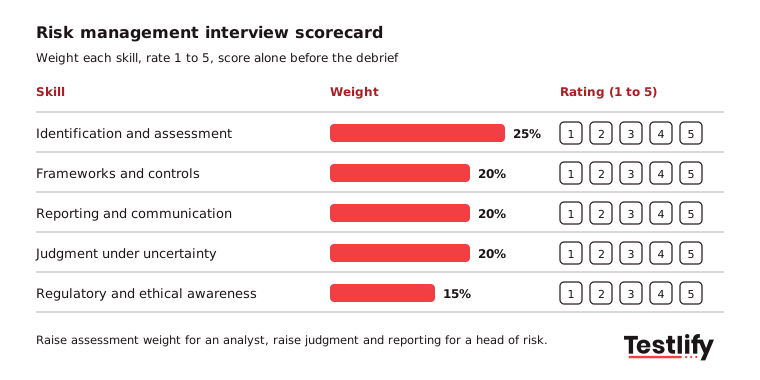
Adjust the weights to the role. An analyst who maintains the register needs more weight on assessment and data accuracy. A head of risk needs more weight on judgment, reporting and risk appetite.
Pro tip: Write down the score and one piece of evidence for each skill straight after the interview. Across the hiring teams we work with, scores written the next day drift toward the overall impression and lose the detail that separates two good candidates.
What work sample should you use for a risk management role?
A risk management work sample asks the candidate to build a short risk register for a scenario from your own business, and it is the closest preview you will get of how they think. Most interview guides stop at questions, so here is a format that takes 45 minutes and is easy to score.
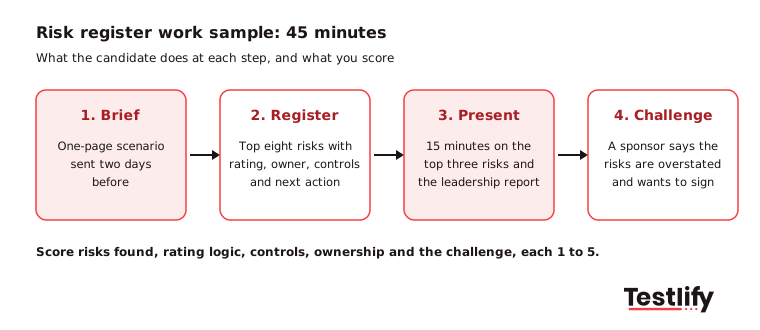
- Brief: send a one-page scenario two days before, for example a company moving its customer support to an outside provider in another country within three months.
- Register: ask for the top eight risks in a simple register with a description, likelihood, impact, owner, current controls and next action for each.
- Present: the candidate has 15 minutes to walk the panel through the top three risks and what they would report to leadership.
- Challenge: one panelist plays a business sponsor who thinks the risks are overstated and wants to sign the contract this week.
Score the register on the quality of risks found, the logic of the ratings, practical controls, clear ownership and how the candidate handled the challenge, each from 1 to 5.
What are the red flags in risk management interview answers?
The biggest red flags in risk management interview answers are vague results, ratings with no evidence and a habit of saying no to everything. Watch for these patterns:
- Lists instead of decisions: the candidate describes long risk registers but never a risk they helped close or accept.
- Framework recital: they list the parts of ISO 31000 or COSO perfectly but cannot say how they used them on a real project.
- Ratings by feel: likelihood and impact scores have no scale, data or near-miss history behind them.
- Always the blocker: every story ends with the candidate stopping a project, never with a safer way to do it.
- No failures: an experienced candidate who cannot describe a risk they missed is either not reflecting or not being honest.
- No owner: risks in their stories belong to "the business" or "management", never to a named person with a date.
Key takeaway: A strong risk professional talks about specific risks, evidence and decisions. A weak one talks about monitoring.
How do skills tests help you hire for risk management roles?
Skills tests help you hire for risk management roles by checking assessment, numeracy and judgment before you spend panel time on live interviews. A short test stage means the people who reach the work sample can already rate risks sensibly and read data correctly.
A typical test stage for this role combines three or four of these:
- The risk management skills test for the risk process, controls and responses.
- The risk assessment test for rating likelihood and impact on realistic scenarios.
- The governance, risk and compliance test for regulatory and control knowledge.
- The numerical reasoning test or the data analyst test for working with loss data and indicators.
- The critical thinking test for judgment when the facts are incomplete.
For roles that lean on modeling and quantitative analysis, use our separate list of risk analyst interview questions alongside this one. For lending and credit roles, see our credit risk analyst interview questions.
Testlify's library has 3,500+ tests and 25+ question types, including video, audio and file upload, so you can ask candidates to upload a sample risk register or record a two-minute risk briefing. Results come back scored, with a per-skill breakdown, and sync to 100+ ATS and HRIS tools such as Workday, Greenhouse and SAP SuccessFactors. We have seen hiring teams use this stage to cut a long applicant list to a shortlist of five or six, then spend live interview time only on the questions and work sample above. For more ideas on what to measure, read our tips to evaluate risk management skills.
Ready to hire your next risk manager?
Build a test stage for your risk management role from the Testlify test library, add a one-way video question, and share a ranked shortlist with your hiring manager before the first interview. Start a 7-day free trial with no credit card, or book a demo to see it set up for a risk, compliance or finance role.
Frequently asked questions about risk management interviews

Wordpress Developer
Yash Patel is a Wordpress and SEO Specialist at Testlify with 3+ years of experience in technical SEO, on-page optimization, and content strategy. He works on improving Testlify's organic presence and produces content focused on hiring, talent assessment, and HR technology.
LinkedInRelated resources
View all
HR & recruitment
60 Learning and Development Assistant interview questions to ask job applicants

HR & recruitment
60 Employee Engagement Coordinator interview questions to ask job applicants

HR & recruitment
40 technical writer interview questions to ask in 2026

HR & recruitment
40 help desk interview questions and answers for 2027

HR & recruitment
60 Systems Analyst interview questions to ask job applicants

HR & recruitment
60 IT Support Analyst interview questions to ask job applicants
Get started.
Hire on proof, not resumes.
Run your first skills-based assessment free — no credit card required.