
How to hire Photoshop experts with a skills test
Hire Photoshop experts on proof, not portfolios alone: the skills to test, a short screening test, a paid task, a rubric and interviews.

To hire a Photoshop expert, screen portfolios first, give shortlisted candidates a short Photoshop skills test, set one paid practical task using your own assets, and finish with an interview that walks through their layered files. Each step checks something the one before it cannot, so you hire people who can do the work, not people who only present well.
TL;DR:
- The reliable way to hire a Photoshop expert is four steps: portfolio screen, a 10 to 20 minute skills test, one practical task, then an interview.
- Test the core skills for every hire: layers and masks, selections, adjustment layers, color modes and export. Add retouching, compositing or batch work by role.
- A portfolio shows taste, not process. Ask for the layered PSD: named layers and masks show real skill, flattened files hide it.
- Keep the practical task under 2 hours, use your real brand assets, pay for it, and score it with a written rubric.
- The US median pay for graphic designers was $62,960 in May 2025, according to the BLS, a useful anchor for in-house Photoshop roles.
- Testlify's Adobe Photoshop test takes 10 minutes and its Graphic Designer (Photoshop) test 20 minutes, so you can screen every applicant before anyone reviews a task.
 ChatGPT
 Gemini
 Claude
 Grok
 Perplexity
How do you hire a Photoshop expert?
Hiring a Photoshop expert works best as a funnel with four checks: a portfolio screen for range and relevance, a timed skills test for tool knowledge, a practical task for real output, and an interview for process and feedback. Cutting candidates at each step keeps reviewer time for the few who reach the end.
Most hiring teams already judge creative candidates on portfolios. The trouble is that a portfolio is curated, may include team projects, and says nothing about speed or file hygiene. Skills-first hiring fixes that gap, and it is spreading.
SHRM's 2025 research on the skills-first movement found that 34% of organizations often or almost always use skills-first strategies, and 46% of organizations that use project-based assessments report low or very low turnover, compared with 34% of those that do not.

Which roles need a Photoshop expert?
Photoshop experts work under many job titles, and the skills you test should follow the title. A retoucher at a fashion brand and a designer on a growth marketing team both use Photoshop daily, but they use different parts of it. Map the role before you write the test.
Role | Main Photoshop work | Skills to weight most | Testlify starting point |
|---|---|---|---|
Photo editor or retoucher | Skin, color and detail retouching, batch edits | Masks, frequency separation, color correction | Adobe Photoshop test |
E-commerce image editor | Product cut-outs, backgrounds, consistent sizing | Pen tool, selections, actions and batch processing | Adobe Photoshop test |
Graphic designer | Social and ad creative, brand templates | Layers, typography, color theory, design principles | Graphic Designer (Photoshop) test |
Marketing or growth designer | Fast ad variants, resizing for channels | Smart objects, artboards, export settings | Graphic Designer (Photoshop) test |
Digital artist or illustrator | Compositing, painting, concept art | Brushes, blending modes, compositing | Adobe Photoshop test plus a task |
Use the photo editor job description template to agree on duties with the hiring manager before the role goes live. If the job is mostly layout and brand work, the graphic designer hiring guide covers the wider design skill set.
What Photoshop skills should you test?
The Photoshop skills to test depend on the role and level you are hiring for. Every candidate should demonstrate proficiency in essential editing tools, while senior roles may require advanced techniques such as compositing, retouching and automation.
You should also assess role-specific skills based on the work they will handle. Adobe's own certified professional exam covers project setup, layers, masks and adjustments, adding content, modifying visual elements and publishing digital media.
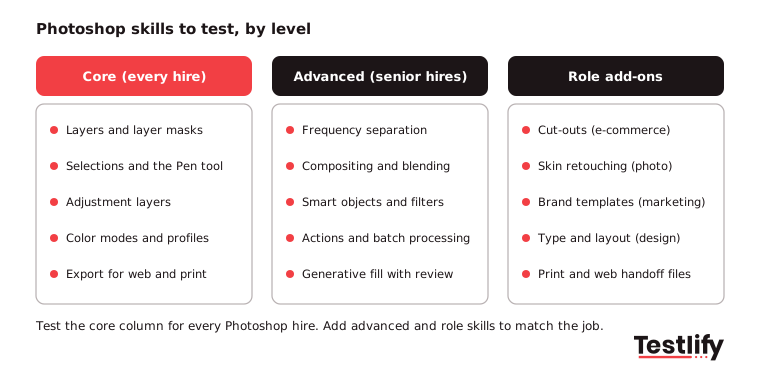
The skills you prioritize will depend on the role, but you can group them into three categories:
- Core skills: Layers and layer masks, selections and the Pen tool, adjustment layers, color modes and profiles, and exporting for web and print. A candidate who is weak here is not a Photoshop expert, whatever the portfolio shows.
- Advanced skills: Frequency separation retouching, compositing and blending modes, smart objects and smart filters, actions and batch processing, and Generative Fill used with careful review.
- Role add-ons: Product cut-outs for e-commerce, skin and color work for photo teams, brand templates for marketing, and typography and layout for designers.
Certifications help but do not replace a test. Adobe says its Certified Professional credential typically takes 150 hours of hands-on experience and instruction, which signals effort, not how someone handles your brief under a deadline.
Pro tip: Write down the 3 to 5 skills that matter most for the role before you pick a test. A short, focused test beats a long one that checks features the job never uses.
How do you hire Photoshop experts step by step?
You hire Photoshop experts step by step by moving candidates through portfolio review, a timed skills test, a practical task and a structured interview, with a clear cut at each stage. The order matters: the short test comes before the longer task so only qualified people spend time on your brief.
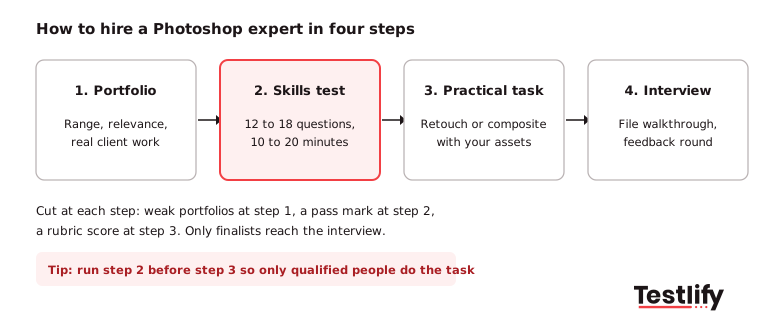
Here are four steps to build an effective Photoshop designer hiring process:
- Screen portfolios: Look for range across project types, work that matches your style, and client-facing projects. Ask candidates to say what they did on each team project.
- Run a skills test: Send a 10 to 20-minute Photoshop test to everyone who passes the screen. Set a pass mark in advance and advance only those above it.
- Set a practical task: Give finalists one real job, such as retouching a product shot or building an ad from your brand kit. Keep it under 2 hours and pay for it.
- Interview with the files open: Ask the candidate to share their screen and walk through the PSD from the task. Then give one round of feedback and see how they respond.
Skills-based screening is now the norm for entry-level hiring too. NACE's Job Outlook 2025 spring update found that almost two-thirds of employers use skills-based hiring to identify candidates, so a short test is a normal step for junior Photoshop applicants as well.
What should a Photoshop skills test include?
A Photoshop skills test should include short questions on the core tools and at least one task that produces a real file. Questions show whether someone knows layers, masks, color and export settings. The task shows whether they can apply that knowledge to your kind of work at your quality bar.
Testlify has two ready-made tests for this:
- Adobe Photoshop test: A 10-minute, intermediate test with 12 questions on layers, colors, vector graphics and Photoshop basics. Built for graphic designers, digital illustrators, photo editors and graphic artists. Explore our Adobe Photoshop test today.
- Graphic Designer (Photoshop) test: A 20-minute, intermediate test with 18 questions on Photoshop proficiency, image manipulation, color theory, design principles, collaboration and communication.
For the practical part, good tasks mirror work the person will do in the first month:
- Retouch task: Clean up a product or portrait photo to a written spec, delivered as a layered PSD and a web export.
- Composite task: Combine 3 supplied images into one banner with consistent light and color.
- Brand task: Build a social ad in 2 sizes from your logo, fonts and color codes.
- Batch task: Record an action that resizes and sharpens 20 images, and explain the settings.
For more task ideas across design roles, see how to create a graphic design test for hiring.
How do you score Photoshop test results fairly?
Scoring Photoshop test results fairly means agreeing on a written rubric before anyone sees a submission, scoring each criterion separately, and having two reviewers score blind where possible. The test questions score themselves. The practical task needs a rubric, or the loudest reviewer's taste decides.
Criterion | What a 1 looks like | What a 5 looks like | Weight |
|---|---|---|---|
Technical accuracy | Visible halos, banding, wrong color mode | Clean edges, correct color profile and export | 30% |
Non-destructive workflow | Flattened file, edits baked into pixels | Masks, adjustment layers, smart objects | 20% |
Brief and brand fit | Ignores specs or brand assets | Matches every spec and the brand kit | 25% |
File organization | Unnamed layers, no groups | Named, grouped layers anyone can pick up | 10% |
Speed and judgment | Overran the time box, no notes | Within time, notes explain trade-offs | 15% |
Score the skills test and the task separately, then combine them with the interview using weights you set before the first candidate starts. This keeps every candidate on the same scale.
What should you ask in a Photoshop expert interview?
A Photoshop expert interview should ask about process and decisions, not features a test already covered. Open the candidate's task file together and ask questions that only someone who did the work can answer. These six work well:
- Walk me through your layer stack. Why is it organized this way?
- Which edits did you make non-destructively, and which did you not, and why?
- What would you change if this image had to go to print instead of web?
- How did you use, or avoid, Generative Fill on this task?
- Tell me about a time a stakeholder rejected your edit. What did you do next?
- How would you speed this task up if you had 200 images instead of one?
Then give one round of real feedback on the task and ask how they would apply it. Strong candidates ask clarifying questions and make real changes. For more prompts by seniority, use these graphic designer interview questions.
What does it cost to hire Photoshop experts?
The cost to hire Photoshop experts depends on whether the role is in-house or freelance. For in-house roles in the US, the BLS Occupational Outlook Handbook for graphic designers puts median pay at $62,960 a year ($30.27 an hour) as of May 2025, a useful anchor for photo editor and designer roles that lean on Photoshop.
The same BLS page counts about 253,100 graphic designer jobs in 2025, projects a 2% decline in employment from 2025 to 2035, and still expects about 16,000 openings a year from people leaving the field. In practice, that means a steady supply of experienced applicants, so the screening process matters more than reach.
Freelance rates vary widely by region, platform and task, so compare quotes on the same test brief rather than on hourly rates alone. Whatever the budget, the highest cost is a bad hire who looks strong on paper.
Which red flags should you watch for?
The red flags that matter most when you hire a Photoshop expert are process problems that a polished portfolio hides. Watch for them in the practical task and the interview, where candidates show how they work rather than only what they finished.
- Flattened or destructive files: Edits baked into pixels make every future change slow and costly.
- Template-heavy portfolios: Work built mostly on templates or stock mockups can overstate skill. Ask which parts they made.
- No reasons behind choices: A strong candidate can explain why they chose a crop, a color grade or a mask.
- Token revisions: Small tweaks after clear feedback suggest they will struggle with stakeholders.
- Missed time boxes: Late delivery on a 2-hour task is a preview of late delivery on real work.
Key takeaway: A portfolio tells you what a candidate can produce with unlimited time and help. The test, the task and the file walkthrough tell you what they will produce for you.
How does Testlify help you hire Photoshop experts?
Testlify helps you hire Photoshop experts by putting the skills test, the practical task and the scoring in one place, so every applicant gets the same checks and reviewers see ranked results instead of a pile of files.
- Ready-made and custom tests: Start from the Adobe Photoshop or Graphic Designer (Photoshop) test, pick from 3,500+ tests in the library, or build a custom assessment from your job description with the AI test builder.
- Practical tasks in the same assessment: 25+ question types include file upload and practical tasks, so candidates can submit a layered PSD alongside the timed questions.
- Fair, remote-friendly testing: 20+ anti-cheating and proctoring checks, including tab tracking, webcam snapshots and copy-and-paste blocking, help keep remote tests honest.
- Scored results in your ATS: Automated scoring, per-skill reports and 100+ ATS and HRIS integrations send results to the tools your recruiters already use.
If you are not hiring right now, keep the candidates who scored well. Staying in touch with top talent between openings means your next Photoshop hire can start from people you have already tested.
Ready to hire your next Photoshop expert?
Screen every applicant on real Photoshop skill before anyone opens a portfolio. Start a 7-day free trial of Testlify, no credit card required, and send the Adobe Photoshop test to your next applicants today.
Frequently asked questions (FAQs)
People and Talent Partner
Arushi Shah runs day-to-day talent acquisition and candidate experience at Testlify. She writes on interviewing, structured hiring, and giving candidates a fair, fast process.
LinkedInRelated resources
View all
HR & recruitment
Challenges of candidate screening: common problems and how to solve them

HR & recruitment
Tips to overcome legal compliance issues related to equal employment opportunity

HR & recruitment
How to manage and prioritize multiple open positions simultaneously

HR & recruitment
Small business background check: how to run a rigorous one on a lean budget

HR & recruitment
Cultural awareness in hiring: how to assess it fairly

HR & recruitment
Early career talent assessments: how to spot who will grow
Get started.
Hire on proof, not resumes.
Run your first skills-based assessment free — no credit card required.