
ATS integration trends: 9 shifts to plan for in 2026
AI agents, two-way sync, skills data and new AI rules are changing how hiring tools connect to the ATS. Here is what to plan for in 2026.

ATS integration trends in 2026 are less about new ATS features and more about how the rest of the hiring stack plugs into the ATS. AI agents now read and write ATS data through APIs, sync runs both ways in near real time, assessment scores land as structured fields, and new AI rules decide what every connected tool must log.
TL;DR:
- The biggest ATS integration trends for 2026 are AI agents working through ATS APIs, two-way event-driven sync, skills data written back to the ATS, and compliance built into every connection.
- The ATS is becoming the system of record, while screening, assessments, interviews and scheduling run in connected tools that sync results back.
- Native APIs and webhooks beat CSV or SFTP file drops, which are one-way and often a day out of date.
- LinkedIn found 37% of organizations were using or testing generative AI in recruiting, up from 27% a year earlier.
- EU AI Act duties for hiring AI, such as logging and human oversight, now apply from 2 December 2027, so audit trails belong in the integration plan today.
- Clean your ATS stages and fields before you connect anything new. Messy data spreads to every tool you add.
 ChatGPT
 Gemini
 Claude
 Grok
 Perplexity
What are ATS integration trends?
ATS integration trends are the shifts in how an applicant tracking system connects to other hiring tools: sourcing, assessments, interviews, scheduling, HRIS and analytics. In 2026 the main shifts are API-first connections, AI agents that act on ATS data, two-way real-time sync, structured skills data, and audit trails that satisfy new AI hiring rules.
An applicant tracking system stores jobs, candidates, stages and notes. On its own it rarely tells you whether a candidate can do the job. That evidence comes from the tools around it, which is why the way those tools connect now matters as much as the ATS itself.

Why does the connected hiring stack matter more in 2026?
The connected hiring stack matters more in 2026 because most hiring work now happens outside the ATS. AI screens resumes, candidates take skills tests, AI interviewers run first rounds, and schedulers book the panel. If results do not flow back into the ATS, recruiters retype data, reports break and decisions lose their audit trail.
Three numbers show the pressure:
- AI use is climbing: The LinkedIn Future of Recruiting 2025 report found that 37% of organizations were integrating or experimenting with generative AI in recruiting, up from 27% the year before. Those teams saved about 20% of their work week.
- Integrations are expected: According to Employ's 2025 Recruiter Nation Report, most teams need background checks (67%), recruitment marketing (58%), video interviewing (51%) and scheduling (49%) connected to the ATS.
- Integration is a pain point: The same report found that 25% of respondents named integration difficulty as a key barrier to satisfaction with their main recruiting system.
For TA leaders, the question has moved from "which ATS?" to "how well does everything else talk to it?"
What are the biggest ATS integration trends in 2026?
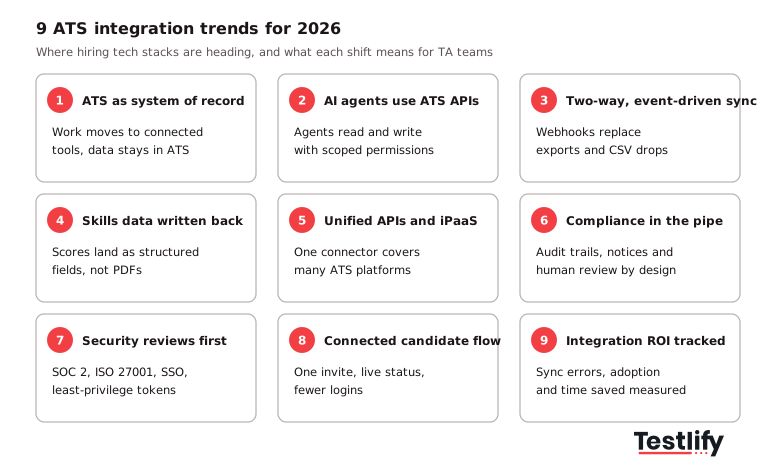
The biggest ATS integration trends in 2026 are nine connected shifts. Some change the technology, such as APIs and webhooks. Others change the rules, such as AI audits and candidate notices. Together they decide how fast a team can add new hiring tools without breaking reports.
How is AI changing the way tools connect to the ATS?
AI is changing ATS connections in two ways. First, AI features now sit in connected tools that pull candidates from the ATS, score them and push results back. Second, AI agents are starting to act on ATS data directly, moving candidates between stages, booking interviews and drafting messages through the same APIs a person would use.
Adoption is already broad. A SHRM survey of 2,366 HR professionals found that about 1 in 4 employers used AI for HR work, and 64% of those adopters used it in talent acquisition. In staffing, Bullhorn's 2026 GRID Industry Trends Report found that 78% of firms with revenue growth above 25% use AI tools embedded in their ATS, against 51% of firms whose revenue fell by more than 10%. The same report found 30% of firms already use some agentic AI.
What this means in practice:
- The ATS stays the source of truth: Agents and AI tools do the work, but stages, decisions and notes must land back in the ATS so reporting and audits still work.
- Permissions matter more: An agent with write access can reject candidates at scale. Give each agent its own scoped credentials and log every action it takes.
- Explainable outputs win: A score with reasons, such as an AI resume match with fit labels, is easier to review than a bare number.
- New connector standards are appearing: Some ATS vendors now publish connectors for AI assistants, so a model can query or update ATS records with the same rights as the user who connects it.
How are ATS sync methods changing?
ATS sync methods are moving from scheduled file exports to native APIs and webhooks that push events as they happen. Unified APIs and integration platforms (iPaaS) fill the gap for the long tail of smaller ATS platforms. File drops over SFTP remain only as a fallback, because they are one-way and usually a day old.
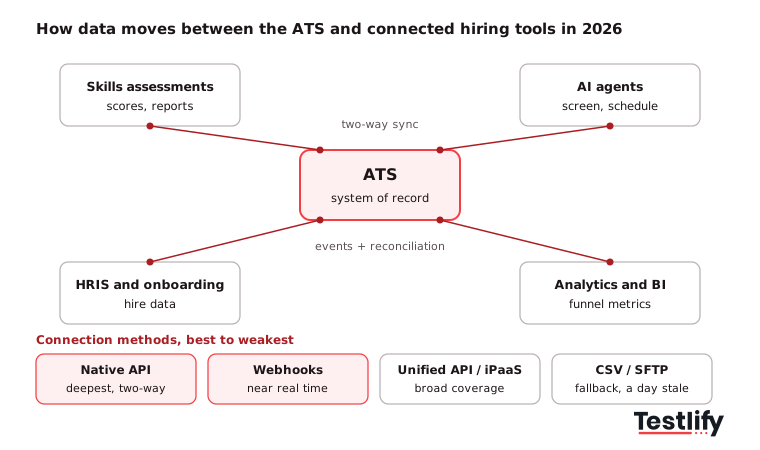
Pro tip: Ask for reconciliation, not just webhooks. A good connector compares record counts between systems on a schedule and alerts you when they drift, so a missed event does not leave a candidate stuck in the wrong stage.
Custom stages are the usual weak spot. If your team renamed a stage or added a custom field, a connector with a fixed stage list can stop syncing without any error. Testlify's guide to common pitfalls in ATS integration covers the other failure points.
Why are skills scores moving into the ATS?
Skills scores are moving into the ATS because hiring teams want to filter, compare and report on proven ability in the same place they track candidates. A PDF report attached to a profile cannot be sorted or measured. A score stored as a structured field can drive auto-advance rules, shortlists and quality-of-hire reports.
The demand is clear in recruiting data. The LinkedIn Future of Recruiting 2025 skills findings show 93% of TA professionals agree that accurately assessing skills is crucial for quality of hire, and 61% believe AI can improve how they measure it.
What good write-back looks like in 2026:
- Scores as fields: Overall score, per-skill scores and a pass or fail flag, mapped to fields you can filter on.
- Status as stages: Invited, started, completed and expired, so recruiters see progress without logging in elsewhere.
- Evidence one click away: A link from the ATS profile to the full report, recordings and integrity flags.
- Rules on top: Score thresholds that move candidates forward automatically, with a person reviewing edge cases.
How do AI rules affect ATS integration trends?
AI rules affect ATS integration trends because any connected tool that screens or scores candidates now carries legal duties, and the integration is where the evidence lives. Logs of what the tool did, notices sent to candidates and records of human review all have to sync and stay retrievable.
- European Union: The EU AI Act framework lists AI used for recruitment, such as CV-sorting software, as high-risk. After the AI Omnibus, these obligations apply from 2 December 2027 and cover risk management, activity logging, documentation and human oversight.
- New York City: Local Law 144 requires a yearly bias audit, public audit results and candidate notice before an automated employment decision tool is used. Testlify publishes its NYC bias audit for this reason.
- Data protection: GDPR and CCPA still govern how candidate data moves between systems, so consent and retention settings must travel with the record.
The practical trend is "compliance by design": choose connectors that log every automated action against the candidate record, so you can answer a regulator or a candidate without rebuilding history from emails.
What security checks do connected hiring tools need now?
Connected hiring tools now need the same security review as any system that holds personal data. Expect SOC 2 Type II or ISO 27001 evidence, single sign-on, encryption in transit and at rest, a signed data processing agreement and a clear answer on where data is stored.
Integration-specific checks are where teams slip:
- Token ownership: Ask which account the API token is tied to. If it belongs to an admin who leaves, the sync can fail quietly.
- Least privilege: Give each connector access only to the objects it needs, such as candidates and stages, not the whole ATS.
- Data residency: For EU, UK or Middle East hiring, confirm the region where assessment data is stored.
- Audit logs: Every sync and every automated change should be logged with a time stamp.
Testlify's security and trust page lists its certifications if you are reviewing an assessment vendor.
How will connected tools change candidate experience?
Connected tools change candidate experience by turning several separate logins and emails into one journey. When the ATS, assessment and interview tools share status, candidates get one invite, see where they stand and hear back faster, because recruiters are not waiting on manual updates.
Trust is the other half. Gartner's 2026 talent acquisition trends note that candidates expect transparency and, where possible, choice, and recommend letting candidates opt out of AI interviews. Gartner also predicts that by 2027, 75% of hiring processes will include certifications and tests for workplace AI proficiency.
For integrations, that means:
- One branded flow: Assessment and interview invites triggered from the ATS stage, in the candidate's language.
- Live status: Completion and next steps pushed back, so the careers portal and recruiter emails match.
- Clear AI notices: The notice and any opt-out choice recorded on the candidate record.
How should hiring teams act on ATS integration trends?
Hiring teams should act on ATS integration trends in five steps: map the stack, clean the data, choose the right connection method, set governance, and measure results. Most teams can do the first two in a few weeks without buying anything new.
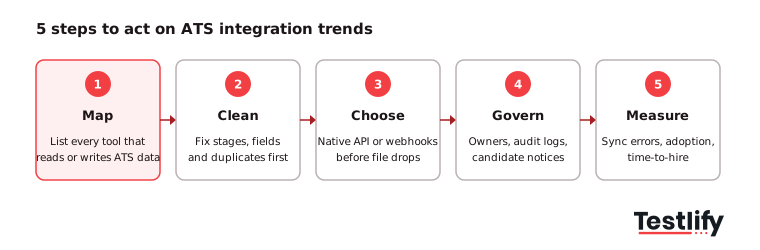
- Map the stack: List every tool that reads or writes ATS data, what it syncs, in which direction, and who owns it.
- Clean the data: Merge duplicate candidates, standardize stage names and job titles, and remove unused custom fields before adding connectors.
- Choose the connection: Prefer native APIs or webhooks for core tools such as assessments and HRIS. Use an integration platform for the long tail, and file drops only as a last resort.
- Set governance: Name an owner per connector, scope each token, and decide which automated actions need human review.
- Measure results: Track sync errors, recruiter adoption, time-to-hire and drop-off by stage. Testlify's guide to measuring the ROI of ATS integrations covers the metrics.
What should you ask an integration vendor in 2026?
An integration vendor in 2026 should answer five questions clearly before you sign. Vague answers on sync direction, custom fields or token ownership usually turn into manual work for recruiters six months later.
- Which events sync in each direction, and how quickly?
- Are our custom stages and fields supported, or only the defaults?
- How do you detect and recover from missed events?
- Can an AI feature or agent change a candidate's stage, and is every change logged?
- Which certifications and data regions do you offer?
For a fuller buying checklist, see how to choose the right ATS integration.
Key takeaway: The ATS integration trends that matter most are not new features but stronger connections: two-way sync, structured skills data and logged AI actions. Teams that clean their data and set governance first can add new tools quickly without losing the audit trail.
How does Testlify connect assessments to your ATS?
Testlify connects skills assessments to more than 100 ATS and HRIS platforms with two-way sync, so recruiters send tests and see scores without leaving their ATS. Supported platforms include Workday, SAP SuccessFactors, Oracle HCM, Greenhouse, SmartRecruiters, BambooHR, Workable and Ashby, and most connect in under five minutes.
- Skills data in the ATS: Results from Testlify's 3,500+ tests sync to candidate profiles as scores and reports. See the ATS integration page for how sync works.
- AI screening that writes back: The AI resume screener pulls resumes from the ATS, adds an explainable match score with High, Medium or Low fit labels, and syncs the result back.
- Build your own flows: A REST API and webhooks cover custom workflows, alongside connectors listed in the integrations directory.
- Security and audits: ISO 27001, SOC 2 Type II, GDPR and CCPA compliance, regional data residency, and a third-party NYC Local Law 144 bias audit of the matching model completed on June 16, 2023.
Ready to connect skills data to your ATS?
See how assessment scores flow into the ATS you already use. Start a 7-day free trial of Testlify, no credit card required, or book a demo to walk through your own ATS setup.
Frequently asked questions
Related resources
View all
HR & recruitment
Best practices for designing and implementing employment assessments

HR & recruitment
5 benefits of integrating employment assessments into your hiring process

HR & recruitment
What are employment assessments? Types, uses and how to choose

HR & recruitment
Top 25 employment assessment tools in 2026

HR & recruitment
Pre-hire testing: 7 strategies for fairer, faster hiring

HR & recruitment
Unbiased Assessments: An HR Guide to Fair Hiring and Reviews
Get started.
Hire on proof, not resumes.
Run your first skills-based assessment free — no credit card required.